Battle of Personal AI’s entry-points intensifies — why does it matter and what are the…
Over the past year, “Personal AI” has shifted from a futuristic concept to the defining battleground for the next decade of consumer…
Battle of Personal AI’s entry-points intensifies — why does it matter and what are the possibilities?
Over the past year, “Personal AI” has shifted from a futuristic concept to the defining battleground for the next decade of consumer technology — and the entry point to this world has become a million-dollar question that every major tech company is urgently trying to answer.
Why? Because in the AI-native era, the first touchpoint between a user and their AI agent will determine who owns the customer relationship, who controls the data flywheel, and ultimately who captures the platform economics. Just as mobile apps reshaped the 2010s and cloud reshaped the 2020s, the 2030s will be defined by AI-native interfaces: invisible, proactive, context-aware digital companions that live across devices, sensors, and services.
Today, the competition is escalating dramatically:
- Apple is building a seamless “Apple Intelligence” loop across iPhone, Mac, AirPods, and Vision Pro — its AI entry point is expected to merge Siri, Spotlight, and on-device intelligence into a single experience.
- Google is placing Gemini as the universal AI layer across Android, Chrome, Search, and the upcoming wearable ecosystem — trying to make Gemini the default entry point for everything.
- Meta is pushing AI glasses and multimodal assistants to win the always-on, hands-free interface of the future.
- Microsoft is betting on Copilot across Windows, Office, and Edge — turning the productivity stack into an AI-first experience.
- OpenAI is trying to bypass all device makers and become the direct entry point through GPT-Bots, GPT-Store, and the “Proactive Agent” direction.
- Emerging players like Humane AI Pin, Rabbit R1, and smart-ring/glasses startups are challenging the notion that the smartphone will remain the dominant entry point at all.
The race is not simply about delivering a smart assistant — it’s about defining the default gateway into a user’s digital life.
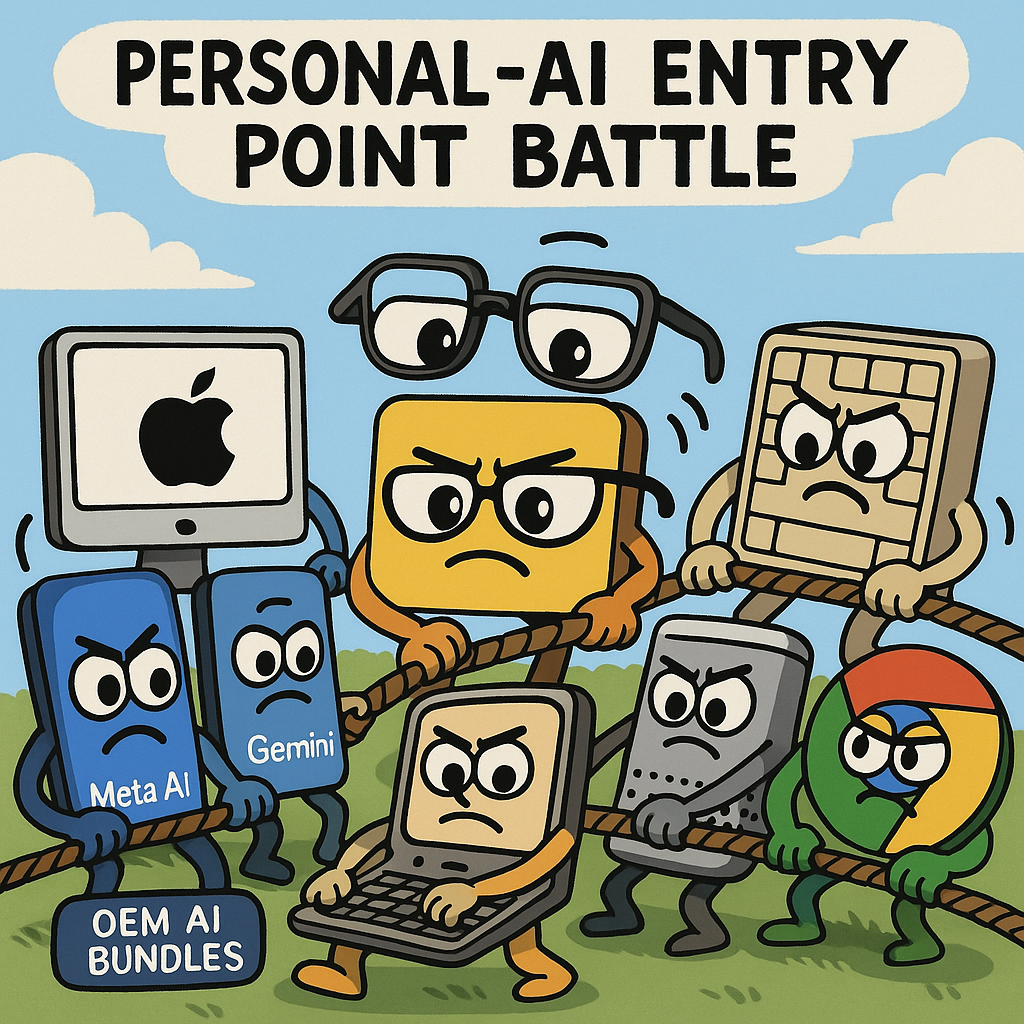
Introducing a Clear Framework: Sense → Reason → Act
To understand Personal AI’s strategic landscape, we can break down any Personal-AI system into three universal stages:
1. Sense / Perceive
How the AI gathers context and signals. This includes inputs from text, voice, vision, sensors, device activity, location, and user history. It answers: “What’s happening right now?”
2. Reason / Plan
How the AI interprets the world and decides what to do. This covers LLM reasoning, agentic workflows, memory retrieval, personalization, and orchestration across apps and services. It answers: “What does the user need, and what should happen next?”
3. Communicate / Act
How the AI interacts with the user or executes tasks. This includes dialog, UI actions, app control, automation, task completion, and multi-device coordination. It answers: “How do I deliver value instantly?”
Under such framework SENSE / PERCEIVE (2, 5, 7, 9) → REASON / PLAN (1, 4, 6, 9) → COMMUNICATE / ACT (3, 5, 7, 8), we can see there are multiple areas that tech companies are exploring opportunities.
1. AI-Native OS / Cross-Device Layer
Definition: The operating system becomes AI-first — context-aware, multimodal, and coordinating intelligence across phone, PC, tablet, wearables, cars, and home devices.
Why It Matters:
- The OS owns the deepest context (sensor data, user behavior, app permissions).
- OS-level AI can unify the entire digital life and become the default agent across all devices.
- It becomes the most defensible entry point due to lock-in.
Who Is Competing:
- Apple: “Apple Intelligence” at OS level (iOS/macOS/watchOS); continuity across devices.
- Google: AI-infused Android + ChromeOS; Gemini as system-level agent.
- Microsoft: Windows + Copilot + Recall (paused) as AI-native OS direction.
2. AI Wearables / Glasses (The Always-On Entry Point)
Definition: Wearables — especially glasses, earbuds, rings, watches — become the new sensory and interaction interface for Personal AI.
Why It Matters:
- Always-on sensing (audio, vision, location) creates the richest Perceive/Sense layer.
- Hands-free experience shifts AI from reactive → proactive.
- Could replace the smartphone as the primary entry point.
Who Is Competing:
- Meta + Ray-Ban: Leading AI glasses category.
- Apple: Vision Pro today, lightweight glasses tomorrow.
- Samsung, Xiaomi: Smart rings and watches with on-device AI.
3. OEM AI Bundles (Device + Cloud + Services With AI Built-In)
Definition: OEMs ship devices with pre-installed AI models, personal agents, cloud services, and device-to-device orchestration.
Why It Matters:
- Allows device makers to compete directly in Personal AI without owning the OS.
- Bundles create ongoing revenue (subscription / compute credits).
- Provides a differentiated experience vs. commodity hardware.
Who Is Competing:
- Dell, HP: AI PC bundles with Copilot+, Recall, security agents.
- Samsung Galaxy AI: Integrated with Gemini.
- Xiaomi HyperOS + AI capabilities.
4. Default AI Assistant (First-Touch Conversational Interface)
Definition: The primary assistant a user talks to — via voice, text, or proactive actions — such as Siri, Gemini, or GPT.
Why It Matters:
- The “default assistant” becomes the gateway to all tasks and apps
- Controls where the user starts their request → controls value capture.
- The simplest, most universal AI entry point.
Who Is Competing:
- Apple Siri evolving into Apple Intelligence.
- Google Gemini: Becoming the default across Android.
- OpenAI GPT-5/GPT Proactive Agent: Trying to bypass OS owners entirely.
- Amazon Alexa (reboot).
- Microsoft Copilot.
5. Keyboard / Input Layer (Where Every Request Starts)
Definition: AI embedded into the system keyboard or input method, providing suggestions, rewriting, command execution, and multimodal shortcuts.
Why It Matters:
- Keyboard sees everything the user types → richest personal context.
- Always accessible → extremely high-frequency entry point.
- Lower barrier than OS-level change.
Who Is Competing:
- Google Gboard + Gemini integration.
- Microsoft SwiftKey + Copilot.
- Apple Keyboard Intelligence.
- Startup plays: ParagraphAI, Grammarly, Typewise AI.
6. Browser / Search Layer (Where Information Requests Begin)
Definition: AI sits on top of search and browsing — becoming the default starting point for information, planning, and online tasks.
Why It Matters:
- Search queries = user intent → high-value signals.
- AI can reshape browsing into task-oriented agent execution.
- Browser extension or embedded agent requires zero OS control.
Who Is Competing:
- Google Search + Gemini.
- Microsoft Bing + Copilot.
- Arc Browser + AI.
- Perplexity: Comet — High-growth AI-first search.
- OpenAI: GPT integrated with real-time browsing.
7. Messaging / Social Entry Point (Where User Attention Lives)
Definition: AI agents embedded inside chat apps, social platforms, and messaging services.
Why It Matters:
- Messaging is the highest daily active usage platform in consumer life.
- Conversations naturally blend into task execution → ideal for agents.
- High virality potential.
Who Is Competing:
- Meta (WhatsApp / Messenger / Instagram AI).
- Snapchat MyAI.
- Tencent (WeChat AI Assistant).
- Telegram AI bots.
- Apple adding AI into iMessage.
- Google Messages + Gemini.
Strategic Insight: Messaging-based AI could surpass OS-based assistants in RPU and attention share.
8. Model / Agent Store (Distribution for Personal AI)
Definition: A marketplace where users download AI agents, specialized models, workflows, and task-bots — similar to App Store, but for agents.
Why It Matters:
- Becomes the ecosystem hub for the agentic economy.
- High monetization potential (take rate, subscription, revenue share).
- Winner becomes the “App Store of AI”.
Who Is Competing:
- OpenAI GPT Store (first at scale).
- Google Extensions / Gemini Apps.
- Apple Intelligence plug-in architecture eventually.
- Meta: Exploring AI plugins inside WhatsApp/Instagram.
- Microsoft Copilot Studio / Fabric Agents.
9. File Management (AI That Organizes, Finds, and Acts on User Files)
Definition: An AI layer that deeply understands your files, documents, screenshots, images, and knowledge — and becomes the entry point for retrieval, actions, and organization.
Why It Matters:
- A user’s real personal memory lives in their files.
- An AI that can understand, extract, and automate based on personal files becomes indispensable.
- High trust, high stickiness entry point.
- Essential for enterprise workers but equally powerful for consumers.
Who Is Competing:
- Microsoft Recall (ambitious, halted temporarily).
- Apple Spotlight + Apple Intelligence search.
- Google Files AI + Drive AI-powered organization.
- Dropbox Dash / AI search.
- Notion AI universal file layer.
- Rewind AI / Sora Memory agents.
As we look across AI-native OS layers, wearables, assistants, keyboards, browsers, messaging apps, agent stores, and even file-centric intelligence, one thing becomes clear: the battle for Personal-AI entry-points is just beginning. No one knows which interface — or which combination — will ultimately win. The industry is still in the early innings, experimenting across hardware, software, cloud, and ecosystem layers.
But what is certain is that every major entry point we know today will be fundamentally revamped by AI. The OS will become predictive. Assistants will become proactive. Keyboards, browsers, and messaging apps will morph into agent hubs. Wearables will evolve into always-on sensors. File systems will turn into personal knowledge graphs. And entirely new entry points may emerge that we have not yet imagined.
We are entering a decade defined not by a single breakthrough, but by continuous reinvention. The companies that win will be those that stay flexible, bold enough to experiment, and fast enough to adapt as user behavior shifts.
The future of Personal AI is still unwritten — but the race to define its entry point is already reshaping the entire consumer technology landscape.
메타데이터
- post_id
- 362dd6d58b7e
- slug
- battle-of-personal-ais-entry-points-intensifies-why-does-it-matter-and-what-are-the-362dd6d58b7e
- url
- https://medium.com/@shuai.wang.us/battle-of-personal-ais-entry-points-intensifies-why-does-it-matter-and-what-are-the-362dd6d58b7e
- canonical_url
- https://medium.com/@shuai.wang.us/battle-of-personal-ais-entry-points-intensifies-why-does-it-matter-and-what-are-the-362dd6d58b7e
- author_url
- https://medium.com/@shuai.wang.us
- status
- ok
- fetched_at
- 2026-07-18 04:34:52





