The Data Mesh Misdiagnosis: Why 82% of Implementations Stall at the Platform Layer
Most organisations did not fail because they lacked the right platform. They failed because they never built the product discipline…
The Data Mesh Misdiagnosis: Why 82% of Implementations Stall at the Platform Layer
Most organisations did not fail because they lacked the right platform. They failed because they never built the product discipline, governance maturity and federated accountability the model requires.
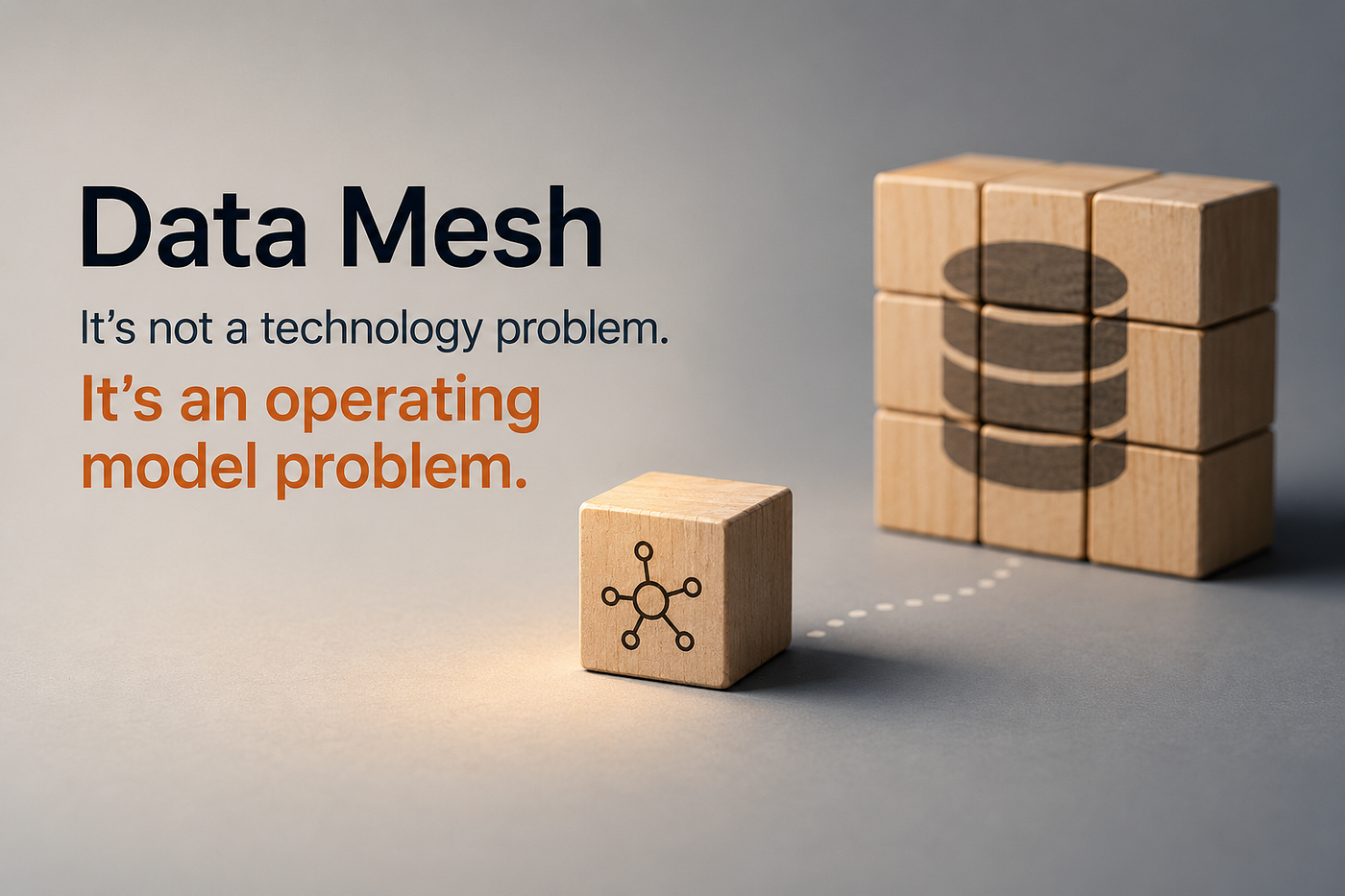
Five years after the term entered enterprise vocabulary, data mesh has become one of the most quietly contested ideas in data architecture. Vendors still ship reference architectures. Conference agendas still feature implementation tracks. LinkedIn still produces a steady drip of “lessons learned” posts. Yet behind the noise, a more revealing pattern has emerged: most organisations claiming a data mesh do not, in any meaningful sense, have one.
The most cited number in this debate, that only 18% of organisations have the governance maturity to run a data mesh, traces back to Gartner’s *2021 Data and Analytics Governance Survey*. The figure measures a specific metric: the proportion of organisations whose data and analytics governance is “mature and scaling across the enterprise.” Gartner’s analysts flag this directly as the precondition for federated ownership at scale. The corollary is unflattering. The other 82% have not earned the right to a mesh, which has not stopped a great many of them from declaring one anyway.
The discourse is finally catching up. The conversation in 2025 was about how to implement data mesh. The conversation in 2026 is about why it keeps failing. That shift matters because the failure mode is not architectural. It is a product and governance discipline, or rather, the absence of either.
The misdiagnosis: architecture vs operating model
The recurring failure pattern is identifiable from a few hundred metres away. An organisation invests in a domain-aligned data platform. Storage is decentralised across business-unit accounts or workspaces. A self-service catalogue has been set up. Domain teams take nominal ownership of their pipelines. The architectural artefacts are present and visible. The behavioural ones are missing entirely.
Domains do not own outcomes; they own infrastructure. Data quality is still policed by a central team writing tickets. Discoverability still depends on a Confluence page that no one updates. Consumers still raise tickets; producers still triage them. The mesh exists on a slide deck and in a Terraform repository. It does not exist in the operating rhythm of the business.
Thoughtworks — the consultancy that originated the data mesh hypothesis- addressed this directly in its *State of Data Mesh in 2026* assessment. Its observation, after six years of client implementations, is unambiguous: data mesh is an organisational transformation, not a technical one. The greatest obstacles are organisational and behavioural rather than technological. The firm specifically calls out a recurring anti-pattern: IT departments rebadging existing teams as “domains”, the SAP domain, the Salesforce domain, without genuine business ownership, clear mandate or decision rights.
Gartner’s own forward projection sharpens the point. The firm has predicted that 80% of data governance initiatives will fail by 2027, absent an externally imposed crisis catalyst. The same governance maturity gap that prevents data mesh adoption also undermines the broader governance programmes those organisations are running in parallel. The two failure modes are not coincidental; they are the same failure mode wearing different badges.
The original hypothesis was about the operating model, not the architecture
Re-reading the founding articulation of the data mesh, the four principles are well known: domain ownership, data as a product, self-serve data platform, and federated computational governance. It is striking how much of the original specification concerned the operating model rather than the infrastructure. Three of the four principles describe organisational behaviour. Only one is recognisably technical.
The misreading was, in fairness, almost certainly inadvertent. Architectural patterns are tractable. Operating models are not. When an idea offers both an architectural pattern and a cultural transformation, organisations naturally gravitate to the former. The architecture can be procured, contracted, prototyped and demonstrated to a steering committee. The operating model has to be earned. Boards approve technology programmes; they rarely approve multi-year programmes to redistribute decision rights and accountability.
The result is that the most demanding of the four principles, federated computational governance , has been treated as the easy one to skip. Ironically, it is the principle that determines whether anything else holds together at scale.
Why product thinking is the gating capability
The single discriminator between organisations that make data mesh work and those that produce a costly relabelling exercise is whether domains genuinely operate as product organisations.
“Data as a product” is the principle that has suffered most from corrosive overuse. In the original specification, it carries serious weight: identified consumers, articulated value proposition, contracts, roadmaps, lifecycle management, deprecation rules, support obligations, measurable usage and trust metrics. None of these is a storage or compute concern. All require funded, named ownership.
In practice, the term has been hollowed out into “table with a README”, or, more recently, “schema registered in the catalogue with a lineage diagram attached.” Without product management discipline, the construct does not survive its first quarter. The role most organisations have not staffed and funded is the data product manager, an accountable owner with a roadmap, a backlog, and authority over consumer relationships. Without this role, domain ownership collapses back into engineering ownership; engineering ownership collapses back into central platform ownership; and the mesh dissolves into the warehouse it was built to replace, typically within twelve to eighteen months.
The contract layer is what makes federated ownership tractable at scale. Without enforceable producer-consumer contracts, something the Open Data Contract Standard and similar specifications now make practical, federation degenerates into either chaos or, more commonly, a quiet reassertion of central control. The platform team, exhausted by ad-hoc disputes between producers and consumers, becomes the de facto arbiter, and the operating model reverts to its prior state.
Two anonymised illustrations from financial services
Consider a global universal bank that began its data mesh programme in the early 2020s. Its design choices, documented across multiple public conference sessions and vendor case studies, are instructive. Each data product is owned by a triumvirate: a business owner, a technical owner, and a small team of data engineers with domain expertise. Data products are organised around business constructs, wholesale credit risk, trading and position data, and reference data rather than source systems. The platform team owns the blueprint and the controls; the domains own the products. Critically, the bank made the explicit decision not to migrate its most heavily regulated data first, recognising that the operating model needed to mature before the highest-stakes domains could safely transition. Five years on, the implementation continues to expand because the foundations were product and governance, not storage and compute. This pattern is what the 18% looks like in practice.
Now consider the inverse, drawing on patterns documented across recent industry assessments, particularly the Thoughtworks observation cited earlier and consistent reporting from BFSI advisory firms. A UK-headquartered asset manager begins a “data mesh transformation.” Existing centralised data engineering teams are reorganised into “domains” aligned to the firm’s investment, distribution and operations functions. A new data catalogue is procured and populated automatically from the existing warehouse. Data products are declared by re-tagging the same tables that previously sat in the warehouse. No data product manager role is created. The federated governance council meets quarterly and produces position papers. Quality SLAs remain aspirational. Consumers, when surveyed eighteen months in, report no perceptible change in their experience; they still raise tickets, they still wait, they still distrust the numbers. The architecture diagram has changed; nothing else has.
The two cases differ on essentially one axis. In the first, product and governance disciplines were treated as the work itself. In the second, they were treated as enabling functions to be addressed once the platform was up and running. The platform always ships. The disciplines almost never get back-filled.
The diagnostic checklist
The signs of a data mesh that is, in fact, a warehouse with new branding, are recognisable across organisations and sectors. A central platform team still owns the substantive ingestion, modelling and curation work. “Domains” map to source-system teams or technology stacks rather than business capabilities. There is no data product backlog distinct from the engineering backlog. Quality SLAs are aspirational rather than contractual. Discoverability depends on a wiki page or a Slack channel rather than a marketplace with usage telemetry. The catalogue is populated by automation but curated by no one. Consumers still raise tickets; producers still triage them on best-effort terms.
If a programme exhibits four or more of these traits, it is functionally a warehouse with a marketing exercise attached. The organisation has neither the maturity nor the operating model to claim a mesh, and the gap will not be closed by adding more platform features.
What the 18% actually do differently
The minority that succeeds shares recognisable, replicable traits. Data product management is a funded discipline with named owners, defined career paths and explicit consumer-facing accountabilities. Contracts are enforced at the platform layer, not negotiated by email. The federated governance body has decision rights and a meeting cadence that includes domain heads themselves rather than their delegates. The platform team is measured on adoption and self-service ratios, not on throughput of central pipelines. Cultural artefacts, product reviews, consumer feedback loops, deprecation notices, and version migration plans are normalised across domains rather than improvised in each.
Perhaps most tellingly, the 18% rarely talk about “mesh” anymore. They talk about products, contracts and consumers. The terminology recedes once the operating model takes hold, because the operating model is the point. The architectural label was always the smaller half of the idea.
The discourse is shifting.
The 2022–2024 wave of data mesh content was implementation-focused: tooling decisions, reference architectures, vendor playbooks, AWS and Azure landing-zone templates. The 2025–2026 wave reads differently. It is post-mortem-focused: why programmes stalled, why investments did not yield returns, and why the term itself has become a credibility risk in some forums. Some practitioners now actively avoid the label, even when describing implementations that hew closely to the original specification.
This is a healthy correction, not a repudiation. The field is converging on a truth that was present in the original articulation but routinely deprioritised in practice: data mesh is an operating model dressed in architectural language, and the architecture is the easy part. The hard part, product discipline, governance maturity, federated decision rights, is exactly the part most organisations are unprepared to invest in. That preparation gap, not the technology, is what produces the 82% figure.
For organisations in regulated sectors, particularly financial services, the calculus is unforgiving. The strongest case for mesh, BCBS 239 lineage requirements, MiFID II reporting domains, SFDR data sourcing, fund-level transparency obligations, exists in environments where governance maturity is high but centralised by long-established design. Translating that maturity into federated maturity is precisely where most programmes stall, because it requires accepting that the centre must give up control before the domains have proven they can hold it.
A more useful question
The right question for any organisation evaluating a data mesh programme is not how to implement it. The right questions are:
Where does the organisation sit on the rebranded-warehouse checklist? Is data product management a funded discipline with named owners — or a slide in a steering deck? Does federated governance exist as a forum with decision rights, or as a working group on SharePoint? Is the contract layer enforced by the platform or by goodwill and reciprocity? Are consumers measurably better served eighteen months in, or have they simply learned not to ask?
The 82% are not failing at technology. They are failing at the discipline that the original specification described from the outset. The good news, such as it is, is that the discipline can be built, but only if the organisation stops trying to buy it.
메타데이터
- post_id
- 3639d2adf5fe
- slug
- the-data-mesh-misdiagnosis-why-82-of-implementations-stall-at-the-platform-layer-3639d2adf5fe
- url
- https://medium.com/@arrufus/the-data-mesh-misdiagnosis-why-82-of-implementations-stall-at-the-platform-layer-3639d2adf5fe
- canonical_url
- https://medium.com/@arrufus/the-data-mesh-misdiagnosis-why-82-of-implementations-stall-at-the-platform-layer-3639d2adf5fe
- author_url
- https://medium.com/@arrufus
- status
- ok
- fetched_at
- 2026-06-12 22:02:08






