Drafts Refined Collectively: Why Structured Revision Makes MBA Case Analysis Consequential
The first draft starts the work. Structured revision makes it consequential.
Drafts Refined Collectively: Why Structured Revision Makes MBA Case Analysis Consequential

A first draft becomes more useful when the reasoning behind each revision stays visible.
The first draft starts the work. Structured revision makes it consequential.
In MBA teaching, the first draft of a case analysis is rarely the artifact that should reach the classroom. It is a first visible argument: useful, incomplete, and often more revealing for what it misses than for what it gets right.
The real instructional value emerges when faculty can examine how the draft changed, where assumptions were challenged, which trade-offs were clarified, and why one teaching direction became stronger than another. That revision trail is often where the teaching insight lives.
For 250 years, consequential ideas have depended on people who could structure complexity, challenge assumptions and make the path forward visible.
That tradition matters to MBA instructors now because case teaching is not just about explaining a situation. It is about helping learners see how rigorous judgment is formed. A clean final note may look polished, but it can hide the messy reasoning that made it useful.
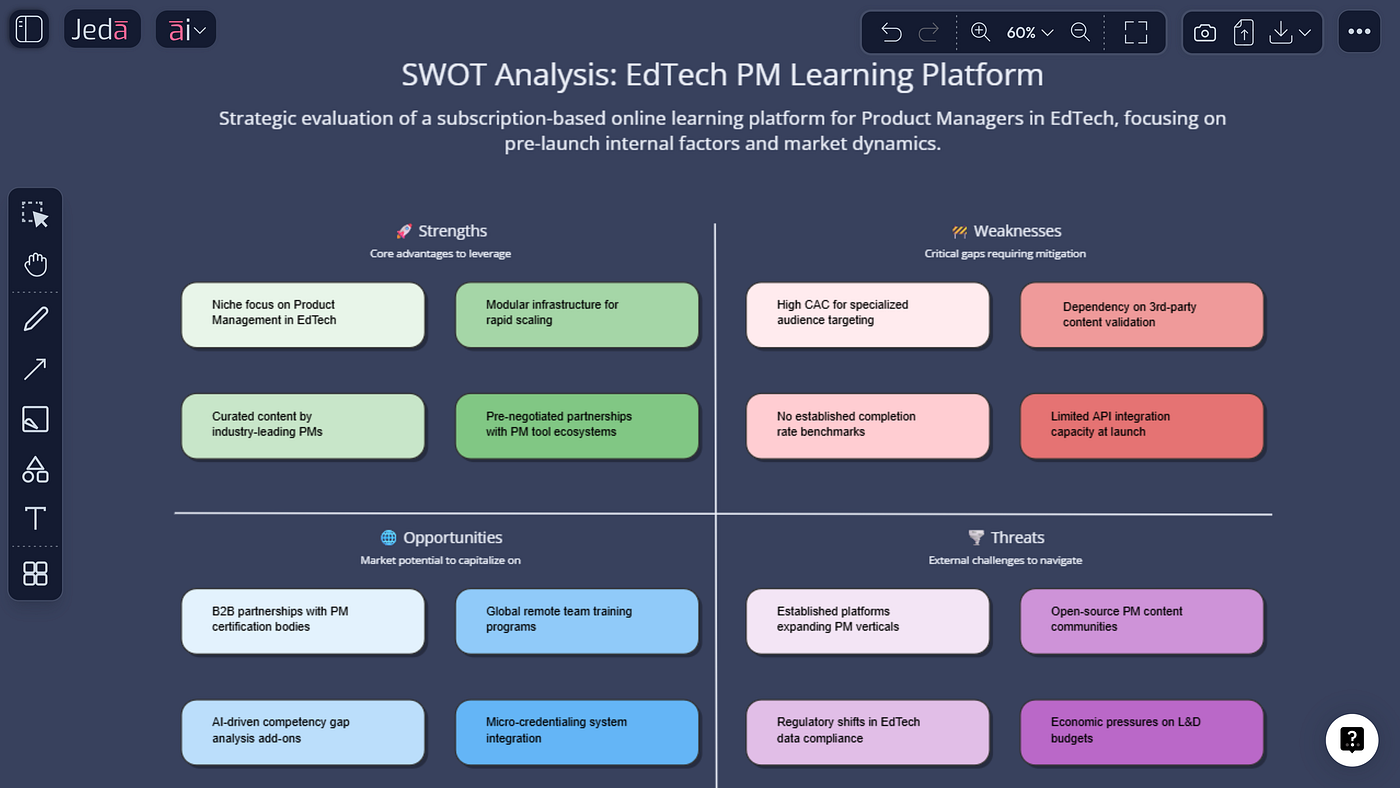
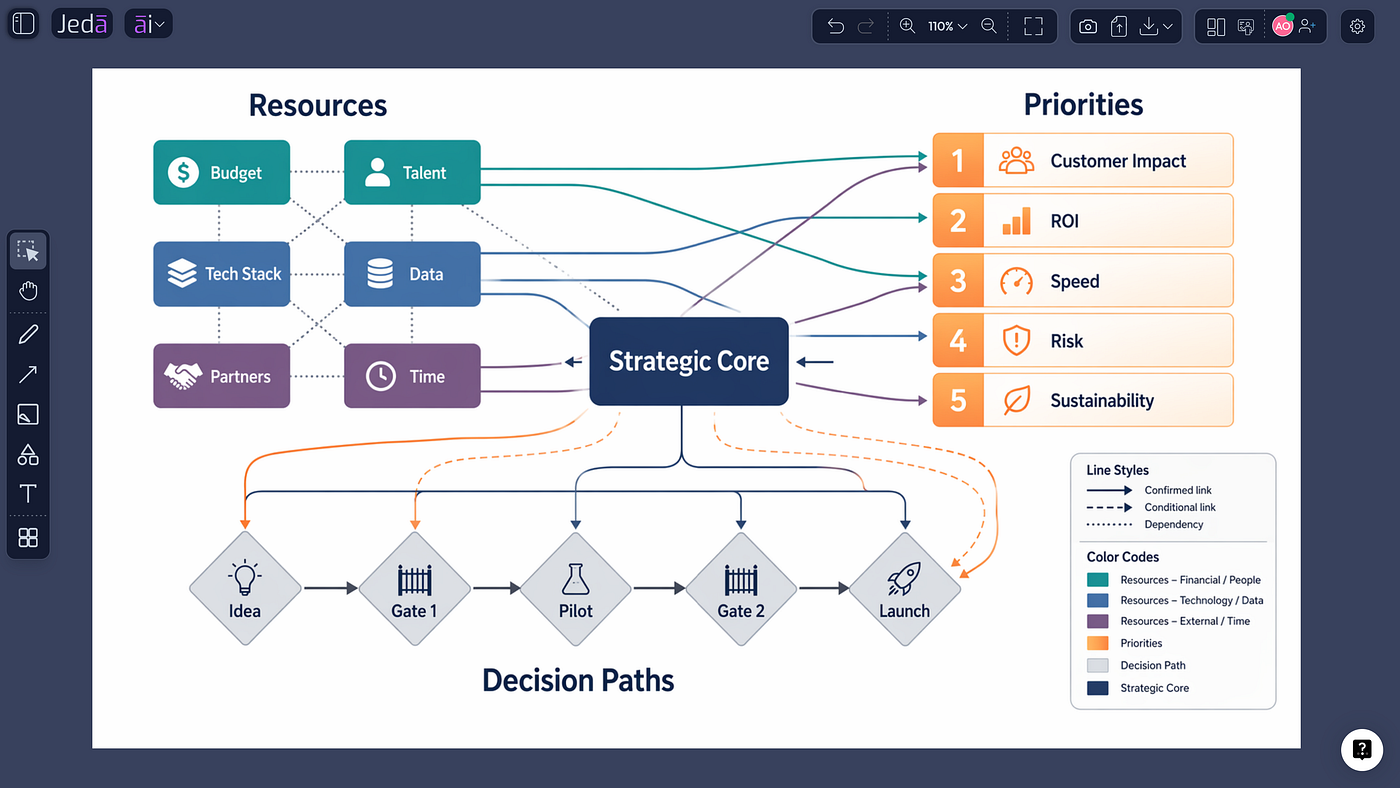
Jeda.ai gives instructors a shared Visual AI workspace where documents, prompts, sticky notes, matrices, mind maps, diagrams, and collaborative comments can sit in one editable canvas. Instead of turning case preparation into a private drafting exercise, faculty can make the revision process visible enough to improve it together.
Why first drafts fail MBA instructors when revision disappears
A first case interpretation often captures the obvious structure: the visible problem, the central actors, the apparent decision point, and a few initial teaching questions. That is useful, but it is not enough for a strong MBA classroom experience.
The stronger teaching artifact usually emerges after several rounds of pressure: What is the real decision? What evidence matters most? Which assumptions are weak? Which alternative interpretation should students confront? What should remain ambiguous so discussion stays alive?
When revision happens across scattered comments, separate documents, private notes, and disconnected slide drafts, instructors may lose the reasoning trail. The final material may improve, but the team cannot easily see why it improved. That makes it harder to reuse the thinking, train new faculty, or adjust the case for a different cohort.
Collective refinement changes the work. It turns revision from cleanup into intellectual infrastructure. The goal is not to make every contributor agree immediately. The goal is to make competing interpretations visible enough to evaluate.

Structured revision preserves what changed, what was challenged, and why the teaching artifact became stronger.
What collective revision should make visible
For MBA instructors, collective revision is not simply multiple people editing the same text. It is a disciplined process for exposing the intellectual moves behind a teaching artifact.
· The initial interpretation: what the first reader believed the case was really about.
· The evidence map: which passages, exhibits, or data points shaped the argument.
· The assumption register: claims that need challenge before becoming teaching guidance.
· The alternative readings: plausible interpretations students may raise in class.
· The teaching decision: what the instructor chooses to emphasize, remove, delay, or leave unresolved.
· The revision rationale: why the final structure changed from the first draft.
This is where a visual workspace becomes more than a prettier note-taking surface. The point is not decoration. The point is cognitive traceability: the ability to see the movement from raw material to structured teaching judgment.
How Jeda.ai supports document-to-revision workflows
Jeda.ai’s AI Workspace combines document analysis, editable visual outputs, and collaboration on one canvas. Official Jeda.ai materials describe Document Insight as a way to upload documents such as PDF, document, presentation, Markdown, text, or rich-text files and turn them into visual structure. The broader workspace includes matrices, mind maps, diagrams, flowcharts, sticky notes, and collaboration features that instructors can refine manually after generation.
For an MBA instructor, that means the workflow can begin with source material rather than a blank page. A case packet, teaching note draft, reading excerpt, program brief, or participant exercise can become a first visual structure. Faculty then revise the structure together before it becomes classroom material.
The important boundary is judgment. Jeda.ai can help extract structure, compare viewpoints, and organize draft material visually. It should not be framed as deciding what is pedagogically correct. Faculty remain responsible for accepting, rejecting, reframing, and sequencing the work.
How-To Method 1: Use Document Insight from the Prompt Bar
Use this method when an instructor already has a case document, draft teaching note, workshop handout, or participant reading and wants a structured first version for review.
-
Open a Jeda.ai workspace and use the Prompt Bar at the bottom of the canvas.
-
Choose Document Insight as the command and upload the relevant document file.
-
Select the output structure that fits the teaching task: Matrix for trade-offs and criteria, Mindmap for themes and relationships, Flowchart for classroom sequence, or Diagram for dependencies.
-
Prompt Jeda.ai to extract the teaching structure, not the final answer. For example, ask it to identify the central decision, supporting evidence, assumptions, alternative interpretations, and discussion risks.
-
Review the generated visual framework on the canvas. Rename sections, remove weak claims, and mark assumptions that require faculty judgment.
-
Invite faculty collaborators into the workspace and use visible comments or canvas notes to challenge, clarify, or strengthen the structure.
-
Create a final teaching-note outline only after the reasoning map has been revised and reviewed.
The practical advantage is speed with accountability. The first structure appears quickly, but it remains editable. Faculty can see the draft, challenge the logic, and preserve why the teaching artifact changed.

Document Insight can give faculty a structured first version that remains open to review.
How-To Method 2: Use AI Recipes with document analysis for a guided faculty workflow
Use this method when the team wants a more guided workflow, especially for repeatable preparation across modules, cohorts, or executive-education sessions.
-
Open the AI Menu from the top-left area of the workspace.
-
Choose a relevant recipe category such as Matrix, Diagram, Mindmap, or Writer, depending on the desired teaching artifact.
-
Fill in the recipe fields with the course level, learning objective, session type, and the kind of classroom discussion the instructor wants to provoke.
-
Use the advanced file-analysis option to include the case document or teaching material through Document Insight.
-
Generate the first structured output as an editable visual framework on the canvas.
-
Ask collaborators to review the structure by section: evidence quality, assumption strength, question sequencing, ambiguity, and fit with learning objectives.
-
Use AI+ only to extend or deepen an existing visual where more detail is useful. Do not ask it to make the final teaching judgment. Faculty decide what stays.
This method is useful when the revision process itself needs to become repeatable. Instead of every instructor inventing a new preparation method, the faculty team can reuse a visible workflow while still adapting each case to the instructional moment.

A guided recipe helps faculty repeat the revision process without flattening their judgment.
Example prompt for MBA instructors
Use this as a starting prompt after uploading a case document through Document Insight. Edit the details to match the course, cohort, and session objective.
Analyze this case material for an MBA classroom discussion. Create a visual matrix with six sections: central decision, key evidence, assumptions to challenge, competing interpretations, discussion questions, and revision notes for faculty. Keep the output editable so faculty collaborators can refine the teaching logic before class.
The prompt deliberately asks for a revision-ready structure, not a polished conclusion. That matters. Instructors should be able to inspect the reasoning, see where the model may have over-compressed the material, and decide how the classroom arc should unfold.

A useful prompt turns the document into a revisable reasoning structure, not a sealed conclusion
A practical revision framework for faculty teams
A collective drafting session becomes stronger when the review questions are explicit. MBA instructors can use the following structure as a faculty review pass after Jeda.ai generates the first visual output.

A practical revision framework for faculty teams
What changes when the canvas becomes the revision room
The old revision model treats the final teaching note as the main artifact. The stronger model treats the reasoning pathway as part of the artifact. That distinction matters for experienced faculty, new instructors, guest lecturers, and executive-education teams preparing high-stakes sessions.
When the canvas becomes the revision room, the team can preserve multiple interpretations before selecting one. They can compare evidence without burying it in paragraph comments. They can see which questions are too leading, which assumptions are fragile, and which discussion sequence may create better learning tension.
This is where Jeda.ai’s AI Whiteboard and AI Workspace are most useful for MBA instruction. The value is not that AI creates a final teaching position. The value is that the workspace gives faculty a shared place to turn documents into visible reasoning, improve the reasoning collectively, and keep the final artifact connected to the decisions that shaped it.
Where faculty judgment must stay in control
The strongest use of AI in case preparation is not delegation. It is disciplined augmentation. Instructors should treat AI-generated structures as drafts that require review, not as classroom-ready authority.
· Check whether the generated structure overstates the available evidence.
· Remove interpretations that do not fit the case material or the session objective.
· Add missing teaching tensions that a generic summary may overlook.
· Keep unresolved questions unresolved when ambiguity is pedagogically useful.
· Record why the final teaching path changed from the first draft.
That is how collective revision protects the intellectual standard of the course. The workspace accelerates structure, but the faculty team owns the judgment.
The professional outcome: stronger teaching materials with a visible reasoning trail
For MBA instructors, the professional outcome is not simply faster preparation. It is better preparation that can be inspected, discussed, reused, and adapted. A refined case framework can support pre-class faculty alignment, session planning, participant prompts, executive-education facilitation, and post-session reflection.
A teaching artifact becomes more durable when the reasoning behind it remains visible. That is why the first draft should not be treated as a disposable beginning or a private scratchpad. It should become the first object in a structured revision process.
Drafts refined collectively do more than improve wording. They make judgment visible. They help instructors teach not only what to think about a case, but how disciplined thinkers move from evidence to interpretation to decision.
Offer CTA
To ask about the offer, create a free Jeda.ai account, open the AI Workspace, and contact Jeda.ai support through the chat in the bottom-right corner for an Independence Day discount — up to 25% off a monthly or yearly Shifu plan.
Required Jeda.ai links for publication
Jeda.ai visual intelligence workspace — official workspace overview.
Jeda.ai document-to-visual workflow page — official feature page for document analysis and visual extraction.
Jeda.ai guide to visual document analysis — supporting blog source for turning documents into editable visual outputs.
메타데이터
- post_id
- 367e08ec76ee
- slug
- drafts-refined-collectively-why-structured-revision-makes-mba-case-analysis-consequential-367e08ec76ee
- url
- https://medium.com/@ProductiveAiTools/drafts-refined-collectively-why-structured-revision-makes-mba-case-analysis-consequential-367e08ec76ee
- canonical_url
- https://medium.com/@ProductiveAiTools/drafts-refined-collectively-why-structured-revision-makes-mba-case-analysis-consequential-367e08ec76ee
- author_url
- https://medium.com/@ProductiveAiTools
- status
- ok
- fetched_at
- 2026-07-10 13:01:02