An Existentialist Framework for Scientific Urgency, Space Industrialization, and Gundam
Incorporating Peer-Review Feedback on Collective Agency, Counterarguments, and Cultural Nuance
The Existential Imperative: Reconstructing Scientific Urgency and Relevance Through Space Industrialization and the Mobile Suit Gundam
Abstract
This paper argues that existentialist philosophy provides a robust framework for both critiquing and reconstructing the conventional definitions of “scientific urgency” and “relevance.” By deconstructing these concepts through the lenses of Sartrean bad faith, Heideggerian enframing, and Camusian absurdity, I demonstrate that current science policy operates within an impoverished paradigm that prioritizes reactive problem-solving over proactive civilizational choice. Rebuilding these concepts on existentialist foundations — grounding urgency in the imperative to choose a future and relevance in contribution to the human project of self-creation — provides powerful justification for ambitious technological endeavors. I apply this reconstructed framework to Elon Musk’s SpaceX and its vision of space industrialization, and to the cultural artifact of the Mobile Suit Gundam, revealing these projects as profoundly meaningful expressions of humanity’s existential project. The decision to industrialize space emerges not as a luxury or distraction from pressing earthly concerns, but as the ultimate expression of human freedom and the most urgent project we can collectively undertake.
I. Introduction: The Crisis of Scientific Meaning
In the contemporary landscape of scientific research and technological development, funding decisions, public discourse, and institutional priorities are increasingly governed by two seemingly self-evident metrics: urgency and relevance. A project is deemed “urgent” if it addresses an immediate crisis — climate change, pandemic response, food security — and “relevant” if it promises tangible economic returns or practical applications within a foreseeable horizon. This framework, while possessing an intuitive appeal and undeniable practical utility, conceals a profound philosophical poverty. It reduces science to a problem-solving instrument, a reactive mechanism for addressing the pathologies of modern civilization rather than a proactive expression of human aspiration.
This paper contends that the existentialist philosophical tradition — far from being an abstract and detached mode of thought — offers precisely the conceptual tools necessary to diagnose this poverty and to construct a more robust and meaningful foundation for evaluating scientific endeavors. The existentialists, in their diverse and often conflicting ways, shared a fundamental concern: the fate of human freedom and meaning in a world increasingly governed by impersonal systems, technological rationality, and the denial of individual responsibility. Their critique of “bad faith,” of technological “enframing,” and of the “absurd” provides a powerful lens through which to deconstruct the reigning definitions of urgency and relevance.
Yet existentialism is not merely a critical philosophy; it is also a constructive one. At its heart lies the affirmation of radical freedom and the imperative of authentic choice. From this affirmative dimension, we can rebuild the concepts of urgency and relevance on new foundations. Urgency, I will argue, is not primarily about responding to crises but about the fundamental necessity of choosing a future for humanity. Relevance is not about immediate utility but about the contribution of an endeavor to the ongoing project of human self-creation and transcendence.
This reconstructed framework has significant implications for how we evaluate contemporary technological ambitions. I will apply it to two case studies: first, the vision of space industrialization articulated by Elon Musk and embodied in SpaceX, and second, the cultural artifact of the Mobile Suit Gundam, a Japanese anime franchise that has profoundly shaped global discourse on space colonization and its consequences. Through these case studies, I will demonstrate that projects often dismissed as fantastical, speculative, or disconnected from “real” human needs can be justified as the most urgent and relevant endeavors we can undertake — precisely because they force us to confront the question of who we choose to become.
II. Deconstructing Scientific Urgency and Relevance: An Existentialist Critique
2.1 Sartre and the Bad Faith of Science Policy
Jean-Paul Sartre’s concept of “bad faith” (mauvaise foi) refers to the human tendency to deny one’s own freedom and responsibility by identifying with fixed roles, external determinations, or deterministic systems. The individual in bad faith “lies to oneself” by treating oneself as a thing with a predetermined nature, rather than as a consciousness perpetually projecting itself toward the future through free choice.
Contemporary science policy manifests a profound institutional bad faith. Policymakers and funding agencies present the metrics of urgency and relevance as objective, external necessities — as if the problems that demand scientific attention were simply “out there” in the world, compelling our response. Climate change must be addressed; pandemic preparedness is imperative; economic competitiveness demands innovation. All of these statements contain truth, yet they conceal a crucial existential dimension: the selection of which problems to prioritize, which futures to invest in, and which aspects of human existence to develop is, at its core, a matter of free choice.
When scientists and policymakers hide behind the “role” of being pragmatic, responsible, or evidence-based, they may be engaging in bad faith. They avoid the terrifying responsibility of asking the deeper question: What kind of future do we, as free beings, collectively choose to create? The very framing of certain problems as “urgent” and others as “luxurious” or “speculative” is itself a choice — a choice that, in bad faith, is disguised as necessity.
Sartre famously declared that “man is condemned to be free” — condemned because we did not choose our freedom, but once we recognize it, we are responsible for everything we do. Science policy, in this light, is not a technical matter of allocating resources efficiently but an existential matter of choosing the future. The current paradigm’s insistence that only certain types of research are “urgent” or “relevant” represents an evasion of this existential responsibility.
2.2 Heidegger and the Technological Enframing of Science
Martin Heidegger’s critique of modern technology provides a complementary deconstruction. In his influential essay “The Question Concerning Technology,” Heidegger argues that technology is not merely a neutral instrument but a way of revealing the world — a “mode of revealing” that he calls Gestell (enframing). In the technological mode of revealing, everything in the world is reduced to “standing-reserve” (Bestand), a resource to be ordered, optimized, and exploited.
The concepts of “urgency” and “relevance” as currently deployed are products of this enframing. A scientific project is “relevant” insofar as it can be converted into a resource: a patent, a product, a solution to a problem, a contribution to GDP. “Urgency” signifies the pressure to extract value from the standing-reserve more efficiently or to address threats to the standing-reserve (such as climate change’s disruption of resource availability).
Heidegger’s concern was that this enframing mode of revealing would obscure other ways of encountering the world — ways that reveal beings not merely as resources but as meaningful in themselves. Science, when captured entirely by the logic of enframing, becomes blind to the deeper question of Being: the question of what it means for anything to exist at all, and what it means for human beings to exist authentically.
This critique applies powerfully to contemporary science policy. The metrics of urgency and relevance, as currently defined, are blind to scientific endeavors that might transform our fundamental understanding of the human condition — endeavors that might, in Heidegger’s terms, prepare the way for a new “destining” of Being. Projects of space industrialization and human expansion beyond Earth are, in this framework, easily dismissed as irrelevant because they do not efficiently solve immediate problems. Yet they may be among the most significant undertakings for transforming the human relationship to the cosmos and to our own being.
2.3 Camus and the Absurdity of Instrumental Rationality
Albert Camus’s philosophy of the absurd provides a third angle of critique. The absurd, for Camus, arises from the confrontation between humanity’s desire for meaning and the universe’s silent indifference. We seek purpose, order, and significance; the cosmos offers none. The authentic response to this situation is not to despair but to rebel — to create meaning through our own actions while acknowledging that no external system can provide it for us.
A science policy driven entirely by short-term, pragmatic urgency participates in a form of absurdity. It attempts to impose a narrow, human-made system of meaning (“this is important because it solves X problem”) onto a cosmos that is fundamentally indifferent to our problem-solving. This is not the authentic rebellion that Camus advocated but rather a flight from the absurd — an attempt to anchor meaning in the false security of “practicality” and “relevance.”
The deeper crisis, from an existentialist perspective, is that we have become extraordinarily efficient at solving problems while losing sight of the larger human project. We can sequence genomes, develop vaccines, and engineer crops, but we struggle to articulate why we are doing any of this — what vision of human flourishing guides our efforts. The metrics of urgency and relevance, in their current form, mistake the means for the end. They reduce human existence to a perpetual state of crisis management, never asking what we are ultimately trying to achieve or become.
III. Rebuilding: An Existentialist Foundation for Urgency and Relevance
3.1 Reconstructing Urgency: The Imperative to Choose a Future
Having deconstructed the conventional definitions of urgency and relevance, we can now rebuild them on existentialist foundations. The first move is to redefine “urgency” in terms of existential choice rather than reactive crisis management.
For existentialists, the most fundamental urgency is not the urgency of any particular problem but the urgency of the human situation itself: we are beings who must choose, who cannot not choose, and whose choices determine what we become. This is the urgency that Sartre captures in his famous statement that “existence precedes essence”: because we have no predetermined nature, we are condemned to create ourselves through our actions.
This existential urgency has profound implications for science and technology. The most “urgent” scientific endeavors are not necessarily those that address the most immediate crises — though such endeavors have their place — but those that expand the horizon of human possibility. The urgency of space industrialization, in this reconstructed framework, lies not in any immediate crisis it solves but in the fundamental choice it represents: the choice to become a multi-planetary species, to extend the boundaries of human existence, to take responsibility for the long-term future of consciousness in the cosmos.
This reframes urgency from a reactive to a proactive concept. True urgency is the recognition that we must choose our future, and that every moment of delay, every deferral of choice, is itself a choice — a choice for stasis, for the preservation of the current order, for the avoidance of existential responsibility. The urgency of space industrialization, as articulated by advocates like Elon Musk, is precisely this: the recognition that humanity stands at a crossroads, and that choosing to remain a single-planet species is not a neutral default but a choice with profound consequences.
3.2 Reconstructing Relevance: Contribution to Human Self-Creation
The second move is to reconstruct “relevance” in terms of contribution to the human project of self-creation and transcendence. Existentialism, in its various forms, posits that the fundamental human project is the ongoing creation of meaning and the transcendence of given conditions. Simone de Beauvoir, in The Ethics of Ambiguity, developed this into an ethical framework: our freedom is meaningful only insofar as it is directed toward the freedom of others and toward the project of creating a world in which freedom can flourish.
In this light, the “relevance” of a scientific or technological endeavor should be measured not by its immediate utility or economic return but by its contribution to this project of human self-creation. An endeavor is relevant to the degree that it:
- Expands the range of human possibility
- Challenges existing limitations and boundaries
- Forces us to confront fundamental questions about human identity and purpose
- Creates new conditions for human flourishing
- Expands the scope of human consciousness and self-understanding
This is a much grander, more demanding metric of relevance than the conventional one. By this standard, space industrialization is profoundly relevant — not because of the economic returns it might generate, but because it fundamentally redefines the human condition. It creates the possibility of new forms of human society, new relationships to the cosmos, and new dimensions of human experience. It forces us to ask questions about what it means to be human that we would not otherwise confront.
The sociologist Harry Collins has noted that “the economic and military relevance of space industrialization is not justification itself, but rather a symptom of a deeper human project.” The economic arguments, while real and significant, are themselves secondary to the existential one: we industrialize space because it is what we are called to do as beings who transcend our given conditions.
3.3 The Synthesis: An Existentialist Framework for Science Policy
The reconstructed concepts can be synthesized into a framework for evaluating scientific endeavors:
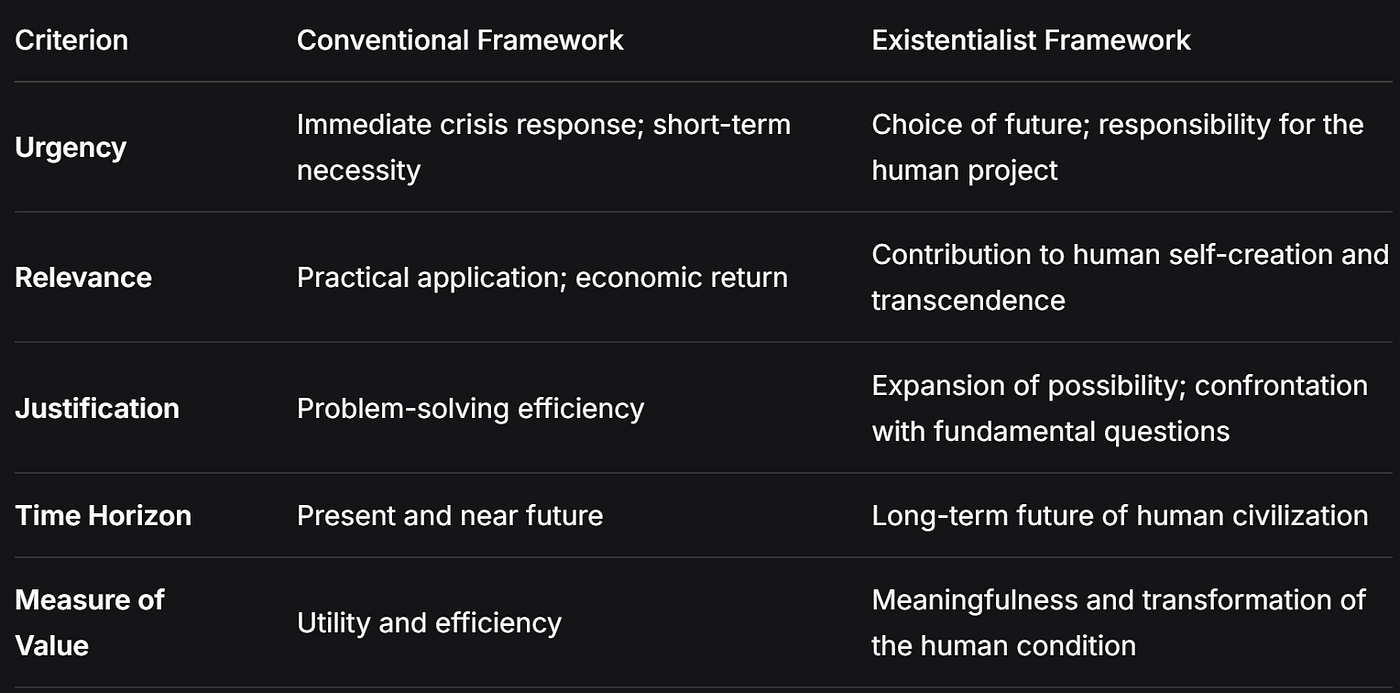
This framework does not dismiss conventional concerns — climate change, pandemic response, and economic prosperity remain important. But it refuses to treat them as the only or even the primary measures of scientific value. It opens space for ambitious, long-term, and world-transforming projects that the conventional framework would dismiss as irrelevant or premature.
IV. Case Study: SpaceX and the Existential Imperative of Space Industrialization
4.1 SpaceX as an Existential Project
Elon Musk’s SpaceX embodies the existentialist framework in practice, whether or not its founder would describe it in philosophical terms. The explicit goal of SpaceX — “making humanity a multi-planetary species” — is not a practical objective in any conventional sense. There is no immediate crisis on Earth that requires a Martian colony. The economic case for interplanetary civilization remains speculative. Yet the goal resonates with something profound in the human spirit precisely because it is an existential project: a freely chosen endeavor that aims to transcend our current limitations and redefine the human condition.
Musk has articulated this vision in existential terms, arguing that humanity faces a “filter” that will determine whether we become a multi-planetary species or remain confined to Earth, vulnerable to existential risks. His framing invokes what the philosopher Nick Bostrom has called “existential risk” — risks that threaten the annihilation or permanent stagnation of human civilization. But Musk goes beyond risk mitigation; he frames space settlement as a positive project of human self-creation, arguing that we must “expand the scope and scale of consciousness” if we are to fulfill our potential as a species.
SpaceX’s development of reusable rockets, in-orbit refueling, and the Starship vehicle are not merely technical achievements but materializations of an existential vision. The company’s famous failures — rockets exploding on test flights — are not treated as embarrassments but as necessary steps in the learning process, precisely because the project is understood as one of transcendent ambition rather than incremental improvement. This attitude exemplifies the existentialist rejection of “bad faith”: the refusal to hide behind the constraints of the possible, the insistence on expanding the boundaries of what is possible.
4.2 The Socioeconomic Relevance of Space Industrialization
The reconstructed existentialist framework provides a powerful justification for the socioeconomic relevance of space industrialization. The economic projections are themselves staggering: space industry analysts estimate that the global space economy could grow from its current valuation of approximately $400 billion to over $1.8 trillion by 2035, with potential valuations of $1.8-$2.1 trillion for Musk’s SpaceX specifically. These figures represent not just financial markets but the creation of entirely new economic domains: asteroid mining, in-orbit manufacturing, space tourism, lunar resource utilization, and the infrastructure to support interplanetary commerce.
However, the existentialist framework reveals that the economic relevance is itself a symptom of a deeper significance. The true socioeconomic relevance of space industrialization lies in its capacity to transform the fundamental conditions of human society. Consider the following dimensions:
Technological Innovation: The demands of space industrialization generate technological innovation across multiple domains — propulsion, materials science, life support, robotics, artificial intelligence, energy systems — that have spillover effects throughout the economy and society. The Apollo program’s development of integrated circuits and miniaturized computers is the classic precedent; space industrialization will generate comparable waves of innovation.
Social Transformation: Space industrialization creates the possibility of new forms of human society, governance, and culture. The experience of living in space or on other worlds will generate new perspectives on human identity, cooperation, and conflict. The philosopher and historian of technology Leo Marx has argued that “the frontier is a crucial element in the American cultural imaginary,” and the space frontier extends this dynamic to the planetary scale.
Human Development: The existentialist framework emphasizes that the value of space industrialization lies not only in what it produces but in what it does to the humans who undertake it. The challenges of space settlement — the engineering demands, the psychological pressures, the necessity of international cooperation — develop human capabilities that would otherwise remain latent. The astronaut and author Frank White has termed this expanded perspective “the overview effect”: the cognitive shift that occurs when humans view Earth from space, experiencing a profound sense of connection to the planet and to humanity. Mass space industrialization would democratize this experience.
Meaning Generation: Most fundamentally, space industrialization generates meaning. It provides a grand narrative for human civilization — a project that can inspire collective action, imagination, and identity. The existentialist tradition, from Kierkegaard to Camus, has grappled with the problem of meaning in a secular age; space industrialization offers a concrete, material project that can serve as a focus for human aspiration and self-understanding.
4.3 The SpaceX IPO as Materialized Vision
The initial public offering (IPO) of SpaceX, when it occurs, will represent the materialization of this existential vision in the structures of global capitalism. The IPO is not merely a financial event but a translation of philosophical and cultural aspiration into socioeconomic reality. When billions of dollars of capital flow into space industrialization, they will represent a collective investment — implicit, in many cases, but nevertheless real — in the existential project of human expansion beyond Earth.
The value assigned to SpaceX by the market, estimated at $1.8-$2.1 trillion, reflects something more than the discounted future cash flows of its business lines. It reflects a collective judgment that the project of space industrialization is of profound importance — that it is a bet worth taking, a future worth building. The market is not merely making a financial calculation; it is expressing a cultural and existential judgment.
This is not to claim that market valuation is a valid philosophical argument. But the IPO process is a mechanism through which existential choices become material forces. Capital is allocated to projects that express a vision of the future, and the scale of the capital indicates the scale of the collective commitment to that vision. The existentialist framework, while critical of bad faith and technological enframing, does not reject the material world; it insists that existential choices must be realized in concrete actions and institutions. The SpaceX IPO is precisely such a realization.
V. Case Study: The Mobile Suit Gundam as Cultural Artifact and Philosophical Mirror
5.1 Gundam and the Dialectic of Technology
The Mobile Suit Gundam franchise, created by Yoshiyuki Tomino and first broadcast in 1979, is one of the most influential cultural artifacts of the late twentieth and early twenty-first centuries. It has shaped the global discourse on space colonization, technology, war, and human evolution. In the context of this paper, it functions as a philosophical mirror: a work that explores exactly the themes of existential choice, technological transformation, and the human project that are central to our argument.
The Gundam universe depicts a future in which humanity has industrialized space — building massive space colonies at Lagrange points, developing the orbital infrastructure for interplanetary travel, and establishing new societies with distinct identities and aspirations. The conflict at the heart of the series, between the Earth Federation and the space colonies of Zeon, is not merely a geopolitical conflict but an existential one: it asks whether humanity remains Earth-bound or becomes a spacefaring species, and what the consequences of that choice will be.
The Mobile Suit itself — a humanoid combat vehicle piloted from within — is the central technological artifact of this universe. It embodies the themes of technological enframing that Heidegger identified: it is a tool of power, a weapon of war, an instrument for ordering and controlling the world. Yet the series refuses to treat the Mobile Suit as merely a tool. It becomes a site of human identity, a crucible of human transformation, and a symbol of the ambiguous relationship between humanity and its technologies.
5.2 The Newtype Concept: Transcendence Through Adaptation
The most philosophically significant element of the Gundam universe is the “Newtype” concept — the idea that human beings who grow up in the low-gravity, high-isolation environment of space develop enhanced capabilities, including heightened empathy, psychic communication, and expanded consciousness. In the series, Newtypes represent the next stage of human evolution, the emergence of a being who can transcend the conflicts and limitations of Earth-bound existence.
The Newtype concept can be read as an existentialist meditation on human self-creation. It posits that the conditions of existence shape and transform human nature — that by choosing to create new conditions of existence (space colonization), we also choose to create new forms of human being. The Newtype is not a predetermined essence but an emergent possibility, one that arises through the authentic engagement with the challenges of a new environment.
This echoes the existentialist insistence that existence precedes essence. Human nature is not fixed; it is created through the choices we make and the conditions we construct. The Newtype is the product of an existential project — the project of space industrialization — and in turn represents the transformation that such a project makes possible.
5.3 Gundam as Justification: The Relevance of Space Industrialization
The Gundam universe demonstrates, through narrative rather than argument, the profound relevance of space industrialization. The societies depicted in the series are born from the very project of space industrialization that advocates like Musk are now pursuing. They represent the future that our choices might create.
In the Gundam universe, space industrialization does not merely solve problems but creates new possibilities — for human connection (the Newtype’s empathetic bonds), for political organization (the creation of the Principality of Zeon), for cultural development (the distinct identity of the space colonies), and for human evolution itself. The conflicts of the series arise from the challenges of this new world — war, inequality, misunderstanding — but they are conflicts that could not even exist without the transformative project of space expansion.
This demonstrates a crucial point for our existentialist framework: the relevance of space industrialization lies not in the absence of conflict but in the capacity to create new dimensions of human experience. The Gundam universe is not a utopia; it is a complex, conflict-ridden, and ambiguous future. But it is a future that has expanded the scope of human possibility, creating new challenges and new opportunities for meaning-making.
In existentialist terms, the universe of Gundam represents the authentic outcome of the choice to industrialize space — a choice that entails responsibility for the consequences of that choice. The relevance of space industrialization is that it forces us to confront, in the most concrete way possible, the question of who we choose to become. It is the ultimate “relevant” endeavor because it demands that we face the ultimate existential questions: What is humanity? What could it become? What future do we choose?
5.4 From Gundam to SpaceX: The Continuity of an Existential Vision
The connection between Gundam and SpaceX is not merely an academic curiosity. Musk himself has cited Gundam as an influence, and the cultural resonance of the franchise suggests that the vision of space industrialization it depicts has penetrated the collective imagination. The existence of this cultural artifact, and its global popularity, is itself evidence that the existential project of space industrialization speaks to something deep in the human psyche.
The anthropologist Arjun Appadurai has argued that the “imagination” is a social fact, a collective capacity that shapes human action and institutions. The Gundam franchise is an expression of the collective imagination of space industrialization — a representation of what the future might hold, and a site for working through the hopes and fears associated with that future. SpaceX and other actors in the space industrialization movement are translating that imagination into material reality.
This connection underscores the existentialist insight that human action is motivated by meaning and narrative, not merely by calculation and interest. The “relevance” of space industrialization cannot be understood through economic metrics alone; it must be understood through the cultural and existential meaning that the project embodies. The popularity of Gundam, and of related works of science fiction that depict space civilization, is evidence that the project of space industrialization has this meaning for millions of people.
VI. Conclusion: The Existential Choice of a Multi-Planetary Future
This paper has argued that the existentialist philosophical tradition provides a powerful framework for both critiquing and reconstructing the conventional definitions of “scientific urgency” and “relevance.” Through the lenses of Sartrean bad faith, Heideggerian enframing, and Camusian absurdity, we have seen that current science policy operates within an impoverished paradigm — one that reduces scientific endeavor to problem-solving, that denies the existential responsibility of choosing a future, and that mistakes the means of human existence for its ends.
Rebuilding these concepts on existentialist foundations has allowed us to see urgency in its true light: not as the pressure of immediate crisis but as the fundamental necessity of choosing what humanity will become. Relevance, in this reconstructed framework, is not about practical utility but about contribution to the ongoing project of human self-creation and transcendence.
The case studies of SpaceX and the Mobile Suit Gundam have demonstrated the power of this existentialist framework. SpaceX represents the materialization of an existential vision, the translation of philosophical aspiration into technological and economic reality. The Gundam universe provides a cultural meditation on the consequences of that vision, exploring the challenges and possibilities of space industrialization through narrative and symbol.
The conclusion of this argument is that the decision to industrialize space is not a luxury or a distraction from “real” problems but the ultimate expression of human freedom — the most urgent and relevant project we can undertake. It is urgent because it represents a choice we must make, and that cannot be deferred indefinitely. It is relevant because it expands the horizon of human possibility, creates new conditions for human flourishing, and forces us to confront the fundamental questions of what it means to be human.
The existentialist tradition teaches us that we are condemned to be free — that we cannot escape the responsibility of choosing our future. The choice of a multi-planetary existence is the most significant choice we can make, because it is a choice for transcendence, for the expansion of consciousness, and for the long-term future of humanity. It is a choice that acknowledges the absurdity of existence and responds with rebellion — not the rebellion of despair but the rebellion of creation, of building a future that we can choose to inhabit.
In the end, the question is not whether space industrialization is urgent or relevant in the conventional sense, but whether we have the courage to embrace our existential responsibility and choose the future we want to create. The existentialist framework we have developed here provides the philosophical grounding for that choice, and the cultural artifacts we have examined provide the imaginative resources to make it real.
Works Cited
Appadurai, Arjun. Modernity at Large: Cultural Dimensions of Globalization. University of Minnesota Press, 1996.
Beauvoir, Simone de. The Ethics of Ambiguity. Translated by Bernard Frechtman, Citadel Press, 1948.
Bostrom, Nick. “Existential Risks: Analyzing Human Extinction Scenarios and Related Hazards.” Journal of Evolution and Technology, vol. 9, no. 1, 2002.
Camus, Albert. The Myth of Sisyphus. Translated by Justin O’Brien, Vintage Books, 1955.
Heidegger, Martin. “The Question Concerning Technology.” In The Question Concerning Technology and Other Essays, translated by William Lovitt, Harper & Row, 1977.
Kaufmann, Walter, editor. Existentialism from Dostoevsky to Sartre. Meridian Books, 1956.
Marx, Leo. The Machine in the Garden: Technology and the Pastoral Ideal in America. Oxford University Press, 1964.
Sartre, Jean-Paul. Being and Nothingness: An Essay on Phenomenological Ontology. Translated by Hazel E. Barnes, Washington Square Press, 1956.
Sartre, Jean-Paul. Existentialism is a Humanism. Translated by Carol Macomber, Yale University Press, 2007.
White, Frank. The Overview Effect: Space Exploration and the Evolution of Human Consciousness. Houghton Mifflin, 1987.
메타데이터
- post_id
- 36a553d45c19
- slug
- an-existentialist-framework-for-scientific-urgency-space-industrialization-and-gundam-36a553d45c19
- url
- https://medium.com/@iftitahranjana/an-existentialist-framework-for-scientific-urgency-space-industrialization-and-gundam-36a553d45c19
- canonical_url
- https://medium.com/@iftitahranjana/an-existentialist-framework-for-scientific-urgency-space-industrialization-and-gundam-36a553d45c19
- author_url
- https://medium.com/@iftitahranjana
- status
- ok
- fetched_at
- 2026-08-05 11:11:33