Solar Fury Unleashed: Why Your Tech Needs IBM & NASA’s AI (Survya)
How cutting-edge AI, like the new Survya model, is empowering us to predict and protect against the Sun’s most destructive outbursts…
Unseen Threats & AI’s Watchful Eye
Solar Fury Unleashed: Why Your Tech Needs IBM & NASA’s AI (Survya)
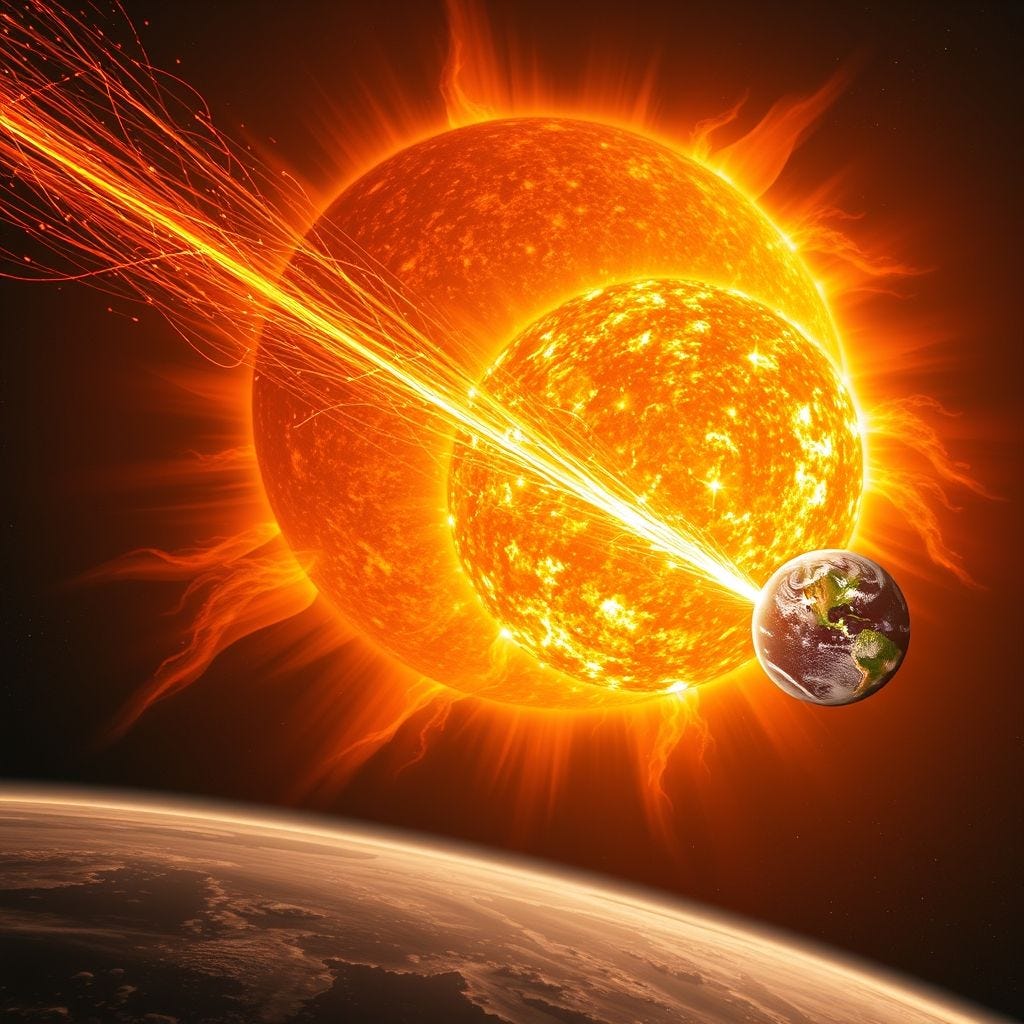
A conceptual image illustrating future AI research directions in space weather, perhaps showing data fusion or explainable AI concepts.
How cutting-edge AI, like the new Survya model, is empowering us to predict and protect against the Sun’s most destructive outbursts, safeguarding Earth’s vital infrastructure.
Have you ever stopped to consider the invisible forces that constantly bombard our planet? Beyond the blue sky and the gentle warmth of the sun, lies a chaotic, energetic beast capable of unleashing havoc on our meticulously built digital world. It’s not a sci-fi movie plot; it’s the very real, ever-present threat of space weather. And let me tell you, as someone who spends their days wrestling with code and complex models, the sheer scale of this problem kept me up at night until I saw the latest breakthroughs.
Imagine a world where GPS systems falter, power grids blackout for days, and your internet connection becomes a distant memory. Sounds dystopian, right? This isn’t just theoretical; it’s the potential fallout from severe solar storms — colossal eruptions of energy and particles from the Sun’s surface. For years, predicting these events with enough accuracy and lead time has been a holy grail for scientists and engineers. It’s a problem that genuinely pins us against the unpredictable might of our star.
The Problem: Our Digital Vulnerability to Solar Outbursts
Our modern lives are inextricably linked to technology. Satellites enable everything from navigation to global communication, power grids deliver the electricity that fuels our homes and businesses, and countless interconnected systems depend on their stable operation. Solar flares and Coronal Mass Ejections (CMEs) send high-energy particles and magnetic fields hurtling towards Earth. When these interact with our planet’s magnetosphere, they trigger geomagnetic storms.
These storms are the silent assassins of our technological age. They can:
- Damage Satellites: Disrupting communications, navigation, and weather forecasting.
- Induce Geomagnetically Induced Currents (GICs): Overloading power transformers and causing widespread blackouts.
- Affect Aviation: Disrupting high-latitude flights due to communication outages and radiation risks.
- Corrode Pipelines: Accelerating corrosion in long-distance pipelines.
The reality is, we’ve been largely reactive. We could see the storm coming, but often not with enough precision or time to implement robust protective measures. That’s where the beauty of AI steps in, offering a glimmer of hope in this cosmic gamble.
The Invisible Shield: Enter AI for Space Weather Prediction
For years, predicting these fierce solar outbursts has been like trying to forecast a hurricane from a tiny rowboat — we knew it was coming, but the exact path and intensity remained maddeningly elusive. But what if we could equip that rowboat with an advanced radar system, capable of seeing patterns and trajectories invisible to the human eye? That’s precisely what Artificial Intelligence is bringing to the table for space weather.
My own journey into this realm began with a healthy dose of skepticism. Could a machine truly decode the complex, plasma physics of our Sun? The Sun is a churning, magnetic dynamo, and its behavior is governed by incredibly intricate, non-linear dynamics. Traditional physics-based models are computationally intensive and often struggle with the sheer unpredictability. This is where the strength of machine learning, particularly deep learning, shines. Instead of explicitly programming every physical law, we train models to learn the underlying patterns from vast datasets of solar observations.
Survya: NASA & IBM’s AI Breakthrough Against Solar Fury
And here’s where things get really exciting. Remember how I mentioned feeling a bit more hopeful? A significant part of that stems from the open-sourcing of Survya, a groundbreaking AI model developed collaboratively by IBM and NASA.
Survya isn’t just another model; it’s a game-changer for solar physics. It leverages deep learning techniques to analyze an enormous influx of data from solar observatories, such as NASA’s Solar Dynamics Observatory (SDO). Its primary mission? To predict solar energetic particle (SEP) events — the most hazardous components of space weather, which can quickly reach Earth after a solar flare or CME.
How does Survya do this magic? Think of it like this: the Sun’s surface is constantly in motion, with magnetic fields twisting and turning. These motions are precursors to flares and CMEs. Survya is trained on historical data, meticulously learning the subtle signatures and evolving patterns in solar imagery and magnetograms (maps of magnetic fields) that precede a major eruption.
Instead of a human expert poring over countless images, trying to spot the needle in the haystack, Survya can:
- Identify Precursor Signatures: It recognizes specific magnetic field configurations and plasma movements that often lead to an outburst, much like recognizing the subtle atmospheric shifts before a tornado.
- Process Vast Datasets: The sheer volume of solar data is immense. Survya can chew through terabytes of information, finding correlations and trends that would be impossible for human analysis alone.
- Provide Earlier Warnings: By automating and accelerating this analysis, Survya aims to give us more lead time — hours, or even a day — before a major geomagnetic storm hits. This crucial window allows for protective actions to be taken.
Imagine the Sun’s surface as a complex, ever-changing tapestry of magnetic lines. Survya essentially learns to predict where and when a thread in that tapestry is about to snap, unleashing a powerful wave of energy.
Why Survya Matters: Protecting Our Planet, One Prediction at a Time
The implications of accurate, early space weather prediction are profound, especially for a planet as technologically dependent as ours. Survya is not just a scientific curiosity; it’s a vital tool for Earth’s defense, giving us a much-needed heads-up.
- Safeguarding Power Grids: With earlier warnings, power grid operators can implement preventative measures like temporarily reducing voltage or re-routing power, mitigating the risk of widespread blackouts caused by GICs. This could save billions in damages and prevent widespread societal disruption.
- Protecting Astronauts and Satellites: Space agencies can advise astronauts on the International Space Station to take shelter and can put satellites into “safe mode” or reorient them to minimize exposure to harmful radiation. This directly protects critical infrastructure in orbit.
- Enhancing Aviation Safety: Airlines can adjust flight paths for polar routes, avoiding communication blackouts and reducing radiation exposure for passengers and crew.
- Improving GPS Reliability: Protecting the integrity of GPS signals is crucial for countless applications, from agriculture to logistics.
This isn’t about stopping the Sun — we can’t. It’s about giving ourselves the foresight to prepare and protect. Survya represents a massive leap in that capability, shifting us from a reactive stance to a proactive one.
The Road Ahead: Limitations and Open Questions
While Survya is incredibly promising, it’s essential to maintain intellectual transparency. AI, however powerful, isn’t a magic bullet. There are still limitations and fascinating open questions that fuel further research:
- Data Dependency: AI models are only as good as the data they’re trained on. Gaps in historical solar observation data, or new types of solar phenomena, can challenge a model’s accuracy. What if the Sun throws a curveball we’ve never seen before?
- Model Interpretability: Understanding why Survya makes a particular prediction is still a complex area. “Black box” issues, common in deep learning, mean we know the input and output, but the exact internal reasoning can be opaque. This is crucial for building trust in high-stakes predictions.
- Real-time Performance: The Sun is constantly changing. Processing massive streams of real-time data and making rapid, accurate predictions is a significant engineering challenge.
- Forecasting Distance: While Survya excels at near-term prediction of SEPs, long-range forecasts of general solar activity remain incredibly difficult. Predicting the next solar cycle’s intensity, for instance, still involves a mix of models and expert judgment.
These challenges aren’t roadblocks; they’re invitations for the next generation of ML researchers and tech enthusiasts to dive in. How can we make these models more interpretable? Can we develop new sensors or data assimilation techniques to feed even richer data into these systems? The frontier is wide open.
Conclusion: Our Shared Future Under a Fiery Sun
The Sun, our life-giver, is also a source of formidable, unpredictable power. For centuries, its tantrums were beyond our comprehension and control. But with the advent of sophisticated AI models like Survya from IBM and NASA, we are beginning to lift the veil, gaining unprecedented insight into its fiery heart.
This isn’t just about protecting satellites or power lines; it’s about safeguarding our increasingly interconnected and fragile way of life. It’s a testament to human ingenuity — that by understanding our universe better, we can build a more resilient future. The journey of predicting solar fury with AI has just begun, and the insights we gain will undoubtedly shape our preparedness for the cosmic dance between our planet and its star.
What are your thoughts on AI’s role in protecting our planet from space weather? Do you think we’re doing enough, or should we be investing more in this critical area? Share your insights and questions in the comments below!
Acknowledgements
This exploration was inspired by the groundbreaking work of IBM and NASA on the Survya project, a testament to collaborative open science. Further insights were gathered from various arXiv research papers focusing on deep learning applications in solar physics and space weather forecasting. Diagrams were conceptualized and sourced to enhance understanding.
AISpaceWeather #SolarFlares #SpaceTech #MachineLearning #NASAIBM #DigitalProtection #TechForGood #GeomagneticStorms
메타데이터
- post_id
- 36d05668aa4d
- slug
- solar-fury-unleashed-why-your-tech-needs-ibm-nasas-ai-survya-36d05668aa4d
- url
- https://medium.com/@akhileshyadav805a/solar-fury-unleashed-why-your-tech-needs-ibm-nasas-ai-survya-36d05668aa4d
- canonical_url
- https://medium.com/@akhileshyadav805a/solar-fury-unleashed-why-your-tech-needs-ibm-nasas-ai-survya-36d05668aa4d
- author_url
- https://medium.com/@akhileshyadav805a
- status
- ok
- fetched_at
- 2026-08-08 04:14:00