Why We Need the Walk, Not Just the Door
Date: 26/04/30, Weather: Beautifully bright sunny, Breakfast: salmon and soft-boiled egg with some vegetable, BGM: Gymnopédie №1 by Erik…
Why We Need the Walk, Not Just the Door
Date: 26/04/30, Weather: Beautifully bright sunny, Breakfast: salmon and soft-boiled egg with some vegetable, BGM: Gymnopédie №1 by Erik Satie
The powder this morning
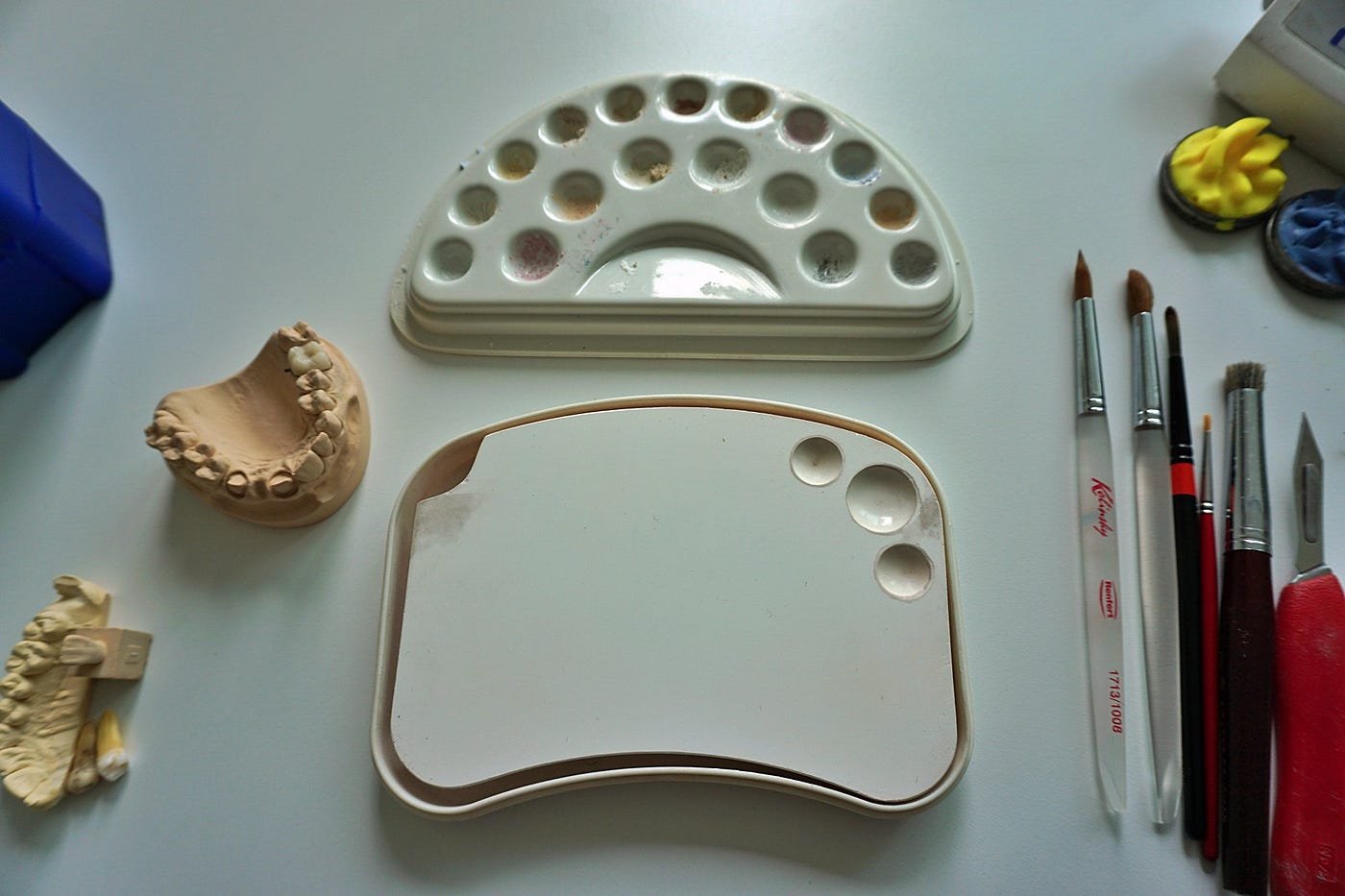
The powder this morning was off.
Not wrong — just slightly too warm in its undertone. I mixed it anyway, slowly, with a small spatula that I’ve used so long it’s worn smooth on one side. There’s a rhythm to it. Fold, press, fold. I wasn’t thinking about the tooth I was building. I was thinking about why I always do this part by hand, even though a machine could do it faster.
The answer I came up with surprised me. And then I thought: of course it did. I had to get there.
The question that keeps following me
Why do we need a journey for an answer?
Not just any answer. The important ones. The ones that change how you see the room you’re standing in.
We live in an age where answers arrive in seconds. You type a question, and something responds. Instantly. Accurately. And yet — and this is the part I keep turning over — something often feels missing. Not from the answer itself. The answer might be correct. But something about receiving it that way leaves you strangely empty.
What a journey actually does to you
Here’s a way to think about it.
Imagine you are trying to find a friend’s house in an unfamiliar neighborhood. You could look at a map. Or someone could just drive you there. Both work. But if someone drives you, you arrive — and you have no idea how you got there. Ask you to go back the next day, alone, and you’d be lost.
The journey builds the map inside you. This is not just about remembering. It’s about transformation(변화). When you walk toward an answer — when you stumble, revise, feel confused and then suddenly clear — your brain is not just storing information. It is reshaping itself around the question. The answer, when it finally comes, doesn’t just sit in your head. It fits into grooves that the journey carved out.
What gets lost in the shortcut

I’ve been making ceramic teeth long enough to know what a shortcut costs.
If I rush the shaping phase, the tooth looks fine at first. Smooth, proportional. But during firing — when heat reveals everything — the flaws emerge. Small collapses. Tension in the wrong places. The material remembers how it was handled.
I think people are similar. When we receive answers without the struggle, we don’t always know what to do with them. The answer sits there, technically correct, but we haven’t built the context (맥락) for it. We haven’t earned the emotional coordinates (좌표) that tell us where the answer lives in our life.
Live the questions. Not because the answers don’t exist. But because you have to grow into them. — Rainer Maria Rilke
This is a philosophy for my postings from now on.
I don’t know what the ideal human looks like in the age of AI.
Nobody does, really. That question is still open. But I have a feeling — a strong one — that Leonardo da Vinci would be somewhere close to that ideal. Not because he was a genius. But because of how he was curious.
Da Vinci didn’t ask questions to get answers. He asked questions because he couldn’t help it. It was almost a sickness(병적이다). He would start with one question and follow it so far that he ended up somewhere no one had ever stood before.
He wanted to know why woodpeckers have such long tongues. So he dissected (해부하다) one. He wanted to understand how water moves. So he watched rivers for years and filled notebooks with spirals and waves. He was designing flying machines not because someone asked him to — but because he looked at birds and simply could not stop wondering how they worked.
None of these questions had immediate practical value. No one commissioned (의뢰하다) the woodpecker study. No one paid him to stare at water. He followed the questions because the journey itself seemed to him like the only honest response to living in a world this strange and detailed.
And here is what I think the AI age will quietly reveal: machines are extraordinarily good at arriving. They retrieve, they calculate, they answer. Fast. Accurately. But they do not wander. They do not get lost on purpose. They do not dissect a woodpecker out of sheer, irrational wonder.
The humans who will matter — who will add something that cannot be automated — might be the ones who are still capable of that. Of following a question past the point where it’s useful. Of being a little sick with curiosity.
Da Vinci would have had a terrible time with search engines. He would have kept asking the next question, and the next, refusing to stop at the answer.
That refusal might be the most human thing of all.
What the tooth taught me this morning
I finished the mixing. The undertone issue corrected itself by the third fold. It always does, if I stay with it.
And I wondered: if I had rushed to fix it — added a correcting powder immediately, tried to solve the problem before I fully understood it — would I have learned why it was off in the first place?
Probably not.
The ceramic doesn’t give you its secrets quickly. It gives them to you through time and attention. Maybe that’s why I keep doing this part by hand.
Some things you can only understand by the way your hand begins to know them.
메타데이터
- post_id
- 36de2c43de8e
- slug
- why-we-need-the-walk-not-just-the-door-36de2c43de8e
- url
- https://medium.com/@djdjgfk/why-we-need-the-walk-not-just-the-door-36de2c43de8e
- canonical_url
- https://medium.com/@djdjgfk/why-we-need-the-walk-not-just-the-door-36de2c43de8e
- author_url
- https://medium.com/@djdjgfk
- status
- ok
- fetched_at
- 2026-06-09 15:37:30