Sutton’s Law and the Stories We Tell
Considering the obvious as the ground for our stories to evolve (Response letter to “Out.formation”)
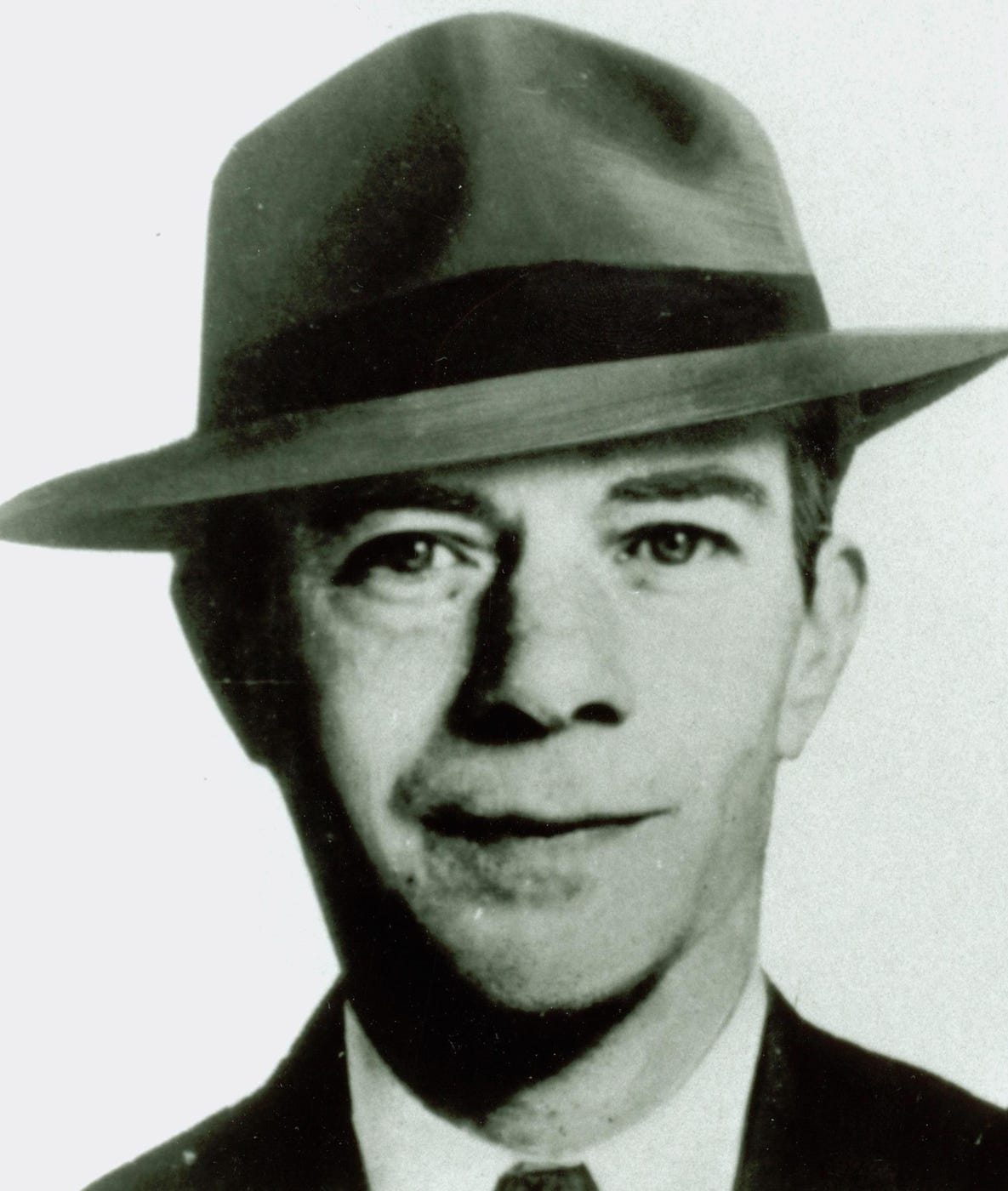
Willie Sutton — American robber
Sutton’s Law and the Stories We Tell
“Great stories happen to those who can tell them.”
-Ira Glass
Dear Unknown,
Willie Sutton, once topping the FBI’s 10 Most Wanted List — was asked after his arrest: “Why do you rob banks, Willie?” To that, Sutton replied: “Because that’s where the money is.”
Since then, Willie got his own law to be named after him and “Sutton’s Law” states that when diagnosing, one should first consider the obvious.
And if I may diagnose for us humans the obvious source to many of our problems (not you, the Unknown), we are all diagnosed with what in Latin might sound more entertaining: “Insperatus Obitus” — an “unexpected or unhoped for death or demise.”
We humans like to get a second opinion to a diagnosis, and a third one and a fifth. It is as you say, a game appearing to defy that which is irreversible. We go around keep trying to bend what is. And yet the diagnosis remains stubbornly the same.
It’s strange to state the obvious, but if it wasn’t strange, we wouldn’t be calling it life.
The diagnosis of death or rather, our avoidance from accepting it as a restriction to the creation of life, scares us humans. Life, its abundanceness (not a word, yet) confuses us, it doesn’t make it to our senses that it is both irreversible and yet so rich beyond grasping. Potentially unlimited with potentiality.
The paradox that is a call to move between scales of perception is also felt as a call to limit life with fear. Limit it by playing our favorite game invented as humans — the future. Our capacity to imagine and anticipate the future often becomes a mechanism that restricts our experience of the present.
We are as you said, thrown into the world, not broken, but always headed towards the Unknown. Even when going towards the direction in which we came from.
It seems to me that the way we choose to engage and interact with this great unknown — the diagnosis of death, affects the stories we tell and the stories we won't. The stories that are being told both express and shape our worldview, and at the same beat, our worldview shapes and expresses the stories they tell.
Every story is a narrative and yet not every narrative is a story
Here at the coffee shop where I’m seated, there are four or five tables scattered along the boulevard outside. Each table hosts two people or more and they all engage in doing the same thing: they all tell stories to one another. It is quite remarkable to witness. And in what only appears to be cause and effect– I eavesdrop a lot. It is inevitable.
I listen and in every instance where a story is told, it is told as a new experience of life, a new occurrence, an opening to expand an old boundary or an edge of thought.
But I am struck with discontent. Are they in fact a telling of a new experience?
As the stable tables are randomly spread in what the long and narrow shape of the boulevard dictates, so are the stories being told — spread randomly and are long and narrow. Too narrow to include uncertainty, which is instead synthetically manufactured.
As you mentioned in your previous letter, the web of stories we hold true is being cast. Although most times, not towards the Unknown, I suspect, but towards the known itself, reaffirming that which is known to be the case already.
On and on, in circular descriptions that are validating the boundaries of an all too familiar territory — a singular self, a singular teller.
More often than not, the technology that storytelling is, is being abused to draw a clear line, a boundary between the teller, a mind and the world around her. In most instances, the “You” that is telling seems to be doing the “You” that she knows herself to be. And the world appears– untouched, unchanged.
The reversible is being disguised as irreversible.
Photo by John Noonan on Unsplash
Returning to the initial diagnosis, in every good story, there’s death. Change is also a form of death that is taking place for the story to evolve. Change is the closest to death without dying.
Maybe, when a change occurs at the thicker, more significant levels of identity as you mentioned, it resembles rebirth rather than simple change? And for rebirth to occur, something must first die.
Opposing this force, I sense, is the human capacity to adapt, and to see what is desired to be seen. We are biased creatures. Biased to that which will prove to be that which has always been. Taking your advice to heart, I do not underestimate this capacity.
I don’t underestimate that it’s a strong bug/ feature of the mind.
When meeting for coffee, I’d like to be asked by a close friend: “Why are you telling me this?” I’d like to introduce to a close friend the same question, while knowing there could never be something inherently “true” to point to the why.
“Everything happens for the first time.” -Jorge Luis Borges
And yet, life, so believes the baseless optimist that I am, strikes most minds as a good deal because it is vibrating with single, irreversible events, all happening for the first time. Yes, meeting a friend for another cup of coffee included. It is quite remarkable to experience.
But traumas clashing, and the devastated child, hearing about the glass that is shattered and will never be unbroken is still asking the question of what to do with the diagnosis of irreversibility? Of death? We avoid confronting the obvious truth of our mortality. The singular, unrepeatable nature of each experience becomes a source of great suffering to most.
We fear you, failing to capture the role you serve as a friend. A highly demanding one, and nevertheless — a friend out of which all ideas come to fruition. And maybe an idea is what is needed?
One that does not come from necessity though being an idea it is still bound to the laws of ideas, that claim to be useful only when trying to solve a problem or make something ideal. Maybe an idea with a capital “I”, to make a distinction and point to a case where there isn't any problem to be solved and yet, it is an Idea. A paradox.
Unlike what is traditionally thought to be the case, I do not believe humans always invented out of sheer sense of necessity. Necessity is not the mother of invention.
Maybe a dangerous Idea is needed? Maybe dangerously spread. Dangerously slow spread. Like a contagious virus. As an existential question: Rather than experiencing being as suffering, can we experience being as an experiment?
A question is asked and voilà — it has always been there. Trickles further in. A seemingly violent intruder with its own unique order, sensed as something foreign as it defies and redefines what our body and its parameters are. And it is asking you:
What do you mean by “You”?
Being as an experiment, seems to me more aligned — psychologically, emotionally and otherwise with our initial diagnosis. There will be death. All else is negotiable.
Who knows, maybe with some creativity of the mind, death is negotiable as well?

Credit: Haragayato
Change, trauma — is introduced. But humans are making art out of the cracks.
So is the case with the Japanese art of Wabi-Sabi: a shattered cup or teapot can never be unbroken. It is irreversible.
Yet the artist will take the fractures of broken pieces and reconnect them with melted metal — an expensive one: gold — filling the points of meeting to be reintroduced anew. Same object, yet something has changed.
John Lennon put it in different words: “I’m an artist. You give me a fucking tuba, I’ll get you something out of it.”
And either way you look at it, the fractures are ever-expanding — biased toward separating from the melted gold once more, while still appearing to be immovable. New cracks will emerge — an invitation for the artist to revisit what is all too quick to become a familiar story. Revisit, and tell us something new.
A seemingly unmovable object of mind begins to shake again. Like a wobbly table outside a coffee shop.
Some say, if it ain’t broken, why fix it? Others say, if you observe more closely, the cracks appear.
Yours with love, L
P.S. — No one can know for sure if either Willie Sutton or John Lennon actually said what was quoted here to be said. But as the old Hasidic saying goes: “What is truer than truth? The story.”
P.P.S. — A small offering to the Unknown in the name of those who walk dreaming, towards that which is irreversible. Towards that which happens of itself: ***The Windmills Of Your Mind***
Photo by Trevor McKinnon on Unsplash
[embed]
메타데이터
- post_id
- 36f5ec7f8a23
- slug
- suttons-law-considering-the-obvious-for-the-story-to-evolve-36f5ec7f8a23
- url
- https://letterstotheunknown.com/suttons-law-considering-the-obvious-for-the-story-to-evolve-36f5ec7f8a23
- canonical_url
- https://letterstotheunknown.com/suttons-law-considering-the-obvious-for-the-story-to-evolve-36f5ec7f8a23
- author_url
- https://medium.com/@dearunknown
- status
- ok
- fetched_at
- 2026-07-20 13:07:22