Neoliberalism, Education, and the Psyche: A Marxist Critique
Learning society is a philosophy which advocates lifelong learning and stresses the importance of education in the development of a nation…
Neoliberalism, Education, and the Psyche: A Marxist Critique


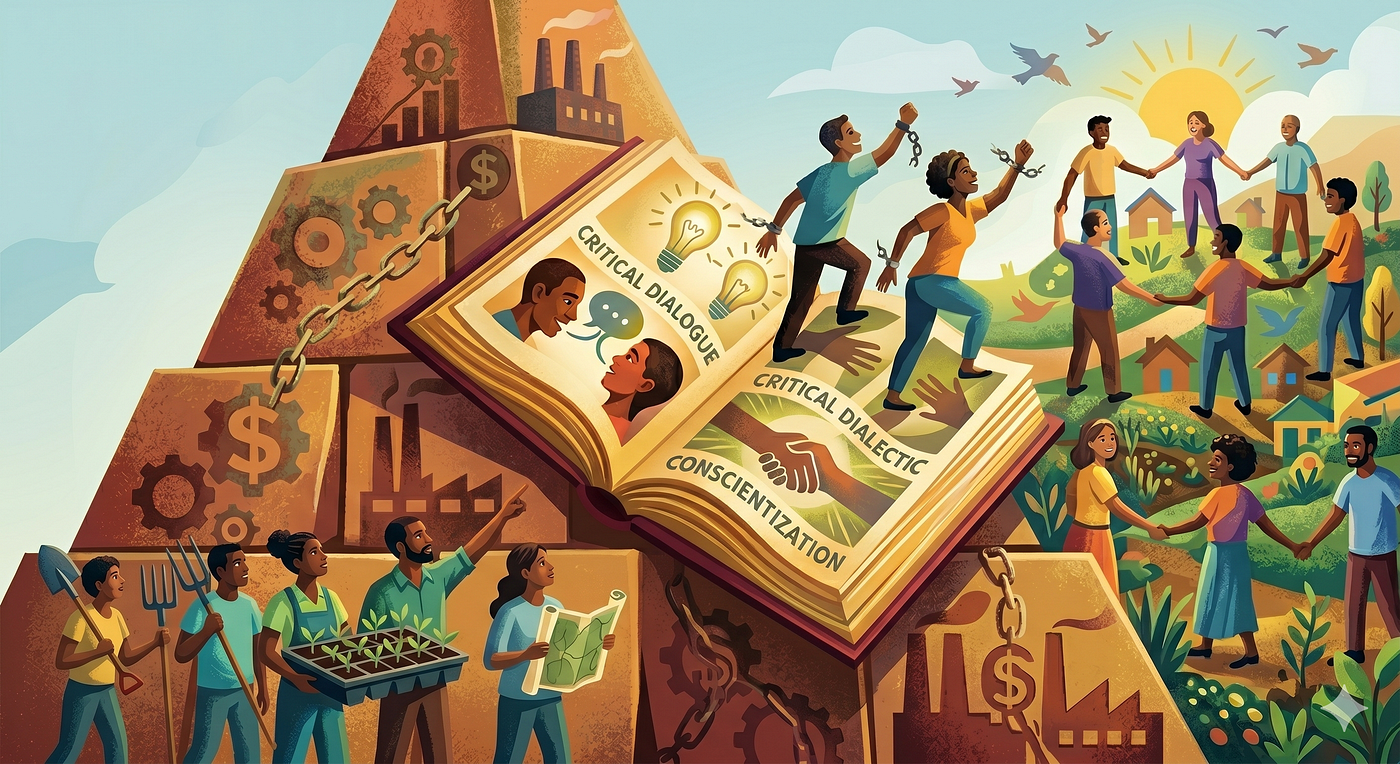
Learning society is a philosophy which advocates lifelong learning and stresses the importance of education in the development of a nation. A necessary part of a learning society is the recognition of an individual’s lifelong learning and the dedication to availability and democratization of knowledge. In many ways, it is a culmination of Enlightenment ideals about learning in conjunction with post-Enlightenment ideals of democracy and individual rights. There have been numerous developments in pedagogy, including the rise of pedagogy and andragogy themselves as sciences in their own right. AI-based tools being a recent revolutionary development in this area, promising either a neoliberal utopia, where everyone has personalized learning materials in a few key-presses, or a totalitarian dystopia, where learning takes a progressively smaller role in the life of a society, which instead employs AI to do the mental work for them. In the context of education, what does the fear of “everyone using AI for everything” tell us about the way we have structured our education systems? Maybe they are not as student-centric as we tell ourselves, or maybe there are other influences involved. In this article, I analyze the way the ideology of neoliberalism has impacted the attitudes and approaches to education. I argue that the recent wave of AI-driven-cheating in academia is symptomatic of underlying issues regarding the role of education in a neoliberal system. Neoliberalism substitutes the question “what kind of person is this person becoming?” with “what kind of output can this person produce?” (Claude). I draw primarily on Marxist theory to discuss the epistemological, institutional, and psychological layers of neoliberal ideology’s impacts on society, with the emphasis being on the education and the learning society. I argue for the value of learning and education not being contingent on its uses in the market economy, and the need to be aware of the broad influence of neoliberalism on our psychology and view of the world.
Humboldtian model of academic education encompasses some of the core tenets of our view of education and the learning society. Wilhelm von Humboldt applied the concept of Bildung to argue that the person should develop independent thinking, seek and engage with knowledge; they should develop themselves for the sake of becoming a better person and a better citizen. In Humboldt’s philosophy, the “students are not just memorizing facts and material that they then spit out in an exam at the end to prove that they’ve learned a lot. But it is about teaching oneself, cultivating oneself . . . “ (Ash qtd. in CBC Radio). Similarly, Comenius was famously a proponent of lifelong learning of everything by everyone. These are undoubtedly noble ideas which are required for a functioning democracy (DWB). The issue arises when these ideas meet with the ideology of neoliberalism, which treats the role of knowledge differently.
Neoliberalism is characterized by the in free market capitalism, rights of the individual, emphasizes the efficiency of the free markets, deregulation, reduction of government spending, promotes free trade and the economy run by private enterprises (Oxford University Press). This has a number of effects on education. Gasser (2024), provides a useful overview from which I draw on for the examples below. Some of the most relevant impacts of neoliberalism on education include:
- Marketisation of education as a commodity — students are to be seen as customers purchasing a commodity. This leads to the perception of education as personal (monetary) investment — one that has to bring economic returns.
- Performance metrics — employment of a range of performance metrics on universities, like graduation rates or research productivity. Standardization of curricula for efficiency; metric-based assessment.
- Commercialization of research — increasing emphasis on acquiring funding, practical application of research. Focus on programs based on market needs.
- Managerialism — universities start focusing on efficiency, cost-cutting measures, maximizing return-on-investments.
- Shifting focus of the education from working for the public good to providing benefits to individuals and private businesses, diminishing the role of universities as institutions of democratic citizenship and social equity.
(Gasser, 2024)
Even as public universities continue to be publicly funded, they are forced to play by the rules of a neoliberal capitalist economy, which results in the developments outlined above.
In Capitalist Realism, Mark Fisher observes that in the decades since the 1970s, there has emerged what he calls the ‘business ontology’- the perception that everything in a society should be run like a business (ch. 3). It should be noted, that while Fisher examines primarily the case of the United Kingdom, his ideas are relevant in the discussion of neoliberal capitalism in general as well. No one needs to explicitly force educational institutions to conform to the logic of neoliberal capitalism, the cultural hegemony of capital does it itself. Fisher then provocatively calls the capitalism’s amicable relationship with bureaucracy “market Stalinism” (ch. 6). He argues that through new kinds of bureaucracy — ‘aims,’ ‘mission statements,’ and the like — neoliberal governments have re-created the levels of bureaucracy which typically characterize totalitarian regimes. In a lengthy paragraph, he recounts a part of the bureaucracy and administrative work required in academia. He concludes that the friction between the public services (such as education) and the market creates
the drive to assess the performance of workers and to measure forms of labor which, by their nature, are resistant to quantification, [creating layers of bureaucracy and management]. What we have is not a direct comparison of workers’ performance or output, but a comparison between the audited representation of that performance and output. Inevitably, a short-circuiting occurs, and work becomes geared towards the generation and massaging of representations rather than to the official goals of the work itself. (ch. 6)
This focus on fulfilling metrics and productivity reports is the reasoning for the metaphor of “market Stalinism” — “what late stage capitalism repeats from Stalinism is just this valuing of symbols of achievement over actual achievement” (ch. 6). Since education exists in a highly competitive capitalist environment, it too is motivated to focus on fulfilling metrics and quotas. It should be noted that this phenomenon can also be linked to academic inbreeding — as the focus on metrics encourages stability and risk-aversion, it becomes more sensible to hire academics already versed in the local assessment culture. For more on academic inbreeding, see Tůma & Knecht (2019), Horta et al. (2021), Kohoutek et. al (2023). I have briefly discussed neoliberalism on an institutional level, now let’s turn to the epistemology.
As AI becomes an assistant in a large part of our intellectual output and even education, how much does it remain ‘ours’? To begin the discussion of epistemology in capitalism, I would like to introduce the concept of Reification (Verdinglichung). Although it was introduced by György Lukács in his 1923 essay Reification and the Consciousness of the Proletariat, here I would like to quote the definition by Gajo Petrović:
[Reification is] the act (or result of the act) of transforming human properties, relations and actions into properties, relations and actions of man‑produced things which have become independent . . . of man and govern his life. Also transformation of human beings into thing‑like beings which do not behave in a human way but according to the laws of the thing‑world. (Petrović, 1983)
Reification describes the way human relationships and activities become exchangeable and quantifiable. Although Lukács talked primarily about labour, this process is also involved in the commodification of knowledge as well as time. Erich Fromm observed that “Knowledge itself becomes a commodity. Here, too, man is alienated from his own power; thinking and knowing are experienced as a tool to produce results” (Man for Himself, 1947, p. 83). Time itself became split into neat chunks ready to be sold and purchased, became commodified. The perception of time as scarce and expensive was born in the Industrial Revolution. The Economist observed that
ever since a clock was first used to synchronise labour in the 18th century, time has been understood in relation to money. Once hours are financially quantified, people worry more about wasting, saving or using them profitably. When economies grow and incomes rise, everyone’s time becomes more valuable. And the more valuable something becomes, the scarcer it seems. (2014)
Since time became quantifiable, and industrial capitalism made it directly tradeable, it has become commodified. Note the language we use to talk about time — we usually use ‘save,’ ‘spend’, ‘invest,’ ‘allocate’ and similar words— the same language used to talk about money.
In part thanks to time being neatly organized into quantifiable chunks, modern education lends itself well to being quantifiable as well. How much ‘education’ or ‘learning’ is one ECTS credit worth? Ideally about 25–30 hours. However, why is it measured in raw hours and not anything else? Marxist theory would say that because time is treated as a commodity, it extends this commodification to the time ‘spent’ in education, which already exists in a neoliberal environment. With the aforementioned focus on metrics, performance, and optimization, knowledge too becomes fragmented and is treated as easily quantifiable. To look at some recent trends — micro-certificates and nano-learning epitomize this fragmentation. Knowledge is “sliced into monetizable, atomized units optimized for labor-market legibility” (Claude). It signifies the high level of competition between workers, where the mere appearance of knowledge can be a deciding factor in employment, as well as the nature of fragmentation and the increasing speed of time under neoliberal capitalism. Instead of deeply engaging in learning, people are motivated to focus on bite-sized units designed to signal their ‘motivation’ to an employer, or to provide the satisfaction of learning to a person who does not have time or motivation to engage in it fully — an interesting adaptation of education to the neoliberal culture of being busy.
Since, as mentioned previously, time became commodified with the rise of industrial capitalism, we have come to associate our busyness with our worth. Neoliberal preoccupation with being busy is analyzed in Celeste Headlee’s Do Nothing: How to Break Away from Overworking, Overdoing, and Underliving, where she argues that in the late 20th century, “the cultural emphasis shifted from luxury to busyness” — we have come to equate how busy we are with our worth (ch. 4) — contrary to the thesis of The Theory of the Leisure Class (Veblen, 1899), which famously observed that capitalists engage in unproductive conspicuous consumption and conspicuous leisure because the work is done for them, the contemporary capitalist fashion is being busy (even if the degree of their contribution to society has not changed much). As The Economist put it: “being busy can make you rich, but being rich makes you feel busier still“ (2014).
Time-space compression in relation to capitalist mode of production was noticed by Marx himself. Although the concept describes the drive to the shortening spatial and temporal distances for the quicker turnover time of capital (Altvater, 1989), it would seem, that in a highly competitive economy, perceived knowledge — even if fairly surface-level — is itself a form of capital (for more on the topic of time-space compression, see Time–space compression, Pressed for Time: The Acceleration of Life in Digital Capitalism by Judy Wajcman; the concept is also discussed in The Condition of Postmodernity by David Harvey). This sentiment is openly shared by some tech executives, like OpenAI’s Sam Altman, who recently said that he imagines “a future where intelligence is a utility, like electricity or water, and people buy it from us on a meter” (Altman qtd. in Spirlet, 2026). If knowledge is increasingly valued in small chunks, rather than in its totality, and the leading technology companies strive to turn intelligence into a subscription service, what does it mean for learning and intellectual work in neoliberalism?
Now, I would like to examine the increasing use of AI tools in education and in our creative intellectual output in general. When Marx observed the effects of the mechanization of labour on a worker, he concluded that “as labour is progressively rationalised and mechanised [the worker’s] lack of will is reinforced by the way in which his activity becomes less and less active and more and more contemplative“ (Lukacs, 1923). Lukacs uses ‘contemplative’ similarly to ‘powerless.’ The ‘human in the loop’ (that is, together with an AI) approach to thinking and writing is extending this mechanization to intellectual work — our role in the process is reduced to a ‘contemplative’ one. Since we are becoming more and more reliant on those tools, are we becoming increasingly alienated from what we create? I would like to compare the alienation between a person and their intellectual ‘output’ (which includes student assignments and such) to the alienation of the worker from their labour.
In Karl Marx’s Theory of Alienation, developed in Economic and Philosophic Manuscripts of 1844, he argues that a worker is alienated in four ways:
- From the product of labour — the worker only creates a part of a product, whose production is directed by someone else. The worker does not feel that the product is their own, as they have contributed only a tiny part of it, albeit to many of them.
- From their work (the activity) — the process of labour “does not belong to [the worker’s] intrinsic nature… in his work he does not affirm himself but denies himself” (30). A worker has to work as their employer requires them, not according to their own motivation.
- From themselves — satisfying work is a part of being human. Since the workers under capitalism are alienated from their work, a person’s “nature and his spiritual species property” is turned into “a being alien to him . . . it estranges man’s own body from him” (32). The worker is alienated from their true selves and desires.
- From other human beings — individuals see others through their role as workers. When a worker is alienated from their own labour, this alienation extends to their view of other people. Note the connection with the way human relationships become quantifiable ‘objects’ as described by Lukács’ Reification.
I think it would be productive to compare the adoption of AI tools with the conditions of factory capitalism that Marx based his Theory of Alienation on. I do not want to go point by point — I think the comparison between factory machinery enabling higher throughput while alienating workers from the fruits of their labour — and AI tools enabling greater productivity in our intellectual work — is a rather direct one. As a craftsman became a machine operator, a writer or designer is becoming a ‘prompt-operator.’ Industrial Revolution and AI-revolution undoubtedly represent revolutionary advances in production of goods and services; AI, like machinery, can empower us to do more or, crucially, be better in what we do — with debatable implications for ourselves as humans.
Having looked at some socioeconomic effects of capitalism, including Reification, the fragmentation of knowledge, and the alienation of people from their work — how do these and other aspects of neoliberal capitalism impact our psyche and modes of thinking, and what it means for the learning society as a whole? Byung-Chul Han observes that in neoliberal capitalism, we have internalized the market logic. We view ourselves not as “subjugated subjects” but rather as ‘projects’ and “entrepreneurs of the self” (Psychopolitics, 2017, ch. 1). The subjugation in neoliberalism takes the form of “compulsive achievement and optimization” (ch. 1). Han observes how the genius of neoliberal exploitation is framed through ‘can’ instead of ‘should’ — “now freedom itself, which is supposed to be the opposite of constraint, is producing coercion” (ch. 1). Such an achievement-subject, Han argues
deems itself free, in reality it is a slave. In so far as it willingly exploits itself without a master, it is an absolute slave. There is no master forcing the achievement-subject to work . . . Today’s neoliberal slave lacks the sovereignty — indeed, the freedom — of the master who, according to Hegel’s dialectic, performs no labour at all and only enjoys. For Hegel, the sovereignty of the master derives from his rising above bare life and risking death itself in the process. Such excess — living and enjoying beyond measure — is alien to the slave, who worries only about bare life. But counter to what Hegel assumed, labouring does not make the slave free. The slave remains enslaved to labour. (ch. 1).
As we have internalized the logic of production, we can never be absolutely ‘free’ in the classical sense, as we can always ‘produce’ more. Such a person, for Han, is an absolute slave, for no amount of work can free them of their internalized ‘master,’ this is capitalism’s psychopolitics, according to Han. He observes that in neoliberal capitalism “everyone is an auto-exploiting labourer in his or her own enterprise. People are now master and slave in one. Even class struggle has transformed into an inner struggle against oneself.” (ch. 1; original emphasis). Further, Han notes: “As the entrepreneur of its own self, the neoliberal subject has no capacity for relationships with others that might be free of purpose.” (ch. 1). As I mentioned in the discussion of Reification, human relationship under capitalism have been viewed as another kind of commodity that is exchangeable and exploitable. Likewise, this extends to a neoliberal view of education.
We see ourselves as human capital to be optimized. A student, as much as any other individual, is led to believe that they ought to “optimize” to “improve efficiency” and “increase productivity.” This is the exploitation of ‘can’ that Byung-Chul Han talks about. The person is taught that their time has a price, and their knowledge has a price. If the purpose of an individual in the capitalist economy is reduced to being employed (by someone else), for which they need an education, why wouldn’t that individual ‘optimize’ their way through education? Neoliberalism is diametrically opposed to Humboldtian or similar post-Enlightenment principles of a learning society. The contemporary neoliberal paradox is that a complex economy requires highly-educated, independently-thinking people, whilst at the same time refusing to entertain the idea of an economy based on anything other than growth, performance metrics, and breaking up tasks into smaller ones in the name of ‘efficiency.’ The “credential factory” argument towards neoliberal higher education points to the way neoliberalism is transforming education into a factory for producing diplomas and certifications, instead of fostering critical thinking and the public good. If the education is turned into an assembly line, AI-driven cheating merely exposes this.
A person influenced by a neoliberal mode of thinking outlined above might see a diploma as a means to an end (employment); they might perceive the process of education as a set of obstacles between them and that diploma. Like Bertrand Russell observed in 1935: “The modern man thinks that everything ought to be done for the sake of something else, and never for its own sake” (Russell, 1932). To go on a quick tangent here — why would a person view it that way? One possible reason relevant here is that if an education is seen primarily as a way to ensure one’s prosperity (=financial security), then they feel obliged to have it, regardless of their personal interest. This is also noted by Fisher:
none of the students I taught had any legal obligation to be at college. They could leave if they wanted to. But the lack of any meaningful employment opportunities, together with cynical encouragement from government means that college seems to be the easier, safer option. (2009, ch. 4)
As I’ve touched upon in the discussion of Marx’s Theory of Alienation, a person’s worth in capitalism is tied to the ability to produce capital and thus to how marketable one’s skills are, instead of a person having an intrinsic worth as a human being. We, as a society, can ask ourselves why we tend to treat those doing so-called ‘skilled’ labour better than those doing so-called ‘unskilled’ labour (a succinct metaphor for humanity in a capitalist economy is that one’s wage depends primarily on how easily replaceable they are by their employer). This is one of the reasons for cheating in education (be it AI-assisted or not), in summary — lack of intrinsic motivation. Another one is that as Han’s ‘achievement-subjects,’ we know that if we do something that is required of us quicker, then we have more ‘free time’ and thus can produce more, regardless of what the core goals of those activities beyond ‘production’ are. There, of course, are other aspects as well — varying levels of existing knowledge and thus amounts of effort needed to learn, time constraints when the student has other responsibilities (such as having to sell one’s labour to an employer) et cetera. Due to the influences of neoliberal capitalism, education is becoming another commodity for the buyer/student to achieve some extrinsic goal.
In this article I’ve examined some systemic, epistemological, and psychological impacts of neoliberalism on society as a whole and on education and learning society in particular. To summarize the discussion of the impacts of neoliberalism on Western society, I would like to use the following quote from Erich Fromm’s beautifully titled The Art of Loving:
Modern man has transformed himself into a commodity; he experiences his life energy as an investment with which he should make the highest profit, considering his position and the situation on the personality market. He is alienated from himself, from his fellow men and from nature. His main aim is profitable exchange of his skills, knowledge, and of himself, his “personality package” with others who are equally intent on a fair and profitable exchange. Life has . . . no principle except the one of fair exchange, no satisfaction except the one to consume. (The Art of Loving, 1963, p. 88)
The modern student, as much as any other person, faces pressures of conditioning by market logic. Instead of seeking knowledge and insight for their own sake, we risk viewing them as means to an end — whatever that may be. This is not to say that knowledge should not be useful, or that being knowledgeable isn’t a valid goal in itself, but that there is value in learning and doing just for the sake of those activities; instead of focusing on efficiency, seeing value in fulfillment.
Works Cited
I have used AI tools Gemini (3.1 Pro, 3.5 Flash), Claude (Sonnet 4.6 Adaptive) and NotebookLM for research, inspiration, proofreading, and in a couple of direct quotes cited in the text.
Altvater, E. (1989). Ecological and economic modalities of time and space∗. Capitalism Nature Socialism, 1(3), 59–70. https://doi.org/10.1080/10455758909358384
CBC Radio. (2025). How the origins of the school system aimed to produce independent, critical thinkers. CBC. https://www.cbc.ca/radio/ideas/humboldt-education-system-bildung-1.7172093
DWB. (2025). Education key to supporting democracy says UN Human Rights Council. Democracy without Borders. https://www.democracywithoutborders.org/36508/education-key-to-supporting-democracy-says-un-human-rights-council/
Fisher, M. (2009). Capitalist Realism: Is There No Alternative? Zero Books. EPUB.
Fromm, E. (1947). Man for Himself. Fawcett Premier.
Fromm, E. (1963). The Art of Loving. Bantam Books. (Original work published 1957)
Gasser, R. B. (2024). Neoliberalism in academia: Reflections from a parasitologist. Parasites & Vectors, 17(1). https://doi.org/10.1186/s13071-024-06574-1
Han, B.-C. (2017). Psychopolitics: Neoliberalism and New Technologies of Power (E. Butler, Trans.). Verso. EPUB.
Headlee, C. (2020). Do Nothing: How to Break Away from Overworking, Overdoing, and Underliving. Harmony Books. EPUB.
Horta, H., Meoli, M., & Santos, J. M. (2021). Academic inbreeding and choice of strategic research approaches. Higher Education Quarterly, 76(1), 76–101. https://doi.org/10.1111/hequ.12328
Kohoutek, J., Hanuš, K., & Sekerák, M. (2023). Academic Inbreeding at Universities in the Czech Republic: Beyond Immobile Inbred Employees? Minerva, 62(2), 287–304. https://doi.org/10.1007/s11024-023-09515-x
Lukacs, G. (1923). History & Class Consciousness. https://www.marxists.org/ebooks/lukacs/history_and_class_consciousness_georg_lukacs.pdf
Marx, K. (1844). Economic & Philosophic Manuscripts of 1844 . Progress Publishers. https://www.marxists.org/archive/marx/works/download/pdf/Economic-Philosophic-Manuscripts-1844.pdf
Mészáros, I. (1970). Marx’s Theory of Alienation. Merlin. https://www.marxists.org/archive/meszaros/works/alien/index.htm
Oxford University Press. (n.d.). Neoliberalism, n. In Oxford English dictionary. Retrieved May 27, 2026, from https://doi.org/10.1093/OED/3100310152
Petrović, G. (1983). Reification. In T. Bottomore, L. Harris, V. G. Kiernan, & R. Miliband (Eds.), A Dictionary of Marxist Thought. Harvard University Press. https://www.marxists.org/archive/petrovic/1983/reification.htm
Russell, B. (1932). In Praise of Idleness, by Bertrand Russell. Harper’s Magazine. https://harpers.org/archive/1932/10/in-praise-of-idleness/
Spirlet, T. (2026). Sam Altman says AI will eventually be sold like electricity and water. Business Insider. https://www.businessinsider.com/sam-altman-ai-utility-electricity-water-openai-2026-3
The Economist. (2014). Why is everyone so busy? The Economist. https://www.economist.com/christmas-specials/2014/12/20/why-is-everyone-so-busy
Tůma, F., & Knecht, P. (2019). Akademický inbreeding jako rakovina vysokého školství, nebo nezbytnost? Přehled zahraničních výzkumů a implikace pro českou vysokoškolskou politiku. Studia Paedagogica, 24(1), 9. https://doi.org/10.5817/sp2019-1-1
메타데이터
- post_id
- 3721ef0649ce
- slug
- neoliberalism-education-and-the-psyche-a-marxist-critique-3721ef0649ce
- url
- https://medium.com/edtech-kisk/neoliberalism-education-and-the-psyche-a-marxist-critique-3721ef0649ce
- canonical_url
- https://medium.com/edtech-kisk/neoliberalism-education-and-the-psyche-a-marxist-critique-3721ef0649ce
- author_url
- https://medium.com/@voise37
- status
- ok
- fetched_at
- 2026-06-09 15:37:30