Apple Put Its AI on Linux and Made It Free. I Spent the Weekend Finding the Catch.
The line that got me out of my chair was buried halfway through a WWDC session transcript: Apple’s Foundation Models framework now has a…
Apple Put Its AI on Linux and Made It Free. I Spent the Weekend Finding the Catch.
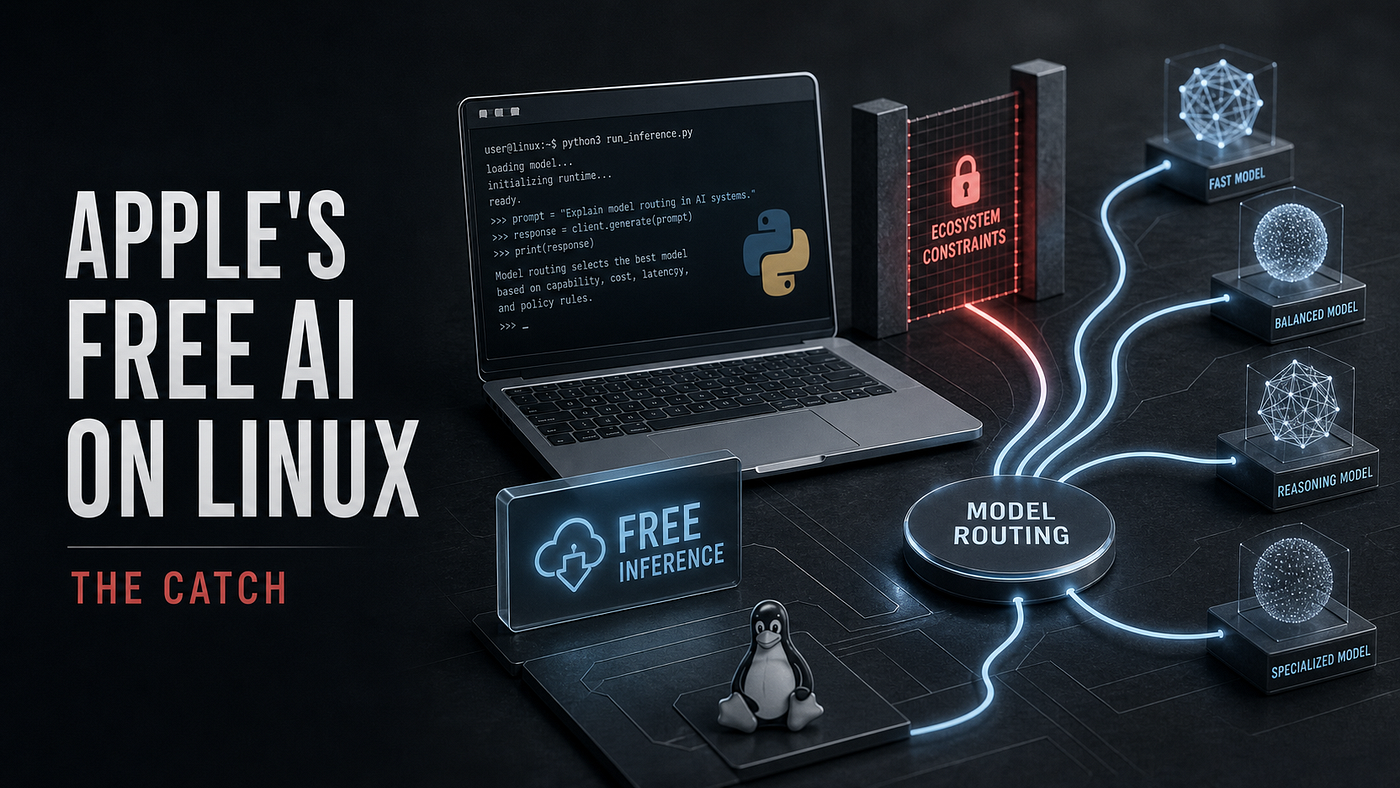
The line that got me out of my chair was buried halfway through a WWDC session transcript: Apple’s Foundation Models framework now has a Python SDK, and it runs on Linux.
I read it twice. Apple. Python. Linux. Those four things have never belonged in the same sentence in my entire career. I’ve spent ten years mostly on the backend — AWS, queues, a couple of Lambda functions I’m still embarrassed about — and Apple has always been the company I bought laptops from, not a vendor I’d put in a build pipeline.
So I cleared my Saturday and decided to actually ship something with it. Not a demo. A thing I’d be willing to run in front of real data. By Sunday night I had a working classifier, a much smaller AWS bill on paper, and a list of complaints long enough that I’m still not sure whether Apple handed me a gift or a very polite trap.
The part that’s genuinely a big deal, and it’s not the model
Let me get the boring framing out of the way, because everyone else already wrote it. Yes, Apple is giving developers free inference. If you’re in the App Store Small Business Program with under two million first-time downloads, you can hit their server models on Private Cloud Compute and pay nothing. The on-device model has always been free because it runs on the user’s phone and costs Apple nothing. Free is free. Fine.
That’s not what made me sit up.
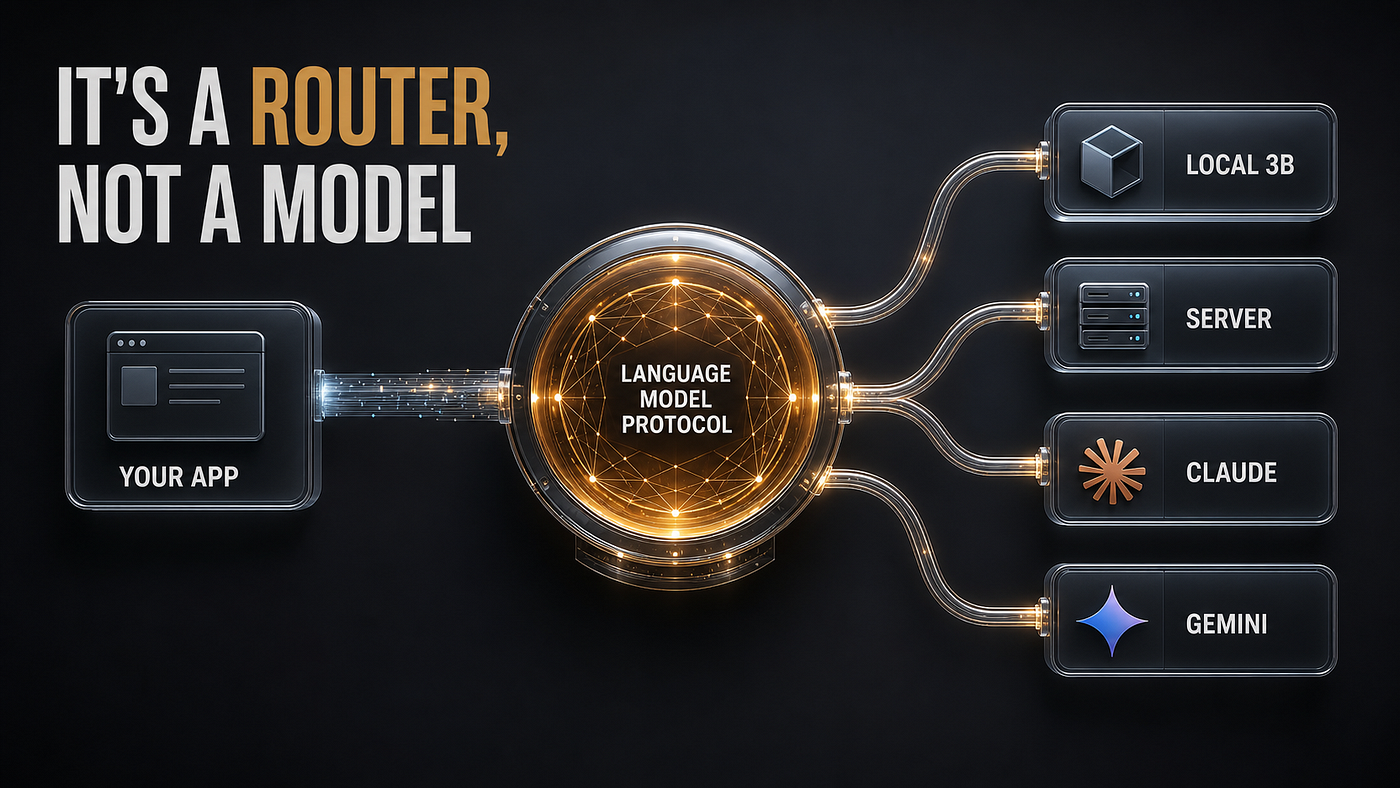
What made me sit up is that Apple shipped a single Swift protocol — and now a Python one — where the model behind it is swappable. The same LanguageModelSession code can point at Apple's on-device 3-billion-parameter model, or at Apple's bigger server model, or at Claude, or at Gemini, through one interface. You change a config, not your app.
I’ve built that abstraction myself. Twice. Badly both times. Every backend team that touches LLMs eventually writes its own little router so they can flip from OpenAI to Anthropic when one of them has a bad latency day or jacks up a price. It’s tedious glue code that nobody wants to own. Apple just shipped it as a first-class protocol and gave it a Python binding that runs on a Linux box that has never seen a single Apple product.
So the headline in my head wasn’t “free AI model.” It was “Apple quietly built the model router I keep rewriting, and they’re not charging for it.” Whether they meant to or not, Apple is positioning itself as a routing layer between your app and whoever’s winning the model race that month. For a backend person that’s a far more interesting move than another 3B model.
I want to be precise about why this matters, because “model abstraction layer” sounds like the kind of thing that excites nobody. The last time I built one of these, it took me about three weeks of evenings. Not because the routing is hard — it isn’t — but because the failure modes are. Each provider returns errors differently. Each one has a different idea of what a “system prompt” is. Each one rate-limits you in its own special dialect. You spend most of your time writing translation code so the rest of your app can pretend all the models are the same. Apple’s protocol does that translation for you, and it does it through a Swift type system that catches half your mistakes before the code even runs. I didn’t appreciate that until I deliberately fed it a malformed request and got a compiler complaint instead of a 3 a.m. production page.
What I actually built, and where it fell apart
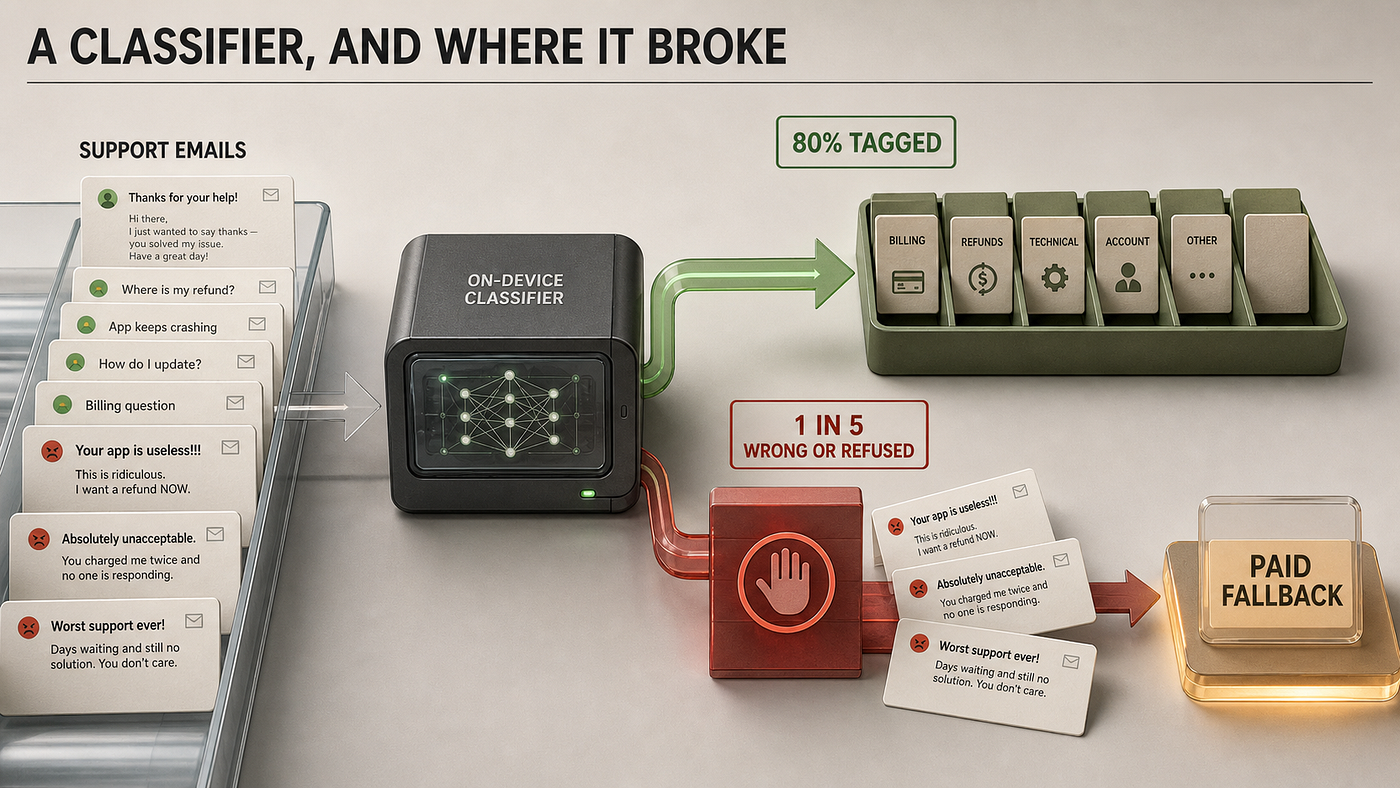
My test wasn’t ambitious. I run a tiny side service that ingests support emails for a hobby project and tags them — billing, bug, feature request, spam, “I forgot my password again.” Today that runs through an API call to a hosted model and costs me real money, a few dollars a month, which is nothing, but it’s the kind of workload Apple’s small on-device model is supposedly built for. Classification. Extraction. Short, structured, boring.
I wrote the prompt in their Xcode Playground first because that’s genuinely the fastest way to feel out the on-device model. Three lines and you’re talking to it. I’ll give Apple that — the developer onramp is smoother than anything Bedrock has ever offered me, and I say that as someone who likes Bedrock.
Then I moved it to the Python SDK on my Mac. Worked. Moved it to a Linux VM. Also worked, which still feels slightly illegal to type. The setup wasn’t frictionless — I burned forty minutes on a dependency mismatch that the docs don’t mention, and the error message was the kind of unhelpful that made me check twice whether I was even supposed to be doing this on Linux. But once it was up, the same code I’d written in the Xcode Playground ran on an Ubuntu box with no Apple anything on it. I sat there for a second genuinely not knowing how to feel about that.
And then I fed it a hundred real support emails and watched roughly a fifth of them come back wrong or refused.
Refused. That’s the word that ruined my afternoon.
The guardrails will fight you over a refund request

Apple’s safety guardrails flag input and output for self-harm, violence, and sexual content. Reasonable on paper. In practice, on a support inbox, they are paranoid to the point of uselessness.
A customer wrote “I’m going to kill this app if it deletes my data one more time.” Flagged. A bug report that said “the export feature is violently broken on iOS” — flagged. Someone described a payment dispute using language that was rude but extremely normal for an angry customer, and the model just declined to classify it.
I don’t have a clean number for the false-positive rate because I stopped counting at twelve out of a hundred, but more than one in ten of my real emails tripped a filter that had nothing to do with anything Apple was actually trying to prevent. There’s no dial to turn it down. You get the guardrails Apple decided you get.
On a backend you build for the angry customer. The angry customer is the entire reason support inboxes exist. A model that refuses to read angry text is a model that refuses to do the one job I gave it. I ended up writing a fallback that catches the refusal and routes those emails to my old hosted model, which means my “free” pipeline now depends on the paid one for exactly the messages that matter most.
There’s a second-order problem here that took me a while to notice. The guardrail doesn’t just refuse — it refuses silently in a way that’s easy to mistake for a low-confidence answer if you’re not watching for it. The first version of my code treated a refusal as an “unknown” tag and quietly dumped those emails into a triage bucket. I only caught it because the triage bucket filled up with exactly the customers I most needed to respond to fast. If I’d shipped that without reading the logs, I’d have built a system that systematically ignores upset people. That’s not a hypothetical bug. That’s the default behavior unless you go looking for it.
Let’s talk about whether “free” actually saved me anything
Here’s the math nobody runs before writing the excited post.
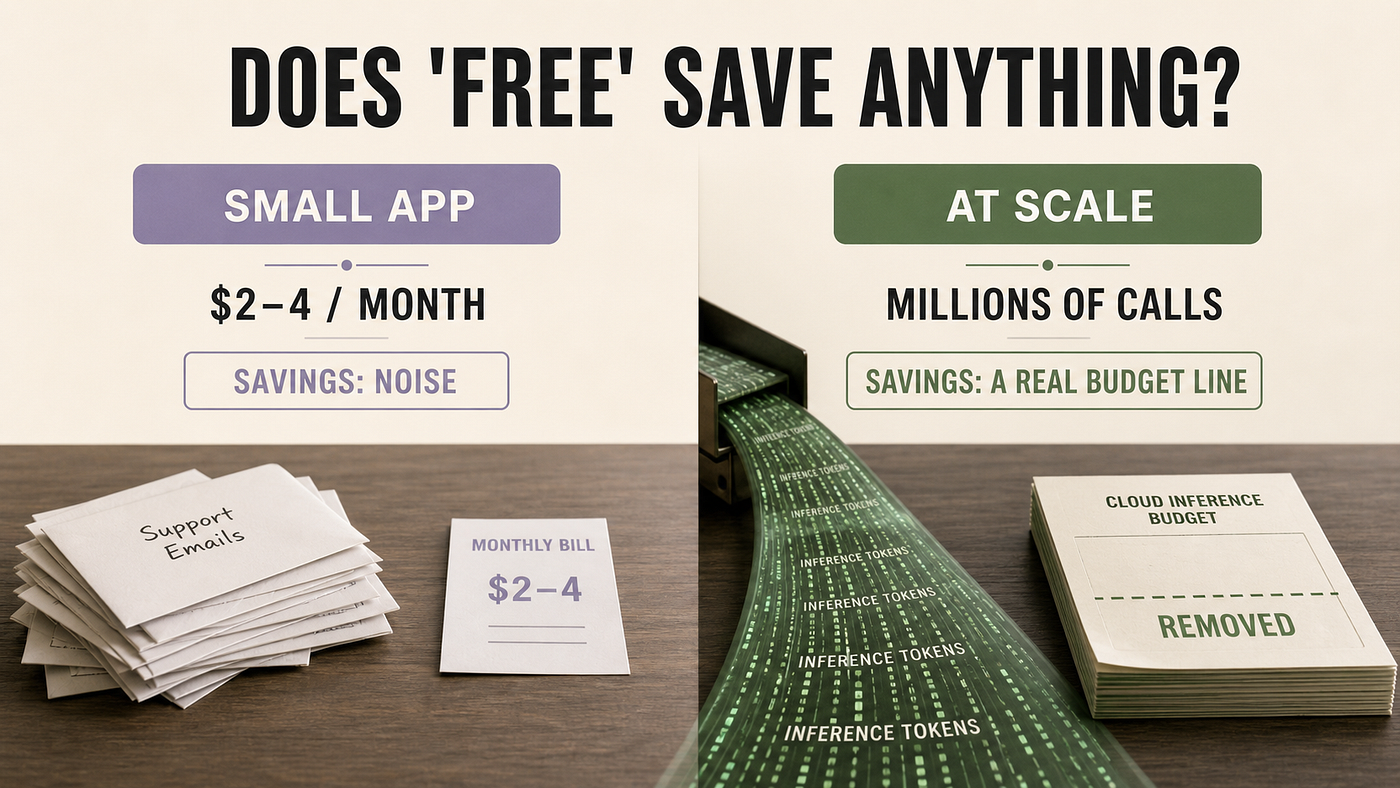
My current hosted-model bill for this classifier is somewhere between two and four dollars a month. It varies with how much the project gets used. That is not a number that keeps me up at night. So the honest question isn’t “did Apple’s free model save me money,” it’s “did the engineering cost of switching exceed the savings,” and the answer is obviously yes, by a wide margin, for a workload this small.
That sounds like a knock on Apple, but it isn’t, because the workloads where this matters aren’t mine. They’re the apps doing millions of classifications a day, where moving the cheap, boring inference onto the user’s own phone takes a real line item off the books and removes a whole category of privacy headaches at the same time. If you’re running summarization at consumer scale, free on-device inference isn’t a rounding error, it’s a budget. For a hobby inbox, it’s a fun weekend and a more complicated pipeline than I started with.
So I’d push back on anyone telling solo developers this changes their cost structure. For most small apps the API bill was already noise. What changed is the ceiling — the apps that couldn’t afford to run AI on every user can now do it for the narrow set of tasks the small model handles. That’s a real shift, just not for the people loudest about it.
The model is not the model you think it is
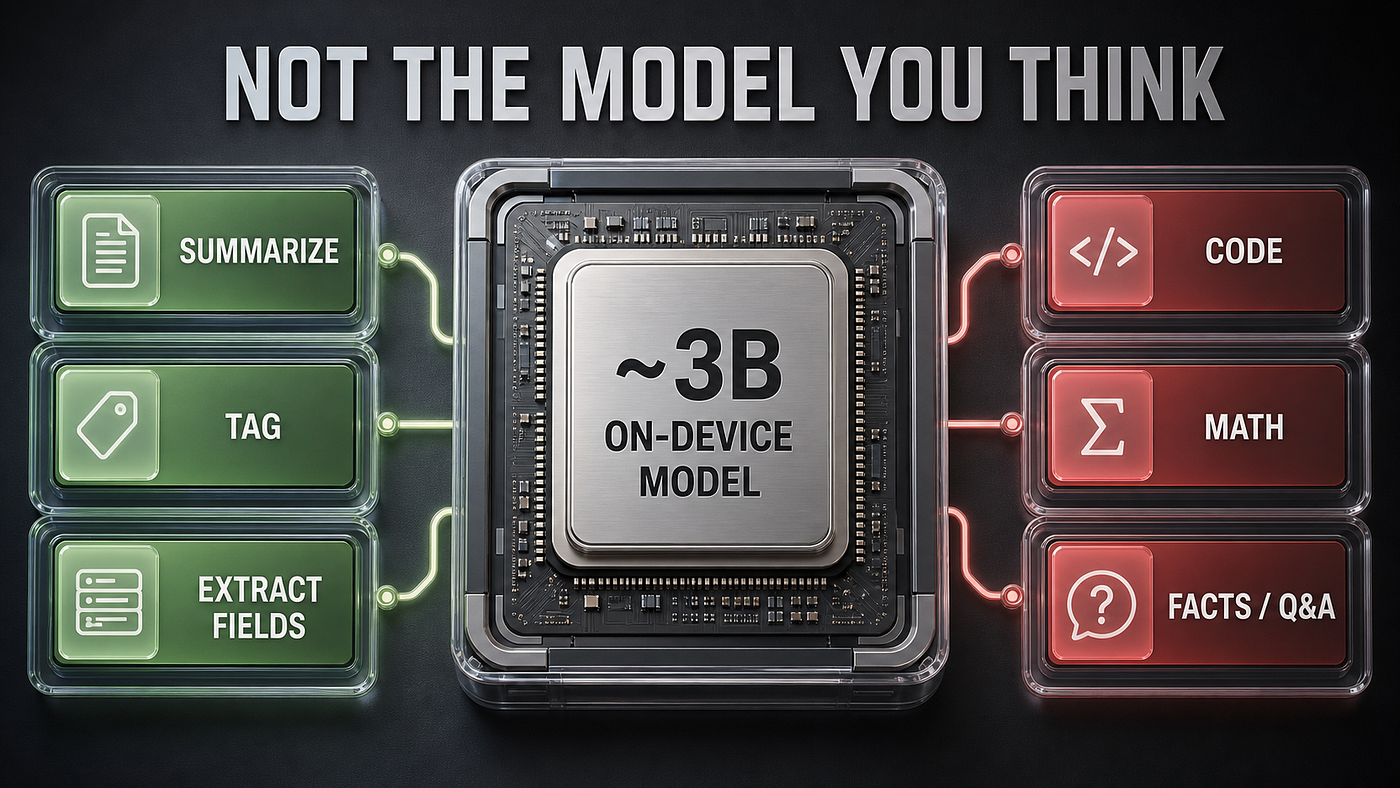
Here’s the thing the “free AI for everyone” posts skate past. Apple’s own documentation tells you, in writing, not to use the on-device model for code generation, for math, or for factual questions. It’s a roughly 3B model tuned for summarizing, tagging, and pulling fields out of text. That’s the whole job description.
And honestly? For that job description it’s fine. When the guardrails didn’t trip, my categorizer was accurate enough that I’d ship it. Summarize a paragraph, extract a date, decide if something is spam — it does that locally, instantly, for nothing, without a single byte leaving the device. That is a real capability and I don’t want to undersell it.
But there’s a gap between “free 3B model that does three boring tasks well” and the way this launch gets talked about, which is closer to “Apple gave every developer free GPT.” Those are not the same product. If you walk in expecting reasoning, world knowledge, or anything resembling a coding assistant, you’ll walk out thinking Apple shipped something broken. They didn’t. They shipped something narrow and were honest about it, and then the internet oversold it on their behalf.
The bigger server model on Private Cloud Compute is more capable, and that’s where the free-tier-under-two-million-downloads thing actually matters. But you don’t control it, you can’t fine-tune it, you can’t bring your own weights, and you’re trusting Apple’s privacy story about Private Cloud Compute completely, because you can’t inspect it. For a lot of apps that trade is fine. For anything where I’m contractually on the hook for where data goes, I’m not signing off on a black box I can’t audit, no matter how good the cryptography white paper reads.
The Linux support is a flex, but I’m not sure who it’s for
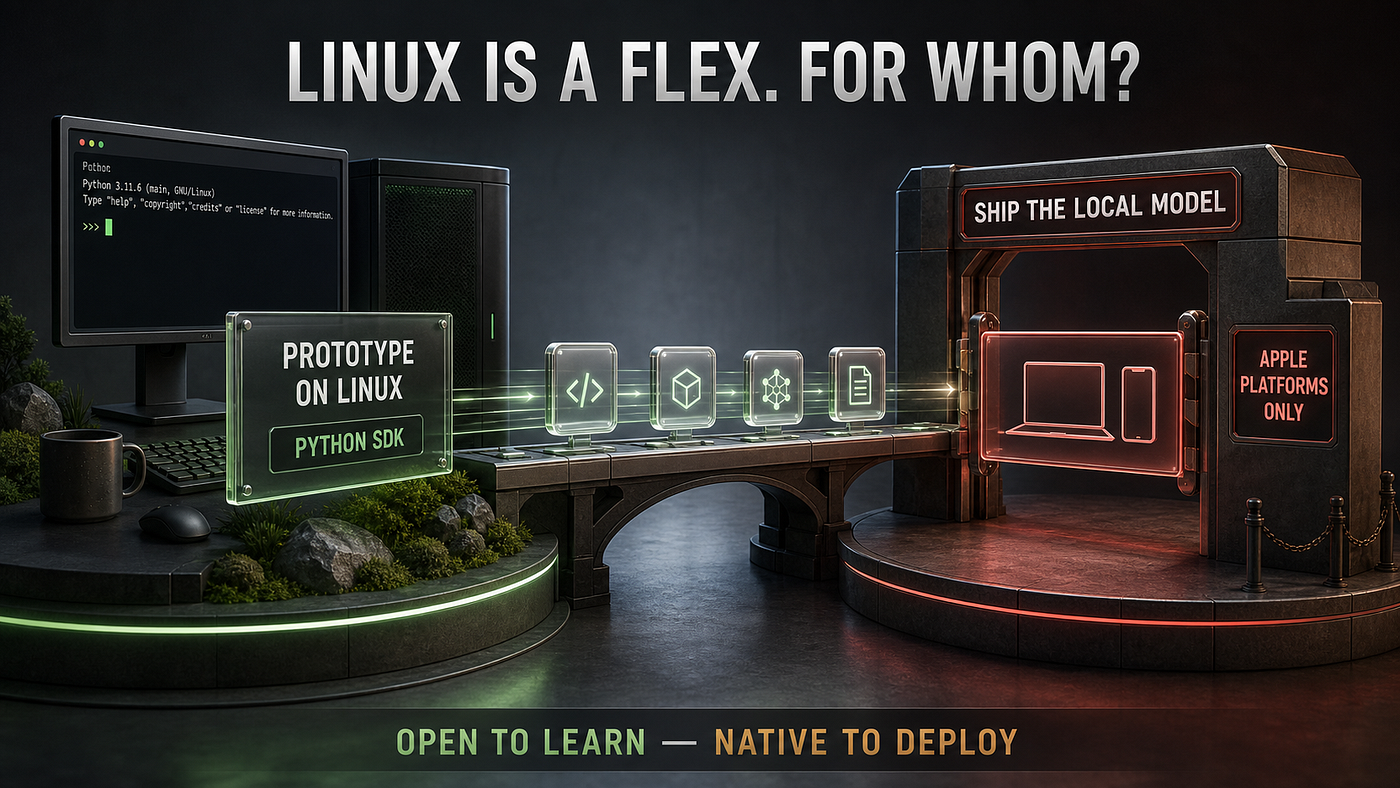
I keep coming back to the Linux thing because it’s the strangest decision in the whole release and nobody can quite explain it.
Apple supporting Linux and Python means a researcher or a backend dev who’s never owned a Mac can now prototype against Apple’s models. That’s genuinely open of them, and out of character. But here’s where it gets weird: you can prototype on Linux, but you can only ship the on-device model on Apple platforms. The phone is where the free local inference lives. So the Linux support is a development convenience, not a deployment path.
I sat with that for a while. The most coherent read I have is that Apple wants their model protocol to become a standard that lives in places Apple hardware doesn’t, the way nobody thinks twice about writing Python against the OpenAI SDK on a Windows machine. Get developers fluent in LanguageModelSession everywhere, and the Apple-only deployment story stops feeling like a cage and starts feeling like the obvious place to ship. It's a platform play wearing the costume of a generosity play.
Maybe I’m being cynical. It wouldn’t be the first time I read strategy into what was really just one team shipping a thing they thought was cool. But Apple doesn’t do “we thought it was cool.” Everything they ship is a position.
And there’s a precedent that makes me trust the cynical read. Apple has done the open-source-protocol-as-leverage move before, with mixed honesty. Swift itself went open and cross-platform years ago, and on paper you can write Swift on Linux today. In practice almost nobody ships server-side Swift, because the gravity always pulls back toward the Apple-native tooling where the experience is actually good. I’d bet the model protocol follows the same arc. Open enough to win mindshare, native enough that you eventually stop fighting it and just buy the Mac. I’ve watched that movie. I know how it ends, because I’m typing this on the Mac it ended with.
So is the catch real, or am I just grumpy
Both, probably.
The catch is real in the sense that “free AI model” describes maybe ten percent of what’s going on, and the part that’s actually free is a small model with hard limits and aggressive guardrails that will reject your angriest, most important inputs. If you build a business on the on-device model expecting it to grow into something it was explicitly never designed to be, that’s on you, but the marketing energy around this release is actively encouraging that mistake.
The catch is also kind of overblown, because what Apple really shipped — a free, swappable model protocol with a Python binding that runs on Linux — is more useful to me than any single model would have been. I rewrite that router every couple of years. I’d rather not. If Apple maintains this protocol and keeps the provider list current, I’d consider using it even in places that have nothing to do with iPhones, purely so I never have to own model-routing glue code again.
That’s the part I didn’t expect to write when I started this weekend. I went in to test a free model and came out more interested in Apple’s plumbing than Apple’s model. The model is a footnote. The protocol is the product, and I don’t think Apple is being loud about that on purpose.
By Sunday night my classifier was running on a Linux VM, falling back to a paid model for the angry emails, tagging the calm ones for free, and I was sitting there trying to decide if I’d just been onboarded into Apple’s ecosystem through the one door I’d never have walked through willingly. The answer is probably yes. The annoying thing is that I don’t fully mind.
Continue reading
If this was useful, here are a few related pieces I’ve written:
I Use 5 AI Tools Every Day. Here’s Exactly What Each One Does for Me.
The Ultimate Toolbox: Best New Apps and Tools for Software Engineers on Mac (2026 Edition)
Most People Are Using AI to Get More Done. That’s Exactly Why They’re Getting Less Productive.
메타데이터
- post_id
- 3745a6cc0b86
- slug
- apple-put-its-ai-on-linux-and-made-it-free-i-spent-the-weekend-finding-the-catch-3745a6cc0b86
- url
- https://medium.com/macoclock/apple-put-its-ai-on-linux-and-made-it-free-i-spent-the-weekend-finding-the-catch-3745a6cc0b86
- canonical_url
- https://medium.com/macoclock/apple-put-its-ai-on-linux-and-made-it-free-i-spent-the-weekend-finding-the-catch-3745a6cc0b86
- author_url
- https://medium.com/@lenner9090
- status
- ok
- fetched_at
- 2026-06-20 20:29:01