Operating Systems
Part 1: Introduction
In this series of narratives, my intention is to explore the fundamental components of operating systems and their practical implementations.

Components of Operating Systems
- **Process Management**: Process management is the orchestration of running multiple processes within an operating system. It involves tasks such as process creation, deletion, suspension, and resumption. Additionally, it encompasses resource allocation and mechanisms for inter-process communication.
- **Memory Management**: Memory management is pivotal in ensuring efficient utilization of computer memory. It includes loading programs into main memory, allocating memory space to processes, and managing virtual memory to augment available memory for processes.
- **I/O Management**: I/O management facilitates communication between the computer and external devices. It encompasses tasks such as disk management, storage allocation, and maintaining a convenient interface between software and I/O devices.
- **File Management**: File management involves organizing and manipulating files stored in secondary storage. It includes creating, deleting, and backing up files, as well as mapping files onto storage media and directories.
- Protection System: The protection system safeguards data and system integrity by controlling access to resources through authentication mechanisms, file permissions, and encryption. It ensures security in networked environments and concurrent execution scenarios.
- **Networking Management**: In networked or distributed architectures, operating systems function as network resource managers. They handle communication between computers, addressing routing strategies, network security, and other networking concerns.
- Command Interpreter: The command interpreter serves as the interface between users and the operating system, executing user commands. It allows for flexibility in interface customization and enhances system security by running separately from the kernel.
Each of these components plays a crucial role in the smooth operation and efficiency of an operating system, contributing to its overall functionality and user experience.
Operating System Services:
An Operating System (OS) provides crucial services to both users and programs, facilitating efficient execution and management of tasks. Here’s an in-depth look at these services:
1. Program Execution:
- The OS manages diverse activities, ranging from user applications to system utilities like printer spoolers and file servers, encapsulating each as a process.
- Processes encompass the entire execution context, including code, data, registers, and OS resources in use.
- Major OS activities regarding program management include loading programs into memory, executing them, handling their execution, and providing mechanisms for process synchronization, communication, and deadlock handling.
2. I/O Operations:
- The I/O subsystem consists of I/O devices and corresponding drivers, with the OS mediating communication between users and drivers.
- I/O operations encompass read/write operations with files or specific devices, with the OS providing access to required I/O devices.
3. File System Manipulations:
- Files store related information on secondary storage, organized into directories for efficient usage.
- OS activities related to file management include facilitating read/write operations, managing permissions, enabling file and directory creation/deletion, and providing interfaces for file system backup.
4. Communications:
- In multitasking environments, the OS facilitates communication between various processes through shared memory or message passing.
- Processes are organized hierarchically, with the OS managing routing, connection strategies, contention, and security.
5. Error Detection & Recovery:
- The OS monitors system health, detecting and addressing hardware issues such as bad sectors, memory overflow, and I/O device errors to ensure consistent computing.
- This service is critical and cannot be handled by user programs due to its complexity and impact on system stability.
6. Resource Allocation:
- In multitasking environments, the OS allocates essential resources (e.g., CPU, memory, storage) to processes using various algorithms such as process scheduling and disk scheduling.
- Effective resource management ensures optimal system performance and utilization.
7. Accounting:
- The OS tracks resource usage by processes and users, enhancing system performance by allocating resources efficiently and ensuring fair access to all processes.
8. System Protection:
- With multiple users and concurrent processes, the OS implements mechanisms to protect processes from unauthorized access and interference.
- Protection mechanisms control access to system resources, prevent invalid access attempts to external I/O devices, and provide user authentication features.
9. System Calls:
- System calls serve as essential interfaces between user programs and the OS, enabling access to OS services and functionalities.
- System calls are categorized into different types:
a. Process Control
b. File Management
c. Device Management
d. Information Management
e. Communication
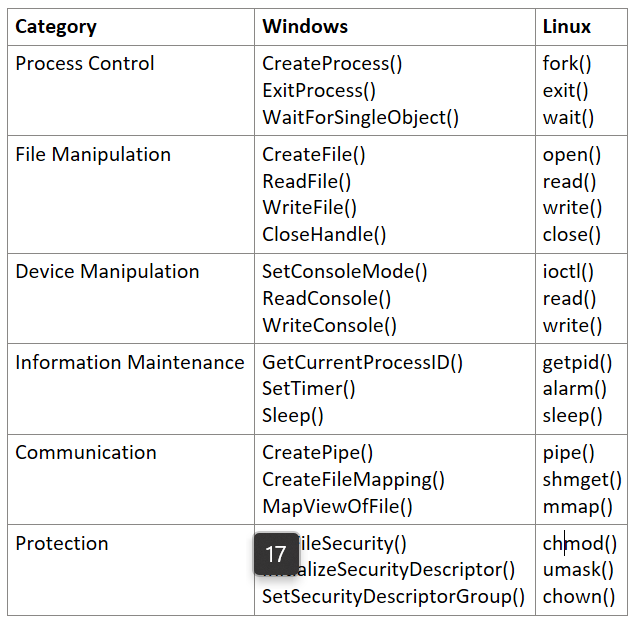
System Call Example
- System call execution involves several steps, including parameter passing, invocation, kernel trapping, dispatching, and handling return status and values.
System Call Execution Flow:
- When a program needs OS services, it invokes system calls.
- System calls are executed through a series of steps:
- Parameters are pushed onto the stack.
- The system call is invoked.
- The system call code is placed in a register.
- A trap to the kernel is initiated.
- The kernel dispatches the intended system call.
- Return status and values are handled.
For example, invoking a system call involves pushing parameters onto the stack, invoking the system call, placing the system call code in a register, trapping to the kernel, dispatching the intended system call, and handling return status and values.
By providing these services and managing the flow of system calls, the OS plays a crucial role in facilitating efficient and secure operation of computer systems, ensuring smooth interaction between users, programs, and hardware resources.
In the next segment, we’ll delve into how the operating system handles processes, including their management and communication methods such as Inter-Process Communication (IPC), semaphores, and more.
Part — 2: Process Management Part — 3: Memory Management Part — 4: Network Management Part — 5: Disk/File Management Part — 6: I/O Management
메타데이터
- post_id
- 37659c19aefc
- slug
- in-this-series-of-narratives-my-intention-is-to-explore-the-fundamental-components-of-operating-37659c19aefc
- url
- https://medium.com/@Kannan91/in-this-series-of-narratives-my-intention-is-to-explore-the-fundamental-components-of-operating-37659c19aefc
- canonical_url
- https://medium.com/@Kannan91/in-this-series-of-narratives-my-intention-is-to-explore-the-fundamental-components-of-operating-37659c19aefc
- author_url
- https://medium.com/@Kannan91
- status
- ok
- fetched_at
- 2026-06-27 23:56:40