Rarest elements reveal planets eaten by white dwarfs
Despite their rarity, boron and beryllium can both be detected within white dwarf atmospheres. What does their presence and abundance…

Despite the fact that white dwarfs are the final remnants of Sun-like stars after the end of the red giant phase, planets are known to be able to persist around them. When planets or other massive, heavy element-rich bodies encounter a white dwarf, their chemical elements can get deposited onto the white dwarf’s outer layers, and absorption spectroscopy can then reveal their presence. (Credit: International Gemini Observatory/NOIRLab/NSF/AURA/UCL/University of Warwick/University of Sheffield/Mark Garlick)
Rarest elements reveal planets eaten by white dwarfs
Despite their rarity, boron and beryllium can both be detected within white dwarf atmospheres. What does their presence and abundance imply?
Quick take:
- Probing the absorption lines on a star or stellar remnant can often reveal the composition of the object’s outer layers, but recently devoured material can alter and add to those imprints.
- Many elements are seen on stars and white dwarfs, including the extremely rare elements lithium, beryllium, and boron, where beryllium and boron normally have a specific ratio and are only produced by cosmic spallation.
- In a surprise, elements beryllium and boron were discovered in the atmospheres of white dwarf stars, in abundances greatly enhanced from the cosmic average and with ratios that also differ from the cosmic average. Could a devoured planet be to blame?
All across the Universe, we can learn what stars are made of simply by taking a spectrum of the light coming from them. While some stars are low in what astronomers call metallicity — the fraction of elements that are heavier than hydrogen and helium — and others have high metallicities, the ratios of the heavy elements inside of them are normally fairly consistent. Oxygen is the third most abundant element in the Universe; carbon is fourth, followed by neon, nitrogen, magnesium, silicon, iron, and sulfur rounding out the top 10. By measuring the strength of the absorption lines coming from these elements, we can determine their abundances: relative to hydrogen and relative to each other.
This is true for stars like our Sun, and it’s also true for the remnants of stars like our Sun: white dwarf stars. Every once in a while, however, a star or stellar remnant will encounter an object — a planet, moon, asteroid, or comet — and devour it. When it does, the elements from that object get smeared out across the surface of that stellar object, and greatly enhance the observed abundance of what are normally relatively rare elements for a star.
Although the rarest elements of all are the heaviest ones, there are two very light elements, beryllium and boron, that are also incredibly rare. Just a few years ago, the first hint of beryllium, ever, was found in a white dwarf star. It may provide evidence for a devoured planet around a white dwarf star, and boron and beryllium in general may hold tremendous implications in the search for recently devoured objects. Here’s the science of how.
The elements of the periodic table, and where they originate, are detailed in this image above. While most elements originate primarily in supernovae or merging neutron stars, many vitally important elements are created, in part or even mostly, in planetary nebulae, which do not arise from the first generation of stars. Beryllium, boron, and some lithium are primarily created through a process known as spallation: when cosmic rays strike and split apart heavier atomic nuclei. (Credit: NASA/CXC/SAO/K. Divona)
For most of the chemical elements — or species of atom — in our Universe, stars are the key to making them. After the Big Bang, the Universe was made of about 75% hydrogen and 25% helium, with just a tiny amount (about 0.0000001%) of lithium. No other stable heavy elements were made in any appreciable abundance. Once stars begin to form, heavier elements start to emerge. Stars begin by fusing hydrogen into helium, but the more massive ones move on to fuse:
- helium into carbon,
- carbon into neon,
- neon into oxygen,
and on up to make magnesium, silicon, sulfur, iron, and more. Other, often heavier elements are created in various ways, including in evolved, giant stars that create neutrons that can be captured by various nuclei, by core-collapse supernova explosions, from exploding white dwarfs, and from colliding neutron stars.
However, those processes — with the exception of certain radioactive decays that result in the aftermath of heavy element creation — only allow you to climb up the periodic table in terms of the elements. Because there was a gap between helium and carbon, skipping over lithium, beryllium, and boron, there’s no good way to hop back down to those elements that nature missed. There was a little bit of lithium made in the Big Bang, but practically negligible amounts of beryllium and boron. Fortunately, nature has a way to fill in that gap, at least a little bit.
The relative abundances of elements in the Solar System has been measured overall, with hydrogen and helium the most abundant elements, followed by oxygen, carbon, and numerous other elements. However, the compositions of the densest bodies, like the terrestrial planets, are skewed to be a vastly different subset of these elements. Beryllium’s and boron’s abundances are heavily suppressed relative to the adjacent elements, as they are only produced when cosmic rays strike an atomic nucleus: the process of spallation. (Credit: 28bytes/English Wikipedia)
The way we make practically all of the beryllium and boron (and a substantial fraction of the lithium) in the Universe is instead by a completely different process: spallation. Once heavy elements are produced in the Universe, there’s always a chance that an energetic cosmic ray — a fast-moving particle — will strike one of those heavy atomic nuclei. Whenever that occurs, those heavier nuclei can be split apart, generating a wide array of lighter, daughter nuclei, including those key atomic nuclei that nature largely missed: lithium, beryllium, and boron.
Beryllium is one of the most difficult elements to make, where hydrogen atoms are approximately 100 billion times more abundant than beryllium atoms in our Universe today. Boron remains rare as well: approximately 30 times more abundant than beryllium, but around a million times less abundant than the next atoms up in the periodic table: carbon, nitrogen, and oxygen.
Once those elements are created, they can get incorporated into the next generation of stars and planets: appearing in a star’s spectrum, but appearing more abundantly in the rocky planets, asteroids, and other solid bodies than the stars, as the lack of huge amounts of hydrogen and helium allows even these rare elements to appear with larger relative ratios.
The visible light spectrum of the Sun, which helps us understand not only its temperature and ionization, but the abundances of the elements present. The long, thick lines are hydrogen and helium, but every other line is from a heavy element that must have been created in a previous-generation star, rather than the hot Big Bang. (Credit: N.A.Sharp, NOAO/NSO/Kitt Peak FTS/AURA/NSF)
When we look at our Sun, we can break its light up into a spectrum: where we separate that light out continuously as a function of its wavelength. Because each individual element has its own atomic spectrum — a set of wavelengths where it will absorb light as its electrons get excited to higher energy levels — we can measure the presence and abundance of the elements present in the Sun. To no one’s surprise, even though it’s a hundred billion times less abundant than hydrogen, we actually have detected beryllium in the Sun. Boron, which is about 20 times more abundant in the Sun than beryllium, also appears.
While we can take spectra for other stars and stellar remnants as well, detecting elements as rare as boron and beryllium are challenging, especially for white dwarfs. In fact, the first detection of beryllium in a white dwarf only happened recently: it was announced back in 2021, for two white dwarfs, GALEX J2339 and GD 378. Because white dwarfs are:
- formed from the contracted cores of dead, Sun-like stars,
- incredibly massive, compact, high gravity environments,
- and are made out of a variety of elements,
it only takes a short period of time — a few million years at most — for the heavier elements to sink to the interior of a white dwarf, leaving only the lightest elements, hydrogen and helium, on their exterior surfaces.
This illustration shows a star, an orbiting exoplanet, and a cloud (or tail) of debris that emanates off of the exoplanet and obscures a fraction of the parent star’s light. At close enough distances and hot enough temperatures, it won’t just be an exoatmosphere that gets vaporized and turned into a tail, but the planet’s surface, interior, mantle, and even core can disintegrate and vaporize as well. Around a white dwarf star, various layers can be boiled off and deposited onto the white dwarf’s surface, where the evidence of having eaten the planet (or part of it) will appear in the white dwarf’s absorption spectrum. (Credit: NASA, ESA and D. Player (STScI))
Therefore, if you find elements heavier than helium — not just beryllium and boron but also things like oxygen, silicon, aluminum, magnesium, calcium, etc. — in your white dwarf’s spectrum, it’s strong, indirect evidence that some form of matter has only recently been devoured by that white dwarf. It could be a planet, moon, asteroid, comet, planetesimal, or even potentially just the fragments of a massive world, such as a crust or crust and mantle.
In fact, the very first isolated white dwarf ever discovered was van Maanen 2, found way back in 1917 and located just 14.1 light-years away. (Sirius B and Procyon B, white dwarfs orbiting relatively bright, nearby stars, are the only two that are closer.) When we take a spectrum of van Maanen 2, we don’t just find hydrogen and helium in its stellar spectrum, but also absorption lines that reveal the presence of calcium. In fact, the evidence for calcium absorption shows up in van Maanen’s original 1917 spectrum as well! Even though the puzzle pieces from that historical observation weren’t put together until almost 100 years later, demonstrating that van Maanen’s observations actually provided the first astrophysical evidence for an extra-solar planetary system.
(And yes, if you’re wondering, this is the same van Maanen who provided now-spurious evidence for observing rotation in a distant spiral galaxy: a key fact used in the Shapley-Curtis “Great Debate” of 1920!)
The more massive a white dwarf is, the smaller in radius it gets. The largest white dwarfs are the lowest in mass, and are only slightly smaller than a planet like Uranus or Neptune. The smallest white dwarf ever discovered, however, is comparable in size only to the Moon, very close to the maximum mass threshold for such an object. The outermost layers of a white dwarf are generally composed of hydrogen and helium, unless another object has been recently devoured. (Credit: Giuseppe Parisi)
Over the remainder of the 20th and the start of the 21st centuries, many heavy elements have been found to indicate the presence of recently devoured matter around white dwarf stars. They include iron, magnesium, sodium, silicon, chromium, aluminum, potassium, phosphorous, and even elements with much lower natural abundances. However, the 2021 detection of beryllium was unusual not just because beryllium is so cosmically rare, but because the observations indicated that the beryllium-to-hydrogen ratio in the white dwarfs where they were detected was more like 1-to-500-million, not 1-to-100-billion like we find in the Sun.
Somehow, something must have greatly enhanced the beryllium abundance around these white dwarfs, and by a severe amount: about a factor of 200.
Meanwhile, at the 248th meeting at the American Astronomical Society on June 15th, 2026, UCLA Professor Ben Zuckerman presented the first evidence for the detection of boron in a white dwarf: one of the same white dwarfs that was observed to have beryllium in its spectrum back in 2021. While the beryllium abundance was enhanced by a factor of 200 over its typical value, the boron abundance was also enhanced, but only by a factor of about 10. This means that boron and beryllium appear in this white dwarf’s atmosphere with about the same abundance as each other, while in most places, they differ by a factor of 15-to-30. (With boron being more abundant.)
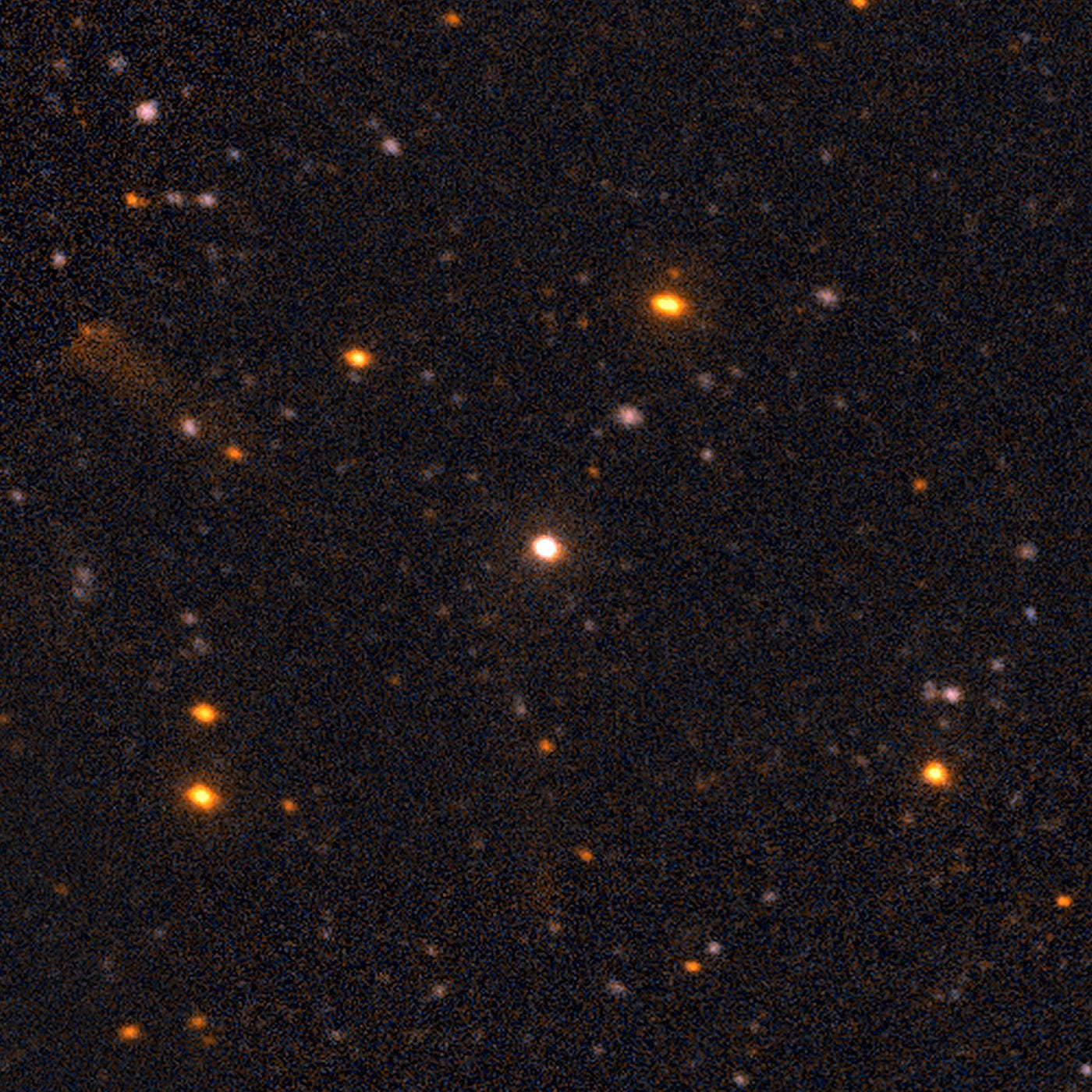
This image shows the deep space object GALEX J2339–0424, originally misidentified as a quasar and now known to be a heavy-element-rich white dwarf. This object was the first white dwarf to have its beryllium signature detected, in 2021, and was later joined by a (still unpublished) detection of boron within it as well. The heavy elements provide evidence for a recently devoured planet, as most white dwarfs don’t display any elements heavier than helium at all. (Credit: NASA/JPL-Caltech GALEX)
First off, the presence of these heavy elements — even though beryllium and boron are some of the lightest “heavy elements” to an astronomer — does indeed provide excellent evidence that some sort of planetary body was indeed devoured by these white dwarf stars, and recently: within the past 3 million years, but also at least 100+ years ago. (If it had been devoured longer ago, the heavy elements would have sunk beneath the white dwarf’s surface, and would now be invisible.) So when you see these heavy elements of any type within a white dwarf, it provides strong evidence not only for recent activity of having eaten something major, but having done so recently.
This also implies that there is still at least a remnant planetary system of some type persisting around these white dwarfs, as a substantial source of material is required (e.g., much bigger than a standard comet, although a giant one, like an analogue of Bernardinelli-Bernstein, could potentially do the job) to create a signal of this magnitude. We know, from missions like Kepler and TESS, that exoplanet systems are common around stars here in our Milky Way, and we can also learn — from absorption line spectroscopy around white dwarfs — that exoplanet systems are also common around stellar remnants. It’s a remarkable find.
This spectrum of white dwarf GALEXJ2339, acquired from the Keck/HIRES telescope/instrument, shows the signs of singly-ionized beryllium: the first detection of beryllium in a white dwarf ever. The interpretation is that this must be a recently devoured planet or planetary body, but with a greatly enhanced Be abundance over the cosmic average. (Credit: B.L. Klein et al., Astrophysical Journal, 2021)
Furthermore, these new studies here in the 2020s show that even the rarest of the light elements on the periodic table, beryllium and boron, can be used to reveal the presence of exoplanetary systems around white dwarfs. Even though white dwarf spectroscopy is a scientific field that dates back over 100 years, the first detections of beryllium and boron in a white dwarf’s atmosphere only arrived this decade: a remarkable showcase of how active this field still is, and how superior observations — including state-of-the-art facilities, observatories, and instruments — enable new discoveries that weren’t possible with earlier technology.
And, perhaps most importantly, the discovery also raises a mystery: what could possibly be responsible for the wildly enhanced abundance of beryllium, but also a much lower enhanced abundance of boron?
There are some options, of course. Beryllium abundances are enhanced in planetary bodies in our Solar System: the Earth, the Moon, asteroids-and-meteorites, and potentially in several of the moons that orbit the gas giant planets. However, boron remains abundant in most of these objects as well, with the boron-to-beryllium ratio typically sitting at around 15-to-1 or more.
The Earth, beneath its thin atmosphere and oceans, transitions from primarily rocky material to a metallic core once you go about 45% of the way down. Elemental compositions change as you go through various layers of the Earth, with lighter elements generally overrepresented in the outermost layers. With core pressures exceeding 3.6 million atmospheres, the atoms in the core are compressed to a fraction of their original size, explaining Earth’s uncharacteristically high density. Recent evidence indicates an innermost core inside the inner core, where a different solid phase of metals exists than in the rest of the inner core. (Credit: USGS)
In a large, massive planet like Earth, however, elemental abundances change with the various layers of our planet. The Earth’s core, for example, is dominated by heavier metallic elements. The mantle consists of lighter elements that appear earlier on the periodic table, on average. And the Earth’s crust is dominated by oxygen, silicon, and aluminum, in that order: a bit of a surprise, as the crust’s aluminum abundance is greatly enhanced in comparison to its cosmic abundance.
Earth’s crust also had a severe enhancement of both beryllium (objectively) and the boron-to-beryllium ratio (relatively), where the latter is only something like 2-to-1 or 3-to-1, as compared with the more standard 15-to-1, 20-to-1, or 30-to-1 found overall.
Therefore, one can’t help but wonder whether something that could have separated a planetary body’s outer layers from its inner layers — like a collision that kicked up large amounts of material from the crust or crust-and-mantle alone — couldn’t have fed material with a biased abundance of elements to these white dwarf stars. Of course, there are issues with that scenario, too: the lack of elements like aluminum, for instance, which is normally greatly enhanced in the crusts of rocky planets, including the Earth.
This cutaway shows the densities and compositions of solid worlds within the Solar System. Mercury has by far the largest metallic core relative to its size, and is made up of the densest elements of any of these worlds, as all of its crust and an estimated 85% of its mantle was boiled/sublimated away in the early stages of our Solar System. (Credit: Bruce Murray/The Planetary Society)
Other options abound, of course, as astronomers are creative types when it comes to seeking an explanation to unexpected observations.
- There could have been a large amount of “cosmic spall” directly around the white dwarf, directly enhancing its atmosphere with the lightest of the heavy elements.
- There could have been an enriched moon of a planet — one potentially formed from an earlier impact itself — that became unbounded from the planet itself, and was swallowed by the white dwarf.
- It could have come from a planet close to the white dwarf that had its crust and mantle boiled away, similar to how Mercury’s crust and most of its mantle were boiled away early on in the Solar System’s history.
- Or, perhaps, it was simply a devoured, rocky planetary body that occurred more than 1 million years ago: where most of the heavier elements (and likely some of the boron, too) have already sunk into the white dwarf’s interior, leaving only the “lightest” heavy elements behind.
All of these scenarios are speculative, and all of them have aspects to which one could easily object. As with most things in science, new discoveries don’t just provide answers and clues to our prior questions, but they often raise new questions too: questions that we didn’t know we needed to ask until we made the latest discovery.
Still, we now know that the lightest, rarest elements of all can reveal planets that were recently devoured by their parent star, including by white dwarf stars, and that includes both beryllium and boron. Explaining why they appear in the ratios that they’ve been spotted in, however, is a question that will fall to future researchers — likely armed with new, superior data — to deliver a definitive answer to.
*Starts With A Bang is written by Ethan Siegel, Ph.D., author of (affiliate links following) Beyond The Galaxy, Treknology, [The Littlest Girl Goes Inside An Atom](https://amzn.to/44FQQOl), and [Infinite Cosmos](https://amzn.to/3zEUHjX). His latest, The Grand Cosmic Story, is out now!*
메타데이터
- post_id
- 378ec8782c3f
- slug
- rarest-elements-reveal-planets-eaten-by-white-dwarfs-378ec8782c3f
- url
- https://medium.com/starts-with-a-bang/rarest-elements-reveal-planets-eaten-by-white-dwarfs-378ec8782c3f
- canonical_url
- https://medium.com/starts-with-a-bang/rarest-elements-reveal-planets-eaten-by-white-dwarfs-378ec8782c3f
- author_url
- https://medium.com/@startswithabang
- status
- ok
- fetched_at
- 2026-06-29 22:44:20