The Swift Motif in Derek Walcott’s Omeros
Derek Walcott, Omeros,1990.
The Swift Motif in Derek Walcott’s Omeros
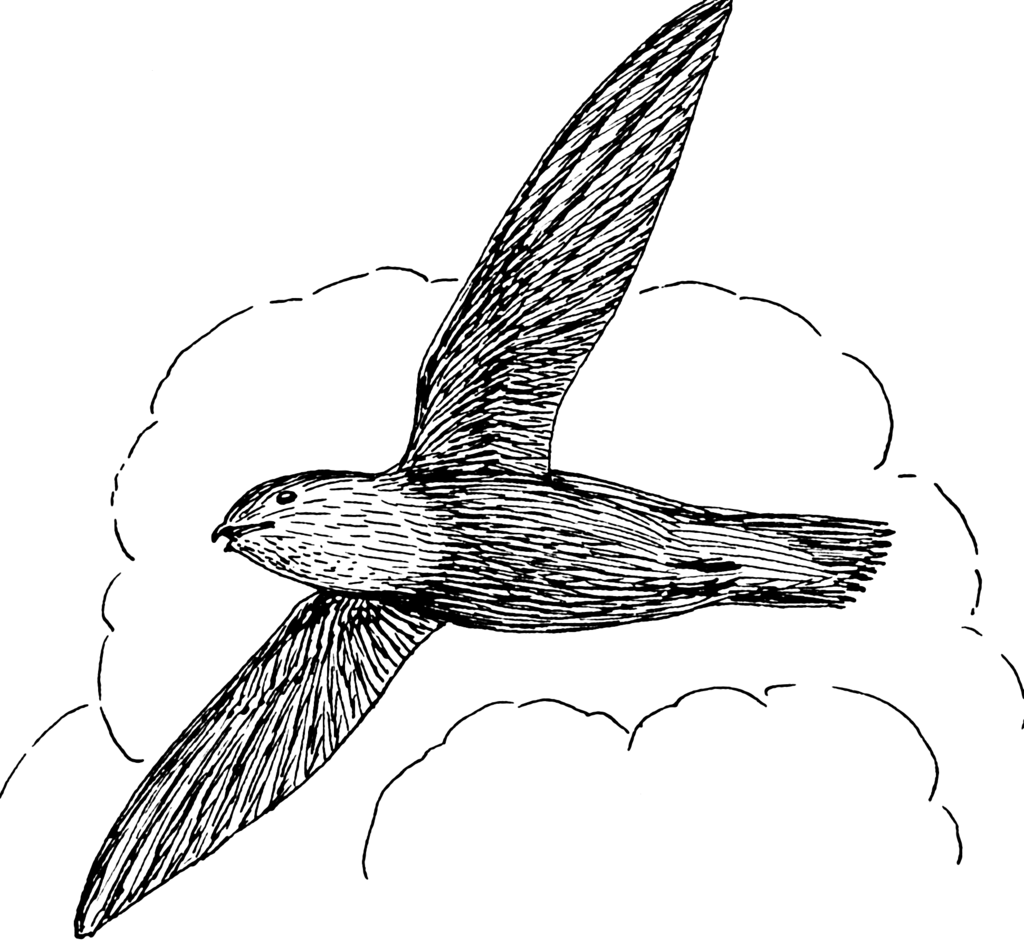
Sketch by Pearson Scott Foresman, Wikipedia Commons, Public Domain
Derek Walcott, Omeros,1990.
Omeros is an epic book length poem by the late Derek Walcott, 1992 recipient of the Nobel Prize in Literature. It can be read and appreciated on my levels. One is as an emotionally moving confessional. For example, the narrator, quite obviously Walcott’s alter ego, recollects conversations with his dying mother, and his attempts to communicate with his (now) dead father. And the narrator/Walcott makes himself very vulnerable, struggling for example with feeling like a hypocrite as he drives by a new hotel, for wanting
the poor to stay in the same light so that I could transfix them in amber [in his poems], the afterglow of an empire, preferring a shed of palm-thatch with tilted sticks to that blue bus-stop? [Chapter XLV, Part II]
But the poem is also a collection of intertwining epic narratives, spanning numerous epochs and places around the globe. And all of these narratives are woven together with recurring themes and motifs. What I want to highlight in this article is Walcott’s use of the motif, The Swift.
The term ‘swift’ or one of its variants is sometimes used in the poem as a noun (a bird or a moth or symbolically as a sign of the cross), and other times as an adjective or an adverb (swiftly). Used poetically, its intended meaning is often ambiguous or a possible pun, as in
[Achille] made a swift sign of the cross.
The use of the swift symbol starts early in the poem in Chapter I when Achille
saw the swift crossing the cloud-surf, a small thing, far from its home
and continues right into the last chapter where
riding these last worried lines; its rhythm agrees that all it forgot a swift made it remember.
The swift symbol connects the narrator’s identity in The New World to Africa and helps heal some of the pain left over from slavery.
In Chapter IV, Philoctete limps down an abandoned road towards his yam garden,
past huge rusted caldrens, vats for boiling sugar … the only ruins left here by history.
He screams in pain and curses the yams. Later he looks up and sees
‘ branch where a swift settled without a cry.’ The sea-swift watched him and then ‘twittered seaward.’
Later in Chapter XXIV, Achille, dealing with the pain of realizing he has lost Helen, is
lured by the swift out to sea, towards Africa [and] felt he was heading home.
While in Africa, God tells Achille,
Is I send the sea-swift as a pilot, the swift whose wings is the sign of my crucifixion . … And Achille felt the homesick shame and pain of his Africa.
In Chapter XLVII we learn that it was a swift flying from Africa to the New World centuries ago that carried the seed, in its stomach, that sprouted after the bird died to form a vine whose flower provides “the cure that precedes every wound.”
Finally, the swift is a symbol for the narrator of the poem, Walcott’s alter-ego. In an imagined conversation that takes place in Chapter XXXVI, the narrator’s dead father implores the son to travel the world to see
those streets whose History had made great. … Once you have seen everything and gone everywhere, cherish our island…
Then continuing somewhat enigmatically, the father tells the son,
The sea-swift vanishes in rain, and yet in its traveling all that the sea-swift does it does in a circular pattern. Remember that son.
And the son does remember, telling us near the end of his poem:
I followed a sea-swift to both sides of this text; her hyphen stitched its seam, like the interlocking basins of a globe, in which one half fits the next
into an equator, both shores neatly clicking into a globe; except that its meridian was not North and South but East and West. One the New
World, made exactly like the Old, halves of one brain, or the beat of both hands rowing that bear the two vessels of the heart with balance, weight, and design.
Her wing-beat carries these islands to Africa… Chapter LXIII, Section III
Ron Boothe psyrgb@emory.edu
메타데이터
- post_id
- 379d42e1b8a7
- slug
- the-swift-motif-in-derek-walcotts-omeros-379d42e1b8a7
- url
- https://medium.com/@psyrgb/the-swift-motif-in-derek-walcotts-omeros-379d42e1b8a7
- canonical_url
- https://medium.com/@psyrgb/the-swift-motif-in-derek-walcotts-omeros-379d42e1b8a7
- author_url
- https://medium.com/@psyrgb
- status
- ok
- fetched_at
- 2026-07-25 04:08:47