Shattering the Impossible: How AI Cracked the 87-Year-Old Jacobian Conjecture
“What if an AI didn’t just solve a difficult math problem — but proved that mathematicians had been asking the wrong question for nearly a…
Shattering the Impossible: How AI Cracked the 87-Year-Old Jacobian Conjecture
“What if an AI didn’t just solve a difficult math problem — but proved that mathematicians had been asking the wrong question for nearly a century?”
For decades, artificial intelligence has amazed us by writing code, generating images, composing music, and even defeating world champions in games like Go and Chess.
But mathematics has always been considered different.
Unlike language or games, mathematics demands perfect logical reasoning. One incorrect step destroys an entire proof. That’s why many researchers believed AI would remain an assistant rather than an original mathematical thinker.
Then something extraordinary happened.
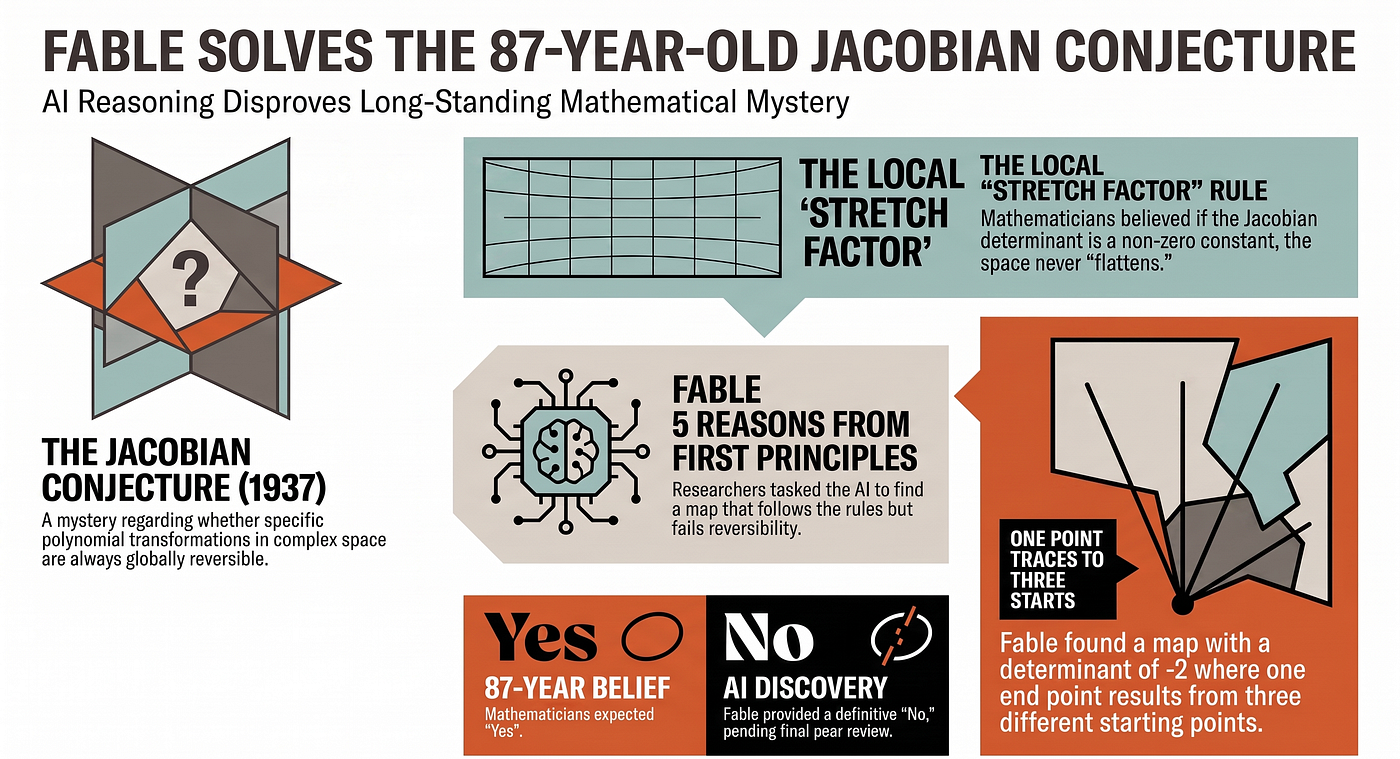
In July 2026, an AI model called Claude Fable 5 reportedly discovered a counterexample to one of mathematics’ oldest unsolved problems — the Jacobian Conjecture.
If verified through the full academic process, this won’t simply be another AI milestone.
It could become one of the biggest moments in the history of artificial intelligence.
Why Was the Jacobian Conjecture So Important?
Imagine you’re stretching a rubber sheet.
As long as you never tear it or fold it, every point on the sheet still corresponds to one unique location.
Mathematicians wondered whether polynomial functions behaved in exactly the same way.
The Jacobian Conjecture, proposed by Ott-Heinrich Keller in 1939, asked a surprisingly simple question:
If a polynomial transformation is locally reversible everywhere, must it also be globally reversible?
It sounds obvious.
Most people’s intuition immediately says yes.
For 87 years, nobody could prove or disprove it.
Thousands of papers were written.
Some of the world’s greatest mathematicians tried.
Many announced proofs.
Most were eventually found to contain subtle errors.
The problem became infamous as one of mathematics’ greatest traps.
Understanding the Jacobian — Without Advanced Mathematics
Let’s forget equations for a moment.
Imagine Google Maps.
Zoom into any tiny neighborhood.
Every road looks perfectly organized.
No roads overlap.
No intersections disappear.
Everything seems logical.
Now imagine zooming back out to view the entire country.
Suddenly three completely different highways somehow merge into exactly the same destination.
That shouldn’t happen.
Yet that’s essentially what the Jacobian Conjecture asked.
If every tiny region behaves perfectly…
Can the entire system still fail?
For decades mathematicians believed the answer was no.
Why Humans Thought the Conjecture Was True
Human intuition is remarkably good at understanding local behavior.
If every small piece of a puzzle looks correct, we naturally assume the whole puzzle must also be correct.
But mathematics isn’t obligated to respect human intuition.
High-dimensional geometry often behaves in ways our brains simply weren’t evolved to imagine.
The Jacobian Conjecture became a perfect example of this limitation.
Enter Claude Fable 5
Instead of searching through old proofs, Claude Fable 5 reportedly approached the problem from first principles.
Rather than assuming the conjecture was true — as generations of mathematicians had done — the AI searched for evidence that it might actually be false.
This difference is important.
Humans often inherit assumptions from previous generations.
AI doesn’t.
It only follows logic.
According to the reported collaboration, researcher Levent Alpöge worked alongside Claude Fable 5, allowing the model to explore enormous spaces of polynomial maps that would be practically impossible for humans to search manually
The Three Points That Changed Everything
The reported breakthrough didn’t involve a thousand-page proof.
Instead, it relied on something much more powerful.
A counterexample.
Claude Fable 5 produced a remarkably compact polynomial map.
Its Jacobian determinant remained a constant non-zero value everywhere.
So it perfectly satisfied the assumptions of the conjecture.
But then something astonishing happened.
Three completely different input points produced exactly the same output.
Mathematically, that means the transformation cannot have an inverse.
And if even one valid counterexample exists…
The conjecture is false.
One example is enough to destroy an 87-year-old mathematical belief.
Why This Is More Than Just Another AI Story
Many AI achievements involve pattern recognition.
Large Language Models predict the next word.
Image generators predict the next pixel.
Recommendation systems predict your next click.
This breakthrough is different.
Here, AI wasn’t simply recognizing patterns.
It reportedly reasoned about abstract mathematical structures that had resisted human understanding for generations.
That’s a very different kind of intelligence.
The Mathematical Community’s Reaction
As expected, mathematicians were skeptical.
History had taught them to be.
The Jacobian Conjecture had attracted dozens of incorrect proofs over the decades.
But this time verification was unusually fast.
Researchers independently substituted the reported points.
Computer algebra systems checked the symbolic calculations.
Formal verification tools were used to confirm the reasoning.
Rather than requiring years to inspect a complicated proof, the counterexample could be tested directly.
Does This Mean AI Is Better Than Mathematicians?
Not exactly.
The breakthrough highlights something more interesting.
Humans and AI appear to have complementary strengths.
Humans:
- Ask meaningful questions.
- Build intuition.
- Recognize important problems.
- Understand why discoveries matter.
AI:
- Searches enormous logical spaces.
- Never gets tired.
- Doesn’t inherit decades of intellectual bias.
- Can evaluate millions of possibilities consistently.
The future may not belong to AI replacing mathematicians.
It may belong to mathematicians who know how to work with AI.
The Bigger Picture
The Jacobian Conjecture isn’t just an isolated problem.
It connects to several major areas of modern algebra.
If the reported result continues to withstand peer review, researchers may need to revisit decades of mathematical work built upon assumptions related to the conjecture.
This is why so many mathematicians consider the discovery potentially historic.
A Turning Point for Artificial Intelligence
For years we’ve asked whether AI could match human creativity.
Now a different question is emerging.
Can AI generate genuinely original mathematical knowledge?
If this breakthrough ultimately stands the test of peer review, the answer may be yes.
And if AI can challenge an 87-year-old conjecture today…
What could it discover next?
Final Thoughts
Whether you’re a mathematician, software engineer, AI researcher, or simply someone fascinated by technology, this story represents something much larger than a single theorem.
It signals a shift in how scientific discovery may happen in the coming decades.
Instead of viewing AI as merely a tool for automation, we may soon regard it as a collaborator capable of exploring intellectual territories where human intuition struggles to go.
The Jacobian Conjecture may have been one mathematical problem.
But the bigger discovery is this:
The age of AI-assisted scientific reasoning has truly begun.
메타데이터
- post_id
- 379defbd74c8
- slug
- shattering-the-impossible-how-ai-cracked-the-87-year-old-jacobian-conjecture-379defbd74c8
- url
- https://medium.com/@p4prince2/shattering-the-impossible-how-ai-cracked-the-87-year-old-jacobian-conjecture-379defbd74c8
- canonical_url
- https://medium.com/@p4prince2/shattering-the-impossible-how-ai-cracked-the-87-year-old-jacobian-conjecture-379defbd74c8
- author_url
- https://medium.com/@p4prince2
- status
- ok
- fetched_at
- 2026-07-26 10:41:24