Good Laboratory Practice Explained: What GLP Means for Pharma Quality
Good Laboratory Practice (GLP) protects the credibility of non-clinical safety studies used in regulatory submissions. OECD GLP principles…
Good Laboratory Practice Explained: What GLP Means for Pharma Quality

Good Laboratory Practice (Image Generated By AI)
Good Laboratory Practice (GLP) protects the credibility of non-clinical safety studies used in regulatory submissions. OECD GLP principles and FDA 21 CFR Part 58 guide laboratories in controlling raw data, study plans, QA inspections, and archives, ensuring safety evidence for pharmaceuticals, chemicals, food additives, and medical products remains reliable worldwide.
GLP Created to Make Safety Data Traceable
GLP was created because regulators needed stronger confidence in laboratory safety data. Before formal GLP systems, some studies lacked clear protocols, controlled raw data, proper archives, or independent quality checks. Therefore, GLP introduced a structured framework where every study decision, test result, deviation, and final conclusion could be reconstructed during inspection or regulatory review. OECD explains that GLP applies to non-clinical safety testing and supports reliable regulatory data. (OECD)
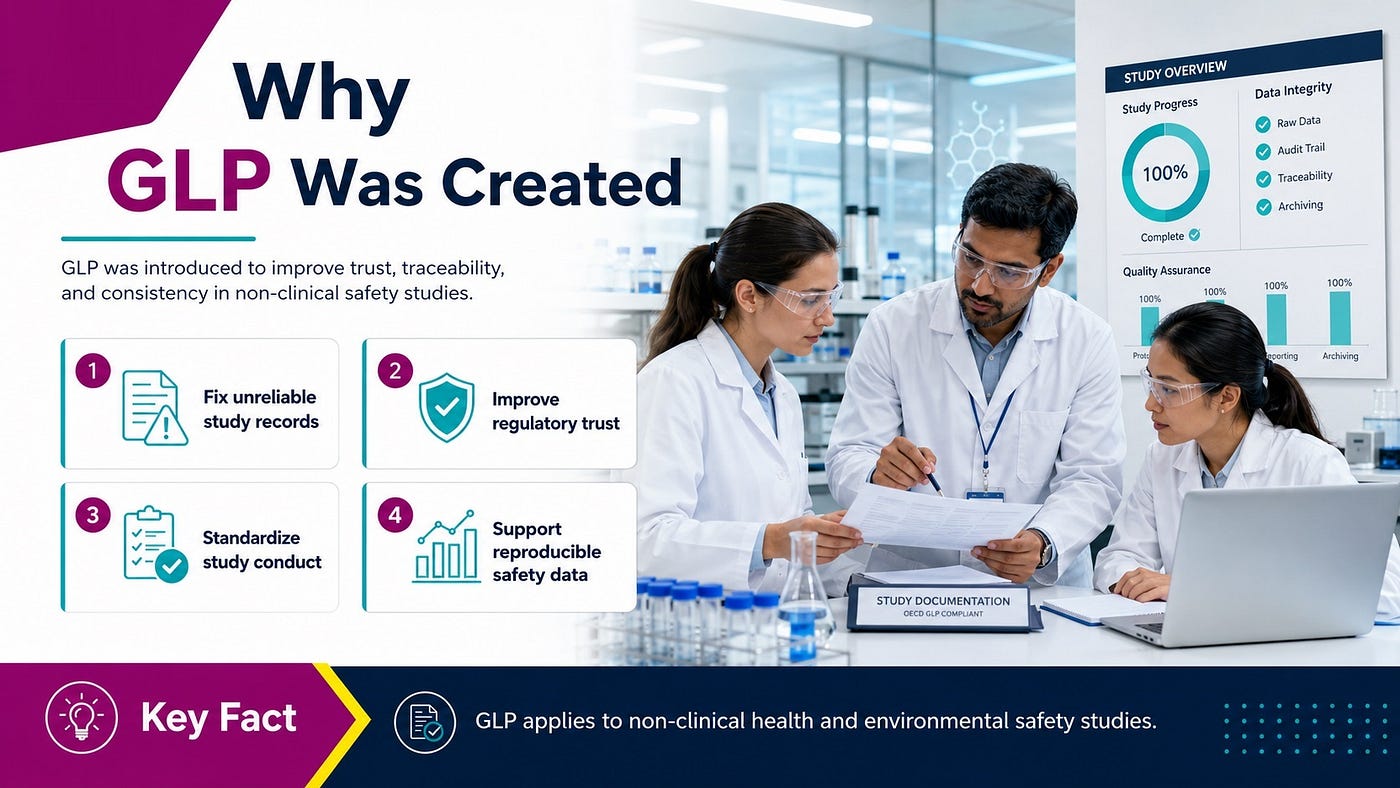
Why GLP was Created (Image Generated By AI)
The scientific problem behind GLP
GLP solved the problem of weak study reliability by requiring controlled study plans, defined responsibilities, documented methods, complete raw data, and final reports that match the actual work performed in the test facility.
Regulatory confidence through reproducible evidence
GLP improved regulatory trust because assessors could review not only the final result, but also the study design, equipment records, personnel training, deviations, test-system handling, and archive controls behind the result.
Why GLP still matters in modern submissions
GLP still matters because non-clinical studies support important safety decisions before human exposure, market approval, or environmental release, especially when regulators assess pharmaceuticals, pesticides, food additives, chemicals, or medical products.
Study Types That Commonly Follow GLP
GLP applies mainly to non-clinical health and environmental safety studies. These studies may happen in laboratories, controlled animal facilities, greenhouses, field environments, or specialized testing sites.
Common GLP study types include toxicity, mutagenicity, bioaccumulation, environmental toxicity, analytical chemistry, clinical chemistry, and residue studies used to support regulatory applications.
Non-clinical safety studies under GLP
Toxicology, safety pharmacology, genotoxicity, environmental fate, residue, bioaccumulation, and ecotoxicology studies often follow GLP when their results support a regulatory submission or product safety assessment.
Pharmaceutical safety testing applications
In pharmaceutical development, GLP supports non-clinical safety packages by controlling how test articles, control articles, dose groups, biological samples, pathology records, and toxicology observations are managed and reported.
Studies usually outside GLP scope
Clinical trials, exploratory discovery research, routine manufacturing batch release testing, and early screening studies are usually outside GLP scope unless they are formally designed to support regulated non-clinical safety submissions.
GLP Value in Pharma and Life Sciences
GLP matters because product safety decisions depend on trustworthy evidence. A laboratory may produce advanced scientific results, but regulators also need proof that the study was controlled. Therefore, GLP connects science, quality assurance, documentation, and regulatory acceptance.
It reduces the risk of rejected data, repeated studies, delayed submissions, and inspection findings.
Protection before human exposure
GLP protects patient safety by supporting controlled non-clinical decisions before a medicine, biologic, device material, chemical, or food-related substance moves closer to human use or wider market exposure.
Why regulators rely on GLP data
Regulators rely on GLP data because it shows that study conduct was planned, monitored, documented, reviewed, and archived using a quality system that supports data integrity and scientific accountability.
Reducing costly study failure
GLP reduces study failure risk by controlling critical elements such as protocols, test-system conditions, dosing records, equipment calibration, raw data capture, deviation handling, final reports, and long-term archive access.
Core GLP Principles for Reliable Laboratory Work
The core principles of GLP cover organization, personnel, facilities, equipment, test systems, test and control articles, SOPs, study plans, raw data, final reports, quality assurance, and archives. These principles create a documented chain of control. For learners comparing regulated systems, Pharmuni’s related blog on GLP vs GMP can provide useful context.
Data integrity as the central goal
GLP supports data integrity by requiring records to be accurate, complete, attributable, legible, contemporaneous, original, and available for review throughout the study lifecycle and after final report approval.
Clear responsibilities prevent compliance gaps
Clear responsibilities matter because GLP separates management duties, study director accountability, study personnel execution, sponsor expectations, archive control, and independent QA oversight to prevent confusion during inspections.
SOPs create repeatable laboratory behavior
SOPs support consistent laboratory work by standardizing recurring activities such as equipment use, reagent preparation, animal care, sample handling, computerized system access, deviation reporting, and archive transfer.
GLP, GMP, and GCP Are Not the Same
GLP, GMP, and GCP are all part of the broader GxP compliance family, but they control different stages of product development. GLP controls non-clinical safety studies. GMP controls manufacturing and product quality. GCP controls clinical trials involving humans. Confusing these systems can create wrong procedures, weak training, and audit gaps.
For a practical comparison, read Pharmuni’s blog **GMP vs GLP: Key Differences 2026 Update** to understand when each quality system applies in pharma.
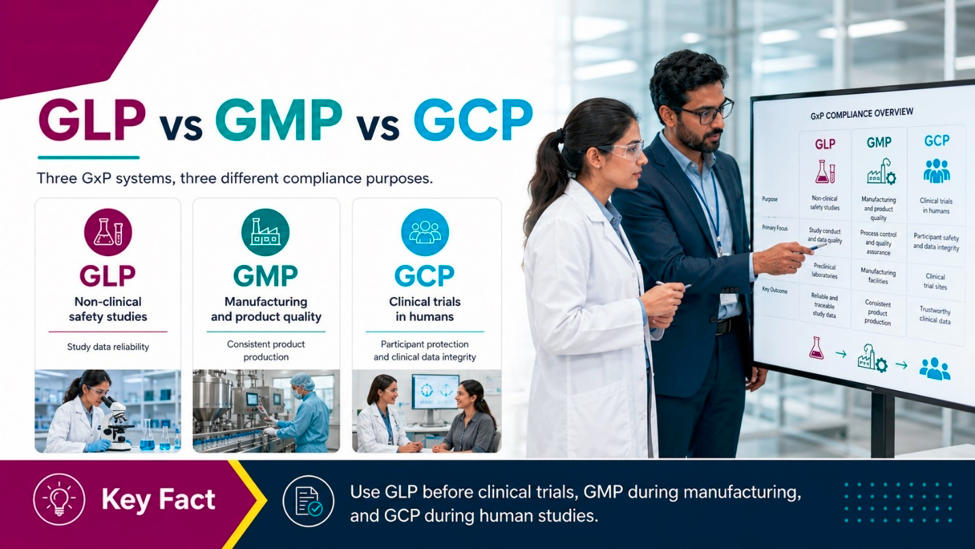
GLP vs GMP vs GCP (Image Generated by AI)
When laboratories should follow GLP
Laboratories should follow GLP when performing non-clinical safety studies intended to support research permits, marketing applications, environmental safety evaluations, or regulated product approval decisions.
GLP compared with GMP
GLP focuses on study reliability and safety data integrity, while GMP focuses on consistent product manufacturing, contamination control, batch quality, validated processes, and release of medicines or related products.
GLP compared with GCP
GLP applies before human clinical testing and controls non-clinical studies, while GCP protects trial participants and ensures reliable clinical data during studies involving human subjects.
Main GLP Requirements for Laboratories
GLP requirements are practical and detailed. A compliant facility must control its people, rooms, instruments, computerized systems, test articles, samples, test systems, records, and reports. Under FDA 21 CFR Part 58, GLP applies to nonclinical laboratory studies supporting FDA-regulated research or marketing permits for products such as drugs, devices, biologics, and food additives. FDA 21 CFR Part 58 defines GLP requirements for nonclinical laboratory studies supporting FDA submissions. (eCFR)
Facilities and equipment expectations
Facilities must be suitable for the study, prevent mix-ups or contamination, separate incompatible activities, support proper test-system care, and include maintained, calibrated, and documented equipment fit for intended use.
Validated and suitable test methods
Validated or scientifically justified methods are essential because unreliable methods can create inaccurate safety conclusions, poor reproducibility, weak regulatory confidence, and major inspection observations.
Documentation required for compliance
GLP documentation usually includes master schedules, study plans, SOPs, training records, equipment logs, raw data, amendments, deviations, QA inspection reports, final reports, specimen records, and archive indexes.
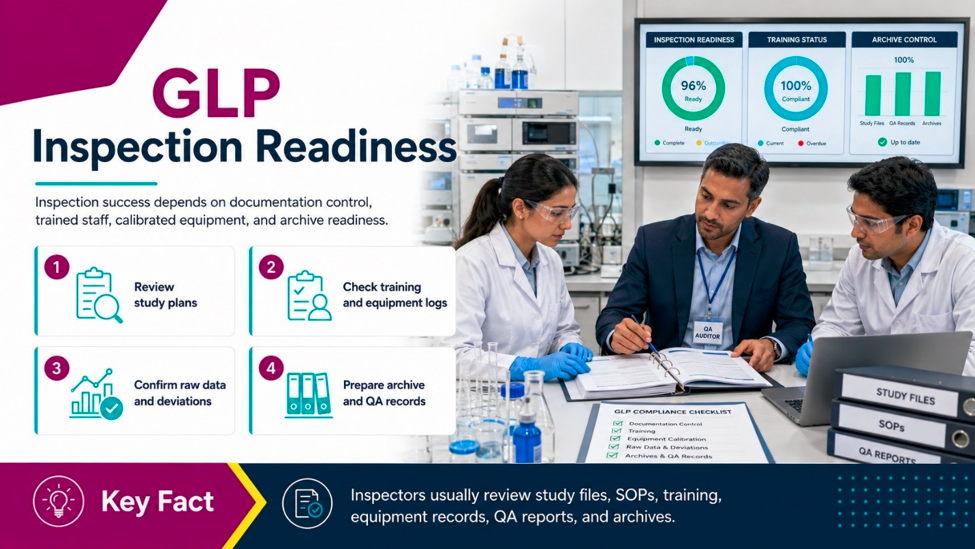
GLP Inspection Readiness (Image Generated by AI)
Quality Assurance in GLP Studies
Quality Assurance is a major GLP control because it independently checks whether the study follows the approved plan, SOPs, and GLP expectations. QA does not run the study, but it monitors compliance and reports findings to management and the study director. Professionals can explore Pharmuni’s GxP compliance-related course for structured learning.
Independence of the QA unit
The QA unit must be independent from direct study conduct so it can identify compliance risks, report findings objectively, and avoid conflicts between operational pressure and quality oversight.
Monitoring study compliance
QA monitors compliance through protocol reviews, critical-phase inspections, facility inspections, process checks, raw data reviews, report audits, deviation follow-up, and communication with management.
What QA should check
QA should check whether the study plan is approved, staff are trained, SOPs are followed, deviations are justified, raw data are complete, and the final report accurately reflects the study.
A Practical Note from GMP Experience
From my experience supporting GMP teams in multinational pharma environments, GLP becomes easier when learners connect rules with daily laboratory behavior. My advice is simple: master documentation, respect data integrity, ask why each control exists, and build habits that make quality visible before an inspection, not only during one every single day.
메타데이터
- post_id
- 37a08bb5bb7a
- slug
- good-laboratory-practice-explained-what-glp-means-for-pharma-quality-37a08bb5bb7a
- url
- https://medium.com/@ershadmoradi25/good-laboratory-practice-explained-what-glp-means-for-pharma-quality-37a08bb5bb7a
- canonical_url
- https://medium.com/@ershadmoradi25/good-laboratory-practice-explained-what-glp-means-for-pharma-quality-37a08bb5bb7a
- author_url
- https://medium.com/@ershadmoradi25
- status
- ok
- fetched_at
- 2026-07-27 11:15:34