‘Supergirl’ and My Grudge Against Superhero Movies
I have a strained relationship with superhero movies. Here’s how I felt about Craig Gillespie’s ‘Supergirl’.
‘Supergirl’ and My Grudge Against Superhero Movies
I have a strained relationship with superhero movies. Here’s how I felt about Craig Gillespie’s ‘Supergirl’.

Supergirl (2026), Warner Bros. Pictures
As a kid, superhero films were some of the first movies I ever truly loved. I counted down the days for each new entry in the Marvel Cinematic Universe (MCU) all through middle and high school, and some of my very first “movie reviews” were exorbitantly long essays I wrote about Tony Stark.
However, while I still consider myself a cinephile, this particular interest in comic-book heroes has not stood the test of time for a variety of reasons.
Perhaps contrary to popular opinion, for me, everything went downhill with Avengers: Endgame. Story-wise, I felt as if that movie was a major betrayal, violating every principle that I expected it to follow by leaning hard into cameos, callbacks, shock value, and contrived emotional beats instead of a strong arc that would have neatly tied up the decade of time I had invested in the franchise and its characters.
I (predictably) wrote a 6000-word academic essay chock-full of citations in MLA formatting about how much I hated the movie.
Despite being a sixteen-year-old girl, I had really seen myself in Tony Stark. Iron Man 3 was and remains one my favorite MCU films, namely because I appreciated that it didn’t shy away from the emotional ramifications of being a hero. The film showed how Tony’s PTSD caused him to suffer from panic attacks and forced him into a cycle of perfectionism: constantly working on his tech and trying to make the new best suit to keep his loved ones safe and prepare for an invisible threat he felt in his gut was coming, even if it seemed irrational.
This sort of obsessive-compulsive feedback loop (while eventually proven correct) resonated with me deeply, even if I wasn’t sure why at the time. Back then, I used to read and re-read every assignment I wrote for school, usually going through the final draft upward of ten times for fear of missing an obvious mistake. I’d ask my friends and family to read it afterward as well, just to be sure. Even though everything I wrote was entirely my own, I’d compare it back against my sources for fear of accidental plagiarism. When I did make a mistake or hit a block in my writing, I would be overtaken by anxiety and insecurity.
Tony’s death in Endgame, specifically through self-sacrifice, hit like a punch to the gut. If not even the fictional superhero I looked up to could work past his issues and find a life worth living, absent of compulsion and routine and paranoia, then how could I?
Since then, I soured on superhero films. It didn’t feel the same once the lights were on and I understood how the machine worked. Character and story always had and always would come second to artificial moments of emotion designed for a room full of children to cheer in the theater and post about online when they got home.
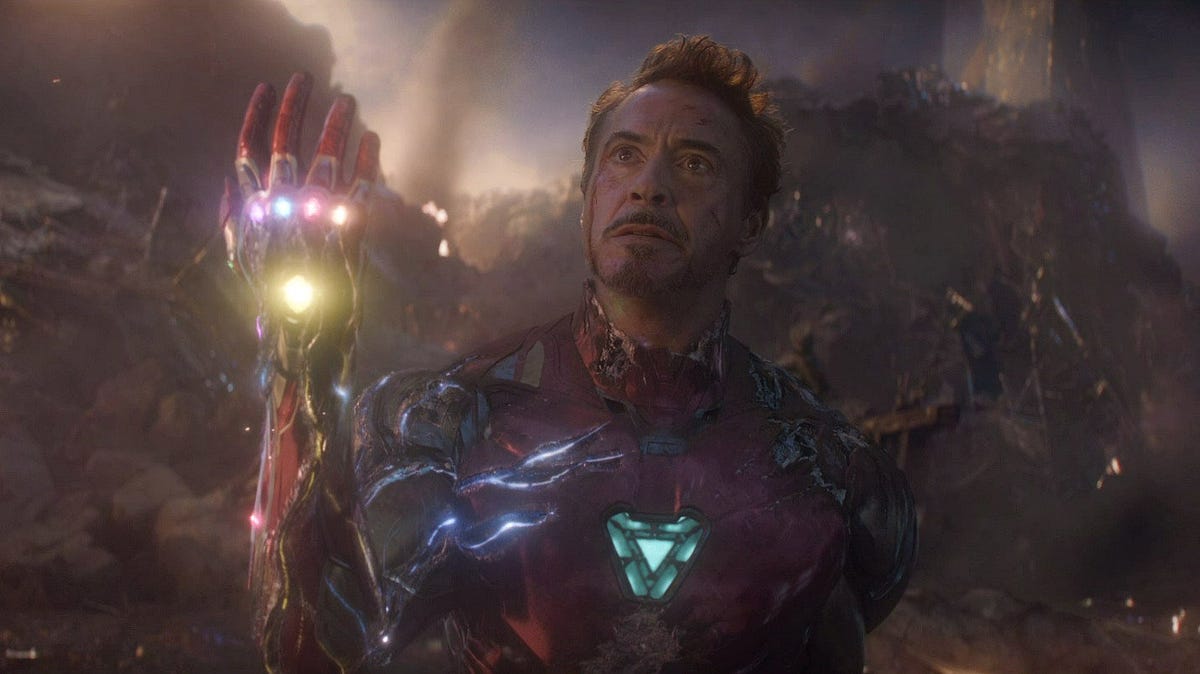
Avengers: Endgame (2019), Walt Disney Studios Motion Pictures
Beyond that, I had to deal with what it meant to be a fan of these films as a woman. It feels simple to write off, but the MCU didn’t even have a female antagonist until 2017 with Hela in Thor: Ragnarok (nine years after Iron Man in 2008), let alone a female lead protagonist, which didn’t come until Captain Marvel in 2019.
Supporting female characters weren’t exactly treated like equals either. I wish I could forget the over-sexualized introduction of Natasha Romanoff in Iron Man 2, in which she is written to strip out of her clothes in front of a character played by the film’s director, as well as her contrived romance with Bruce Banner beginning in Avengers: Age of Ultron (lest we forget about Tony’s gross “prima nocta” joke in the same film).
Women barely existed outside of the roles of dead mothers or love interests. Think of Wanda Maximoff, Hope van Dyne, Gamora, Pepper Potts, Lady Sif, Jane Foster, or even Peggy Carter, who was brought back to Endgame to serve as a silent trophy for Steve Rogers’s happy ending; that one in particular felt like salt in the wound after that film’s corny attempt to shoutout its female characters during the final fight despite many if not most of them not having any speaking lines in the film.
Even on a less literal note, qualities that were considered heroic also tended to be tied closely to masculinity. For Tony, finding a happy life with a family wasn’t the answer to his story; he instead had to go back and fight, again and again, until it killed him.
For the others, being a hero was standing stoically in the face of death (like fellow Avengers watching stone-faced at the funeral of a longtime friend), abandoning your family to go back to a “simpler time” (with a woman who had lived an entire life without you, per Marvel’s Agent Carter), or becoming a super soldier. It was Superman laying siege to the world upon losing his love interest, violent and full of rage.
Like a romance, the job of a superhero film is to indulge a fantasy. As Laura Mulvey outlined in Visual Pleasure and Narrative Cinema:
As the spectator identifies with the main male protagonist, he projects his look on to that of his like, his screen surrogate…A male movie star’s glamorous characteristics are thus not those of the erotic object of the gaze, but those of the more perfect, more complete, more powerful ideal ego conceived in the original moment of recognition in front of the mirror.
The movies specifically fulfill a masculine fantasy of power. Big, veiny muscles brought on by excessive dehydration, for one thing, are more to the taste of other men than of women (with men tending to overestimate how attractive muscles are to women). The superheroes satisfy the ideals of what a male body can be, as desired for by men, activating an ego-libido and allowing the male audience to feel as if they are achieving these feats of strength and power alongside the characters.
Women as love interests, victims, or damsels in distress, exist in these films to fuel this fantasy. Studies show female superheroes are portrayed accordingly; they tend to be more sexualized, weaker, less violent, and less likely to work independently, while male superheroes ask for help less, talk about their emotions less, and accept comfort less.
As a woman watching these films, while I often enjoyed them, I never felt like any of the stories being told were made with an audience of people like me in mind. They counted on me getting a ticket as a sister to a boy who likes superheroes or as a daughter to a man who grew up reading comics. These stories weren’t written or directed by women, nor did they star women. I existed as an audience member who they could pull in with nothing but a crumb here and there, and I would keep coming back because it was the best I could get.
I cried watching Captain Marvel when it first came out and defended the character to anyone online who complained about her. I saw the film over and over again while doing my best to not the let the misogynistic hate train left in its wake get me down, though even as a kid I knew how ridiculous it was when fanboys got upset that Carol Danvers wasn’t smiling enough.

Captain Marvel (2019), Walt Disney Studios Motion Pictures
DC’s original extended universe was marginally better; I mostly enjoyed Wonder Woman, though I resented the choice to change her backstory from being born entirely of women to instead gaining her powers as a result of being the daughter of Zeus. Justice League blatantly turned its back in what meager progress that film made, however, judging by the costumes of the Amazons alone, not to mention how weak Wonder Woman was made to be in comparison to the other heroes.
I won’t even get into David Ayer’s Suicide Squad here, though I believe that was the most disappointed I have ever been in a movie I had previously been excitedly anticipating.
These recollections are not to say that every superhero film is horribly sexist but to give context to what I experienced as a kid growing up in these communities. What little representation I got was inevitably met with atrocious hate campaigns online, whether it be the flack Black Panther: Wakanda Forever got for giving Shuri the Black Panther mantle (though I’ve heard T’Challa’s son may be slated to take over in the next film) or the dismissive criticism of Birds of Prey as “woke” or “misandrist.”
Seeing Craig Gillespie’s Supergirl this past weekend moved me more than I had thought it would, and that is namely because Kara Zor-El is everything I’ve ever wanted out of a female superhero. Outside of specific anti-heroes like Harley Quinn, there really was no model for women in the genre as simultaneously self-destructive and cocky, rude and kind, and messy and good as Kara; this archetype was dominated by men like Tony Stark, or Peter Quill, or even Deadpool.
Unlike them, Kara is my age. Her hair is messy like mine often is, too long to get under control some days. I don’t wear makeup, and neither does she. She wears shirts two sizes too big on her, unfashionable but practical boots, and big jackets no matter the weather just like I do. Comparing her super suit to the likes of Wonder Woman’s revealing, swim-suit style armor or Black Widow’s skin-tight catsuit (often unzipped just low enough to show off her cleavage), it feels much more practical (especially with the shorts underneath, which, to be clear, most women wear under dresses/skirts).
The film follows Kara as she is unwittingly pulled along on a revenge quest by a young girl named Ruthye. Despite some friction, after Kara’s dog Krypto is attacked, the two women end working together to hunt Krem, a member of an all-male alien population who killed Ruthye’s family and kidnaps young girls to “wed” and assault for the sake of reproduction. Kara drinks heavily and feigns apathy to cope with her grief for her home planet, the destroyed Krypton, and avoid Earth, where she struggles to find belonging despite the clumsy attempts at comfort from her cousin, Clark.
Kara (and Ruthye, for that matter) is unapologetically herself, and she gets to be a real mess; she is capable and confident, even if she doubts her own goodness and the worth of her life in the wake of all the death surrounding her, and she gets to be all of that without being reduced down to a love interest or a part of a male-dominated ensemble.
Opposite to my experience with Endgame, I found Supergirl to be very character forward; the point of the plot seems to be to serve her development rather than the other way around. For instance, Krem, the main villain, doesn’t have a particularly philosophical motivation for his actions (his cruelty all the more off-putting given how insidiously casual it is), but his character and his treatment of women creates an interesting bouncing off point for Kara and Ruthye, characterizing both through how they respond to him: Kara’s strained nonchalance, a farce to protect herself from further grief, and Ruthye’s brave anger and desire for revenge, hitherto unjaded by the world.
Even the movie’s action feels entirely reflective of the stage Kara is at in her development. She begrudgingly helps Ruthye to withhold a promise to her mother despite wanting to protect her own heart, and she fights without her powers, instead using sheer will and Krypto’s support alone (the same two things keeping her going day-to-day, too); the moment she finds her footing, her own innate power and worth, the whole world seems to calm around her despite the carnage she rains down on Ruthye’s attackers. It’s particularly interesting in comparison to a film like Superman, where despite him having insecurities of his own, the fight scenes feel more about the set pieces and plot than Clark’s mental state.
I don’t know that I realized I didn’t have a hero like Kara until I saw her in this film, and it was a great feeling. I kicked my feet in the lobby while talking to my friends about how I loved the movie and grinned like an idiot my whole way home from the theater.
Supergirl made me understand why even well into adulthood, men cling onto these stories: it feels good to see yourself in these films, as someone who is allowed to be a mess but also change the world for the better. It feels good to see someone like you fight for what they believe in and win. That in particular is something that has felt impossible for me in these past few years, so to watch Supergirl beat up a ship full of space pedophiles was a much-needed breath of fresh air, of hope.

Supergirl (2026), Warner Bros. Pictures
I have no intention of arguing that Supergirl is a perfect movie (as I had my own gripes with some aspects of it), but I do feel it’s easy to overlook how significant and unfairly rare a film like it truly is.
From the beginning, action movies and TV shows starring women haven’t had fair treatment, and it frankly hasn’t improved much in recent years. Marvel unceremoniously dumped Ironheart on Disney Plus last year; The Marvels and Furiosa famously bombed; and even Star Wars spinoff The Acolyte was met with massive disdain and review-bombing before being abruptly canceled after one season. More broadly, actresses like Melissa Barrera and Rachel Zegler have been subject to smear campaigns and unending waves of hate for simply participating in franchise films.
Supergirl itself has inevitably been subject to the same hate. Prior to the movie coming out, I saw far too many edits and AI-generated images of lead actress Milly Alcock in maid outfits or forced into a smile. Variety put out a review that disparages her appearance, comparing her to “the Feral Kid from ‘The Road Warrior’” or “Little Orphan Annie with desert-wastrel hair,” and plenty of feedback across other social media was quick to discuss Kara with terms that give away their true intentions; she’s a brat or a girlboss or a pretty girl, and she’s always cocky or scowling (instead of smiling, I would guess). Beyond that is the subsect of people shunning Alcock for alienating male audiences for being glad her story isn’t a romance and calling queer people “resilient”.
There is an increasingly popular perception that representation for women, queer people, and people of color has been consistently growing over the years, spawning complaints from people resistant to these changes, but according to the statistics, no matter the population in question, that’s just not the case.
On one hand, I find film criticism very important (especially when the dominant way of thinking about movies nowadays seems to be who cares, just have fun) and believe films should be judged objectively on the state of their content; however, on the other, I think to evaluate a film without taking these other factors into consideration comes from a place of privilege. Some people have never had to doubt or fight for their places in blockbusters, art, or the world as it is and can’t understand what that’s like.
While I try to cling to the belief that the people perpetuating these harmful behaviors are a vocal minority, as someone who has found community in film circles, this past week has been quite disheartening. I tend to avoid worrying about a film’s success no matter how much I like it, but to see major publications repeatedly setting up another young actress for hate online and how quick voices in the community that I trusted are to participate in all of it has deeply changed my perception of these circles.
It’s a wake-up call that even the places where I felt I could be most myself and where my opinion was truly valued still reject seeing women in these positions, whether it be due to outright, boldfaced misogyny that some don’t feel the need to conceal or subconscious, internalized biases some don’t feel the need to evaluate.
For each of Supergirl’s flaws, I can point to another superhero movie I’ve seen that had the same if not a more egregious version. Some attribute its failure to its visuals and yet ignore that the surprisingly colorful and emotionally poignant Masters of the Universe bombed barely a month ago; Deadpool & Wolverine succeeded on a massive scale both critically and financially despite its forgettable villain, notoriously boring settings, subpar visual effects, and queerness in its marketing (albeit leaning more toward mockery than representation); and many MCU films, including Thor: Ragnarok and Captain America: Civil War found their audiences despite deviating substantially from the original comic books.
With all of this in mind, while I’m sure many of the negative reviews were as genuine as the positive, it’s hard not to feel that “superhero fatigue” only seems to be an issue when it comes to supporting superhero films that aren’t designed to satisfy the male fantasy of masculinity, or, more simply, that aren’t about men.

Supergirl (2026), Warner Bros. Pictures
At the end of the day, I wish I could communicate to the crew behind this movie how grateful I am that it exists, and even more so that it’s the second film in a burgeoning franchise. Supergirl and *Superman* have shown me that, while of course limited through the lens of a blockbuster, the creators behind these films aren’t afraid to take risks and won’t pull their punches when it comes to criticizing and celebrating our world in equal measure. While flawed, both movies come across to me as hopeful stories for our time starring true heroes for a modern age.
If you at any point find yourself wondering who Supergirl was made for, then I can give you a simple answer: it was made for me and my best friends, who went to see it at the early fan event and then again in IMAX later that week; it was for my mom, who grew up on the Wonder Woman TV show; it was for a young girl out there somewhere just like me who gets to see herself (her troubles, her feelings, her bad days and messy hair and resilience) making a change.
Say what you will, but all I know is while I’ve been occasionally included in these superhero spaces, I’ve never felt invited until now, and that means something to me. Supergirl gave that to me, and for that, I will put all of my weight behind supporting it.
메타데이터
- post_id
- 37d80b354656
- slug
- supergirl-and-my-grudge-against-superhero-movies-37d80b354656
- url
- https://fanfare.pub/supergirl-and-my-grudge-against-superhero-movies-37d80b354656
- canonical_url
- https://fanfare.pub/supergirl-and-my-grudge-against-superhero-movies-37d80b354656
- author_url
- https://medium.com/@gretapw
- status
- ok
- fetched_at
- 2026-07-10 15:36:45