Monolith vs Microservices: The System Design Battle Behind Netflix, Amazon, Uber, and Every Modern…
Every successful software product eventually faces the same question:
Monolith vs Microservices: The System Design Battle Behind Netflix, Amazon, Uber, and Every Modern Application
Every successful software product eventually faces the same question:
Should we keep our application as a Monolith or break it into Microservices?
At the beginning, a monolithic architecture feels simple, fast, and productive.
As the product grows, teams expand, traffic increases, deployments become risky, and suddenly everyone starts talking about microservices.
But here’s the surprising truth:
Microservices are not automatically better than monoliths.
In fact, many startups fail after moving to microservices too early.
Let’s understand the real differences, trade-offs, and why some of the world’s largest companies use both approaches.
The Early Days: Why Monoliths Win
Imagine you’re building an e-commerce application.
Your application contains:
- User Management
- Product Catalog
- Orders
- Payments
- Notifications
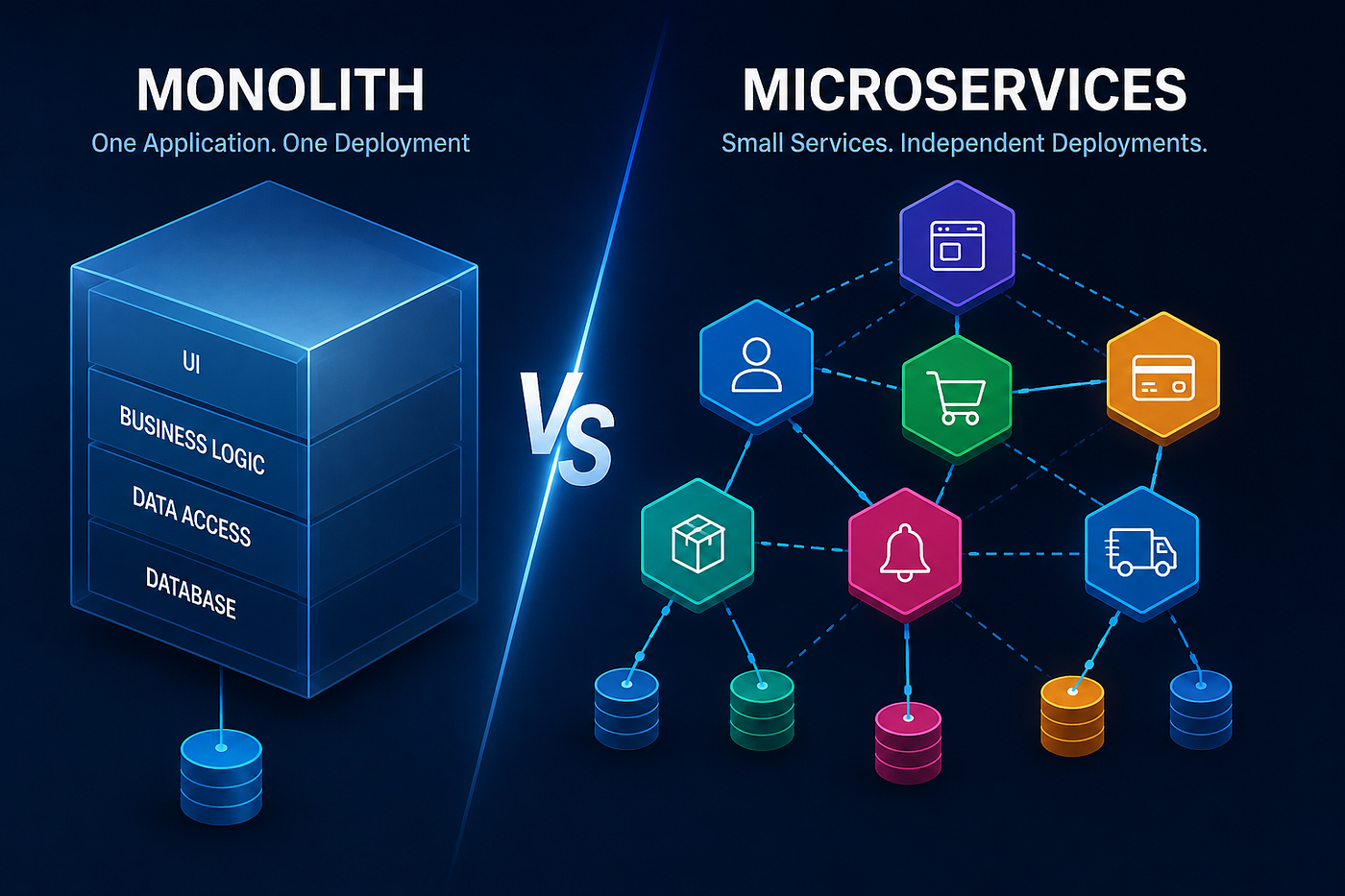
In a monolithic architecture, everything lives inside a single codebase and is deployed as one application.
E-Commerce App
├── Users
├── Products
├── Orders
├── Payments
└── Notifications
One deployment.
One database.
One repository.
One system.
For small teams, this is incredibly productive.
Benefits of a Monolith
1. Faster Development
Developers can work on features without worrying about network calls, service discovery, or distributed systems complexity.
Everything is in one place.
2. Easier Testing
Running the entire application locally is straightforward.
No need to start ten different services.
3. Simpler Deployment
Deploy a single application instead of coordinating dozens of services.
4. Lower Infrastructure Cost
A monolith typically requires fewer servers and less operational overhead.
For startups, this can be a huge advantage.
Why Monoliths Eventually Become Painful
The problems appear when the application becomes successful.
Imagine:
- Millions of users
- Hundreds of developers
- Multiple product teams
Now things start breaking down.
Deployment Risk
A small payment bug requires redeploying the entire application.
Even unrelated modules are affected.
Slow Development
Hundreds of developers modify the same codebase.
Merge conflicts become common.
Build times grow longer.
Scaling Problems
Suppose:
- Payments receive 10,000 requests/second
- Notifications receive 500 requests/second
With a monolith, you often scale everything together.
That means wasting resources.
Single Point of Failure
A memory leak in one module can impact the entire application.
One failure becomes everyone’s problem.
Enter Microservices
Microservices solve these issues by splitting the application into independent services.
Instead of one giant application:
User Service
Product Service
Order Service
Payment Service
Notification Service
Each service:
- Has its own codebase
- Has its own deployment pipeline
- Can scale independently
- Can be developed by separate teams
Services communicate using APIs, events, or message queues.
How Netflix Uses Microservices
When Netflix started streaming globally, their monolithic architecture couldn’t handle the scale.
They migrated to hundreds of microservices.
Today different services manage:
- Recommendations
- Billing
- User Profiles
- Streaming Metadata
- Search
- Viewing History
Each team owns specific services.
This enables independent deployments and rapid innovation.
Without microservices, Netflix would struggle to deploy thousands of changes every day.
The Biggest Advantage: Independent Scaling
Consider an online shopping platform during a festival sale.
Traffic spikes dramatically.
The Product Catalog receives:
50 million requests/hourBut the Payment Service receives:
5 million requests/hourWith microservices:
- Scale Product Service aggressively
- Leave Payment Service unchanged
This saves infrastructure costs and improves efficiency.
Team Scalability Matters More Than System Scalability
Many engineers think microservices are primarily about handling traffic.
They’re actually about handling teams.
Imagine:
- 10 developers → Monolith works great
- 50 developers → Monolith becomes challenging
- 500 developers → Microservices become attractive
Microservices allow teams to move independently.
One team can deploy ten times today while another team deploys once a week.
No coordination required.
But Microservices Introduce New Problems
This is where many articles stop.
The reality is that microservices create an entirely new set of challenges.
Distributed System Complexity
A single user request may travel through:
API Gateway
     ↓
User Service
     ↓
Order Service
     ↓
Inventory Service
     ↓
Payment Service
Debugging becomes significantly harder.
Network Failures
In a monolith, function calls rarely fail.
In microservices:
- Timeouts happen
- Network issues happen
- Service outages happen
Every request becomes a potential failure point.
Data Consistency Challenges
In a monolith:
One transaction
One database
Easy.
In microservices:
Order Database
Payment Database
Inventory Database
Maintaining consistency across multiple services becomes difficult.
Patterns like:
- Saga Pattern
- Event Sourcing
- Distributed Transactions
often become necessary.
Operational Overhead
Now you need:
- Service Discovery
- Load Balancing
- Distributed Tracing
- Monitoring
- Centralized Logging
- API Gateways
- Container Orchestration
This adds significant complexity.
The Hidden Cost of Microservices
Many companies underestimate this.
Moving from:
1 Applicationto
50 Servicesdoesn’t create 50 problems.
It often creates 500 problems.
Every service requires:
- CI/CD pipelines
- Monitoring
- Alerting
- Security
- Scaling policies
- Documentation
The operational burden grows rapidly.
Why Amazon Uses a Service-Oriented Architecture
One of Amazon’s famous engineering principles is:
“You build it, you run it.”
Teams own services from development to production.
This ownership model allows Amazon to scale engineering across thousands of developers.
Without service boundaries, coordination would become impossible.
The Rise of Modular Monoliths
Interestingly, many modern companies are returning to a middle ground.
Instead of jumping directly to microservices, they build a:
Modular Monolith
A modular monolith keeps:
- One deployment
- One codebase
But enforces strict boundaries internally.
Example:
User Module
Order Module
Payment Module
Notification Module
Each module behaves like an independent service while remaining inside the same application.
Benefits:
- Simpler deployments
- Easier debugging
- Lower operational cost
- Easier future migration
Many successful startups follow this approach today.
When Should You Choose a Monolith?
A monolith is usually the right choice when:
- Building a startup MVP
- Small engineering team
- Rapid feature development is important
- Traffic is moderate
- Operational simplicity matters
For most new applications, this is the best starting point.
When Should You Choose Microservices?
Microservices become valuable when:
- Multiple teams work independently
- Different services require different scaling patterns
- Frequent deployments are necessary
- Organizational complexity exceeds technical complexity
- The business is operating at large scale
Microservices solve organizational problems as much as technical ones.
The Most Important Lesson
One of the biggest misconceptions in software engineering is:
“Successful companies use microservices, so we should too.”
That’s backward thinking.
Successful companies often started with monoliths.
They moved to microservices only after growth made it necessary.
Even today, many billion-dollar products run large portions of their systems as monoliths.
The goal isn’t to use the most fashionable architecture.
The goal is to use the architecture that solves today’s problems without creating tomorrow’s headaches.
Final Thoughts
Monoliths are simple, productive, and often underestimated.
Microservices are powerful, scalable, and often overused.
The best architects understand that system design is not about choosing the most advanced solution.
It’s about choosing the simplest solution that can successfully support the next stage of growth.
Because in software engineering, complexity is not a feature.
Complexity is a cost.
And the best architecture is the one that keeps that cost under control for as long as possible.
메타데이터
- post_id
- 3832053c4c9d
- slug
- monolith-vs-microservices-the-system-design-battle-behind-netflix-amazon-uber-and-every-modern-3832053c4c9d
- url
- https://medium.com/@tech-logs/monolith-vs-microservices-the-system-design-battle-behind-netflix-amazon-uber-and-every-modern-3832053c4c9d
- canonical_url
- https://medium.com/@tech-logs/monolith-vs-microservices-the-system-design-battle-behind-netflix-amazon-uber-and-every-modern-3832053c4c9d
- author_url
- https://medium.com/@tech-logs
- status
- ok
- fetched_at
- 2026-07-18 18:47:35