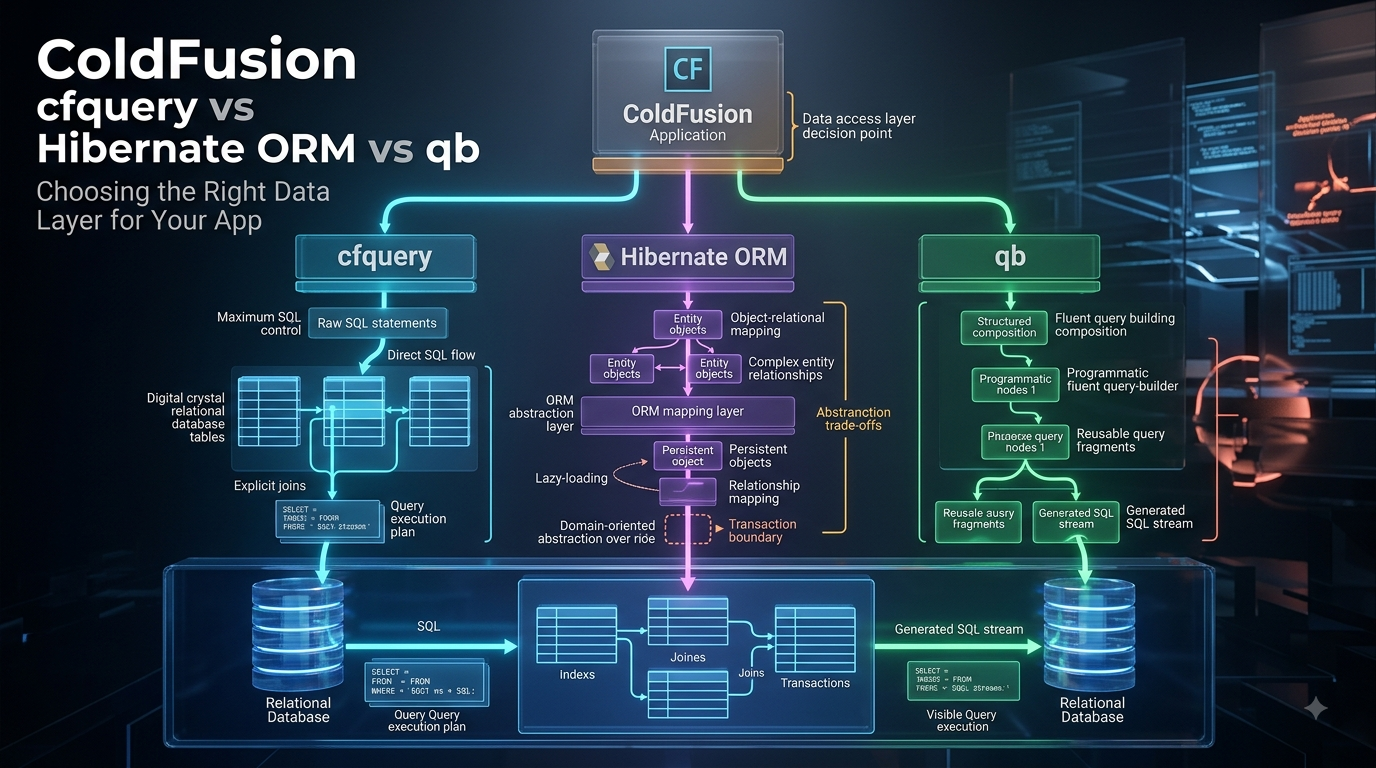
Multi-Tenant SaaS Architecture on ColdFusion: Data Isolation, Throttling, and Per-Client Config
ColdFusion is a capable platform for building multi-tenant SaaS — the core work is three things done right. Data isolation: pick an…
Multi-Tenant SaaS Architecture on ColdFusion: Data Isolation, Throttling, and Per-Client Config
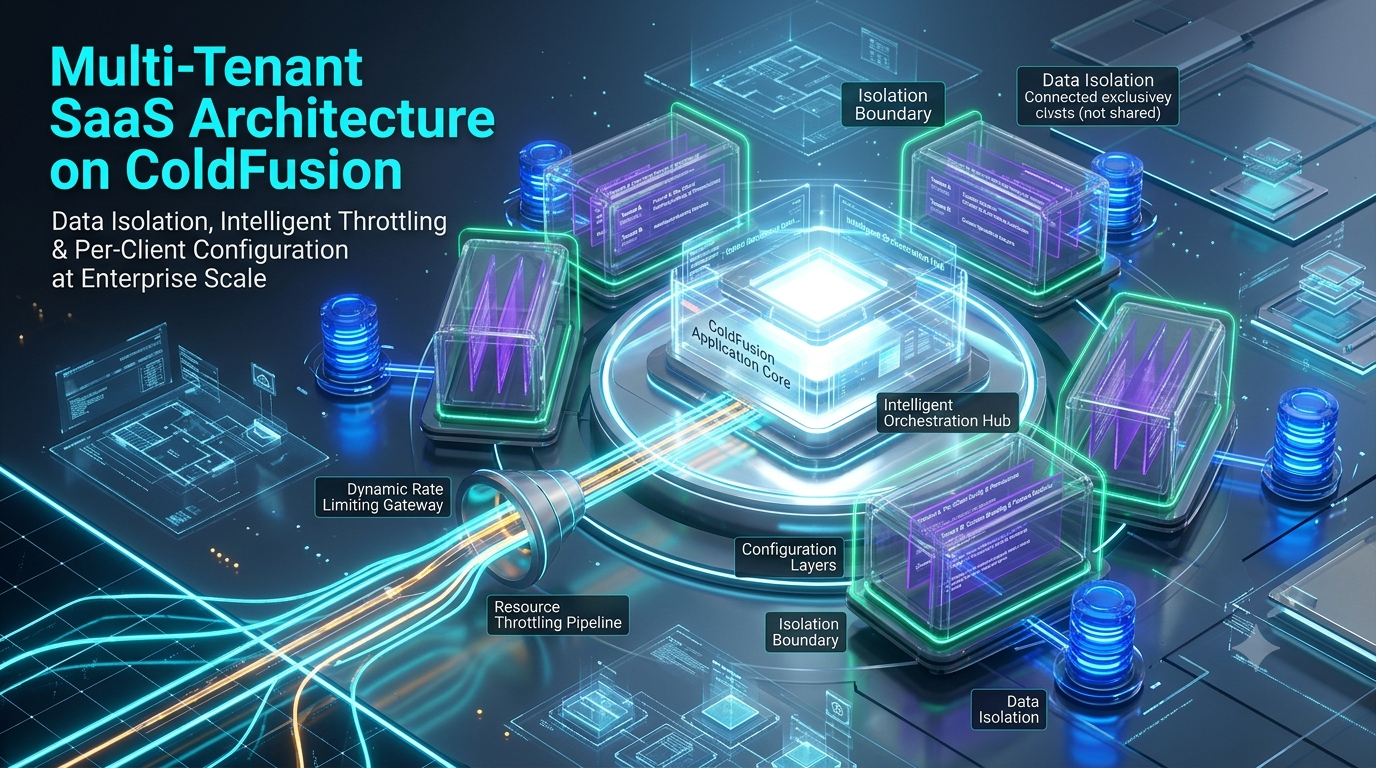
Multi-Tenant SaaS Architecture on ColdFusion: Data Isolation, Throttling, and Per-Client Config
ColdFusion is a capable platform for building multi-tenant SaaS — the core work is three things done right. Data isolation: pick an isolation model (database-per-tenant for maximum separation, schema-per-tenant for a balance, or shared-schema with a
tenant_iddiscriminator column for efficiency) and enforce it rigorously — with ColdFusion you can define per-tenant datasources dynamically inApplication.cfc(this.datasources, supported since CF11) or pass a datasource per query toqueryExecute(), and in the shared-schema model every single query must be scoped bytenant_id. Throttling: ColdFusion has no built-in per-tenant rate limiter, so you implement one with a token-bucket usingcacheGet/cachePut(Redis-backed for multiple nodes) keyed on the tenant, returning HTTP 429 when a tenant exceeds its tier — this prevents a "noisy neighbor" from starving others. Per-client config: load each tenant's configuration (feature flags, plan entitlements, branding, limits) once and cache it, keyed by tenant. The linchpin of the whole design is identifying the tenant early (from subdomain, header, or authenticated user) inonRequestStartand carrying that tenant context through every request. This guide covers all three with verified CFML.
The Foundation: Identify the Tenant on Every Request
Everything in multi-tenancy hinges on one thing: knowing which tenant a request belongs to, established at the very start of the request and carried consistently through data access, config, and throttling. Get this wrong and you get the worst bug in SaaS — one tenant seeing another’s data.
The common tenant-identification strategies:
- Subdomain —
acme.yourapp.com→ tenantacme. Clean and common. - Custom domain —
app.acmecorp.commapped to a tenant. For white-label setups. - Path prefix —
yourapp.com/acme/.... - Authenticated user — the logged-in user’s record carries their
tenant_id(often combined with one of the above). - Header/API key — for API tenants, a key or header resolves to a tenant.
In ColdFusion, resolve the tenant in Application.cfc's onRequestStart and stash it in the request scope so it's available everywhere for that request:
// Application.cfc — establish tenant context at the start of every request
component {
    this.name = "myMultiTenantSaaS";
function onRequestStart(required string targetPage) {
        // Example: resolve tenant from subdomain (acme.yourapp.com → "acme")
        var host = cgi.http_host;                       // e.g. acme.yourapp.com
        var subdomain = listFirst(host, ".");           // "acme"
        // Look up the tenant (cache this lookup - see per-client config below)
        request.tenant = getTenantByKey(subdomain);
        if (isNull(request.tenant) || !request.tenant.active) {
            cfheader(statuscode=404, statustext="Not Found");
            abort;   // unknown/disabled tenant never proceeds
        }
        return true;
    }
}
From here on, request.tenant (with its tenant_id, datasource, plan, config, and limits) is the single source of truth for the request. Never derive tenant identity from user-supplied data that isn't validated server-side, and never trust a client to tell you which tenant's data to return.
Data Isolation: Choose Your Model
There’s no universal multi-tenancy architecture — the right model depends on your customer segment, compliance requirements, performance expectations, and operational capacity. The three primary patterns sit on a cost-versus-isolation spectrum:
Model 1: Database-per-tenant (silo) — maximum isolation
Each tenant gets a completely separate, dedicated database. This provides the maximum possible level of data isolation with zero data commingling. It’s the best fit for enterprise SaaS with a smaller number of large tenants, strict compliance requirements (financial, healthcare), custom SLAs, or geographic data-residency needs. The trade-offs are higher cost and operational complexity (many databases to provision, migrate, back up, and monitor).
In ColdFusion, this maps naturally to a datasource per tenant. You can define these dynamically in Application.cfc using this.datasources (a capability restored in ColdFusion 11 — you define the whole datasource in code, not just reference an Admin DSN), then select the tenant's datasource per query:
// Define per-tenant datasources in Application.cfc (this.datasources — CF11+)
this.datasources = {
    "tenant_acme" = {
        driver: "MySQL", host: "db1.internal", port: 3306,
        database: "acme_db", username: application.secrets.acmeUser,
        password: application.secrets.acmePass
    },
    "tenant_globex" = {
        driver: "MySQL", host: "db2.internal", port: 3306,
        database: "globex_db", username: application.secrets.globexUser,
        password: application.secrets.globexPass
    }
};
// Query the CURRENT tenant's database by passing its datasource explicitly
function getOrders() {
return queryExecute(
"SELECT id, total, status FROM orders ORDER BY created DESC",
{},
{ datasource: request.tenant.datasource } // e.g. "tenant_acme"
);
}Because the datasource is the tenant boundary here, there’s no tenant_id filtering to forget — a strong safety property. (For many tenants, generate the this.datasources struct from a tenant registry rather than hand-coding each one, and keep credentials in a secrets store, not source.)
Model 2: Schema-per-tenant — balanced
Each tenant gets its own schema within a shared database. This offers better isolation than a shared schema and supports tenant-specific schema customizations, at the cost of greater operational complexity — schema migrations must be applied programmatically across every tenant’s schema, and a large number of schema objects can strain the database catalog. In ColdFusion you implement this by qualifying table references with the tenant’s schema, or by pointing the tenant’s datasource/connection at its schema.
Model 3: Shared schema with tenant_id — most efficient (and most dangerous if sloppy)
All tenants share the same tables; every row carries a tenant_id column, and every query filters on it. This is the most resource-efficient and operationally simple option, ideal for early-stage products and large numbers of smaller tenants. But the isolation depends entirely on the application layer enforcing tenant scoping on every query — and a single missed WHERE tenant_id = ? in one endpoint can expose one tenant's data to another. This is the number-one multi-tenant data-leak risk.
Making the shared-schema model safe in ColdFusion:
// EVERY query in the shared-schema model MUST be scoped by tenant_id.
// Centralize it so no developer can forget.
component {
function getOrders() {
        return queryExecute(
            "SELECT id, total, status
             FROM orders
             WHERE tenant_id = :tenantId
             ORDER BY created DESC",
            { tenantId: { value: request.tenant.id, cfsqltype: "cf_sql_integer" } },
            { datasource: application.datasource }
        );
    }
    // A guarded helper: forces tenant scoping so it can't be omitted
    function tenantQuery(required string sql, struct params={}) {
        // Enforce that the caller included the tenant filter
        if (!findNoCase("tenant_id", arguments.sql)) {
            throw(type="TenantScopeError",
                  message="Query missing tenant_id scope - refusing to run");
        }
        arguments.params["tenantId"] = { value: request.tenant.id, cfsqltype: "cf_sql_integer" };
        return queryExecute(arguments.sql, arguments.params, { datasource: application.datasource });
    }
}
The critical disciplines for shared-schema safety, per multi-tenant best practice: integrate the tenant_id check into every data-access path, centralize data access through a layer (a gateway/DAO or query interceptor) so scoping is automatic rather than hand-written per query, and use automated testing for data-leakage scenarios plus regular code review to catch a developer’s missed filter before it ships. If your database supports it, row-level security (e.g., PostgreSQL RLS) provides a database-enforced backstop beneath the application filtering.
A pragmatic reality: the hybrid/tiered model
Many mature SaaS applications adopt a hybrid (bridge) model — free/standard tenants on a cost-effective shared-schema or schema-per-tenant database, while premium enterprise tenants get a dedicated database (silo) as a high-margin upsell and a compliance story. ColdFusion’s ability to select a datasource per tenant per request makes this tiered approach natural to implement: the tenant record simply says which datasource (and thus which isolation tier) that tenant uses.
Isolate the Other Layers Too (Not Just the Database)
Data isolation isn’t only about the database — every stateful layer must be tenant-scoped, or you leak across tenants in subtler ways:
- Cache keys must include the tenant. A cached response for Tenant A must never be served to Tenant B. Prefix every cache key with the tenant identifier:
cachePut("tenant_#request.tenant.id#_dashboard", data, ...). This applies tocacheGet/cachePut, any Redis cache, and query caching. - Session/application scope. Don’t stash tenant-specific data in a shared scope without tenant keying. In ColdFusion, per-tenant application state is best kept in a tenant-keyed structure (e.g.,
application.tenants[tenantId]) or, better, loaded per request from a cached config. - File storage. Store tenant files under tenant-specific prefixes/paths (
/files/{tenant_id}/...ors3://bucket/{tenant-id}/...) with access controls, so one tenant can't read another's uploads. - Background jobs / scheduled tasks. Queue-isolate per tenant or use fair scheduling so a high-volume tenant’s jobs don’t monopolize processing and starve others.
- Logs. Include the
tenant_id(and a correlation ID) in structured log entries so you can trace and audit per tenant.
Throttling: Stop the Noisy Neighbor
In multi-tenancy, “noisy neighbor” is when one tenant’s resource consumption degrades everyone else’s experience — a primary concern in shared models. The defense is per-tenant throttling: application-layer rate limiting based on the tenant’s tier, so no single tenant can monopolize capacity or abuse the system.
ColdFusion has no built-in per-tenant rate limiter, so you implement one. The standard approach is a token-bucket keyed on the tenant, using ColdFusion’s caching functions, returning HTTP 429 when the tenant exceeds its allotment:
// Per-tenant token-bucket rate limiter (returns false → reject with 429)
function checkTenantRateLimit(required struct tenant) {
    // Limit comes from the tenant's plan tier (per-client config)
    var limit  = arguments.tenant.config.rateLimitPerMinute ?: 100;
    var window = 60;  // seconds
    var cacheKey = "ratelimit_tenant_" & arguments.tenant.id;
var bucket = cacheGet(cacheKey);
    if (isNull(bucket)) {
        bucket = { tokens: limit, lastRefill: now() };
    } else {
        var elapsed = dateDiff("s", bucket.lastRefill, now());
        var refill  = int(elapsed * (limit / window));
        bucket.tokens = min(bucket.tokens + refill, limit);
        bucket.lastRefill = now();
    }
    if (bucket.tokens < 1) {
        cfheader(statuscode=429, statustext="Too Many Requests");
        cfheader(name="Retry-After", value=window);
        cfheader(name="X-Tenant-RateLimit", value=limit);
        return false;
    }
    bucket.tokens--;
    cachePut(cacheKey, bucket, createTimeSpan(0, 0, 0, window * 2));
    return true;
}
Two things make this production-grade:
- Back the cache with Redis for multi-node deployments. With per-node in-memory cache, each ColdFusion node enforces its own separate limit, so a tenant on N nodes effectively gets N× their allowance. Shared Redis gives one consistent limit across the cluster. (This is the same caveat that applies to any ColdFusion cache-based rate limiter.)
- Drive limits from the tenant’s tier. The free tier gets a low limit, enterprise gets a high one — pulled from per-client config (next section). You can also enforce database-level limits as a deeper backstop (e.g., PostgreSQL
statement_timeoutper tenant role) and per-tenant circuit breakers to prevent one tenant's failing dependency from cascading.
Combine throttling with per-tenant monitoring — without tenant-level metrics you’re blind to noisy neighbors and bottlenecks. Track request rates, error rates, and latency per tenant so you can see (and act on) a tenant degrading the platform.
Per-Client Configuration: Feature Flags, Entitlements, and Branding
A robust multi-tenant app needs a configuration system supporting per-tenant feature flags, plan-based entitlements, and custom configuration values — so you can vary behavior per tenant without code changes for each one. This config typically includes: the tenant’s plan/tier, feature flags (which features are on), limits (rate limits, storage quotas, user seats), branding (logo, colors, custom domain), the datasource/isolation tier, and integration settings.
The efficient pattern in ColdFusion: load each tenant’s config once and cache it, keyed by tenant, refreshing on change rather than reloading every request.
// Load-and-cache per-tenant configuration
function getTenantConfig(required string tenantKey) {
    var cacheKey = "tenantconfig_" & arguments.tenantKey;
    var cfg = cacheGet(cacheKey);
    if (!isNull(cfg)) return cfg;
// Cache miss - load from the tenant registry (control DB)
    var row = queryExecute(
        "SELECT id, tenant_key, name, plan, datasource_name, config_json, active
         FROM tenants WHERE tenant_key = :key",
        { key: { value: arguments.tenantKey, cfsqltype: "cf_sql_varchar" } },
        { datasource: application.controlDSN }
    );
    if (row.recordCount == 0) return javaCast("null", "");
    var cfg = {
        id         : row.id,
        key        : row.tenant_key,
        name       : row.name,
        plan       : row.plan,
        datasource : row.datasource_name,
        active     : row.active,
        config     : deserializeJSON(row.config_json)   // flags, limits, branding
    };
    cachePut(cacheKey, cfg, createTimeSpan(0, 1, 0, 0));  // 1-hour TTL; purge on change
    return cfg;
}
// Feature-flag check used throughout the app
function tenantHasFeature(required string featureName) {
    return structKeyExists(request.tenant.config.features, arguments.featureName)
        && request.tenant.config.features[arguments.featureName] == true;
}
Usage keeps tenant-specific behavior clean and declarative:
if (tenantHasFeature("advancedReporting")) {
    // render the advanced reporting module for this tenant
}
Two operational notes: purge/refresh the cached config when a tenant’s settings change (an admin update should invalidate the cache key, not wait for TTL), and keep the tenant registry itself (the “control plane” database listing all tenants, their datasources, plans, and config) separate from tenant data — it’s the map that drives everything else.
Provisioning and Operational Realities
A few hard-won truths from multi-tenant practice that apply directly to a ColdFusion build:
- Automate tenant provisioning early. Creating a tenant (registry row, datasource/schema, seed data, config) must be automated before you have many tenants — manual provisioning doesn’t scale and invites mistakes.
- Think in blast radius. Every architectural choice should consider the scope of impact when something fails. Database-per-tenant contains a failure to one tenant; shared-schema spreads risk across all. Choose per your risk tolerance and tier.
- Migrations are harder in multi-tenancy. Schema changes must roll across every tenant database/schema (silo/schema models) or be carefully backward-compatible (shared model). Plan and automate this.
- Compliance shapes isolation. Frameworks like GDPR, HIPAA, and PCI-DSS influence how strict your isolation must be (and may push larger/regulated tenants toward the dedicated-database tier). Match the isolation model to the data sensitivity and the tenant’s compliance needs.
- Monitor per tenant. Tenant-level metrics are the only way to catch noisy neighbors, bill accurately, and spot a tenant in trouble.
Conclusion
Building multi-tenant SaaS on ColdFusion comes down to executing three things with discipline. Data isolation: choose the model that matches your tenants and compliance needs — silo (database-per-tenant) for maximum isolation, shared-schema with tenant_id for efficiency, or a hybrid that tiers them — and enforce it relentlessly, using ColdFusion's per-tenant datasources for the silo model and centralized, always-applied tenant_id scoping for the shared model. Throttling: implement per-tenant rate limiting with a Redis-backed token bucket keyed on the tenant and driven by plan tier, so no noisy neighbor can starve the platform. Per-client config: load and cache each tenant's feature flags, entitlements, limits, and branding, keyed by tenant, so you vary behavior without code changes. Tie it all together by identifying the tenant early in onRequestStart and carrying that context through every query, cache key, file path, job, and log line.
The single most important discipline is consistency: the same tenant boundary, applied everywhere, every time. Do that, and ColdFusion runs a secure, scalable, tier-aware multi-tenant SaaS as capably as any platform.
If your organization is building or scaling a multi-tenant SaaS platform on ColdFusion — designing the data-isolation model, hardening tenant scoping against data leaks, implementing per-tenant throttling and config, planning provisioning and migrations, or meeting compliance requirements across tenant tiers — **Lucid Outsourcing Solutions can help. As a dedicated ColdFusion development partner, Lucid brings the CFML and SaaS-architecture expertise to design your tenancy model, implement bulletproof data isolation and per-tenant controls, and build the provisioning and monitoring that a multi-tenant platform needs to scale safely. The right first step is an architecture assessment scoped to your tenant model, isolation requirements, and growth plans — reach out to Lucid Outsourcing Solutions** to get started.
Sources and Research Audit Trail
ColdFusion-specific data-access & datasource mechanics (Tier 1/2 — Adobe + cfdocs + Ortus + practitioners):
- Adobe ColdFusion — cfquery reference (datasource attribute; username/password override; maxrows; timeout is per-suboperation so cumulative may exceed it — use Request Timeout / cfsetting requestTimeout; CF9 made datasource optional; CF2021 added returnType; CF2025 added cacheMaxIdleTime): helpx.adobe.com/coldfusion/cfml-reference/coldfusion-tags/tags-p-q/cfquery.html
- cfdocs.org — cfquery / queryExecute (CF9+
this.datasourcedefault in Application.cfc;queryExecute(sql, params, {datasource="myDSN"}); the scriptnew Query()component deprecated CF2018, removed CF2025, superseded by queryExecute; named params:namewith cfsqltype structs): cfdocs.org/cfquery; cfdocs.org/queryexecute - Ortus — Modern CFML in 100 Minutes, Database Queries (datasources defined in Global Admin, Application.cfc, or at runtime programmatically / inline; omit datasource to use Application.cfc default — encapsulates in one location; apps with multiple datasources supported; CFConfig to make datasources portable and version-controlled): modern-cfml.ortusbooks.com/cfml-language/queries
- Adam Cameron — Defining datasources in Application.cfc (ColdFusion 11 restored defining entire datasources in Application.cfc via
this.datasourcesstruct — not just referencing Admin DSNs; CF5 supported dynamic DSN on cfquery, dropped in CFMX6, restored in CF11; driver vs Railo/Lucee type): blog.adamcameron.me/2014/05/defining-datasources-in-applicationcfc.html - Ben Nadel — Moving MySQL to a per-application datasource in CF2021 (
this.datasourcesin Application.cfc; quoted datasource key required at times; datasource config recorded alongside app code in source control; neo-datasource.xml storage; CFConfig export): bennadel.com/blog/4220-moving-mysql-to-a-per-application-datasource-in-coldfusion-2021.htm - cfguide.io — Data Sources (create datasources in Application.cfc when “Enable Per App Settings” enabled; queryExecute with explicit datasource; datasource connection test with try/catch + writeLog; DB2 and Sybase removed in CF2025; connection-pool tuning): cfguide.io/coldfusion-administrator/data-services-data-sources
Multi-tenancy isolation models, throttling, per-tenant config (Tier 2 — multiple SaaS-architecture sources, cross-verified):
- Justin Hamade (Medium) — Data Isolation and Sharding Architectures for Multi-Tenant Systems (schema-per-tenant = balanced isolation + tenant-specific customization, but migrations applied programmatically across every schema and many DB objects strain catalogs; database-per-tenant = silo, maximum isolation, dedicated instance per tenant; hybrid/bridge/tiered model = standard tenants shared/schema-per-tenant, premium enterprise tenants dedicated DB as high-margin upsell): medium.com/@justhamade/data-isolation-and-sharding-architectures-for-multi-tenant-systems
- Sigma Infosolutions — How to Build a Multi-Tenant SaaS (three patterns on cost-vs-isolation spectrum; shared-schema every row has tenant identifier used in every query, most resource-efficient, but isolation depends entirely on app layer — a missed WHERE clause exposes data, needs data-access abstraction / row-level security / middleware interceptor; per-tenant cache isolation — cache key includes tenant prefix; async/queue isolation or fair scheduling; feature flagging + per-tenant config for flags/entitlements/custom values without code changes): sigmainfo.net/blog/how-to-build-a-multi-tenant-saas-application-architecture-and-best-practices
- Alok (GitHub blog) — Designing Multi-Tenant SaaS Systems (database-per-tenant best for enterprise <500 large tenants, strict compliance financial/healthcare, custom SLAs, data residency; blast radius; per-tenant circuit breakers; resource quotas — PostgreSQL roles / K8s; application-layer rate limiting based on tenant tier prevents abuse; noisy-neighbor primary concern in row/schema models;
ALTER ROLE tenant_free_tier SET statement_timeout='5s'; automate provisioning before 1000 tenants; monitor per-tenant): aloknecessary.github.io/blogs/designing-multi-tenant-saas-systems - 4Spot Consulting — Secure Multi-Tenant SaaS Data Isolation (integrate tenant ID checks into every data-access layer — every query/API/retrieval filters by authenticated tenant ID; prevents exposure even if a DB query bypasses lower restrictions; regular code reviews + automated testing for data-leakage scenarios; tenant-specific configs/files/cloud resources; categorize data by sensitivity + GDPR/HIPAA): 4spotconsulting.com/architecting-robust-data-isolation-for-multi-tenant-saas/
- Redis — Data isolation in multi-tenant SaaS (tenant-scoped prefixes s3://bucket/{tenant-id}/; IAM per prefix; per-tenant KMS key for compliance; index-per-tenant naming tenant1-logs-*; GDPR Art.32 / HIPAA §164.306(b) flexibility / PCI-DSS segmentation pen-tested annually): redis.io/blog/data-isolation-multi-tenant-saas/
메타데이터
- post_id
- 3838c8faba62
- slug
- multi-tenant-saas-architecture-on-coldfusion-data-isolation-throttling-and-per-client-config-3838c8faba62
- url
- https://medium.com/@Coding-Algorithms/multi-tenant-saas-architecture-on-coldfusion-data-isolation-throttling-and-per-client-config-3838c8faba62
- canonical_url
- https://medium.com/@Coding-Algorithms/multi-tenant-saas-architecture-on-coldfusion-data-isolation-throttling-and-per-client-config-3838c8faba62
- author_url
- https://medium.com/@Coding-Algorithms
- status
- ok
- fetched_at
- 2026-07-19 11:43:23