The Cost of Wasted Effort, But Not Laziness
The anti-waste mindset that runs underneath my work as a PO, and why for a neurodivergent brain it’s about more than productivity.
The Cost of Wasted Effort, But Not Laziness
The anti-waste mindset that runs underneath my work as a PO, and why for a neurodivergent brain it’s about more than productivity.
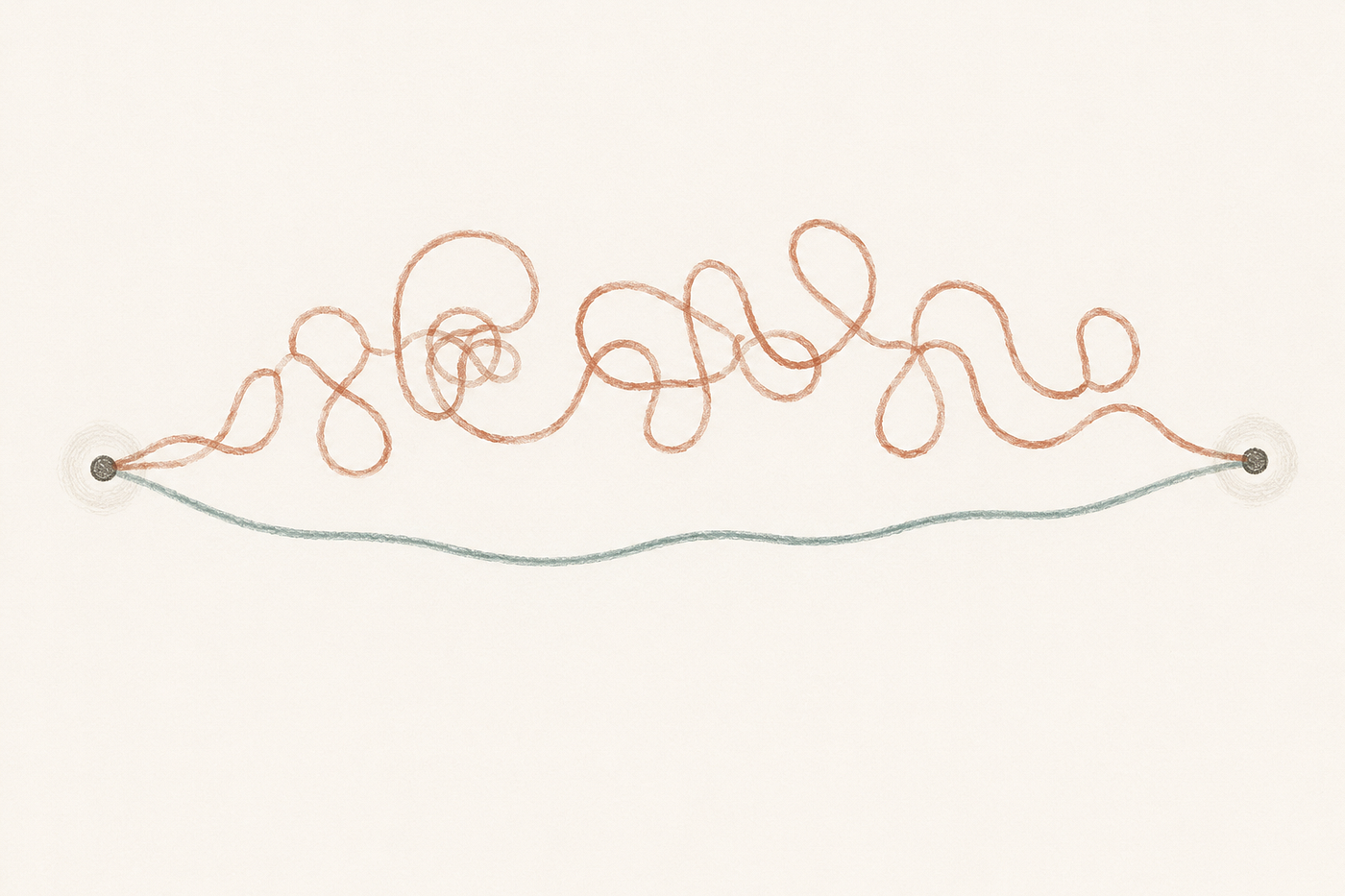
Same start. Same end. One path costs more than the other.
There’s a particular kind of discomfort I feel when I’m wasting time. Not boredom exactly. Something closer to friction. A low, persistent irritation that something could be done better, faster, smarter, and isn’t.
For a long time I thought everyone felt this kind of friction when something was being done inefficiently. To me it was just common sense, you notice the waste, you adjust. But they don’t, not really. It took me a while to see that this isn’t a default setting, it’s a particular way of seeing things, and it’s been with me for as long as I can remember.
It shows up everywhere
This mindset isn’t something I turn on at work. It’s just how I move through the world, and most of the time I don’t even notice I’m doing it.
A few years ago I had a commute of about 70 kilometres each way. That’s a lot of time sitting in a car. So the drive became something else: podcasts, audiobooks, recorded workshops, anything I could pull useful information from. The commute didn’t get shorter. But it stopped being dead time.
Or a much smaller example, the kind of thing I do without thinking. If I walk into another room at home and notice something that belongs in the room I’m heading to, I take it with me. One trip instead of two. It’s automatic. My brain is constantly scanning for the version of things that wastes less.
When I can optimise something, I optimise it. When I can’t, I try to add a useful layer on top of it. Those are the two moves, and I’ll come back to them.
Where it comes from
I don’t think this is purely an ADHD trait, though the two are impossible to separate, you’re born with an ADHD brain, it’s not something added later. But there are other threads in it too.
My father was a big influence. He’s an extremely organised, meticulous person, someone who always put the quality of the result first, no matter what. There was almost an Eastern discipline to it, even though he has no particular connection to that culture. It was just how he worked, and I absorbed it.
The other thread is karate. I practised from 13 to 21, eight years that happened to fall in exactly the years that shape you. That kind of training builds an internal structure that’s slightly different from the standard one. Discipline, repetition, attention to form. It leaves a mark.
So the aversion to waste isn’t just a symptom. It’s a mix of how my brain is wired and the things that shaped me growing up.
It’s not about speed
Here’s the part that matters, and the part that’s easy to get wrong.
Optimising is not about doing things fast. It’s about not wasting effort. Those sound similar but they’re not the same thing at all. There’s no point doing something quickly if the result is bad. A fast, sloppy output isn’t an optimisation, it’s just a different kind of waste, you’ll pay for it later.
I’m meticulous. I care about the quality of what I produce, I treat it as a baseline of professionalism. So the goal is never “less work”. The goal is the best possible result for the effort that genuinely needs to go in. No more than that. No less either.
And I want to be honest here, because this could easily start to sound like I have everything under control. I don’t. My house is often a mess. Laundry piles up, beds stay unmade, things drift out of place. It bothers me deeply, and I’m constantly fighting it, trying to find a balance between the relentless pace of daily life and the energy rollercoaster that comes with ADHD, the high peaks and the days with nothing in the tank.
And it goes further than that. I’m always looking for ways to optimise, my work, my chores, everything, but that doesn’t mean I’m some perfectly tuned production machine. The opposite, actually. I’m messy. I fall off track all the time. My execution is rarely optimal. I procrastinate, I delay, I forget what I’m supposed to do. Underneath all of it, there’s this constant ache that when I do take action, I want to find the best possible way to not lose time. But honestly, I still waste a lot of it, or at least it feels that way (the guilt of resting, of doing nothing, but that is a topic for another post).
The mindset is real. But it’s an aspiration in constant tension with reality, not a superpower that just runs cleanly in the background.
The two moves
When a task is monotonous, I lose motivation almost immediately. The energy to do it just isn’t there. So I’ve learned I have two options, and I take one of them.
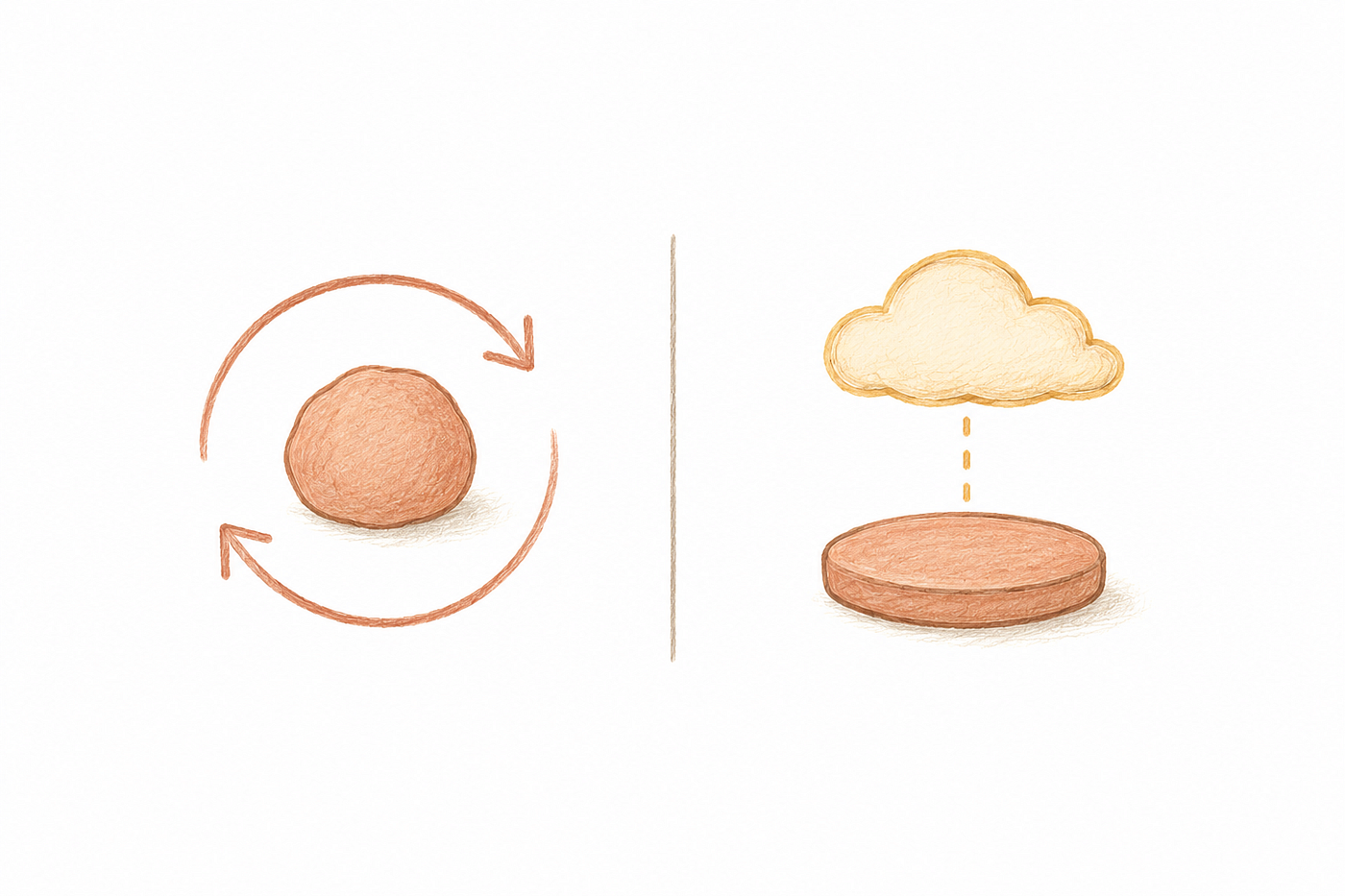
Two ways out of dead time.
Option one: optimise the task itself
One of the clearest examples from my work is User Stories. When I joined the project, the team was already writing them in full Gherkin, the structured “Given, When, Then” format usually associated with behaviour-driven development and automated testing. The thing is, that link to automated testing didn’t exist here. The Gherkin scenarios weren’t feeding any test suite, they were just being used as a way to describe what the Story should do.
In practice, that meant a lot of effort going into something that worked almost like acceptance criteria embedded inside scenarios. The real acceptance criteria, the ones meant to be explicit and clear, ended up neglected or limited.
And the cost didn’t stop there. Every time we ran a refinement, the structure tended to raise more questions than it answered. Any change to the Story meant going back and rewriting whole scenarios, sometimes most of them. The maintenance was disproportionate to the value the format was actually delivering. It was waste, plain and simple, a lot of effort being spent on a shape that wasn’t even being used for what it was designed for.
So the format was costing me time and distorting the structure of the Story itself.
I had two bad options: keep suffering through it, or cut it and leave the dev team without what they needed. Instead I did a third thing. I redesigned the format.
I kept the classic opening, as X, I want Y, so that Z, because that part still carries real value. After that, I split the description into three clear sections: context, the why behind the Story, what value it delivers or what problem it solves; what needs to be done, the practical part, written in bullets so it stays objective and easy to scan; and (additional) notes, for anything that doesn’t fit cleanly into the other two but matters enough to keep close.
The acceptance criteria went back to their own dedicated space, where they could be explicit and unambiguous. The developers still had everything they needed, in some ways more than before, but the Story stopped costing me hours to write and rewrite.
That’s the move. Not removing the task. Reshaping it so it serves everyone better, including me.
Option two: add a useful layer on top
When the task can’t be optimised away, I look for something I can extract from it. This isn’t just about monotonous work, it applies to anything that doesn’t really demand much of my brain. Mechanical tasks, repetitive ones, things I can do almost on autopilot. Without an extra layer, those tasks feel like dead time, and that bothers me far more than the task itself does.
The commute is the clearest example. The driving stayed exactly the same, but I built a layer of learning on top of it, podcasts, audiobooks, recorded workshops. The driving wasn’t intellectually demanding, so I gave the rest of my attention to something I actually wanted to absorb.
I do the same when I’m cooking. Hands busy, brain mostly free, so I let a podcast or a recorded talk fill that space. The cooking still happens, but I’m not just cooking.
What I didn’t expect, and only noticed over time, is that this layer often makes me better at the task underneath, not worse. Because my brain is engaged with something genuinely interesting, it stops trying to escape the boring part. The focus on the task itself, paradoxically, becomes steadier. And when the task has an actual output (something more meaningful than just driving), the quality usually goes up, because the meticulous part of me is calm enough to do the work properly.
The useful layer isn’t a distraction. It’s the thing that keeps me present.
The 80/20 rule, three ways
I’m a big fan of the 80/20 rule, the idea that a small part of the effort produces most of the value. But I’ve noticed it doesn’t show up in just one way in my work. It shows up in at least three, and they’re not the same thing.
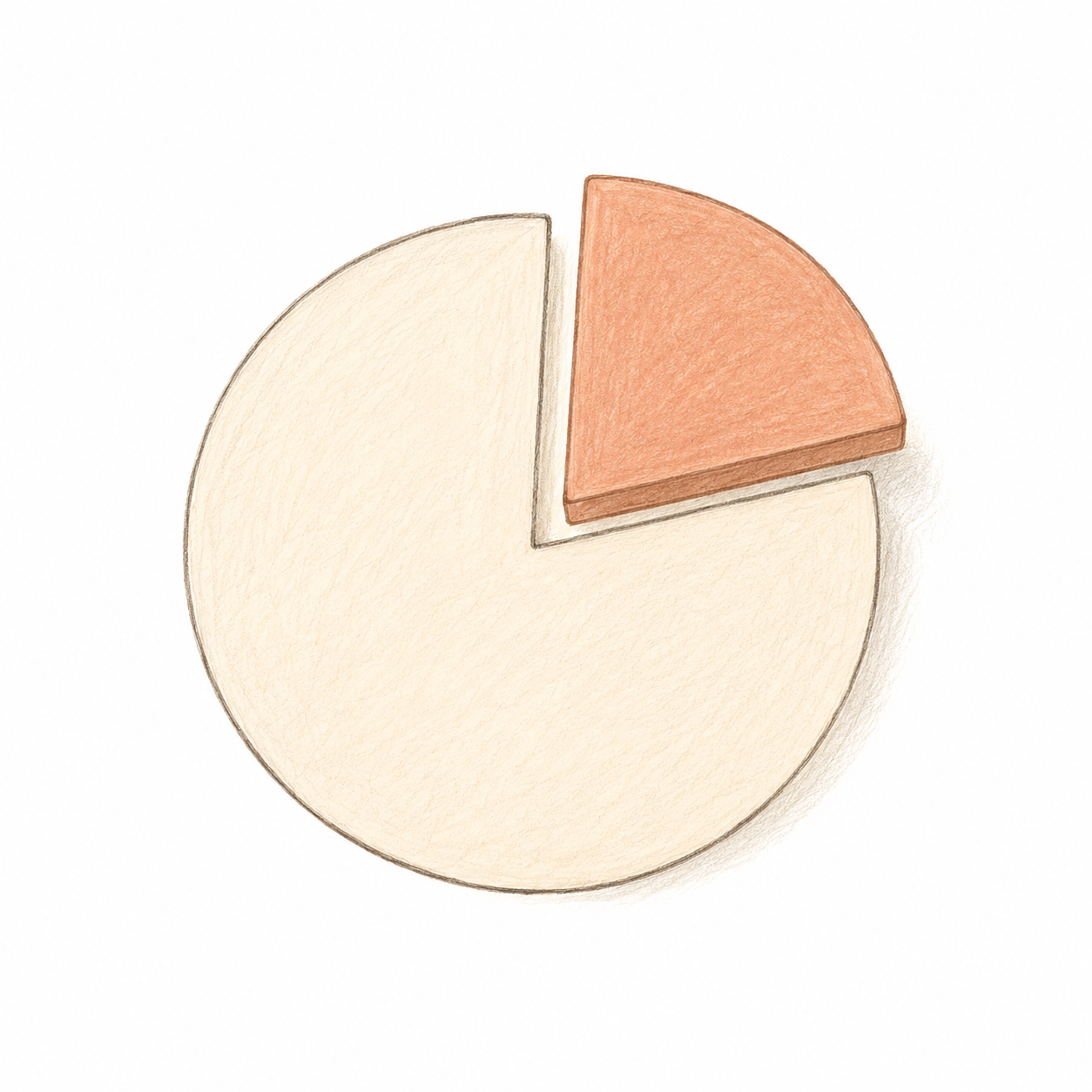
Find the few things that matter. Stop adding more.
80/20 in the artifact
The User Story structure I described above is itself an application of this rule. Three sections, each carrying a specific kind of weight, and nothing more. I don’t write everything I could write. I write what carries the value.
The “what” is deliberately concise, because excessive detail there doesn’t add clarity, it dilutes it. The context is where the depth goes, because that’s where understanding lives. Notes are the safety net for anything that didn’t fit cleanly elsewhere.
The point isn’t the structure itself. The point is the principle behind it: name the few sections that hold the real value, and stop adding more.
80/20 in prioritisation
When prioritising User Stories, the logic is delivery value against implementation effort. High value, low effort comes first. But it’s not mechanical, it has to cross-check with whether the sequencing makes sense, and with the actual level of pain the feature resolves for users.
When something is high value but also high effort, I look for a part that can be separated out, a slice that lowers the development effort while still delivering value on its own. Not necessarily the biggest piece. Just a self-contained one that’s worth shipping.
80/20 in my own energy
On low energy days, I protect the things marked as critical, the responses and decisions that genuinely can’t be delayed. The rest of the time goes to small tasks, things that don’t demand much attention and don’t drain what little energy I have.
I don’t force myself to 100% on a 40% day. I aim the little I have at the things that actually need it.
Why this is really about dopamine
Underneath all of this, the anti-waste mindset, the optimising, the 80/20, there’s something simpler going on. It’s about managing energy. And more specifically, it’s about dopamine.
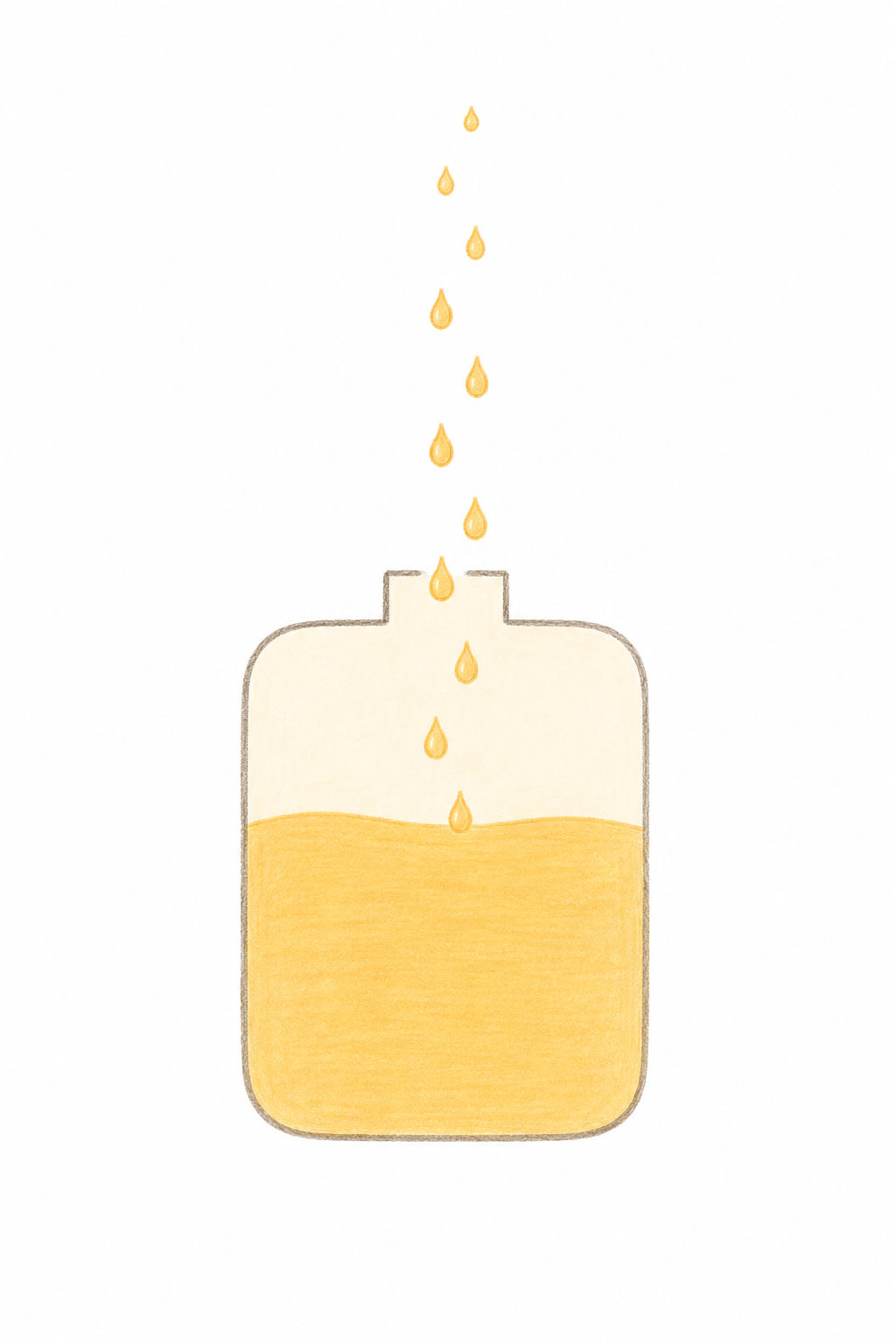
Each optimisation is a small drop of dopamine.
An ADHD brain doesn’t regulate dopamine the way a neurotypical one does. The simple version: motivation and reward don’t flow as reliably, which is part of why monotonous tasks feel almost physically draining, the brain isn’t getting enough of a return to keep going.
So optimising isn’t just a practical habit for me. It’s a way of generating the fuel I don’t always have.
When I optimise something, or cut what doesn’t matter, the strongest thing I feel is “I gained time”. And because wasting time genuinely bothers me, getting it back feels like a real win. On top of that comes the sense of being efficient, of doing more in less time, and that gives a little boost of dopamine.
The optimisation isn’t a means to an end. A lot of the time, the optimisation is the reward.
That’s worth saying clearly, because it reframes the whole thing. This isn’t about being clever or productive for its own sake. It’s about building small, repeatable hits of “that was worth it” into a day, so the tank doesn’t hit empty.
This is what works for me. Not doing less, doing it without the waste, and letting that be its own kind of fuel.
메타데이터
- post_id
- 384e7165282a
- slug
- the-cost-of-wasted-effort-but-not-laziness-384e7165282a
- url
- https://medium.com/@isabeldecastro/the-cost-of-wasted-effort-but-not-laziness-384e7165282a
- canonical_url
- https://medium.com/@isabeldecastro/the-cost-of-wasted-effort-but-not-laziness-384e7165282a
- author_url
- https://medium.com/@isabeldecastro
- status
- ok
- fetched_at
- 2026-06-09 15:37:30