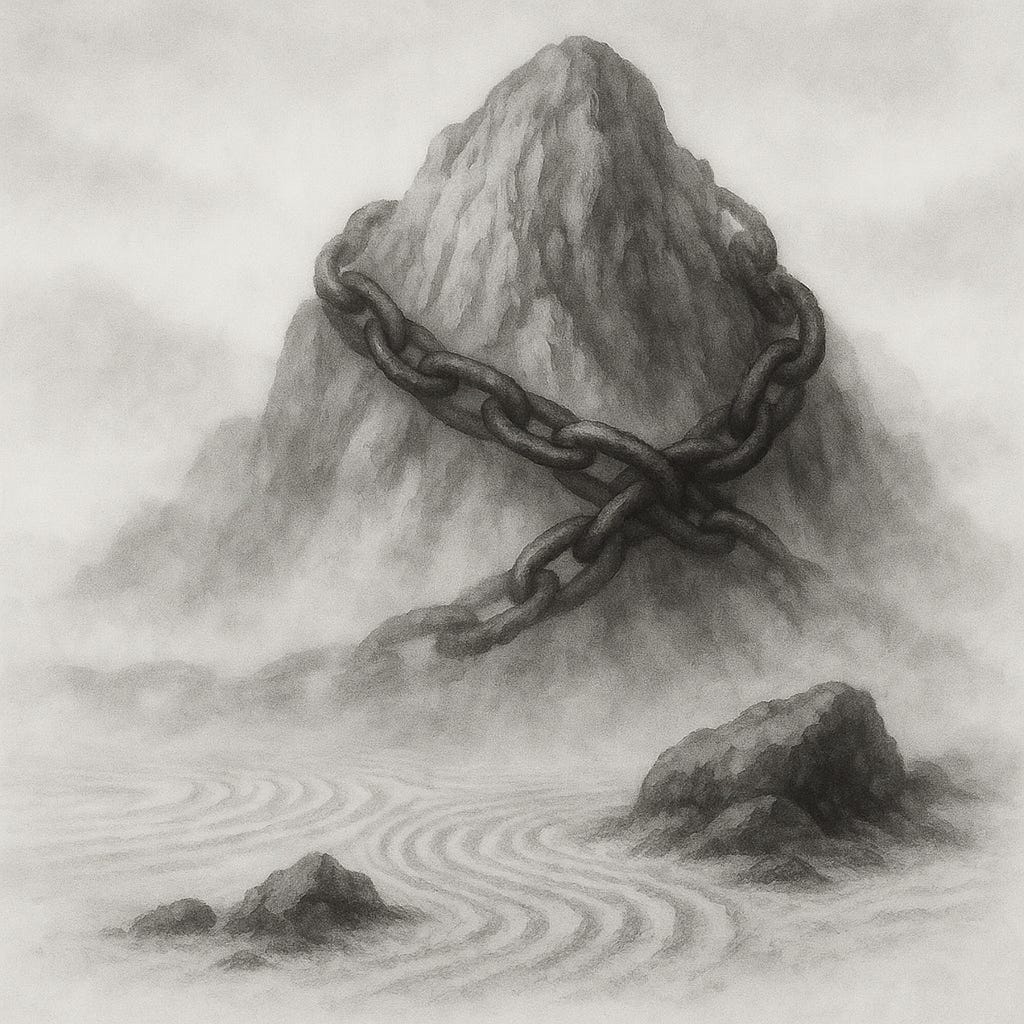
Political Philosophy as the Administration of an Asylum for the Mad
Why should a philosopher concern himself with politics at all — and at what cost to philosophy itself?
Political Philosophy as the Administration of an Asylum for the Mad
Why should a philosopher concern himself with politics at all — and at what cost to philosophy itself?
It is commonly assumed that political philosophy must justify its very existence before the world. The modern questioning or marginalization of political philosophy has led to a series of familiar doubts: first, concerning the legitimacy of this kind of reflection; second, concerning its necessity; and third, to a catalogue of serious accusations — especially in light of the evils of totalitarian systems or the madness of revolutions that claimed to speak in the name of philosophers.

Before raising these questions, however, I would like to reverse our initial doubt. Instead of asking what politics needs philosophy for, I will ask why philosophy needs political reflection at all. For it is not the case that the philosopher is — or should be — a restless individual driven by the urge to impose upon the world his own vision of political order. At least he should not be, if he does not wish to betray his vocation.
To clarify this problem, let us pause for a moment over one of Pascal’s Pensées, which captures the issue with remarkable elegance:
“Men never think of Plato and Aristotle save as pedants. They were honest men, like others, laughing with their friends; and when they amused themselves by writing the Laws or the Politics, they did so as a pastime. That part of their life was the least philosophical and the least serious; the most philosophical was to live simply and quietly. If they wrote on politics, it was as if they were laying down rules for a madhouse; and if they pretended to speak of it as of a great matter, it was because they knew that the madmen to whom they spoke believed themselves to be kings and emperors. They entered into their principles in order to moderate their madness as far as possible.”
Pascal thus overturns the characteristic modern contempt for political philosophy as the madness of world-building — as a violation of the natural order by a deranged mind seeking to impose rules derived from individual reflection upon everything. On the contrary, even in its irony, this passage expresses a distinctly philosophical desire: to limit the madness of a non-philosophical world.
Yet this desire itself must be placed under suspicion. Not every desire — even the desire of a philosopher — is necessarily worth fulfilling. This is not because the philosopher lacks the competence to do so — let us leave that judgment to others — but because it is not immediately clear why the philosopher should disturb the state of contemplation he has attained with such difficulty in order to concern himself with being as it appears in its accidents rather than in itself. Why should he touch a sphere as unstable and uncertain as politics? Why, through political philosophy, should he enter the realm of what Plato called the “broad circles,” where false opinions carry more weight than truths that demand effort? And why, finally, as a reader of Plato, should he risk death — risking that the theses he articulates will be deemed blasphemous, and that he will suffer, like Socrates, the ultimate penalty?
The least of these inconveniences is that he will be forced constantly to justify himself as someone who comes from outside, from beyond the polis, to speak about matters that stir passions and touch the interests of political actors. His language will always be different, and in disturbing the manipulative tendencies of those who govern the state, it will be judged dangerous.
In this sequence of intuitive objections to the practice of political philosophy — perhaps still too chaotic — one can already discern the key problems of classical political philosophy, in which the question raised was less often the epistemic legitimacy of such reflection than its meaning for philosophy itself. Or, more literally, as in Plato’s Letter, the question of the philosopher’s involvement in politics.
This raises a more complex problem: from which point in Aristotle’s corpus should the Politics be read. It certainly cannot be confined to the set of books that Andronicus designated under that title. A more natural introduction to political questions is the Nicomachean Ethics, taken as a whole — and beginning with its opening passages, where Aristotle offers his classification of arts and forms of action.
If, however, we wish to order political science not according to the sequence of books, but according to the natural order of reasoning, we should begin with Book X of the Nicomachean Ethics. It is there that we can understand why the philosopher should concern himself with politics at all. Not for the sake of politics, but for his own sake — for what ought, in fact, to matter most to the philosopher.
The question, then, is not what the philosopher can contribute to politics, but rather what politics contributes to the philosopher’s own intellectual project. It is this project that remains primary, while politics occupies a subordinate place within it.
The ultimate usefulness of philosophy for politics is therefore secondary to this prior question — a point to which we shall return.
Cassius
This text was written over coffee. If you’d like to support the work, you can buy me one.
메타데이터
- post_id
- 38760ae266dc
- slug
- political-philosophy-as-the-administration-of-an-asylum-for-the-mad-38760ae266dc
- url
- https://medium.com/@AristotleonPolitics/political-philosophy-as-the-administration-of-an-asylum-for-the-mad-38760ae266dc
- canonical_url
- https://medium.com/@AristotleonPolitics/political-philosophy-as-the-administration-of-an-asylum-for-the-mad-38760ae266dc
- author_url
- https://medium.com/@AristotleonPolitics
- status
- ok
- fetched_at
- 2026-06-24 11:06:28