Why are Scientists Deliberately Spilling Oil into the Ocean?
Researchers have developed algorithms that can detect oil spills in satellite radar images. But detection is only the first step.
Why are Scientists Deliberately Spilling Oil into the Ocean?
Researchers have developed algorithms that can detect oil spills in satellite radar images. But detection is only the first step.
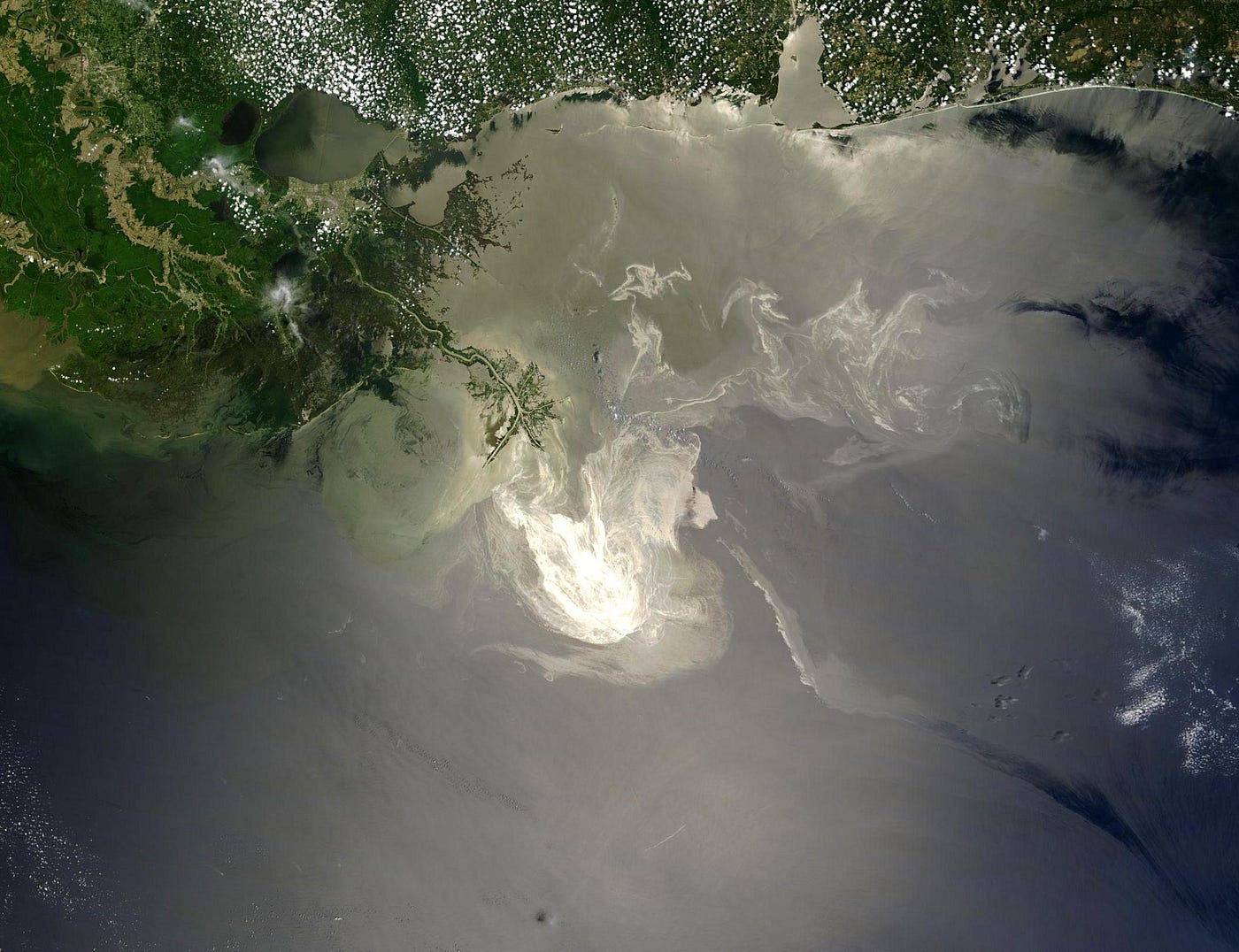
The oil spill caused by the accident on the Deepwater Horizon oil rig, as seen by NASA’s Terra satellite on May 24, 2010. Public domain
Satellites can spot oil spills on the ocean surface without actually seeing the oil. They mostly see what the oil does: because oil is heavy, it smooths the waves on the ocean surface, and the spills appear as dark patches in radar images. (If you’re curious about the physics behind that, I’d recommend my earlier piece on this.)
But here I want to address the bigger issue: we don’t just want to know that something is there. We want to know more details about it: what it is and how it behaves. Is it actually petroleum, or something else (for example, a biological slick produced by algae)? Is it fresh crude oil, bilgewater from a ship (a mixture of water, oils, fuels, and cleaning fluids), or a water-oil emulsion that has been sitting there for hours? How thick is it? How much oil is there? Is it human-caused or natural? How will it evolve in time as wind and waves do their work?
And this is where things become (more) difficult.
Detection is only the beginning
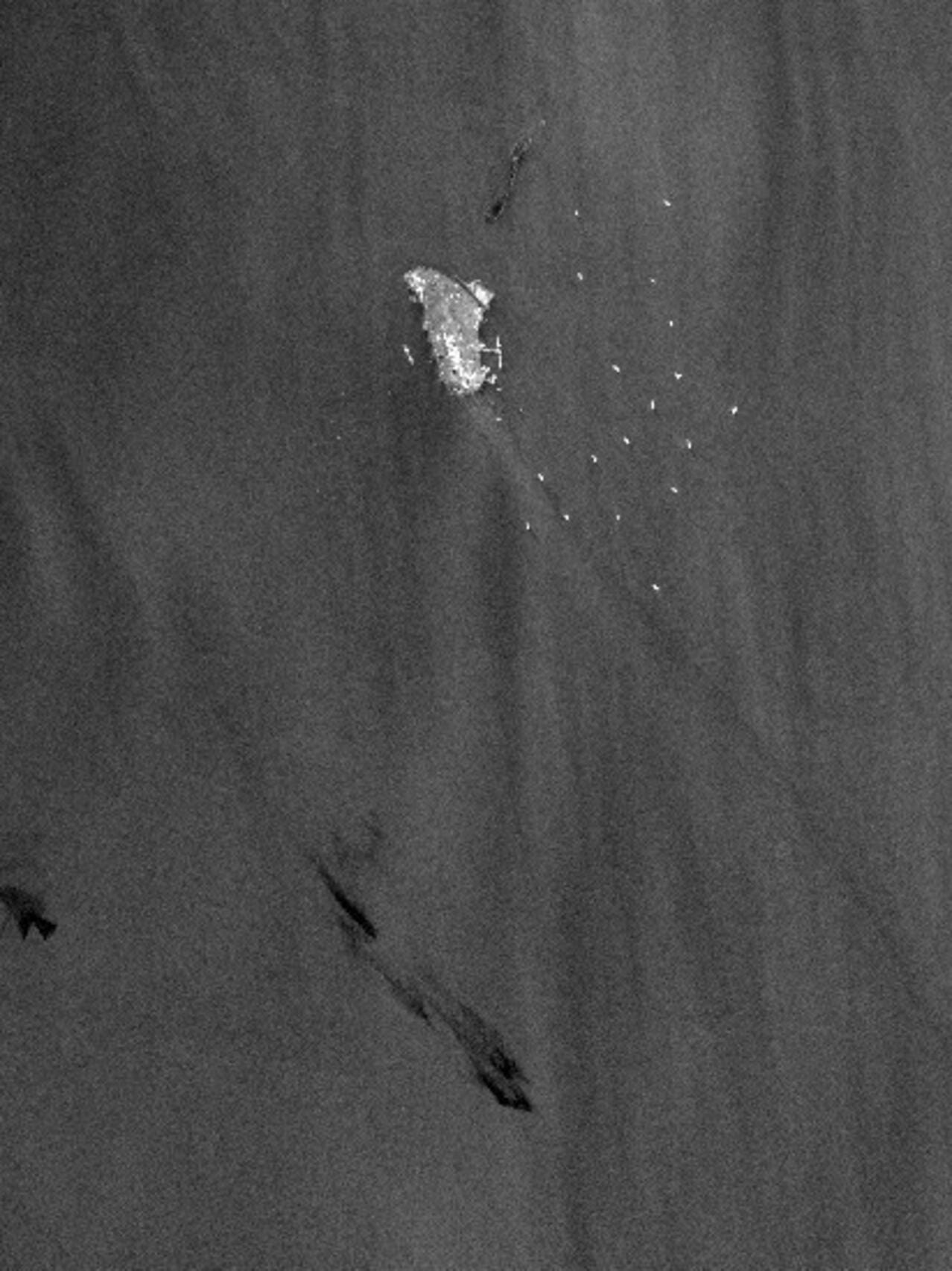
Finding a suspicious dark patch on the ocean is very useful, and at the same time it raises a bunch of new questions. Radar satellite image of Kharg Island (Iran) dated May 9, 2026. Copernicus Sentinel data 2026
Real oil spills are abundant. In U.S. waters alone, thousands of oil spills occur each year. In the whole world, around 1.3 million tons of oil (equivalent to burning about 410 million gallons of gasoline, or 10.3 billion miles of driving) are spilled into the oceans every year. Most of these spills are small, though, for example, when oil leaks while refueling a ship.
They are abundant, yes, but they are terrible as scientific datasets. For so many reasons. They happen unexpectedly, under uncontrolled conditions, with uncertain quantities, and often incomplete documentation. Basically, they’re chaotic events that take us by surprise.
And that’s a problem, because an algorithm needs something robust to be properly calibrated. You can’t validate a detection model if you don’t actually know what was released or how much of it there was. The computer needs what we usually call ground truth, and it can’t make it up by itself.
By the time satellites, aircraft, and response teams have collected observations, the oil slick has already changed through evaporation, dispersion, and other natural phenomena. We are basically left trying to reconstruct the experiment after the fact, when it’s usually the other way around. It’s like trying to train a facial recognition algorithm using blurry photographs taken by night. You would want to put yourself in better conditions to do that.
If you can’t catch the mess, make the mess
So researchers decided to create the experiment for themselves. The first time I heard about it, I have to say it sounded completely insane to me.
They spill oil on purpose onto the sea!
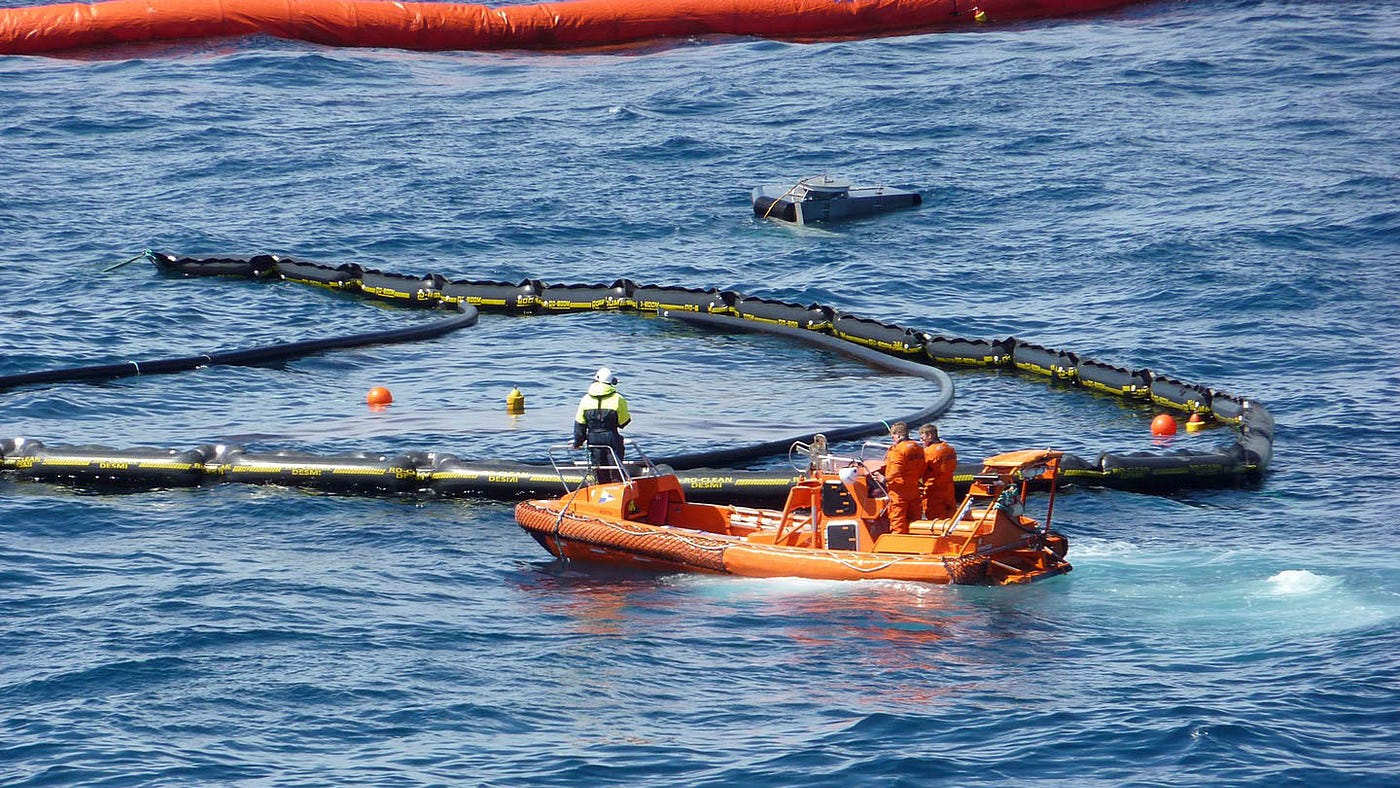
Personnel from the Norwegian Clean Seas Association (NOFO) monitor the dispersion of a controlled oil release in the North Sea during Norway’s annual Oil on Water exercise. Image by NOFO
The most valuable datasets in oil-spill remote sensing do not come from major disasters, but from carefully planned experiments in which ships deliberately release known substances onto the ocean while aircraft, drones, and satellites observe everything from above.
That’s how you get fresh data. The quantities, composition, location, and timing are all known in advance. That’s real ground truth to calibrate the algorithms. Using these data, researchers can answer a ton of new scientific questions: what does this particular substance look like from space after ten minutes? After four hours? Under strong winds? Under calm weather?
And they don’t just release crude oil. Some experiments also use vegetable oils, because natural phenomena like algae films can produce slicks that look similar to petroleum in radar imagery. Others use water-oil emulsions that are almost identical to the mixture released by ships or the natural mix of seawater and petroleum.
Of course, the goal isn’t to create a disaster, but to feed algorithms with fresh and diverse data. An algorithm that can only recognize crude oil is not the most useful if it mistakes every patch of biological material for a spill, or if it misses weathered oil that no longer looks like fresh crude. The challenge is to learn the subtle differences between all these phenomena to be able to identify them.
So many questions
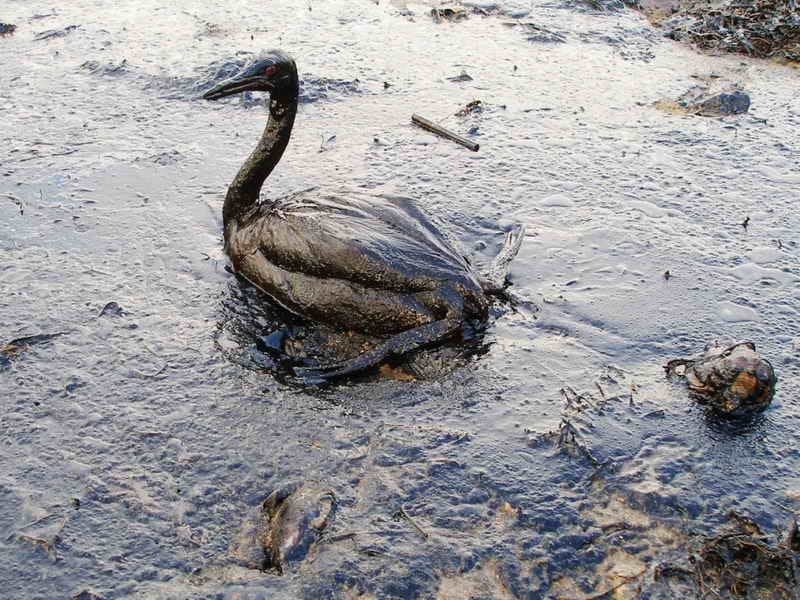
Pic credit: Igor GOLUBENKOV (NGO: Saving Taman). Creative Commons, Flickr
Still, I was left with so many questions the first time I heard about this. Let me try to answer some of them.
The obvious one, of course, coming straight from our heart.
“Are they seriously dumping oil into the sea?”
Well, yes, but under extremely strict conditions. Obviously, you need to request permits from environmental authorities and to involve crisis response organizations in all the phases of the project.
“What happens to the oil? Do they leave it there?”
The experiments are designed as both scientific campaigns and recovery exercises, which means the data acquisition is also an opportunity to test technologies used to clean up real accidents. In Norway, for example, many of these experiments have been organized together with the Norwegian Clean Seas Association (NOFO). Among all their activities, they are responsible for maintaining a task force dedicated to emergency response.
So no, they don’t leave it there. The releases are planned, authorized, monitored, and cleaned up. Sometimes, the primary motivation of a release is to test recovery technologies, and remote sensing data or oil weathering are just a nice bonus for researchers.
“But how do they recover the oil?”
They try to catch it before it spreads too much. The first tool is a boom. Despite the name, it’s not something that explodes — it’s a long floating barrier deployed on the water, like a giant curtain. Boats tow these barriers to surround the oil slick and guide it into a smaller area. This way, it can’t disperse too quickly.
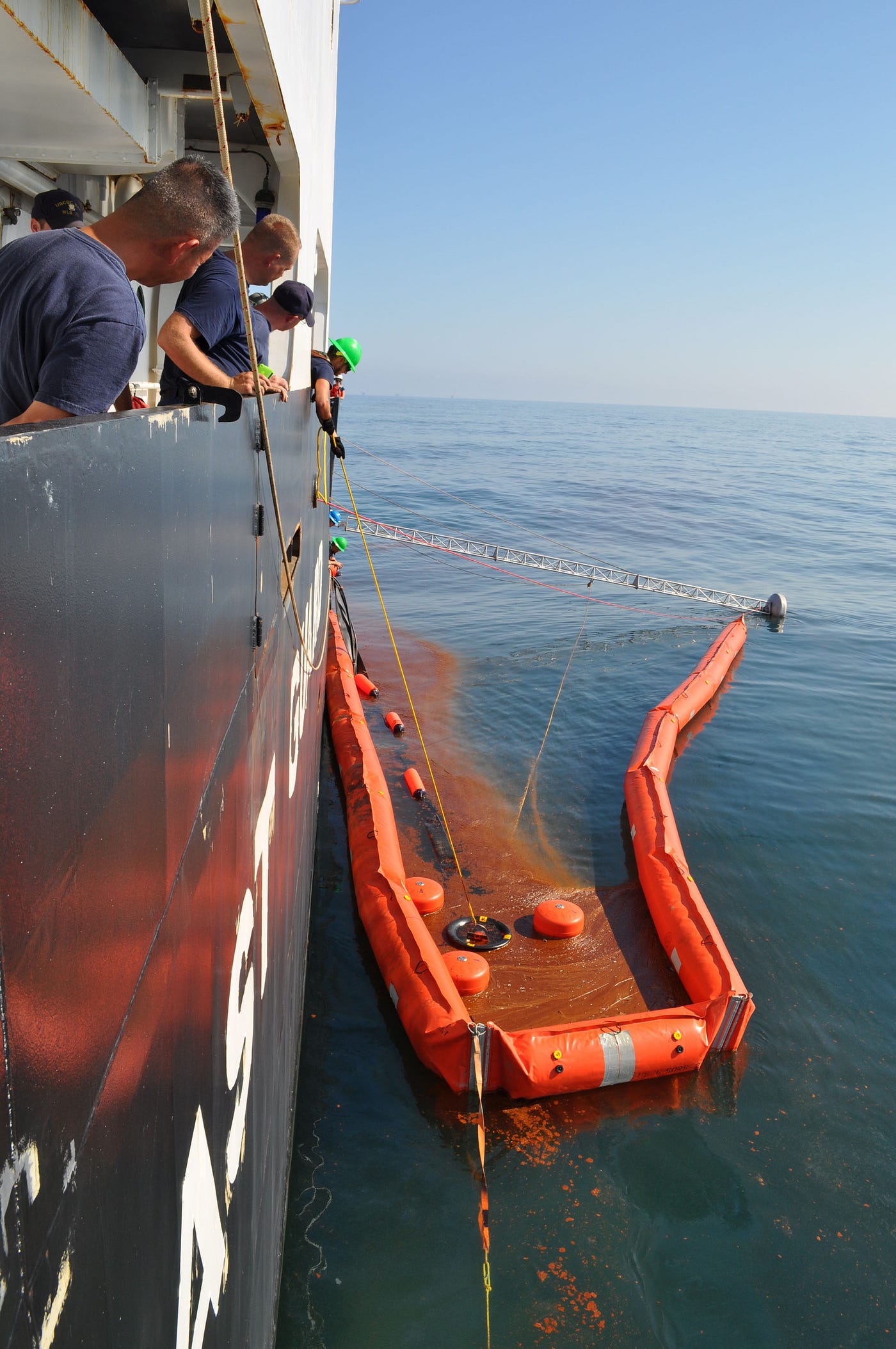
Oil recovery during the Deepwater Horizon response. The orange floating barrier is the boom. Its job is to concentrate the oil into a smaller area, where a skimmer can collect it more efficiently. Public domain
Once the oil has been concentrated, skimmers take over the job. They are giant vacuum cleaners designed to collect oil on the surface while leaving as much water behind as possible. The recovered oil is then pumped into storage tanks on board the ship.
“Are they able to recover everything?”
I’ll be brutally honest here: no.
This whole process of using booms and skimmers is called mechanical recovery. Complete recovery is in fact impossible. These experiments are called controlled releases, but the ocean is not a controlled lab. Wind, waves, evaporation, natural dispersion, and mixing with water immediately begin as soon as the oil is released.
The goal is therefore to recover as much material as possible while generating the scientific data that will be helpful to engineers and researchers. Because of that, the organizers usually keep releases limited, and they choose locations far offshore. They try their best to minimize impact while maximizing the scientific value.
A small price to pay?
A beautiful clean ocean. Photo by Rafael Garcin on Unsplash
We spend enormous amounts of time, energy, and money to prevent oil from reaching the oceans, and yet a bunch of nerds deliberately put it there.
That’s because the best experiment is the one where you know exactly what happened and you’re in total control of the parameters. When you put it this way, I agree that it can feel quite uncomfortable. But it’s also pragmatic.
Keep in mind that a tiny controlled release can generate knowledge that improves detection and response for accidents thousands of times larger. Sometimes, the smallest mess is what allows us to better deal with the biggest ones.
So what has this research achieved so far? Controlled releases of oil have greatly helped scientists to go further than simply flag a suspicious patch on the ocean. Thanks to this valuable scientific data that they couldn’t have gotten otherwise, they are now able to distinguish petroleum from natural look-alikes, classify oil spills by thickness, and separate fresh oil from weathered emulsions to adapt recovery strategies.
Of course, many challenges remain, the first one being to make these experiments unnecessary because we’re simply not polluting the oceans with oil anymore. In the meantime, even though these researches can’t prevent accidents from happening, they still bring valuable knowledge that can make response efforts faster, more targeted and effective, and, in the end, less damaging to the marine environment.
Thank you for reading! I’m Kamel Lahssini, and I share stories about how humans observe and map the world. If you want to read more, don’t hesitate to follow me. I’m always happy to reply to a thoughtful comment and start a conversation!
메타데이터
- post_id
- 387c6d304c80
- slug
- why-are-scientists-deliberately-spilling-oil-into-the-ocean-387c6d304c80
- url
- https://medium.com/the-new-climate/why-are-scientists-deliberately-spilling-oil-into-the-ocean-387c6d304c80
- canonical_url
- https://medium.com/the-new-climate/why-are-scientists-deliberately-spilling-oil-into-the-ocean-387c6d304c80
- author_url
- https://medium.com/@kamel.lahssini
- status
- ok
- fetched_at
- 2026-06-20 20:29:01