Why Enterprise AI Agents Are Failing
The Hidden Tax on Enterprise Intelligence
Why Enterprise AI Agents Are Failing

The Hidden Tax on Enterprise Intelligence
Every enterprise has the same problem — they just don’t know what to call it.
Marketing built a customer segmentation model. Sales created their own account taxonomy. R&D developed a product ontology. Finance maintains a cost classification system. Each department, operating rationally, constructed its view of organizational reality.
The result? Semantic fragmentation — disconnected islands of meaning that cost businesses $3.1 trillion annually, according to McKinsey. Gartner estimates each organization loses $15 million per year to poor data quality alone. And when enterprises deploy AI agents across these fractured semantic landscapes, something predictable happens: they fail.
Not dramatically. Quietly. The agent that works perfectly in marketing produces nonsense when it touches sales data. The supply chain optimizer that saves millions in one division creates chaos when extended to another. Cross-functional insights that should be obvious remain invisible because no system can reason across departmental boundaries.
This isn’t a technology failure. It’s an architecture failure. And three decades of academic research tell us exactly why it happens — and how to fix it.
What Academia Discovered (That Most Enterprises Ignore)
In 1998, researchers at the University of Edinburgh published “The Enterprise Ontology” — a foundational work that identified the core problem enterprises would struggle with for the next quarter century. Michael Uschold and his colleagues recognized that without shared conceptual foundations, organizational knowledge fragments along departmental lines.
The insight was simple but profound: ontologies alone don’t solve heterogeneity — they just raise heterogeneity problems to a higher level.
Think about it. When marketing creates an ontology defining “customer,” they encode their operational reality — engagement metrics, campaign responses, lifetime value calculations. When sales creates their ontology for “customer,” they encode a different reality — deal stages, account hierarchies, revenue attribution. Both are correct. Both are useful. And they’re fundamentally incompatible.
Euzenat and Shvaiko, in their seminal work Ontology Matching, documented this pattern across hundreds of enterprise implementations. The more departments build domain-specific ontologies, the more semantic silos multiply. Each new AI initiative, each new data product, each new integration project encounters the same friction: systems that can’t understand each other because they don’t share meaning.
The academic community spent decades developing the solution. Foundational ontologies like UFO (Unified Foundational Ontology) and BFO (Basic Formal Ontology) — now an ISO standard used by 650+ projects, including the U.S. Department of Defense — demonstrated that domain ontologies must extend from a common semantic core, not emerge in isolation.
Jan Dietz’s Enterprise Ontology methodology proved that starting with “implementation-independent essence” — the fundamental business concepts before departmental interpretation — reduces complexity by 90% or more. The TOVE Project at the University of Toronto showed that distributed enterprise agents require “shared representation (ontology) that distributed enterprise agents can understand” as a prerequisite for any meaningful integration.
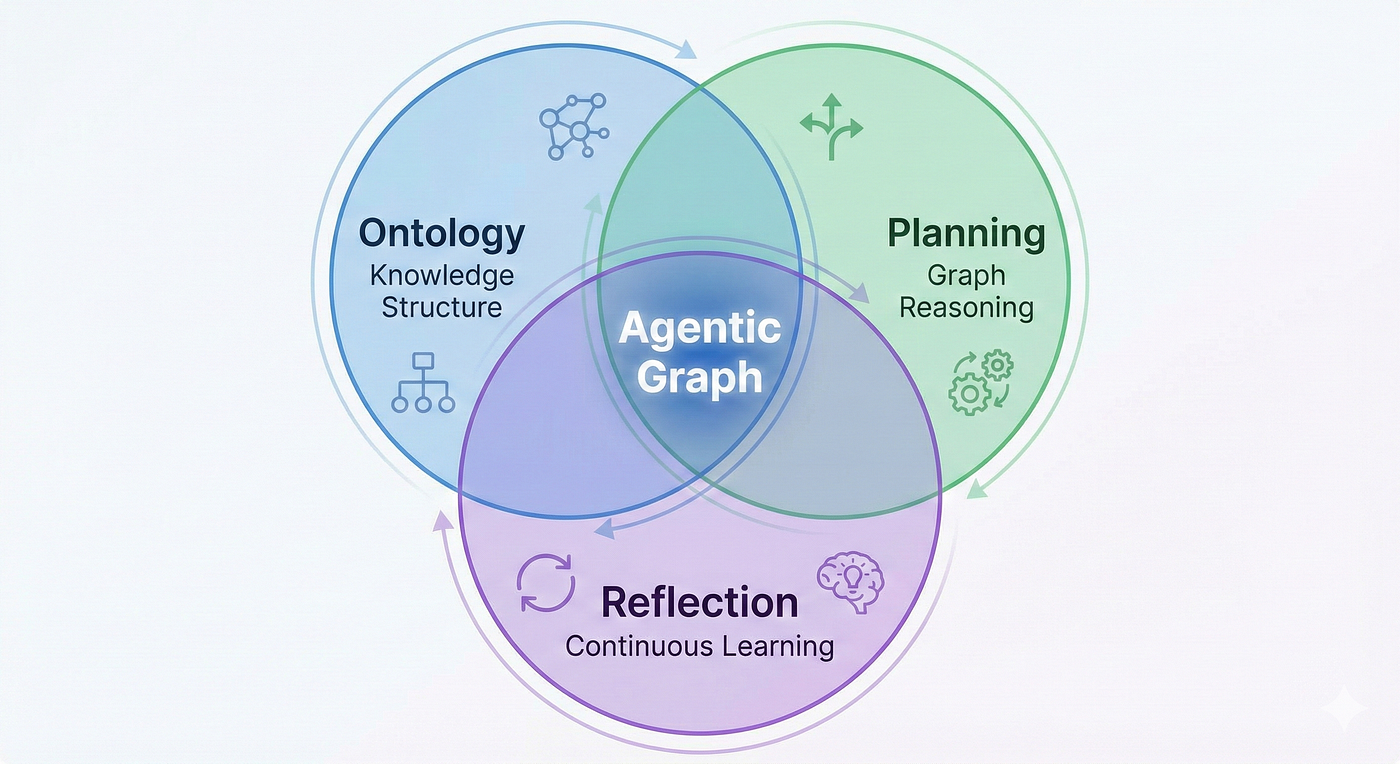
The prescription is clear: Business Data Models defining shared concepts, stabilized by business glossaries, must precede domain ontology development. Ontologies should derive from this foundation as extensions, not exist as independent silos.
Most enterprises ignored this. They kept building bottom-up, department by department, project by project. And they kept paying the trillion-dollar tax.
Why This Matters Now: The AI Agent Imperative
For years, semantic fragmentation was an expensive nuisance — friction that slowed integrations, inflated IT budgets, and created data quality headaches. Knowledge workers are compensated. They learned which systems to trust for which questions. They maintained mental maps of where meaning diverged between departments.
AI agents can’t do this.
When an LLM-powered agent encounters the term “customer” in a query, it doesn’t have thirty years of institutional knowledge to disambiguate context. It doesn’t know that “customer” means something different in the CRM, the financial system, and the support ticket database. It treats fragmentary semantics as coherent truth , and generates confidently wrong answers.
Recent research quantifies the damage. A 2024 study in the Journal of Web Semantics found that knowledge graphs provide “a formal framework to evaluate the validity of a query generated by an LLM, serve as a foundation for explaining results, and offer access to governed and trusted data.” Without this semantic grounding, RAG systems hallucinate. Agents make incorrect inferences. Cross-domain reasoning becomes impossible.
Salesforce’s “Agentic Enterprise IT Architecture” explicitly introduces the Semantic Layer to “resolve the disconnect between raw enterprise data and the semantic understanding that AI agents need.” Stardog’s enterprise AI research concludes that “the only way to win with AI in the enterprise is to have the right data strategy. State of the art for RAG in the enterprise is retrieval from a fully-grounded Knowledge Graph.”
The companies succeeding with enterprise AI share a common characteristic: they built semantic foundations before deploying agents. Those still struggling share a different characteristic: they’re trying to make AI work on fragmented meaning.
Gartner predicts that by 2030, “AI agents will replace 30% of SaaS application user interfaces, relegating SaaS applications to semantically enriched domain data sources.” The enterprises without semantic infrastructure will find their AI investments stranded — powerful engines with no coherent fuel.
How RoboCorp Solves the Semantic Foundation Problem
RoboCorp’s Knowledge Fabric isn’t another data integration tool. It’s the implementation of what academia prescribed for thirty years: a unified semantic foundation from which domain ontologies derive coherent, interoperable meaning.
The Architecture: Three Layers of Semantic Integration
Layer 1: The Business Foundation
Every RoboCorp implementation begins where Dietz’s methodology begins — with business essence. Before connecting data sources, before building agents, before creating workflows, the Knowledge Fabric establishes:
- Business Glossary: The controlled vocabulary that stabilizes meaning across the organization. When we define “customer,” that definition becomes the reference point for every system, every agent, every analysis. Not marketing’s customer. Not the sales customer. The organization’s customer has explicit relationships to departmental interpretations.
- Core Ontology: The foundational concepts — entities, relationships, events, actors — that every domain shares. This isn’t abstract philosophy. It’s practical architecture. When the Knowledge Fabric understands that a “Transaction” involves an “Actor” transferring a “Resource” at a “Time,” it can reason about transactions across sales, procurement, HR, and finance.
- Business Data Model: The canonical representation of enterprise reality that departmental models extend rather than replace. This is what BFO calls “downward population” — generic branches that domain ontologies inherit and specialize while maintaining alignment with the whole.
Layer 2: Domain Extensions
With the foundation established, departments build their specific ontologies — but as extensions, not silos. Marketing’s customer engagement model imports the core “Customer” concept and specializes it with engagement-specific attributes. Sales’ account hierarchy does the same, creating a different view of the same underlying entity.
The Knowledge Fabric maintains these relationships automatically. When an AI agent queries customer behavior, it can traverse from marketing’s engagement metrics through the core Customer concept to sales’ revenue data without manual mapping, without integration projects, without semantic translation errors.
This is what Guizzardi’s UFO methodology prescribes: domain ontologies as “extensions of a common semantic core.” What researchers demonstrated in controlled experiments, RoboCorp implements in production environments.
Layer 3: The Intelligence Layer
The semantic foundation enables what fragmented architectures cannot: intelligent discovery and cross-domain reasoning.
- Automatic Annotation: When new data sources connect, the Knowledge Fabric doesn’t just ingest data — it understands data. Natural language descriptions map to ontological concepts. Schema elements align with the business glossary. Relationships to existing knowledge emerge automatically.
- Entity Resolution: The same customer appearing across systems with different identifiers is treated as a single entity with multiple representations. Not through brittle matching rules, but through semantic understanding of what makes a customer the same customer.
- Cross-Domain Reasoning: An AI agent can answer “Which marketing campaigns drove the highest-margin sales in regions with supply chain constraints?” because it can traverse marketing ontology → core concepts → sales ontology → core concepts → supply chain ontology in a single coherent reasoning chain.
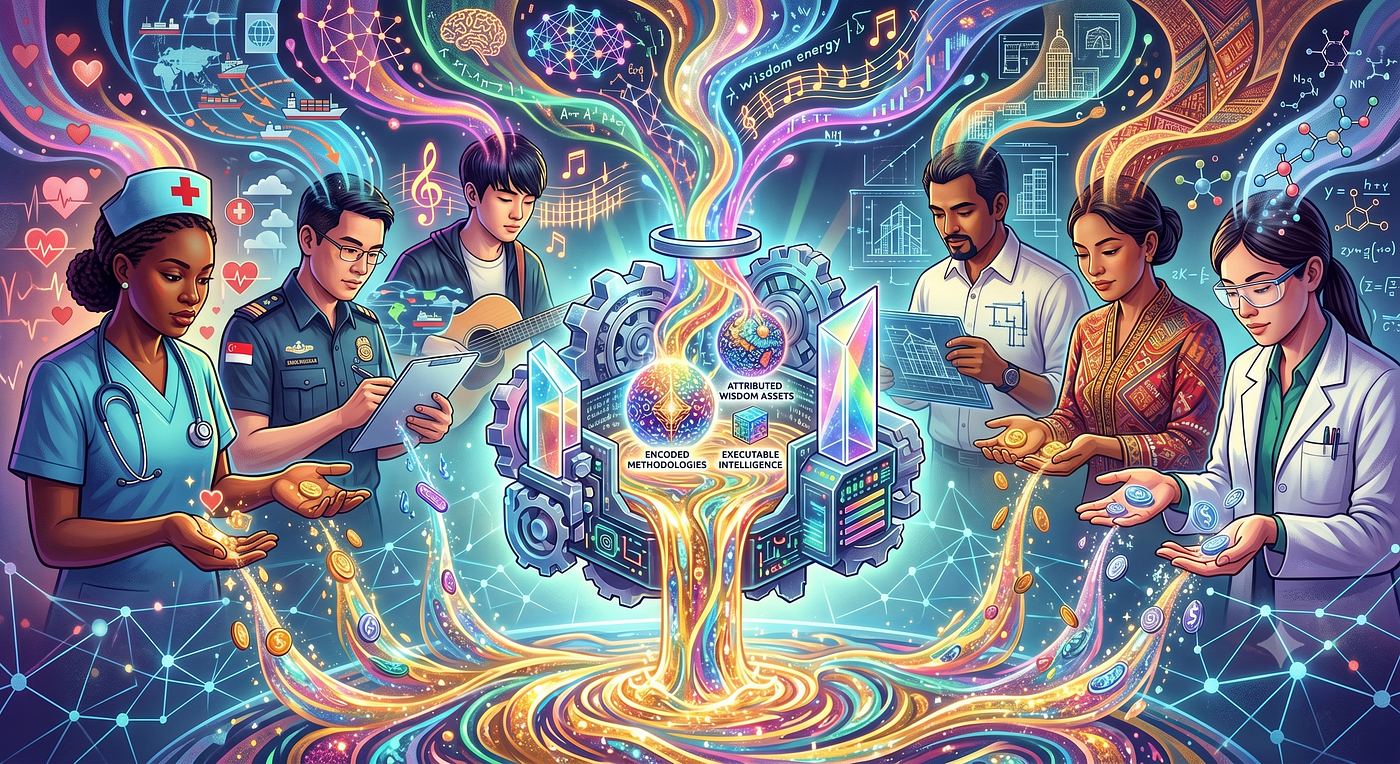
The Studio: Where Wisdom Becomes Executable
The Knowledge Fabric creates semantic coherence. The Studio transforms that coherence into value.
Domain experts — the people who actually understand supply chain optimization, customer segmentation, and financial analysis — describe their expertise in natural language. The system transforms these descriptions into executable AI agents grounded in the enterprise’s semantic reality.
This is possible only because the semantic foundation exists. When Wayne, a retired supply chain consultant, describes his optimization process in plain English, the Studio can:
- Parse intent against the business glossary: “Inventory levels” maps to the defined concept, not a guess at what he might mean
- Identify relevant ontological structures: Supply chain optimization involves Suppliers, Products, Locations, Demand Signals — all with explicit relationships
- Generate grounded workflows: The resulting agent operates on semantically coherent data, not fragmented departmental exports
- Enable cross-domain enhancement: Because the foundation connects domains, the supply chain agent can incorporate demand forecasts from sales, cost structures from finance, quality metrics from manufacturing — automatically
Wayne doesn’t need to understand ontologies. He doesn’t need to map data sources. He describes what he knows, and the semantic foundation handles the rest.
The Marketplace: Semantic Interoperability at Scale
When ontologies share common foundations, something remarkable becomes possible: agents built for one organization can work for another.
Traditional AI solutions are brittle. They’re trained on specific data structures, specific naming conventions, specific departmental interpretations. Move them to a new environment, and they break.
RoboCorp Marketplace agents are different. Because they’re grounded in foundational concepts rather than implementation-specific schemas, they adapt. An invoice fraud detection agent built against one company’s semantic foundation can operate against another’s — the core concepts of Invoice, Vendor, Payment, and Anomaly remain stable even as departmental specifics differ.
This is why the Marketplace can exist. Not as a collection of code to be customized, but as a library of executable wisdom that speaks a common semantic language.
The Technical Implementation
For architects and engineers, here’s how the Knowledge Fabric implements academic prescription:
Business Glossary as Terminological Ontology
The glossary isn’t a spreadsheet. It’s a formally defined terminological ontology with:
- Preferred terms and synonyms: “Customer” = “Client” = “Account” with explicit equivalence relationships
- Scope notes and definitions: What the term means in the business context, not just technical metadata
- Hierarchical relationships: “Enterprise Customer” as a specialization of “Customer”
- Cross-references: Explicit mapping to domain-specific interpretations
Core Ontology Following UFO Patterns
The foundational layer implements UFO’s three-stratum architecture:
- UFO-A (Structural): Endurants — the things that persist (Customers, Products, Locations)
- UFO-B (Event): Perdurants — the things that happen (Transactions, Campaigns, Deliveries)
- UFO-C (Social/Intentional): Agents, Goals, Commitments — the actors and their purposes
This isn’t arbitrary. It’s the structure that two decades of ontological research identified as necessary for enterprise modeling.
Knowledge Graph as Integration Hub
The Knowledge Fabric materializes as a knowledge graph — but not just any graph. Following what Galkin et al. describe as “semantic business data hubs,” it:
- Serves as a single source of truth for entity definitions
- Maintains provenance for every fact and relationship
- Supports both instance data and ontological schema
- Enables queries that traverse semantic relationships
- Provides the grounding layer that LLMs require for reliable enterprise reasoning
MCP Protocol for Agent Integration
The Model Context Protocol (MCP), now under Linux Foundation governance, provides the standard interface for agents to access semantic context. When an agent needs to understand what “Customer” means, it queries the Knowledge Fabric through MCP — receiving not just data but meaning.
The Business Case: From Cost Center to Value Engine
The ROI of semantic foundations is documented across multiple implementations:
Walmart’s Global Data Model integrated 100+ enterprise domains through a unified semantic architecture, improving search accuracy, data quality, and customer experience across their entire operation.
A global bank (McKinsey case study) achieved $400 million+ in annual savings by replacing 600+ fragmented data repositories with a unified enterprise data architecture featuring standardized definitions and “golden source” repositories.
An investment company implementing enterprise taxonomy achieved an 86–99% success rate in auto-tagging content and approximately 80% reduction in human effort for content migration.
These aren’t projections. They’re measured outcomes from organizations that implemented what academia prescribed.
For RoboCorp users, the value compounds:
- Reduced integration costs: 70% of the effort in traditional data integration goes toward resolving semantic mismatches. Semantic foundations eliminate this category of work.
- Accelerated AI deployment: Agents built on coherent semantics work the first time. No months of prompt engineering to handle departmental inconsistencies.
- Cross-domain insights: Questions that previously required manual analysis across multiple systems can now be answered with a single query against a unified knowledge base.
- Monetizable expertise: Because the semantic foundation is portable, agents created in the Studio become Marketplace assets that work across organizations — turning domain knowledge into recurring revenue.
The Path Forward
The academic community spent thirty years understanding why enterprise semantics fragments and how to fix it. The technology industry spent those same thirty years ignoring the lessons, building more silos, accumulating more semantic debt.
The AI imperative changes the equation. You can’t prompt-engineer your way around fragmented meaning. You can’t fine-tune models to understand concepts that are inconsistent. You either have semantic foundations, or you have AI that fails at organizational boundaries.
RoboCorp provides those foundations — not as a theoretical framework, but as an operational platform. The Knowledge Fabric implements what Guizzardi, Guarino, Dietz, Uschold, and generations of researchers prescribed. The Studio transforms that foundation into executable value. The Marketplace makes semantic interoperability a network effect.
The $3.1 trillion tax isn’t inevitable. It’s a choice. Organizations that continue building departmental silos will continue paying it. Organizations that invest in semantic foundations — the “implementation-independent essence” that Dietz identified, the “common semantic core” that enables what we call universal enterprise ontology — will capture value their competitors can’t access.
The research is clear. The technology exists. The only question is who moves first.
RoboCorp is a wisdom-exchange platform that enables organizations to monetize domain expertise, build AI agents on semantic foundations, and participate in the emerging knowledge economy. Learn more at robocorp.co.
References
- Euzenat, J. & Shvaiko, P. (2013). Ontology Matching (2nd ed.). Springer.
- Guizzardi, G. et al. (2022). “UFO: Unified Foundational Ontology.” Applied Ontology 17(1), 167–210.
- Dietz, J.L.G. (2006). Enterprise Ontology: Theory and Methodology. Springer.
- Uschold, M. et al. (1998). “The Enterprise Ontology.” The Knowledge Engineering Review 13(1), 31–89.
- Trojahn, C. et al. (2022). “Foundational Ontologies Meet Ontology Matching: A Survey.” Semantic Web Journal.
- Pan, S. et al. (2024). “Unifying Large Language Models and Knowledge Graphs: A Roadmap.” IEEE TKDE.
- Bian, J. et al. (2025). “LLM-empowered Knowledge Graph Construction: A Survey.” arXiv.
- ISO/IEC 21838–2:2021. “Basic Formal Ontology (BFO).”
메타데이터
- post_id
- 387c6fc21591
- slug
- why-enterprise-ai-agents-are-failing-387c6fc21591
- url
- https://medium.com/graph-praxis/why-enterprise-ai-agents-are-failing-387c6fc21591
- canonical_url
- https://medium.com/graph-praxis/why-enterprise-ai-agents-are-failing-387c6fc21591
- author_url
- https://medium.com/@shereshevsky
- status
- ok
- fetched_at
- 2026-07-22 12:02:30