The Security History of Solana
Outages, Exploits, and Lessons for the Future of Layer 1s
The Security History of Solana

Since its inception, Solana has marketed itself as a high-performance blockchain offering lightning-fast transactions and ultra-low fees. Its innovative architecture — built around parallel transaction processing and proof-of-history — set it apart from other Layer 1s vying for scale. However, with innovation comes complexity, and complexity often opens the door to security challenges.
As a blockchain security researcher, I’ve spent time analyzing the historical security posture of Solana — from protocol-level bugs to supply chain vulnerabilities and ecosystem-level exploits. The goal of this research is not just to document the past, but to extract practical lessons about how modern blockchains should approach security in high-throughput environments.
Over the past few years, Solana has experienced a series of critical security incidents, ranging from network-halting bugs to high-profile exploits in its ecosystem. These events have tested the network’s resilience and raised important questions about the tradeoffs between speed, decentralization, and security.
This article presents a rigorous, data-driven analysis of Solana’s security history. We examine the root causes, repercussions, and lessons learned from major vulnerabilities — focusing on both core protocol failures and application-level exploits. From private key compromises to consensus breakdowns, we assess how frequent these incidents have been, the total losses involved, who was impacted, and how Solana’s security response has evolved — including its bug bounty program, developer engagement, and engineering overhauls.
This is more than just a historical summary. It’s intended to serve as an educational resource for developers, auditors, and researchers — especially those working to secure high-performance blockchains like Solana.
Incident Timeline and Categorization
Despite its architectural innovation and unmatched throughput, Solana has encountered a series of security incidents that have shaped its evolving approach to resilience and safety. These incidents span a spectrum — from protocol-level bugs to infrastructure misconfigurations and stress induced by adversarial activity.
A. Core Protocol Failures
These incidents originated within Solana’s base layer, often resulting in full network halts or validator desynchronization. Root causes ranged from architectural edge cases to resource exhaustion under adversarial load. Each incident challenged assumptions about the protocol’s robustness and led to targeted engineering improvements.
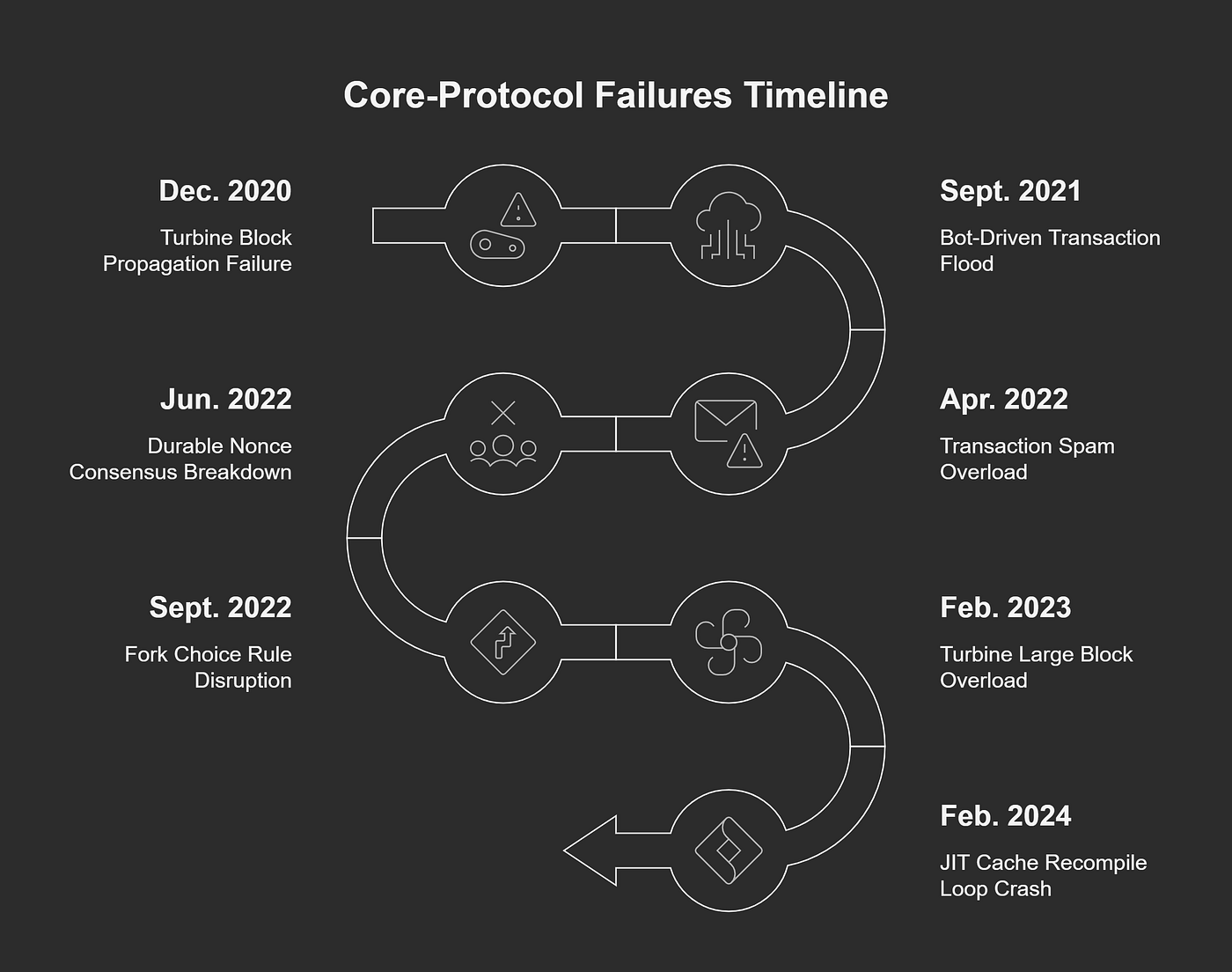
1. Turbine Block Propagation Failure
Date: December 2020 Outage Duration: ~6 hours
Solana’s first major disruption stemmed from a vulnerability in the Turbine protocol, responsible for block propagation across validators. The incident occurred when a validator mistakenly ran two identical nodes, resulting in duplicate block broadcasts. Due to a flaw in how Turbine tracked blocks — by position rather than by hash — validators were unable to distinguish between legitimate and duplicate blocks. The resulting desynchronization brought the network to a complete halt for approximately six hours. This early outage revealed foundational weaknesses in Solana’s propagation mechanism.
2. Bot-Driven Transaction Flood
Date: September 2021 Outage Duration: ~17 hours
An aggressive influx of bot-generated traffic during a token launch overwhelmed Solana’s transaction processing pipeline. The flood of transactions caused memory overflows on validator nodes, leading to consensus failure and a 17-hour network outage. A coordinated validator restart was required. This event exposed the network’s limited spam mitigation measures and emphasized the need for robust rate-limiting strategies.
3. Transaction Spam Overload
Date: April 2022 Outage Duration: ~8 hours
A highly anticipated NFT mint triggered a bot surge that pushed the network to a peak of over 6 million transactions per second. Validators were unable to keep up with the load, leading to a complete halt of block production for roughly eight hours. Although previous improvements had been made to handle spam, a voting transaction issue prevented effective recovery. A full restart was again necessary. This incident further illustrated the systemic risk posed by unbounded throughput under adversarial conditions.
4. Durable Nonce Consensus Breakdown
Date: June 2022 Outage Duration: ~4.5 hours
A bug in the “durable nonce” transaction feature — used for enabling pre-signed transactions — caused validators to diverge in state due to inconsistencies in how different versions of the software handled nonce logic. This consensus failure led to a ~4.5-hour outage and required temporary deactivation of the feature. A fix was scheduled for a later software release. The event revealed the potential fragility introduced by mismatched node implementations and evolving feature sets.
5. Fork Choice Rule Disruption
Date: September 2022 Outage Duration: ~8.5 hours
A subtle bug in the fork choice algorithm created inconsistent views of the canonical chain among validators. One validator broadcasting duplicate blocks triggered diverging forks, which the rest of the network was unable to reconcile. The resulting instability persisted for approximately 8.5 hours, requiring a validator upgrade to reestablish consensus. This incident emphasized the criticality of rigorous fork choice logic in high-throughput consensus systems.
6. Turbine Large Block Overload
Date: February 2023 Outage Duration: ~19 hours
A block of unusually large size overwhelmed the Turbine protocol’s capacity to propagate data across the network. This resulted in a cascading failure where validators entered a processing loop and were unable to progress. The network remained offline for ~19 hours until patched versions (v1.13.7 and v1.14.17) were deployed to improve duplicate data handling. Once again, Turbine’s design limitations under high-stress scenarios were brought to the forefront.
7. JIT Cache Recompile Loop Crash
Date: February 2024 Outage Duration: ~5 hours
A flaw in the Just-In-Time (JIT) cache mechanism used for program execution caused validators to repeatedly recompile the same contract. This infinite recompilation loop led to validator crashes and a ~5-hour outage. A patch was issued to enhance caching efficiency and prevent redundant execution cycles. This event underscored the importance of runtime stability in environments optimized for rapid execution.
B. Application-Level Exploits: Security Breaches Beyond the Base Layer
While Solana’s core protocol has endured its share of challenges, many of the most financially damaging incidents have occurred at the application layer. These attacks exploited vulnerabilities in smart contracts, tokenomics, wallet design, and key management — without compromising Solana’s base chain. What follows is a breakdown of major app-level exploits across the ecosystem, with an emphasis on root cause and attacker strategy.

1. Wormhole Bridge Signature Exploit
Date: February 2, 2022 Loss: ~$326M
The Wormhole bridge — designed to facilitate asset transfers between Solana and Ethereum — was compromised due to a critical vulnerability in its Solana-side contract. The smart contract failed to correctly verify guardian signatures during cross-chain message validation, allowing the attacker to forge a valid message and mint 120,000 WETH on Solana without providing ETH collateral on Ethereum.
Although the exploit did not stem from a flaw in Solana’s protocol itself, it severely damaged trust in cross-chain bridges. Jump Trading, Wormhole’s parent company, immediately covered the full loss to stabilize the ecosystem and offered a $10 million whitehat bounty, which was never claimed. The event served as a stark reminder of the importance of signature verification and security-first design in interoperability infrastructure.
2. Cashio Protocol Minting Exploit
Date: March 2022 Loss: ~$48M
Cashio, a decentralized stablecoin protocol, was exploited after attackers found a vulnerability in the collateral validation mechanism. Specifically, the protocol failed to authenticate the legitimacy of LP tokens submitted as backing for its $CASH stablecoin. The attacker exploited this oversight by minting fake collateral, which allowed them to create 2 billion $CASH tokens. These were then exchanged for real stablecoins, resulting in the loss of ~$48 million.
The attack demonstrated the dangers of inadequate input validation in stablecoin systems and underscored the need for secure collateral onboarding mechanisms.
3. Nirvana Finance Flash Loan Attack
Date: July 2022 Loss: ~$3.5M
Nirvana Finance, a yield optimization platform, was compromised via a flash loan-based price manipulation attack. The attacker borrowed a large sum from Solend, manipulated Nirvana’s oracle-reported ANA token price upward, and used the inflated value to drain ~$3.5 million from the protocol’s treasury in a single transaction.
The attack was possible because the protocol relied on manipulable on-chain price inputs without time-weighted averaging or external validation. After the exploit, funds were bridged to Ethereum to obscure the trail. Nirvana’s token value collapsed, and despite a bounty offer, the attacker never engaged. The protocol never recovered, making this a fatal compromise.
4. Slope Wallet Private Key Breach
Date: August 2022 Loss: ~$5.3M
A major user-facing compromise occurred when Slope Wallet was found to be leaking private keys and seed phrases to a centralized telemetry server in plaintext. The breach led to the theft of assets from over 8,000 wallets, with an estimated loss of $5.3 million.
Though unrelated to the Solana protocol itself, the incident spread panic across the ecosystem. Users were urged to regenerate wallets and migrate funds. Investigators confirmed the root cause to be poor security practices in telemetry data handling. The breach catalyzed a broader reassessment of wallet security standards, especially concerning private key storage and client-side data transmission.
5. Mango Markets Collateral Manipulation
Date: October 2022 Loss: ~$116M
Mango Markets was the target of an advanced market manipulation exploit. The attacker used leveraged trades to inflate the price of the low-liquidity MNGO token, then borrowed against this artificially inflated value to extract ~$116 million from the protocol.
Notably, this exploit did not involve bugs in Mango’s contracts or price oracle logic. The oracle fed accurate prices, but the attacker manipulated market dynamics to game the system. Mango DAO later entered negotiations with the attacker, who returned a portion of the funds. This incident underscored the complexity of securing economic mechanisms, not just code.
6. Raydium Protocol Key Compromise
Date: December 2022 Loss: ~$5.5M
Raydium, a prominent Solana-based AMM, suffered a critical breach after an attacker gained access to a private key with administrative control. The key was used to authorize unauthorized fund withdrawals from liquidity pools, resulting in a ~$5.5 million loss.
In response, Raydium revoked admin access, deployed emergency patches, and initiated a DAO proposal to reimburse users. A 10% whitehat bounty was offered. Post-mortem analysis attributed the breach to poor key management practices, including the absence of multi-signature safeguards on sensitive operations. The exploit reignited calls for rigorous key custody standards across DeFi platforms.
C. Supply Chain Attacks: Compromise Through Dependencies
Not all threats originate within the protocol or smart contract layers. In blockchain ecosystems like Solana, external dependencies — such as developer tooling, libraries, and third-party integrations — can serve as attack vectors. These supply chain vulnerabilities are especially dangerous because they can silently affect multiple applications simultaneously.

1. Web3.js Library Supply Chain Attack
Date: December 2024 Outcome: No major losses; swiftly mitigated
A critical supply chain vulnerability surfaced in December 2024 when malicious code was discovered in a compromised version of the web3.js library widely used in Solana-based development. The injected code was capable of exfiltrating private keys from user environments, posing a significant risk to wallets and dApps relying on the affected version.
Fortunately, the attack was identified early, and the Solana developer community acted quickly. A patched version was released, along with urgent advisories recommending key rotation and secret regeneration from clean environments.
Despite the serious implications, no large-scale losses were reported. The incident served as a powerful reminder that even trusted libraries can become liabilities, reinforcing the need for vigilant package auditing, checksum verification, and tighter supply chain hygiene across Web3 projects.
So far, we have been able to ascertain that Solana’s security journey reveals a dual dynamic:
- Protocol-level failures tend to cause high-visibility, network-wide outages — damaging uptime and trust, but rarely leading to direct financial loss, while,
- Ecosystem-level attacks, particularly on dApps and wallets, have inflicted the most severe monetary damage — exploiting logic flaws, misconfigurations, and key management weaknesses.
Understanding this distinction is vital for shaping a layered defense strategy. Core protocol engineering must prioritize consensus stability and fault tolerance, while application developers must harden smart contracts, external dependencies, and user-facing tooling. As Solana matures, these lessons will help the ecosystem evolve into a more secure and resilient platform for permissionless innovation.
Severity and Impact Assessment
Solana’s security journey over the past four years reflects a maturing ecosystem contending with both the benefits and burdens of rapid growth. The network has faced a range of incidents — some that disrupted consensus, others that inflicted substantial financial damage, and several that exposed vulnerabilities in supporting infrastructure.
To assess the severity of these events, we examine them across three key dimensions: frequency, type, and impact.
A. Frequency and Type of Incidents
From December 2020 through December 2024, this analysis identifies 14 major security incidents, distributed across three primary categories: core protocol failures, application-level exploits, and supply chain attacks.
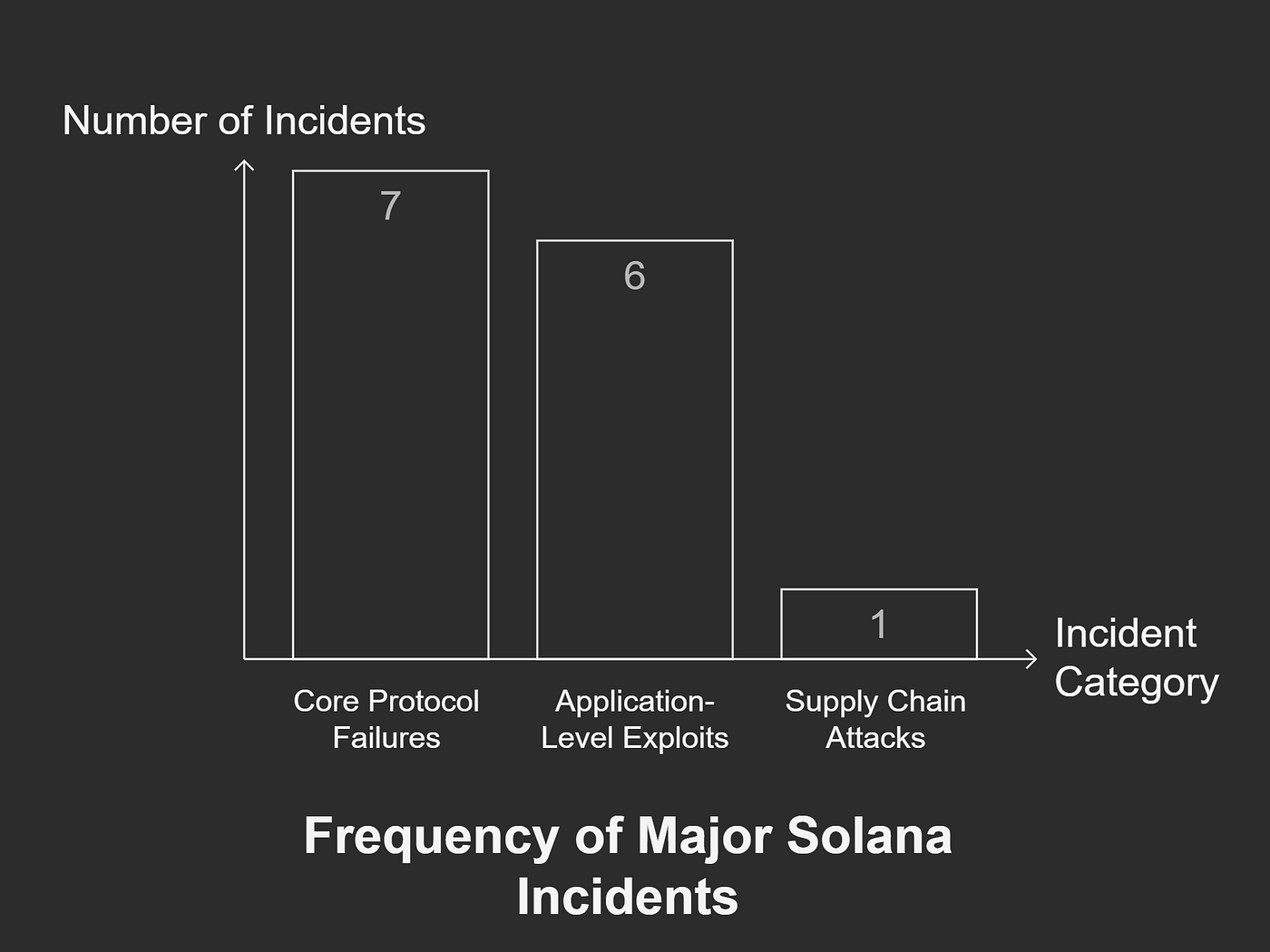
Core protocol failures were more common during Solana’s early developmental phase, reflecting the challenges of hardening a novel consensus and execution environment. As the ecosystem matured and financial activity deepened, the attack surface shifted — later years saw a rise in application-layer vulnerabilities and third-party tooling compromises.
B. Total Funds Lost and Affected Parties
While core protocol failures primarily resulted in operational disruptions — often manifesting as network halts — financial losses were largely concentrated in the application layer and supply chain. These incidents, though external to the Solana protocol itself, underscore the ecosystem-wide consequences of weak key management, flawed logic, and insecure dependencies.

Across the analyzed events, more than $500 million in cumulative losses were reported. The most damaging attacks consistently involved centralized key compromises and low-liquidity price manipulation, highlighting systemic risks in protocol design, treasury access, and market infrastructure.
C. Network Response Time and Resilience
Solana’s response to critical failures has evolved alongside its infrastructure maturity. In the face of core protocol disruptions, the engineering team and validator community demonstrated increasing agility and coordination.
- Average network downtime across core protocol failures was approximately eight hours.
- Manual validator coordination was often necessary to resume consensus and restore liveness.
- Over time, incident response became faster and more structured, reflecting improvements in tooling, communication channels, and incident triage.
Notable examples:
- September 2021 — Bot-Driven Flood: Restart required ~17 hours of coordination among more than 1,000 validators.
- February 2023 — Large Block Crash: Patched clients were deployed and coordinated, leading to recovery within ~19 hours.
- February 2024 — JIT Cache Crash: Fixes to caching logic enabled restoration in just ~5 hours.
For ecosystem-level exploits, response time varied by team. Wallet providers and DeFi protocols like Raydium and Slope issued mitigation updates within minutes, while others required hours — or in some cases, days — to assess and respond to the damage.
Incident Response and Communication
In blockchain security, response speed and clarity of communication often matter as much as the root technical cause. Solana’s ability to rapidly contain threats, mobilize its validator network, and maintain public transparency has been central to its operational resilience.
A. Response Time: Speed and Execution
Solana has demonstrated a consistent capacity to address disruptions swiftly — even in cases involving complex and unforeseen failures. Over time, the team’s response strategy has become more mature, benefiting from improved coordination mechanisms and postmortem discipline.
Key observations:
- Most critical incidents were mitigated within 24 hours.
- Several high-severity issues — especially in later years — were contained in under 6 hours.
- Validator coordination mechanisms became more efficient, significantly reducing the downtime observed in early-stage incidents.
This improved responsiveness reflects both technical preparedness and deeper alignment between core developers, infrastructure teams, and validator operators.
B. Mitigation Strategies
Solana’s mitigation playbook has evolved based on the scope and origin of each incident. The network employed different tactics depending on whether the threat was protocol-level, application-specific, or related to third-party tooling.
- Network-Level Issues: These required swift coordination among validators and timely software patches. The core team used Discord, GitHub, and other real-time channels to align thousands of node operators during high-pressure situations.
- Application-Level Exploits: Typically handled by the affected teams — such as Mango or Raydium — with Solana Labs occasionally offering technical and strategic support.
- Supply Chain Threats: These were addressed with urgent dependency updates, developer advisories, and ecosystem-wide alerts across GitHub, Discord, and Twitter.
In some cases, the Solana team proactively disabled vulnerable features — like durable nonce support — to prevent further exploitation before a complete fix could be rolled out.
C. Community Communication
Solana’s approach to incident communication has noticeably matured. What began as slow and highly technical disclosures evolved into a more transparent and structured effort to keep the community informed.
Notable improvements include:
- Real-Time Updates through Twitter, Discord, and the Solana Status Page.
- Detailed Post-Mortems, such as the widely-referenced breakdown of the September 2021 outage.
- Public GitHub Discussions to ensure validator and developer transparency.
- Validator AMAs held after major incidents to field questions and explain decisions.
Crucially, Solana has shown increasing willingness to take accountability — openly acknowledging architectural weaknesses when responsible, rather than deflecting blame.
Bug Bounty Program Evolution
In the world of blockchain infrastructure, bug bounty programs are a foundational pillar of responsible security. They provide a structured way for white-hat hackers and researchers to disclose vulnerabilities safely — before malicious actors can exploit them. Solana’s bug bounty program has grown from humble beginnings into a mature, multi-platform ecosystem offering million-dollar incentives and proactive coordination with security professionals.
A. Establishment and Early Initiatives
Solana’s structured bug bounty efforts began taking shape in 2020, though the earliest formal records point to August, 2020, with FireBounty launching a vulnerability disclosure program for Solana — marking the start of an organized approach to ecosystem security.
Momentum picked up in August 2021, when validator operator Chorus One offered a **$100,000 bounty for vulnerabilities in Lido on Solana. By December 2021, responsible disclosures — such as the [jet-v1 lending protocol vulnerability** ](https://medium.com/coinmonks/solana-bug-bounty-hunting-with-soteria-1b8b75c741de)— were being publicly patched and credited, signaling an active, functioning bounty pipeline. These developments paralleled Solana’s sharp growth in validator count and DeFi activity, reinforcing the need for robust vulnerability management.
At this early stage, disclosures were coordinated via GitHub, private channels, and direct communication with the Solana Foundation and affiliated project teams.
B. Effectiveness in Mitigating Vulnerabilities
Solana’s bug bounty program has repeatedly proven its utility by surfacing issues before real-world exploitation could occur. One clear example: the jet-v1 protocol bug was responsibly disclosed, triaged, and patched before any funds were lost.
More notably, none of the major core protocol bugs — like the durable nonce flaw or the fork choice bug — were exploited in the wild. Most were either discovered internally or submitted through responsible channels, demonstrating that the bounty program acts as a critical early-warning system alongside audits and in-house testing.
The increasing financial scale of rewards also reflects the program’s seriousness. As of 2024:
- Firedancer, the next-gen validator client, is currently running a $500,000 program on Immunefi.
These incentives not only attract elite security researchers — they actively contribute to the reduction of systemic risk.
C. Public Recognition and Researcher Incentives
Solana has cultivated a researcher-friendly environment by offering more than just cash. Submissions are acknowledged publicly, and the ecosystem encourages detailed writeups, reproducible test cases, and even patches. For instance, the sec3 team was credited for its jet-v1 discovery, alongside thanks to the Jet Protocol and Immunefi teams for their rapid response.
Behind the scenes:
- Bug reports are triaged by experienced engineers.
- Critical issues are fast-tracked through internal workflows.
- There’s collaboration with external security firms to validate high-risk findings.
This culture of transparency, recognition, and follow-through has become one of Solana’s security strong points — and a reason why white-hat researchers continue to engage.
Solana’s bug bounty program has evolved from scattered efforts into a million-dollar, multi-platform initiative. It reinforces the network’s commitment to security by incentivizing early detection, encouraging transparency, and building bridges between developers, researchers, and infrastructure maintainers.
As blockchain threats grow more complex, this evolving bounty system will remain a core part of Solana’s defense strategy — keeping both the protocol and its growing ecosystem secure, agile, and resilient.
Lessons for the Future of Layer 1 Security
Solana’s security journey isn’t just a record of bugs and fixes — it’s a case study in navigating the tradeoffs between speed, scale, and resilience. Here are the big lessons for Layer 1 builders:
1. Performance at Scale Demands Unorthodox Security Thinking Solana’s architecture — parallel execution, Turbine propagation, optimistic concurrency — doesn’t fit the mold. High throughput at the edge of hardware capacity introduces unique failure modes: memory saturation, cache loops, and unstable consensus. Security here means more than safe code; it means ensuring distributed systems degrade gracefully under stress. The faster your chain moves, the harder your fail-safes need to work.
2. Validator Coordination Is a Security Asset — If Used Wisely Coordinated restarts raised centralization concerns, but they also revealed an underrated strength: social-layer resilience. In global, high-speed threat environments, a responsive validator community is a feature, not a bug. Solana’s playbooks, Discord channels, and hotfix workflows form a decentralized human defense layer worth studying.
3. Security Must Expand Beyond the Protocol Layer Solana’s worst incidents weren’t consensus failures — they came from ecosystem tooling. The Slope wallet key leak and Web3.js supply chain attack proved that vulnerabilities in wallets, SDKs, or infra can be just as catastrophic. Lesson: A secure protocol means little without hardened tooling. Devs need better defaults, wallet providers need serious secret management, and the ecosystem must treat app-layer security as a first-class priority.
4. Bug Bounties and Security Culture Matter Solana’s bug bounty program didn’t start big — but it grew into a seven-figure ecosystem, backed by platforms like Immunefi and HackenProof. More importantly, Solana cultivated a culture of transparency, public postmortems, and rewarding white-hat talent.
For other projects, this is the blueprint: Make security cool, not just necessary. Celebrate the people who break your systems before attackers do.
Conclusion
Solana’s security story is one of extremes. It’s a Layer 1 that dared to chase speed, scale, and usability — sometimes at the cost of uptime. But it also evolved fast, adapting to its failures with patches, playbooks, and a growing validator ecosystem.
From consensus bugs to wallet leaks and supply chain threats, Solana faced a wide range of challenges. Yet instead of breaking, it built muscle — shipping fixes quickly, coordinating across the globe, and hardening without sacrificing performance.
For security researchers, Solana is both a warning and a challenge. The warning: high-throughput systems create novel failure modes. The challenge: protecting them requires resilience, creativity, and community.
As other Layer 1s push toward faster, richer user experiences, Solana’s path offers key lessons — not just in what to avoid, but in how to recover, adapt, and reward those who help.
It’s not perfect. But Solana’s security evolution may be the most valuable case study in crypto today.
메타데이터
- post_id
- 3898fc7e4b60
- slug
- the-security-history-of-solana-3898fc7e4b60
- url
- https://medium.com/@vokpukpan/the-security-history-of-solana-3898fc7e4b60
- canonical_url
- https://medium.com/@vokpukpan/the-security-history-of-solana-3898fc7e4b60
- author_url
- https://medium.com/@vokpukpan
- status
- ok
- fetched_at
- 2026-08-07 02:17:00



