Why This Book Frustrated Me Then Kept Me Thinking the Longest
A book that challenged my assumptions — and one idea that challenged my patience
Why This Book Frustrated Me Then Kept Me Thinking the Longest
A book that challenged my assumptions — and one idea that challenged my patience
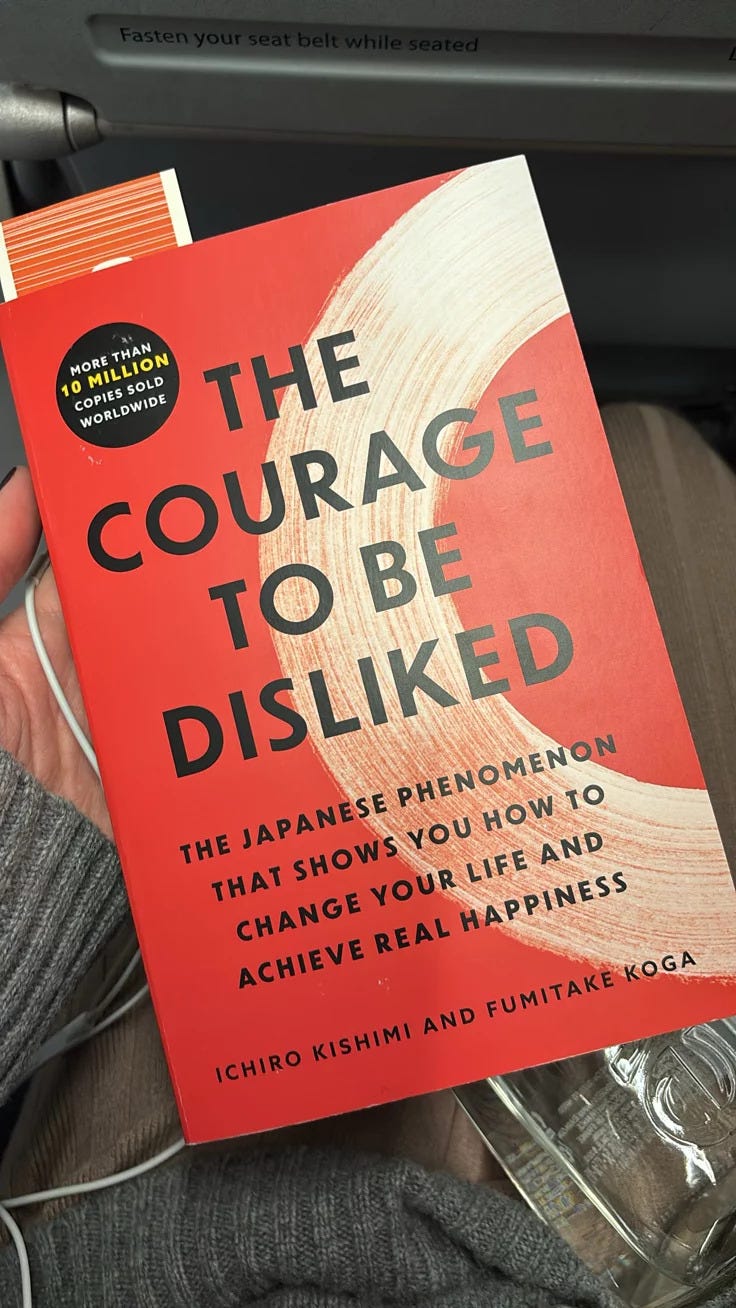
Image from Pinterest
Some books enter your life through recommendations from friends. Some arrive through carefully researched reading lists. And then there are books you buy because a random stranger on Reddit mentioned them once and the title refuses to leave your head. The Courage to Be Disliked belonged firmly to the third category.
I first came across it in a random Reddit thread. I don’t even remember what the discussion was about anymore. What I do remember is seeing the title and immediately thinking: “That’s either going to be brilliant or completely unbearable”. Naturally, I added it to my ever-growing mental list of books I planned to buy “someday.”
Luckily, someday arrived sooner than expected.
During one random evening, while browsing through a street bookseller’s collection, I spotted it sitting among dozens of other books. The title jumped out immediately. A few minutes later, the book was in my bag.
Looking back, I think I bought it for the title before I bought it for the philosophy. And honestly, I don’t regret that. Because even after finishing the book, the title remains one of the smartest things about it.
The title sounds rebellious. The book itself is much more complicated than that.
At its core, The Courage to Be Disliked is a conversation between a philosopher and a young man who spends most of the book doing what many readers are secretly doing while reading it:
… arguing.
The philosopher presents ideas inspired by Alfred Adler, while the young man responds with skepticism, frustration, disbelief, and occasionally the literary equivalent of “there is absolutely no way that can be true.” Which, to be fair, was also my reaction several times.
That dynamic ends up becoming one of the book’s greatest strengths. Instead of presenting its philosophy as a neat collection of lessons to quietly absorb, the book stages an ongoing debate where every major claim is challenged, questioned, and pushed to its limits. As a reader, I often found myself siding with the young man, only to be pulled back by the philosopher’s responses, and then doubting those responses again a few pages later. The result is less like reading a traditional self-help book and more like sitting in on a long, sometimes frustrating, but undeniably thought-provoking argument.
What makes the book interesting is that it doesn’t try to comfort the reader. It challenges assumptions instead. Some of those challenges are genuinely thought-provoking. Others feel like they were specifically designed to test your patience.
The central idea behind Adlerian psychology, at least as presented in the book, is surprisingly radical.
The philosopher repeatedly argues that people are not simply products of their past. Instead, he suggests that people actively choose meanings, goals, and behaviors in the present. At first glance, that sounds empowering. And sometimes it genuinely is. The idea that your future does not have to remain permanently chained to your past carries a certain freedom. The emphasis on personal responsibility, self-acceptance, and refusing to live entirely through other people’s expectations can be refreshing. Especially in a world where comparison has become a full-time occupation. Some of the book’s most memorable ideas came from that perspective.
The concept of “separating tasks”, for example, stayed with me far longer than I expected. The idea is simple: what other people think of you is ultimately their task, not yours. Easy to understand. Much harder to practice. The book repeatedly encourages readers to stop organizing their lives around approval. Not because relationships don’t matter. But because constantly chasing validation eventually turns into a prison disguised as social acceptance. That idea landed.
Other ideas did not. Or at least, not immediately.
The biggest point of friction for me was the book’s treatment of trauma. This is where my internal conversation with the book became significantly louder. The philosopher argues that trauma does not determine present behavior in the way many people assume. Instead, he suggests that people often use past experiences to justify present choices. I understood the point being made. I just wasn’t fully convinced by it. Not because I reject personal responsibility. And not because I think people are permanently trapped by their past. But because human experiences are messy. Pain affects people differently. Healing happens differently. Two people can experience similar events and carry them in completely different ways. Real life rarely divides itself as neatly as philosophical arguments do. That complexity felt larger than the book sometimes allowed it to be.
Yet strangely, my disagreement with that idea became one of the reasons the book stayed with me. Because the more I argued with it, the more I found myself thinking about it. And that, I suspect, is part of the book’s success. It doesn’t merely present ideas. It provokes reactions. Even when you disagree, you’re still participating in the conversation.
What impressed me most was that the book never felt interested in being universally liked. A fitting quality for a book with this title. Many self-help books try to gather agreement. This one seems comfortable creating resistance. It asks uncomfortable questions. It presents uncomfortable answers. And occasionally it leaves you sitting there wondering whether you’re frustrated because the idea is flawed or because it touched something you weren’t prepared to examine.
To be clear, I don’t think this book contains all the answers. I don’t think Adlerian psychology explains every aspect of human behavior. And I certainly don’t think every argument in this book survives scrutiny equally well.
But I also don’t think the value of a book depends on agreeing with every page. Sometimes a book’s value comes from the quality of the conversation it creates. And few books have argued with me as persistently as this one.
I didn’t finish it feeling inspired. I didn’t finish it feeling converted either. What I finished with was something much more interesting:
… questions.
Some of them I disagreed with. Some of them I resisted. And one of them, despite all my efforts, refused to leave.
Maybe that’s why I still think about this book.
Not because it convinced me.
But because it didn’t.
Even now, I can point to ideas I disagree with, arguments I find incomplete, and conclusions I would challenge.
Yet somehow, years later, I’m still having the conversation.
메타데이터
- post_id
- 38b64cce580b
- slug
- why-this-book-frustrated-me-then-kept-me-thinking-the-longest-38b64cce580b
- url
- https://medium.com/hooked-on-books/why-this-book-frustrated-me-then-kept-me-thinking-the-longest-38b64cce580b
- canonical_url
- https://medium.com/hooked-on-books/why-this-book-frustrated-me-then-kept-me-thinking-the-longest-38b64cce580b
- author_url
- https://medium.com/@ms.whatsit
- status
- ok
- fetched_at
- 2026-06-20 20:29:01