The Advisory State
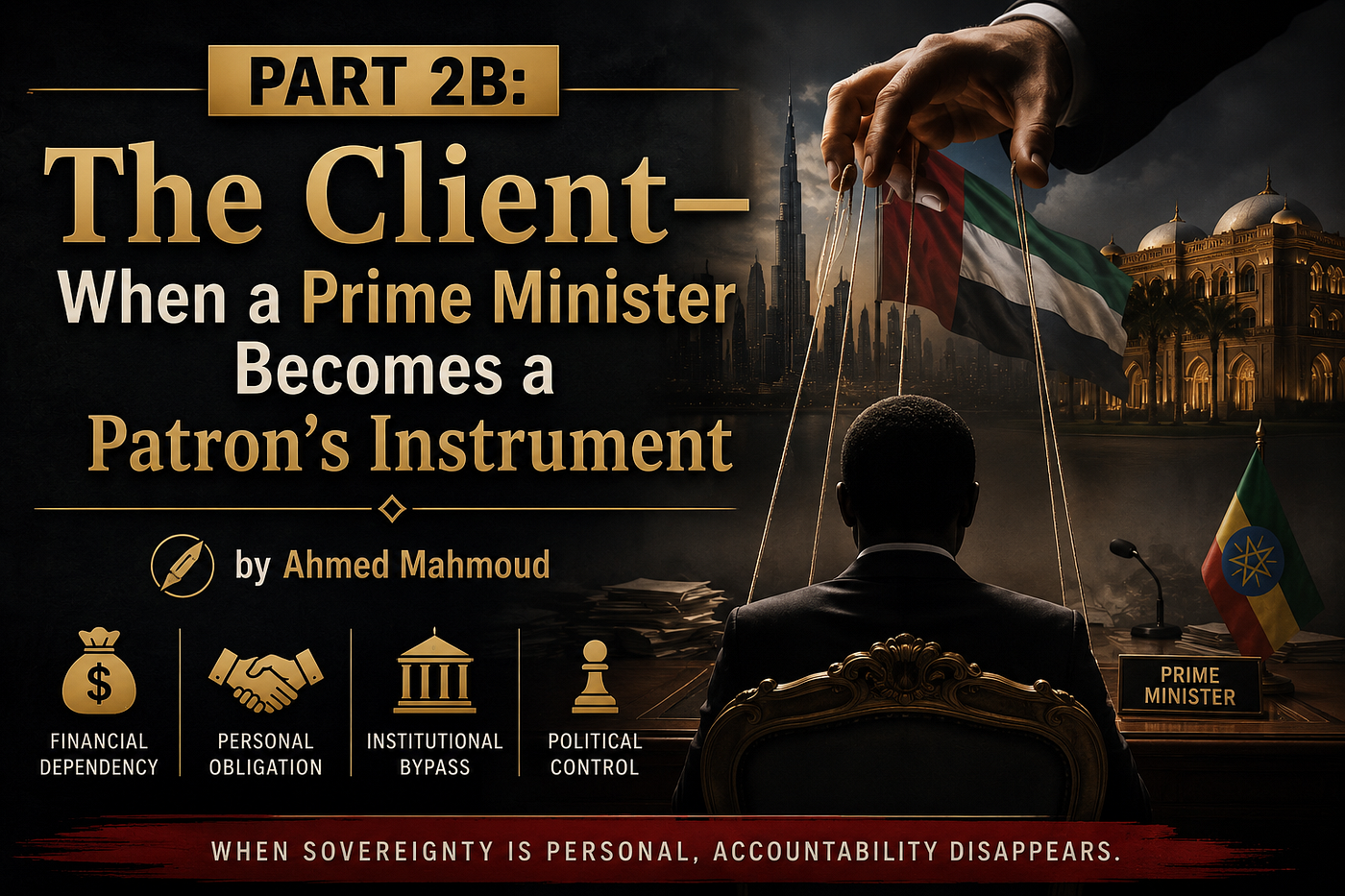
Part 2B: The Client — When a Prime Minister Becomes a Patron’s Instrument
The Advisory State
Part 2B: The Client — When a Prime Minister Becomes a Patron’s Instrument
By Ahmed Mahmoud
In June 2018, weeks after Abiy Ahmed took office as Ethiopia’s Prime Minister and precisely as historic peace negotiations with Eritrea were proceeding, the United Arab Emirates announced a $3 billion financial package.[1] The structure was revealing: $1 billion went directly to Ethiopia’s central bank to address an acute foreign currency shortage — providing immediate, personal relief to a government whose economic survival was in question — while $2 billion was allocated to specific sectors serving UAE commercial interests: tourism, renewable energy, agriculture.[2]
This was not development assistance. It was not routed through multilateral frameworks with transparency requirements. It was personal financial support to a specific leader at his most vulnerable moment, structured to create maximum dependency with minimum institutional oversight. As one Ethiopian analysis would later observe: the UAE “injected billions into Ethiopia’s collapsing reserves, effectively placing a financial leash around the Ethiopian state long before the wars reached their peak.”[3]
Part 2A examined the adviser side of the UAE’s individual capture model — the exiled, the disgraced, and the displaced deployed globally with deniability. Part 2B examines the client side: the national leader captured through personal financial dependency at a moment of maximum vulnerability. Where advisers like Dahlan provide networks and deniability, clients like Abiy Ahmed provide sovereign cover and policy implementation. Both relationships are deliberately structured to bypass institutional accountability. Together, they constitute the advisory state model’s most powerful and most dangerous dimension.
I. Why Individuals, Not Institutions
The distinction between financing institutions and financing individuals appears subtle until its implications become clear.
When UAE provides financial support through official bilateral frameworks — documented loans, multilateral channels, institutional partnerships — that support is subject to parliamentary disclosure, civil society scrutiny, audit trails, and successor government review. The next government can examine what was committed, renegotiate terms, or exit arrangements that prove damaging to national interests. Institutions create accountability across time.
When UAE provides financial support to a specific leader personally — through channels deliberately structured to avoid institutional visibility, for projects that the leader refuses to disclose to parliament — no such accountability exists. The money reaches a person, not a system. The obligation runs to Abu Dhabi, not to the receiving country’s citizens. And the policy decisions that follow reflect personal obligation rather than national institutional interest.
This distinction explains a consistent pattern across UAE-influenced theatre's. In Sudan, UAE financed Hemedti personally — through gold trade facilitation enriching him personally, weapons supplied directly to RSF bypassing state military channels, and a $24 million Dubai property portfolio accumulating his family’s wealth outside any Sudanese institutional accountability.[4] In Yemen, UAE financed STC commanders personally — creating security forces whose salaries and equipment came directly from Abu Dhabi rather than through Yemeni state structures.[5] In Libya, UAE financed specific Haftar units over others — creating internal hierarchies of dependence that gave Abu Dhabi leverage within an already fragmented military structure.[6]
Ethiopia under Abiy Ahmed represents this logic applied to a head of government of a major African state — the model’s most ambitious and most consequential application.
II. The Making of a Dependency: Ethiopia’s Financial Collapse
Understanding how Abiy’s dependency was created requires understanding the financial context into which the UAE’s $3 billion injection arrived.
Abiy Ahmed came to power in April 2018 inheriting a country with serious economic challenges: foreign exchange shortages, mounting debt, and the accumulated costs of two decades of Tigray People’s Liberation Front-dominated governance. His initial reformist energy generated international enthusiasm — and international expectations of good governance that he rapidly failed to meet.
The wars Abiy chose — in Tigray, in Oromia, in Amhara from 2023, against various armed opposition movements — were not forced upon him. They were political choices to govern through military force rather than accommodation and reconciliation. Those choices carried predictable economic costs: war spending that drained foreign exchange, displacement that reduced agricultural production, conflict that destroyed infrastructure, and atrocity allegations that deterred foreign investment and made Ethiopia an indefensible financial risk for multilateral lenders.
Ethiopia defaulted on its Eurobond. The World Bank and IMF did not rush to rescue a government accused of mass atrocities.[7] As one Ethiopian analyst wrote: “By the time Ethiopia defaulted, Abiy no longer governed a sovereign economy. He governed an overdraft.”[8]
A leader who governs an overdraft does not set independent policy — he executes instructions from those who extend his credit. “The UAE did not step in out of charity,” the same analyst observed. “It never does. It stepped in because failed states are opportunities.”[9]
But the UAE’s capture of Abiy was more sophisticated than simple rescue financing. The $3 billion in June 2018 came not when Ethiopia had already failed, but at the precise moment when failure might still be prevented — and when Abiy was most politically vulnerable, most in need of external validation, and least able to negotiate terms from a position of strength. UAE placed a financial leash around the Ethiopian state before the wars reached their peak, before the default, before the complete financial collapse that would have made dependency obvious.
III. The Personal Architecture: Brotherhood and Allegiance
The UAE-Ethiopia financial relationship is not institutional. It is deliberately, structurally interpersonal.
The two leaders maintain what observers describe as a close, almost brotherly relationship — with MBZ described as “clearly seeing something of himself in Abiy, in his vaulting ambitions to reshape his country and immediate neighbourhood in his own image.”[10] Abiy reportedly calls MBZ “my brother.” Reports citing Ethiopian media analysis indicate that Abiy has performed a ritual practice in the UAE declaring personal allegiance to the Crown Prince.[11]
This personal dimension is not diplomatic convention. It is structural dependency dressed in personal warmth. A leader who declares personal allegiance to a foreign patron, who calls him brother, who allows his most significant foreign policy decisions to be made in secret from the institutions supposedly accountable for them — is not conducting diplomacy. He is conducting clientelism.
The Ethiopian Policy Institute documented the institutional consequences with unusual clarity: “In Ethiopia, Abiy Ahmed has de-institutionalized and personalized Ethiopia’s foreign policy for personal and political gain.”[12] The details of UAE financial arrangements are “entirely secret.” The Somaliland MoU was negotiated in secret. The 2018 Eritrea-Ethiopia peace process was conducted through Abiy’s personal office rather than Foreign Ministry structures. GERD negotiations were handled personally. The funding source of the $15 billion palace project — described by Le Monde as “Abiy’s pharaonic palace seized with delusions of grandeur”[13] — was withheld from parliament with the explanation that Abiy had no “legal obligation” to disclose it.
Each of these secrets is only possible when foreign relationships are structured as personal arrangements rather than institutional commitments. A government institution receiving foreign finance faces parliamentary questions. A leader receiving personal foreign patronage does not — unless parliament has the will and capacity to compel disclosure, which, under Abiy’s increasingly authoritarian governance, it does not.
IV. The Palace as Evidence
The $15 billion palace project in Addis Ababa deserves specific analysis as evidence — not as aesthetic controversy or symbol of misplaced priorities, but as documented proof of how personal UAE financing operates and what it extracts in return.
The project proceeds as Ethiopia faces unprecedented economic challenges. Millions of Ethiopians experience hyperinflation and food insecurity. International creditors impose austerity conditions on debt restructuring. The Ethiopian state lacks foreign exchange to import essential goods. And the prime minister is building a $15 billion palace.
When parliament asked Abiy about the funding source, he stated he had no legal obligation to disclose it.[14]
This response is only possible under two conditions: first, that the financing genuinely flows through personal rather than state channels; and second, that parliamentary oversight has been sufficiently weakened that such a response carries no political consequences. Abiy has engineered both conditions. The palace is being built. Parliament cannot question it. The dependency deepens. And Abu Dhabi’s leverage over Abiy grows with every billion spent on a monument to his personal ambition that his country cannot afford and its citizens did not choose.
The palace is not separate from the UAE relationship — it is its most visible expression. MBZ finances a leader’s vanity project; the leader executes MBZ’s strategic agenda. The financial leash runs in both directions: UAE cannot easily withdraw support from a relationship whose physical monument is being constructed in the Ethiopian capital, and Abiy cannot easily distance himself from a patron financing his most cherished project.
V. The Assab Agenda: Externally Originated, Personally Executed
The most damning evidence of how personal capture shapes policy comes from within Abiy’s own political circle. Dr. Milkessa Gemechu — former senior government official and member of the Prosperity Party’s Central Committee — has explicitly stated that “the Assab project is UAE’s and that Abiy is just an errand boy.”[15]
This is not an opposition figure making politically motivated accusations. This is a senior figure from Abiy’s own governing party, from his own ethnic political base, describing the campaign to threaten and potentially invade Eritrea as externally originated — a UAE commercial project being executed through a personally captured leader.
The Eurasiareview analysis reinforces this with structural logic: Ethiopia has no genuine sea access crisis. It has commercial agreements with Djibouti (handling 95% of trade), Berbera, Kenya’s Lamu, and Port Sudan.[16] The manufactured urgency around Eritrean sea access serves UAE strategic interests in controlling all Red Sea trade routes — not Ethiopian logistical needs already served through multiple existing arrangements. The rhetoric about “historic rights” to the Red Sea and “natural boundaries” invoking 19th-century Ethiopian claims serves Abu Dhabi’s commercial interests in eliminating Assab Port competition, not Ethiopian trade interests.
Ethiopia possesses multiple commercial access arrangements through Djibouti, Berbera, Lamu, and Port Sudan. The argument advanced by Eurasia Review is therefore not that Ethiopia lacks maritime access, but that the urgency surrounding Assab cannot be explained solely by commercial necessity. It does not need to invade Eritrea. The war rhetoric is manufactured need, created to justify aggression serving foreign commercial interests.
VI. Two Birds With One Stone: Why the Capture Is Stable
The capture strategy proves durable because it serves Abiy’s interests as well as UAE’s — a convergence that makes the dependency self-reinforcing rather than merely coercive.
Abiy’s challenge of governing Ethiopia — with 120 million people across 80 ethnic groups, facing multiple internal insurgencies, operating without genuine democratic mandate — requires maintaining political dominance against diverse opposition forces. As one regional analysis noted, he needs “to keep the country in permanent wars both internally and externally against neighbouring countries, so as to weaken any opposition forming or uniting against his undemocratic and dictatorial rule.”[17]
External conflict serves this domestic purpose. War rhetoric against Eritrea mobilizes Ethiopian nationalist sentiment and diverts public attention from economic failure and internal repression. UAE’s financial support makes this permanent war footing economically possible. The wars simultaneously serve UAE’s commercial agenda in eliminating Assab Port competition and Abiy’s political survival agenda in maintaining authoritarian rule through manufactured external threat.
He is, as the analysis observed, killing two birds with one stone.[18] The convergence of interests is what makes the dependency relationship so stable despite its obvious costs to Ethiopian sovereignty and welfare. Abiy gets financial survival and political cover for authoritarian governance. UAE gets an instrument for regional aggression against Eritrean sovereignty. The Ethiopian people bear the costs of both.
VII. The Fragility This Creates
The personal financing strategy creates structural fragility that both parties are invested in concealing.
Abiy’s political survival depends on UAE support. UAE’s Ethiopian strategy depends on Abiy’s political survival. Neither has institutional continuity. As Ethiopian analysts have written, there is a theory “widely understood at cabinet level but unspoken”: that the government’s stability “does not rest chiefly upon its democratic mandate, its macroeconomic competence, or even the loyalty of the federal army. It rests, with the elegant fragility of a line of dominoes, upon a single telephone number in Abu Dhabi.”[19]
A state whose foundation rests upon another leader’s personal telephone number is not a state. It is a node in someone else’s network. And nodes, when they cease serving the hub’s purposes, are replaced.
The advisory state’s client model creates a further vulnerability: legitimacy crisis. When a senior official from Abiy’s own Prosperity Party describes him as “just an errand boy” for UAE commercial interests, the question of whose interests Ethiopian governance actually serves becomes politically potent. A prime minister who owes his survival to foreign creditors — and whose most visible personal project is a palace funded by money he refuses to disclose to parliament — does not govern in his nation’s interest. He performs for his patron.
As one Ethiopian analyst concluded: “A prime minister who owes his survival to foreign creditors does not get to say no. He performs.”[20]
Institutions survive elections. Personal obligations do not. A loan to a treasury belongs to the state. A relationship built around private negotiations, opaque funding, and reciprocal political support belongs to individuals. That distinction is the foundation of the advisory state’s client model.
Part 3 examines where this performance leads in regional practice: across Sudan, Yemen, Libya, and Somalia, where UAE advisory networks and client relationships have generated catastrophic fragmentation — and where the human costs of the advisory state model are measured not in analysis but in dead.
One-sentence takeaway: The UAE captures national leaders not through formal alliances or institutional agreements but through personal financial dependency at moments of maximum vulnerability — transforming Ethiopia’s Abiy Ahmed from independent regional leader to what a senior official from his own governing party has described as “just an errand boy” for UAE commercial interests, with a $15 billion palace he refuses to explain to parliament as the most visible monument to a sovereignty sold not through conquest but through an overdraft.
References
[1] Aaron Maasho, “UAE to Give Ethiopia $3 Billion in Aid and Investments,” Reuters, 16 June 2018.
[2] Micheale Kihishen Gebru, “The United Arab Emirates Engagement in Ethiopia,” SWP Policy Brief 35, March 2025.
[3] Yemane Abselom, “Ethiopia on Credit: PM Abiy Ahmed Ali and the Price of Dependency,” Red Sea Beacon, 28 January 2026.
[4] The Sentry, “$24M Property Safe Haven in Dubai Linked to the RSF,” April 2026.
[5] International Crisis Group, “Yemen’s Southern Question” (2020); STC salary and equipment documentation.
[6] UN Security Council, Panel of Experts on Libya (2019–2021); internal Haftar dependency hierarchies.
[7] Abselom, “Ethiopia on Credit,” Red Sea Beacon, January 2026.
[8] Ibid.
[9] Ibid.
[10] Tom Gardner, interview on Ethiopia and Abiy Ahmed, The Hundred, December 2024.
[11] Borkena, “UAE interest in Ethiopia, exploiting Abiy Ahmed’s administration,” December 2023; ABC media analysis cited.
[12] Ethiopian Policy Institute, “The Abiy Doctrine: Ethiopia’s Foreign Policy Under Abiy Ahmed,” November 2024.
[13] Ibid.; Le Monde characterisation of palace project.
[14] Borkena, December 2023; Abiy parliamentary statement on palace funding.
[15] Dr. Milkessa Gemechu, former Prosperity Party Central Committee member, cited via @eri_blooming, 27 January 2026; Red Sea Beacon, January 2026.
[16] Eurasiareview, “PM Abiy Playing UAE’s Proxy War Against HOA and Red Sea Nations,” 28 January 2024.
[17] Ibid.
[18] Ibid.
[19] Ethiopian Tribune, “The Petrodollar Lifeline That Could Break Ethiopia,” February 2026.
[20] Abselom, “Ethiopia on Credit,” Red Sea Beacon, January 2026.
메타데이터
- post_id
- 38c0ad243670
- slug
- the-advisory-state-38c0ad243670
- url
- https://medium.com/@amm121/the-advisory-state-38c0ad243670
- canonical_url
- https://medium.com/@amm121/the-advisory-state-38c0ad243670
- author_url
- https://medium.com/@amm121
- status
- ok
- fetched_at
- 2026-07-09 15:12:33