How Do Concrete Vaults Actually Work?
At a glance, a vault looks simple:
How Do Concrete Vaults Actually Work?

At a glance, a vault looks simple:
You deposit assets. You receive shares. Your balance grows over time.
But behind this clean experience, Concrete vaults operate as a structured system that continuously manages capital, allocates strategies, and compounds returns.
Let’s unpack it in a straightforward way.
The User Experience: What You See
When you interact with a vault, you typically:
- deposit an asset
- receive vault shares
- observe metrics like eRate and NAV
There is no need to manually claim rewards or move funds around.
From the outside, it feels passive.
But internally, the system is actively working.
Vault Shares: Your Ownership Layer
When you deposit, you are issued vault shares.
These shares represent your proportional ownership of the vault.
Think of the vault as a pool of capital:
- if you own 5 percent of shares, you own 5 percent of the pool
- if the pool grows, your ownership grows in value
- your percentage stays the same unless you add or withdraw
Vault shares are not rewards. They are your claim on the underlying assets managed by the system.
NAV: The Total Value of the Vault
NAV (Net Asset Value) represents the total value of all assets inside the vault.
It answers a simple question:
How much is the entire vault worth right now?
When strategies generate returns:
- NAV increases
- the vault becomes more valuable
- each share represents a larger portion of value
NAV is the foundation that connects all activity inside the vault.
eRate: The Value Per Share
If NAV is the total value, eRate is the value per share.
As the vault earns yield:
- NAV increases
- eRate increases
- each share becomes more valuable over time
This is how growth is reflected without issuing new tokens or requiring manual compounding.
Your share count stays constant, but its value appreciates.
How Yield Is Actually Generated
Yield inside DeFi vaults does not come from a single source.
Instead, capital is deployed across multiple strategies such as:
- lending markets
- liquidity provisioning
- restaking mechanisms
- incentive-driven opportunities
The vault aggregates these opportunities and allocates capital where it is most efficient.
This is where onchain capital deployment becomes important.
Active Management Behind the Scenes
Concrete vaults are not static storage systems.
They are actively managed.
Capital is continuously:
- deployed into selected strategies
- rebalanced based on conditions
- adjusted to maintain efficiency
- compounded as returns are realized
This ongoing process is part of what defines managed DeFi.
Rather than requiring users to act, the vault handles execution internally.
Why Time Matters
Vault performance is not linear in the short term.
It depends heavily on time.
Reasons include:
- strategies need time to generate returns
- compounding effects accumulate gradually
- rebalancing improves outcomes over longer periods
- short-term fluctuations can obscure long-term trends
In simple terms:
The longer capital stays in the vault, the more opportunity the system has to optimize it.
The Full Lifecycle of a Deposit
Here is how everything connects:
- You deposit assets into the vault
- You receive vault shares
- The vault deploys your capital into strategies
- Strategies generate yield over time
- NAV increases as value is added
- eRate increases as share value grows
- Your position grows without manual intervention
This cycle continues as long as your capital remains in the vault.
Why Vaults Improve Capital Efficiency
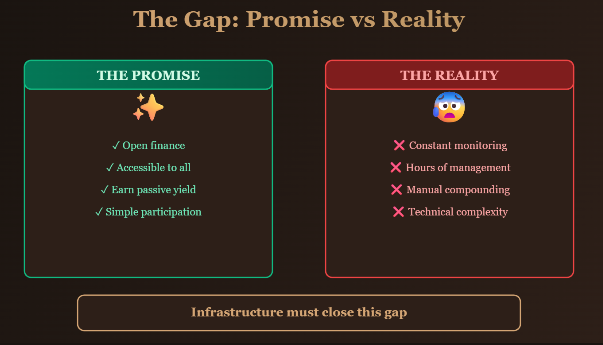
Traditional DeFi often requires users to:
- track multiple protocols
- move funds manually
- claim rewards frequently
- react to market changes
Vaults reduce this complexity by centralizing execution.
Concrete vaults aim to:
- keep capital continuously deployed
- minimize idle funds
- automate compounding
- simplify user interaction
- optimize allocation over time
This leads to more efficient use of capital compared to manual strategies.
A Simple Way to Understand It
You can think of the system like this:
- Vault = a capital management engine
- Vault shares = ownership of that engine
- NAV = total value produced by the engine
- eRate = value of each unit of ownership
- Time = the factor that drives growth
- Management = the mechanism that optimizes performance
The Bigger Picture
As DeFi evolves, systems are becoming more structured and automated.
Instead of users constantly searching for opportunities, capital is placed into systems that:
- identify opportunities
- allocate funds
- manage risk
- compound returns
This is the direction of institutional DeFi and managed DeFi.
Vaults are not just a feature.
They are an interface for capital itself.
Explore Concrete at **app.concrete.xyz**
메타데이터
- post_id
- 38c4bae746c2
- slug
- how-do-concrete-vaults-actually-work-38c4bae746c2
- url
- https://medium.com/@habib096422/how-do-concrete-vaults-actually-work-38c4bae746c2
- canonical_url
- https://medium.com/@habib096422/how-do-concrete-vaults-actually-work-38c4bae746c2
- author_url
- https://medium.com/@habib096422
- status
- ok
- fetched_at
- 2026-06-17 08:20:12