The Face of Jesus in the Eucharistic Miracle of Villakannur, Kerala
Gyaviira Luwaga, Bugiri, 24.04.2026, Gyaviira Luwaga, Catholic Extension, US Catholic magazine, CatholicTV, Catholic Herald
The Face of Jesus in the Eucharistic Miracle of Villakannur, Kerala
Gyaviira Luwaga, Bugiri, 24.04.2026, Gyaviira Luwaga, Catholic Extension, US Catholic magazine, CatholicTV, Catholic Herald
The Eucharistic Miracle at Villakannur, Kerala
In the village of Vilakkannur on November 15, 2013, an event unfolded that would come to stir the faith of many far beyond its small parish boundaries. As the faithful gathered at Christ the King Church, they carried with them the familiar burdens, quiet hopes, and thanksgiving of daily life, entering into a liturgy shaped by reverence, love, and a deep devotion to God.
The celebration unfolded as it always had. Scripture was proclaimed, prayers were offered, and bread and wine were lifted in thanksgiving. To any outside observer, nothing would have seemed unusual. Yet within the Catholic faith, the ordinary is never merely ordinary. At the heart of every Eucharistic celebration lies the Church’s enduring conviction: that Christ becomes truly present under the appearances of bread and wine. In this sacred mystery, the sacrifice of Calvary is not repeated, but made present in one and the same offering of Christ, given in love for the salvation of the world (Tanner, 1990).
For this reason, every Mass is understood as an act of thanksgiving — indeed, the very meaning of the word Eucharist. It is the Church’s participation in that one eternal sacrifice, where the faithful give thanks to God for the gift of His Son, Jesus Christ, who offered Himself to bridge the divide between sin and redemption. In entering the Eucharist, the believer does not merely remember, but is drawn into this living mystery of love and grace.
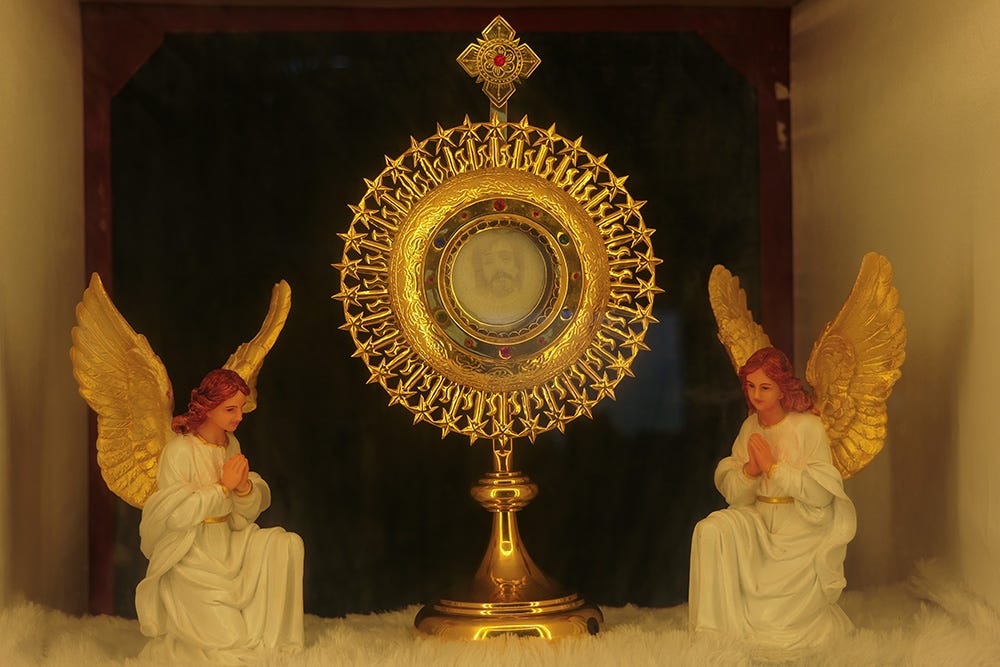
It was within this sacred rhythm that something extraordinary took place. As the consecrated Host was elevated during the Holy Mass, a darkened mark became visible upon its surface. Gradually, this mark took form, revealing what those present recognised as the image of a human face; one that many identified as the face of Christ. The parish priest, Rev. Fr. Thomas Pathickal, immediately aware of the gravity of the moment, responded with reverence and prudence. Rather than continuing as usual, he set the Host aside and proceeded with another, preserving the sacred Host in accordance with the Church’s careful norms regarding such occurrences (Code of Canon Law, 1983).
Marred with uncertainty, he invited the Sacristan to come and see what he was witnessing, and the same sentiments of a miraculous phenomenon were affirmed by both parties. He completed the Mass and later on invited the faithful to bear witness to what had just happened. Those present were struck with awe. While some stood in silent wonder, others sought to comprehend what they had witnessed. Yet what unfolded was not merely a matter of perception. The image remained, drawing attention not only from the local faithful but soon from the wider Church. What had begun in the stillness of a village liturgy quickly became a matter of deeper inquiry.
As news spread, ecclesiastical authorities took notice. The Archdiocese initiated a formal investigation, assembling commissions that included theologians and scientific experts. The Host was carefully preserved and examined over the course of several years. Scientific analyses, reportedly including studies conducted at Christ University in Bangalore, found no evidence of artificial alteration, chemical application, or external manipulation. The image could not be attributed to ordinary processes, and its persistence over time only deepened the mystery surrounding it.
The inquiry did not remain at the local level. The case was brought before higher authorities within the Syro-Malabar Church and eventually to the Holy See. Over more than a decade, the event underwent rigorous theological and scientific scrutiny. Such careful discernment reflects the Church’s long-standing wisdom: that extraordinary signs must be tested, not hastily embraced, so that truth may emerge with clarity (Benedict XIV, 1734/2010).
In time, after this prolonged period of investigation, the event at Vilakkannur was recognised by ecclesiastical authority as worthy of belief in May 31st, 2025. This recognition did not impose belief, but it affirmed that what occurred bore the marks of authenticity and spiritual significance. Within Catholic understanding, such events are received as signs, graces given not to replace faith, but to strengthen it (Rahner, 1978).
And yet, the true significance of Vilakkannur lies not only in what was seen, but in what it reveals. The appearance of a face upon the Eucharistic Host speaks to something deeply human: to see a face is to encounter a person. In a world where the Eucharist can sometimes be approached with familiarity, even routine, this moment interrupts and calls attention anew to the mystery at its heart. If Christ is truly present, then the Eucharist is not simply received; it is encountered.
This is not a new teaching, but the very heart of the Church’s faith. Centuries before Vilakkannur, Thomas Aquinas reflected on this mystery, affirming that while the senses perceive bread, faith recognises Christ (Summa Theologiae, III, q.75). In Adoro Te Devote, he expresses the same truth: that sight may fail, but faith perceives what is hidden. What occurred in Vilakkannur does not replace this faith; it brings it into sharper focus, allowing, even if only briefly, the unseen to become visible.
Today, Christ the King Church has become a place of pilgrimage and Eucharistic adoration. The faithful came not merely to see, but to pray, to kneel before the same Lord believed to be present in every Eucharist. This movement of devotion reflects the deeper purpose of this miracle. Like all of them, it is not given as a spectacle, but as an invitation to you and me to draw our hearts back to the centre of Christian life, the Eucharist itself. (John Paul II, 2003).
What remains, then, is not simply a story of an extraordinary event, but a quiet and enduring call. For if what was revealed in Vilakkannur is true, even in part, then it points to a greater truth that extends far beyond a single moment in time. Every Mass, every Host in the Blessed Sacrament in every place, holds the same mystery. The difference is not in Christ’s presence, but in our awareness of it.
In this light, the miracle does not stand apart from the Eucharist, it draws us back to it. It reminds us that what appears ordinary may conceal something infinite. And for those willing to pause, to reflect, and to believe, it gently asks: what if He has been here all along and yet you keep ignoring Him?
References (APA 7th Edition)
Benedict XIV. (2010). On the beatification and canonization of the servants of God (Original work published 1734).
Code of Canon Law. (1983). Vatican Press.
John Paul II. (2003). Ecclesia de Eucharistia. Vatican Press.
Rahner, K. (1978). Foundations of Christian faith. Seabury Press.
Second Vatican Council. (1964). Lumen Gentium. Vatican Press.
Tanner, N. (Ed.). (1990). Decrees of the ecumenical councils. Georgetown University Press.
메타데이터
- post_id
- 38e35f39618e
- slug
- the-face-of-jesus-in-the-eucharistic-miracle-of-villakannur-kerala-38e35f39618e
- url
- https://medium.com/@mydailyreflection/the-face-of-jesus-in-the-eucharistic-miracle-of-villakannur-kerala-38e35f39618e
- canonical_url
- https://medium.com/@mydailyreflection/the-face-of-jesus-in-the-eucharistic-miracle-of-villakannur-kerala-38e35f39618e
- author_url
- https://medium.com/@mydailyreflection
- status
- ok
- fetched_at
- 2026-07-22 23:32:06