China Built a GPU Without CUDA. Can It Run AI Models Locally?
Lisuan’s LX 7G100 launches as the first consumer GPU built on fully independent Chinese architecture.
China Built a GPU Without CUDA. Can It Run AI Models Locally?
Lisuan’s LX 7G100 launches as the first consumer GPU built on fully independent Chinese architecture.
👨🏾💻 GitHub ⭐️ | 👔 LinkedIn | 📝 Medium | ☕️ Ko-fi | 🌐 InventaAI Blog
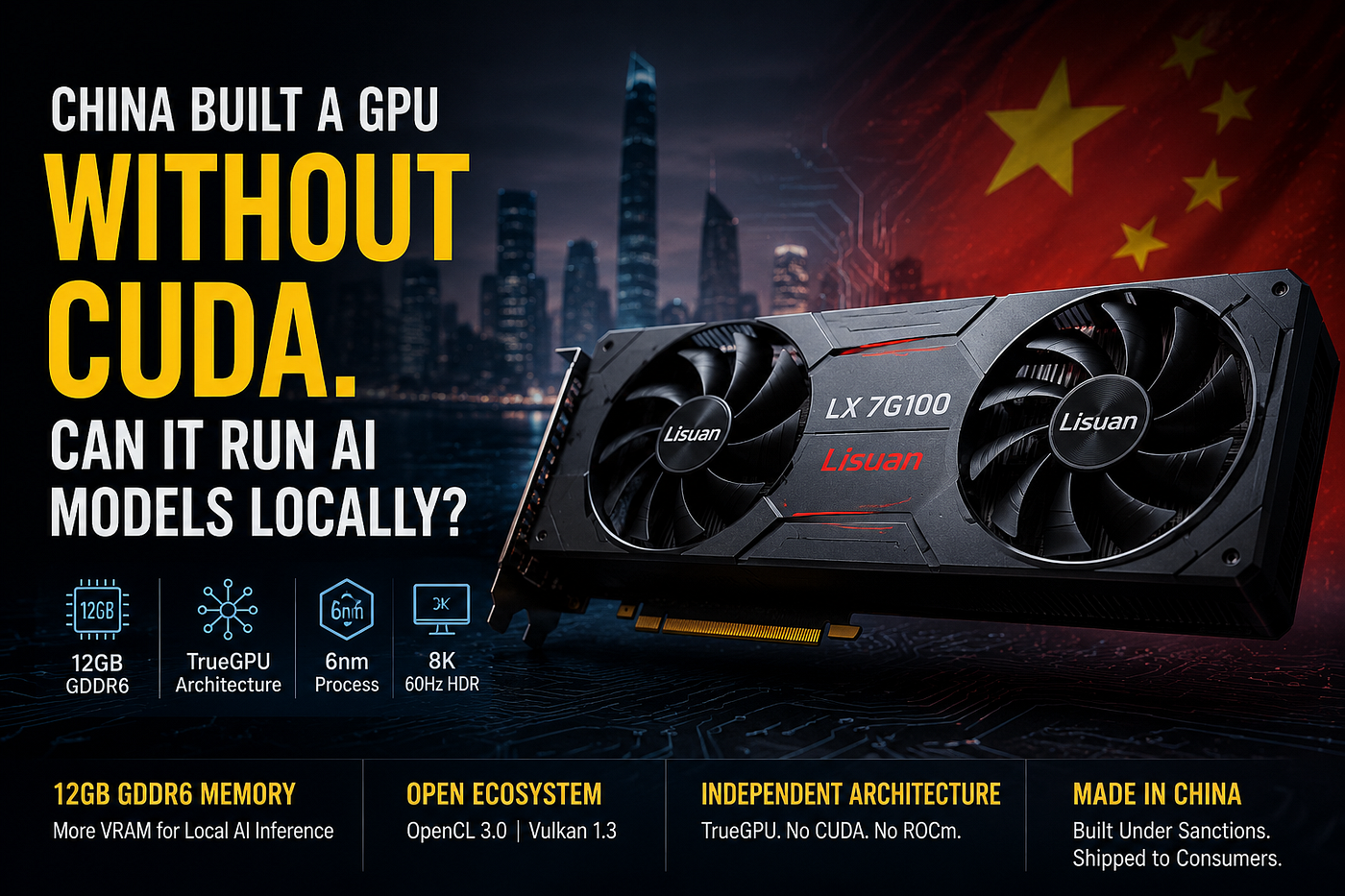
Photo by Author
Introduction
Somewhere in a warehouse in China right now, people are unboxing a graphics card that Nvidia never wanted to exist.
It is called the Lisuan LX 7G100. It costs around $485 USD. It carries 12 GB of GDDR6 memory. And it was built entirely without CUDA, without AMD’s ROCm, and without borrowing a single line of architecture from the two companies that have dominated GPU computing for the last two decades.
That is not a marketing claim. That is the actual situation on the ground.
Lisuan Technology (also written as Lison Tech) spent years quietly developing something called TrueGPU, a completely self-developed GPU architecture. In May 2026, the first consumer product based on that architecture hit retail shelves in China. The question everyone in the AI and hardware space is now asking: does any of this matter, and for whom?
Before we start! 🦸🏻♀️
If you like this topic and you want to support me:
- Clap my article 50 times; that will help me out.👏
- **Follow** me on Medium and subscribe to get my latest article for Free🫶
Who Is Lisuan Technology?
Most people outside China have never heard of Lisuan. The company spent years building in relative obscurity, which was partly deliberate. Under US export controls and chip sanctions, China cannot import Nvidia’s high-end compute GPUs. So Chinese companies are building their own.
Lisuan is not the only player doing this, but they are one of the very few that have shipped a consumer product with independently developed silicon. That distinction matters. A lot of Chinese GPU projects exist only as roadmaps, press releases, and government funding announcements. This one actually shipped.
Key background facts about Lisuan:
- TrueGPU is their in-house GPU architecture, not a licensed or derivative design from any Western vendor
- Built on a 6nm process node, which is real and competitive manufacturing, not cutting-edge like TSMC’s 3nm but absolutely in the game
- Their first chip, powered on earlier in 2026, matched the performance of a 13-year-old GTX 660Ti. The internet largely dismissed it. Lisuan kept building.
- They earned Microsoft WHQL certification, making them only the fourth GPU manufacturer in history to achieve that milestone
- The WHQL certification alone puts them in a category that most Chinese GPU attempts have never reached. It means their drivers meet a baseline standard that Windows actually trusts.
The company launched the LX 7G100 as a Founders Edition, with a unit number stamped on each card, deliberately echoing Nvidia’s own launch tradition. Whether that reads as confidence or provocation depends on your perspective.
Full Specifications: What the Card Actually Offers
The LX 7G100 is a proper retail consumer graphics card. Not a prototype, not a developer kit. A boxed product available on JD.com with real specs and real drivers.
Core hardware specifications:
- GPU Architecture: TrueGPU (fully proprietary, developed entirely in-house)
- Process Node: 6nm
- Video Memory: 12 GB GDDR6
- Texture Mapping Units: 192
- Render Output Units: 96
- PCIe Interface: PCIe 4.0 x16
- Board Power: up to 225W
- Card Dimensions: 294 x 120 x 49mm
- Cooling: Active axial fan cooling
Display and output capabilities:
- Display Connectors: 4x DisplayPort 1.4a
- Maximum Display Output: 8K at 60Hz HDR with FreeSync, supporting DSC
- Video Decode: HEVC up to 8K at 60fps
- Video Encode: HEVC up to 8K at 30fps
API and compute support:
- DirectX 12
- Vulkan 1.3
- OpenGL 4.6
- OpenCL 3.0
The card also supports NRSS, Lisuan’s proprietary super-resolution technology, their answer to Nvidia DLSS and AMD FSR. Official use cases listed by Lisuan cover gaming, AI PC workloads including local LLMs and AI agents, and content creation covering video editing, game development, and live streaming.
Performance
Independent reviews have started coming in, and the numbers paint a clear picture, both the strengths and the gaps.
At 1080p, the LX 7G100 delivers playable performance across most titles:
- Dota 2 and GTA V run comfortably without major issues
- Black Myth: Wukong and The Witcher 3 hit acceptable if unspectacular frame rates
- Average frame rates across lighter titles hover around 56 fps at 1080p
- The card handles the majority of mainstream gaming workloads without falling apart
Where the gap becomes impossible to ignore is in direct comparisons:
- In Cyberpunk 2077, both the RTX 4060 and Intel Arc B580 deliver roughly 2.5x more frames at a similar price point
- That performance delta at the same price bracket is a hard gap to justify on raw performance alone
- The card is not competitive with established mid-range options in demanding titles
The honest framing here is important context. Nobody expected Intel’s Arc lineup to be competitive in its first generation. The Arc B580 is now a genuinely recommended card. NVIDIA’s very first consumer GPU was not competitive with what came before it, either. First-generation hardware from a new GPU vendor follows a pattern. The trajectory matters more than the starting point.
Setup and Installation: Getting the Card Running
Physical installation follows standard procedure for any modern discrete GPU:
- Standard PCIe 4.0 x16 slot fits any modern ATX or mid-tower case
- The dual fan cooler with 294mm card length requires checking the case clearance before purchase
- 225W TDP requires an 8-pin or equivalent power connector
- Four DisplayPort 1.4a outputs are present; no HDMI on this model
Driver installation and software setup:
- Drivers are available through Lisuan’s official driver center at lisuantech.com
- Microsoft WHQL certification means Windows recognizes the card without unsigned driver warnings
- Basic display and gaming functionality works after standard driver installation
- Linux support is in progress, but not production-ready as of this writing
For AI and compute workloads specifically:
- No CUDA support exists. Any workflow that depends on CUDA will not function.
- OpenCL 3.0 is supported, which opens compute paths for certain tools
- Vulkan 1.3 support is present, and this is where the most relevant AI development is happening
- Lisuan has announced dedicated Vulkan compute support in an upcoming release targeting llama.cpp compatibility
- Early community developers have already begun working on driver integration with llama.cpp and are making measurable progress
Running local LLMs on this card today puts users firmly in early adopter territory. It requires patience, active participation in community forums, and a willingness to work around current gaps. It is not plug-and-play for AI inference yet.
AI Inference Potential
For the AI developer and data scientist audience, the hardware foundation is more interesting than the gaming benchmarks suggest.
What the hardware offers for AI inference:
- 12 GB GDDR6 is enough memory to run 7B parameter models comfortably and push into 13B territory with quantization
- Memory bandwidth from GDDR6 at this capacity is competitive for inference-focused workloads
- OpenCL 3.0 provides a real compute path that does not depend on CUDA at all
- Vulkan compute, once fully supported, would open the card to llama.cpp and a growing ecosystem of CUDA-free inference tools
- The card supports local LLM deployment, Copilot, and AI agent workloads according to Lisuan’s own product documentation
The software gap is real, and honest estimates put it at one to two years of work:
- No mature CUDA alternative yet means most popular AI tooling, including PyTorch, Transformers, and vLLM, does not run natively
- The Vulkan compute roadmap is the most credible near-term path forward
- OpenCL backends exist for some inference tools, but performance and stability remain inconsistent
- Community-driven development around llama.cpp integration is active and progressing
Who should pay close attention to this space:
- Developers building AI pipelines that need to be CUDA-independent
- Researchers interested in contributing to open Vulkan-based inference backends
- Organizations in regions where Nvidia cards are expensive or increasingly difficult to source
- Anyone curious about what a practical post-CUDA inference ecosystem might look like
Who Is Actually Buying This Card
The buyer behavior on JD.com tells a story that goes beyond hardware specs.
Early buyer reviews reveal a clear pattern. One verified buyer noted they already own an RTX 5090D but purchased the LX 7G100 purely to support a domestic GPU brand. They are not replacing their Nvidia cards. They are placing a deliberate bet on an ecosystem.
These are not consumers making rational hardware purchase comparisons based on performance per dollar. These are people making a statement about where they want Chinese GPU technology to go. That is a meaningfully different motivation.
For buyers outside China:
- At the $485 price point, a used RTX 3080 delivers full CUDA support, mature drivers, complete ecosystem compatibility, and significantly better AI inference performance
- The value proposition for Western buyers based on raw performance and software maturity is genuinely weak right now
- The ecosystem and strategic bet angle do not translate the same way outside China
For buyers inside China:
- NVIDIA cards have become increasingly expensive and harder to source due to export controls
- A domestically produced mid-range card with real drivers and WHQL certification is a legitimate mid-range option for patient buyers
- Supporting the domestic GPU ecosystem carries strategic value that extends beyond individual benchmark comparisons
The Bigger Picture: Why This Launch Actually Matters
China is building a GPU ecosystem from scratch, under sanctions, with domestically developed architecture, on a competitive process node.
That sentence is worth sitting with for a moment.
The LX 7G100 is not the finish line. It was never meant to be. It is the starting gun. That framing completely changes how it should be evaluated.
What Lisuan has demonstrated with this launch:
- Independent GPU architecture is achievable without licensing from Nvidia or AMD
- A 6nm consumer GPU can be designed, manufactured, and shipped at retail scale by a Chinese company
- Microsoft WHQL certification is achievable for a new GPU vendor outside the established duopoly
- Consumer demand exists in China for domestic GPU hardware, even at suboptimal performance per dollar ratios
- A software ecosystem can be built from scratch, even if the timeline is measured in years
What still needs to happen before the card becomes relevant for AI workloads:
- A mature Vulkan or OpenCL compute stack that provides a real, practical alternative to CUDA
- Driver stability improvements for long-running inference sessions
- Llama.cpp and broader inference tool integration reaching production quality
- Performance improvements in the next silicon generation
- Wider software ecosystem adoption beyond the gaming use case
Comparision Lisuan LX 7G100 vs RTX 4060 vs Arc B580:
Here is the full comparison table covering five categories: core specs, gaming performance, AI and compute, software ecosystem, and display output.
A few things stand out clearly in the data:
- The LX 7G100 actually ties the Arc B580 on VRAM (12 GB each) and beats the RTX 4060 (8 GB), which is notable for AI inference once the software stack matures
- CUDA absence is the single biggest gap against the RTX 4060 for AI workloads today
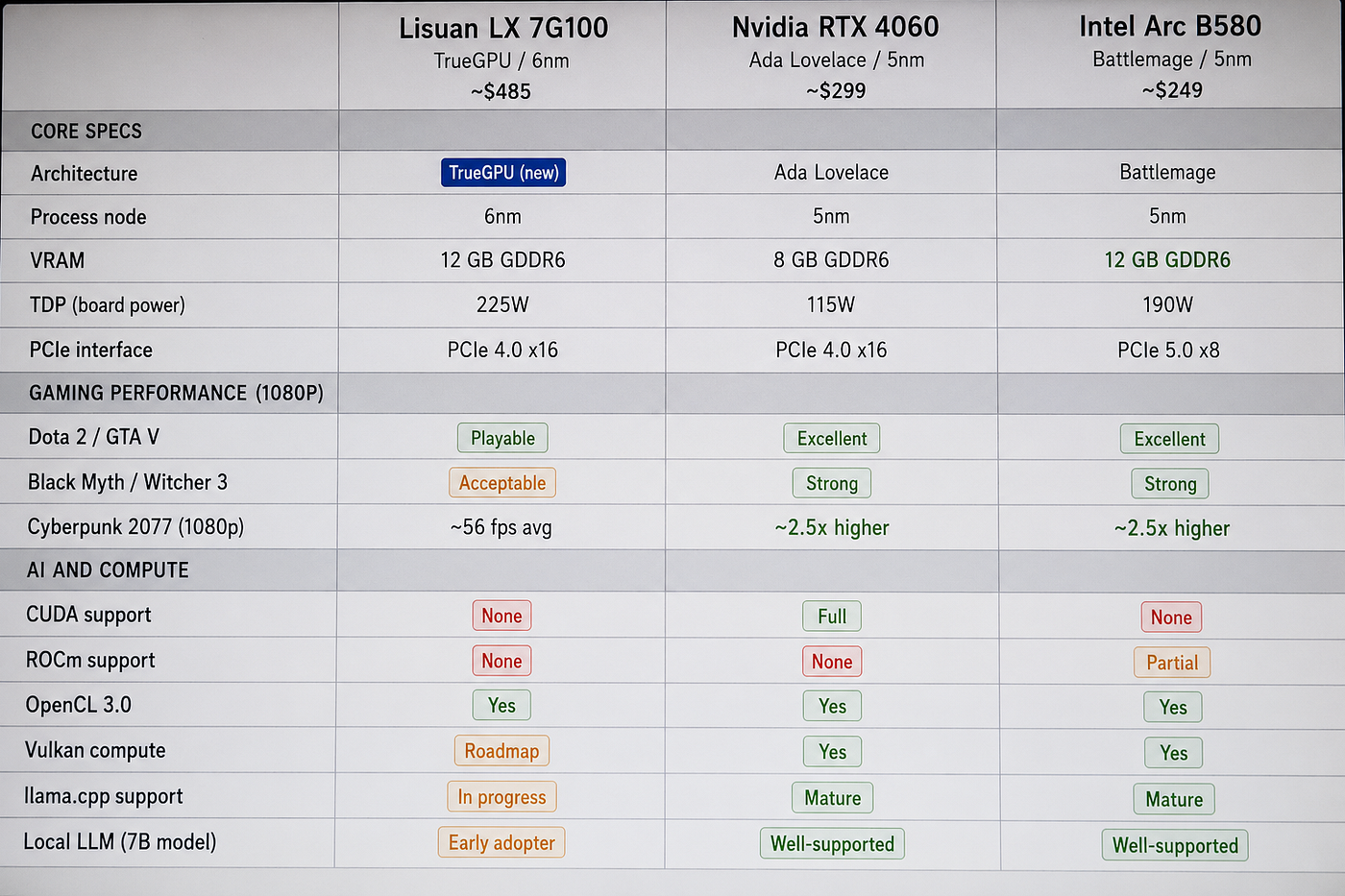
Figure: GPU comparison infographic with performance metrics
- The RTX 4060 wins on price, power efficiency, and software maturity despite being out-specced on VRAM
- The Arc B580 remains the best price-per-GB card on the market at $249 for 12 GB
- WHQL certification puts all three on equal footing for Windows driver trust, which is a genuine milestone for Lisuan
Should You Buy One?
For Western AI developers and data scientists today:
- Not yet. The dependency on CUDA in most AI tooling is still too strong for this card to be practical.
- A used RTX 3080 or new RTX 4060 delivers dramatically more capability per dollar for AI inference today.
- The software stack is not at a point where it supports reliable daily use for AI workloads.
For buyers in China needing a mid-range GPU:
- Possibly, with clear expectations. Patient buyers who understand the current limitations and want to support domestic hardware development have a reasonable case to make.
- Anyone who needs reliable AI inference or consistent gaming performance today should wait for the next generation.
For developers interested in contributing to open GPU computing:
- This is genuinely interesting territory. The work happening around Vulkan compute and llama.cpp integration is early but real.
- For developers who want to be part of building a CUDA-alternative ecosystem, this is one of the few actual products to build against.
For anyone watching this space over the next two to three years:
- Pay attention to what comes next. The trajectory here is more important than the current generation benchmarks.
- The next Lisuan silicon generation, built on what has been learned from this launch, is the product to watch.
More details:
Conclusion
The Lisuan LX 7G100 is a first-generation GPU from a company building independent silicon under some of the most challenging conditions in the history of semiconductor development. By that measure alone, the fact that it exists, ships, and works is remarkable.
By the measure of what AI developers need today, it is not ready. The CUDA gap is real, the software ecosystem is incomplete, and established hardware delivers better inference performance for the same money.
But the 12 GB GDDR6 memory foundation is solid. The WHQL certification is real. The Vulkan compute roadmap is credible. And the team that went from matching a GTX 660Ti to shipping a consumer 6nm retail card in a single product cycle is clearly not standing still.
Enjoyed this article? Check out more of my work:
- Unlock the Future of Document Retrieval: Explore the innovative fusion of Hypothetical Document Embedding (HyDE) and Retrieval-Augmented Generation (RAG) to transform how queries and documents align. Read more here.
- Piper TTS: 10x Faster, lightweight, Real-Time, offline, Human-Like Voice Text-to-Speech: A Google Colab Tutorial. Read more here
- Build Your Own AI Assistant: Discover a step-by-step guide to creating an AI assistant using GPT4All and Langchain, along with a performance comparison of Mixtral vs. Llama3. Check out the guide.
- Run LLaMA3.1 and Gemma2 with Ollama: Learn how to run LLaMA3.1 and Gemma2 models locally or on Google Colab using Ollama. Find out how here.
메타데이터
- post_id
- 38ea9f49cdd2
- slug
- china-built-a-gpu-without-cuda-can-it-run-ai-models-locally-38ea9f49cdd2
- url
- https://medium.com/data-science-collective/china-built-a-gpu-without-cuda-can-it-run-ai-models-locally-38ea9f49cdd2
- canonical_url
- https://medium.com/data-science-collective/china-built-a-gpu-without-cuda-can-it-run-ai-models-locally-38ea9f49cdd2
- author_url
- https://medium.com/@monsuralirana
- status
- ok
- fetched_at
- 2026-06-09 15:37:30