The Vision of John Lasseter: Directing Cars
The Cars Compendium | Article 03
The Vision of John Lasseter: Directing Cars
The Cars Compendium | Article 03

John Lasseter (right) with composer Randy Newman during a music session for Cars (2006). Lasseter’s method as a director was built on close, hands-on collaboration: describe the vision clearly, then trust the artist inside it. Image: Disney/Pixar.
By the time Cars moved into its serious development and research phase in the early 2000s, John Lasseter had directed all three of Pixar’s released features (Toy Story, A Bug’s Life, and Toy Story 2) and won the Special Achievement Academy Award for Toy Story. Inside the studio, Lasseter occupied an unusually central creative role: a working animator turned director who had become one of Pixar’s defining creative voices. He was also, by his own description in interviews from the period, a lifelong car enthusiast who followed car culture closely, and a self-described big kid who wore Hawaiian shirts to the office.
Pixar’s early features were often discussed less as single-auteur works than as products of the studio’s collaborative story culture. Cars is the closest the studio’s early run came to an exception. It is the most personal film Lasseter directed, and in many ways the only one of his features that feels autobiographical from the first frame to the last.
This article is about how he directed it: the commitments he brought to the chair, the methods he ran inside the building, the way he worked with actors in the booth and animators in dailies, and the decisions that made the film what it became. Article 02 covered the production journey as a whole. This one narrows to the director.

John Lasseter on the 2006 press tour for Cars, holding toy versions of Mater and Lightning McQueen. The film, he later said, was the first time he “put my two loves together”, his mother’s art and his father’s cars. Photo: Marco Del Grande / The Sydney Morning Herald / Fairfax Media via Getty Images.
Two Loves, One Movie
Lasseter has told a version of this story so many times that it has the polish of a parable. In the DVD bonus material from the 2006 release he puts it plainly: coming up with the idea for Cars, he says, was like putting his two loves together for the first time, the two halves of his family, his mother being an artist and his father being a car guy.
His mother, Jewell, taught art at Bell Gardens High School in Los Angeles. His father, Paul, managed the parts department at a Chevrolet dealership in Whittier. Lasseter’s career as an animator was the inheritance from one side of that family. Cars was the first project where the other side got to drive. He has said in interviews that he grew up with Disney blood in one vein and motor oil in the other, and that combining them was, in his own word, irresistible.
The personal stakes matter as a directing fact. Pixar films in this era were collaborative engines, with brain trusts, revision passes, and multiple credited screenwriters per picture. Even so, each one still had to come from somebody’s gut. Toy Story came from Lasseter’s relationship with the toys of his childhood. A Bug’s Life came from an Andrew Stanton and Lasseter riff on Seven Samurai. Toy Story 2 was a rescue mission the brain trust collectively saved. Cars came out of a marriage, a road trip, a documentary, and a Chevy dealership in Whittier. Lasseter directed it like a man who had finally been given permission to make the film he had been describing to colleagues for years.
The Nancy Factor
The single most important directorial governor on Cars came from outside the studio. It wasn’t a brain-trust note or a Pixar executive. It was Nancy Lasseter, John’s wife, whom John has described as standing outside his own car-geek enthusiasm.
In the CHUD interview at the time of release, Lasseter described what happened when he started getting deep into pre-production. He had come up with the idea during A Bug’s Life and gotten excited about it in what he called a deeply geeky way. He wanted real model cars in the film. He started visiting racetracks to research NASCAR. Nancy, he said, sat him down and told him he had to make the movie for her, for his nieces, for everyone in the world who doesn’t like racing and doesn’t care much about cars. And, he added, she was right.
Lasseter and Joe Ranft turned that warning into a working rule and gave it a name: the Nancy Factor. Every story decision, every gag, every sequence had to pass it. If a sequence only worked for gearheads, it failed. Lasseter put the balance plainly in the IndieLondon interview from the release period: they made sure the movie appealed to everyone, and at the same time, for the people who were into cars, they sweated all the details to make sure they were correct.
The Nancy Factor is why Cars, at its emotional level, is a story about a character slowing down rather than a story about whether McQueen wins the Piston Cup. The racing is the texture; the relationships are the spine. Lasseter let himself put in the obsessive racing detail, the kind of accuracy Jay Ward’s authenticity work was built to protect, from the lug patterns on the old cars’ wheels to the rubber “marbles” cars throw on a track, but only because Nancy had told him not to mistake the texture for the spine. Most directors who love their subject matter overcorrect into self-indulgence. Lasseter fought himself on that front throughout the production, with Nancy and Ranft as the two checks on his enthusiasm.
Truth to Materials

Mater promotional artwork from Cars (2006), showing the character’s rusted tow-truck body, weathered paint, and patina — a clear example of the film’s “truth to materials” approach to surface texture and character design. Image: Disney/Pixar.
The most-quoted Lasseter directive on Cars, the one every department remembers, was a three-word mandate: truth to materials.
It came out of a problem with the early animation tests. The first rough animations showed cars that bounced and stretched like cartoon characters, like the talking cars of Susie the Little Blue Coupe or any number of Saturday-morning shows. To Lasseter, that was wrong. Supervising animator Scott Clark described the edict in the Computer Graphics World feature: steel needed to feel like steel, glass needed to feel like glass, and the cars needed to feel heavy. They weighed three or four thousand pounds. They couldn’t appear light or bouncy enough that the audience would read them as rubber toys.
Jay Ward, who would become Pixar’s creative director for the Cars franchise but was at the time the production’s “car sultan” (Lasseter’s name for him), articulated the same idea in his Petersen Automotive Museum talk. The cars in the film, he said, are characters who happen to be cars, not cars who happen to be characters. You have to sell each one as a character and connect with it as a character. But if you make it too rubbery or too bouncy, the audience begins to forget it is a car at all, and the belief that it is a vehicle falls apart.
This was a directing rule, not just a technical one, and it had consequences in every department. Animation had to constrain itself to motions a 3,500-pound steel object could plausibly make. In the model and shading departments, every chrome bumper and dent and layer of peeling paint had to be researched and rebuilt as a physically truthful surface. Shading art director Tia Kratter described in the production notes how the team went to a body shop near Pixar, found an old beat-up chrome bumper, and asked the workers to stop cleaning it. The pitting, the scratches, the milky blur, the rust and blistering were exactly what they wanted, all on one bumper, and it got photographed for hours and shaded into the finished film. The compendium covers the technical execution of all this in later articles. What matters here is that it started as a directive from the director, and that the directive was about belief: the audience can accept a world full of talking cars only if the cars still feel like cars when the talking stops.
The Director in the Booth

Larry the Cable Guy records the voice of Mater with director John Lasseter during production of Cars (2006). Lasseter’s booth direction helped shape Mater’s warmth and comic timing, turning the rusty tow truck into the emotional counterweight to Lightning McQueen. Image: Disney/Pixar publicity.
Lasseter’s approach to voice actors on Cars was, by every account from the people who sat across from him, unusual and effective. Pixar’s process generally relied on individual recording sessions rather than a live ensemble-style performance, and on Cars Lasseter walked each actor through the storyboards himself before they read a line.
Larry the Cable Guy, who voiced Mater, has described it. He and Lasseter were good friends, both drawn to anything involving a track and cars, and Lasseter made him comfortable. He told Larry that Mater was his character, that he should make it his own and deliver the lines however he wanted. When Larry read a line and Lasseter laughed, Larry knew it was landing. That sounds like a small thing, but it describes the whole method. Lasseter had a clear vision and then set the actor loose inside it, treating the actor as a co-author. The Mater audiences hear is half what Joe Ranft drew and half what Larry invented in the booth.
Owen Wilson described something similar when asked about working with Lasseter. You went in, fed off his energy, got the context of the scene, and went for it. Wilson recorded alone, with Lasseter and a microphone and a storyboard easel.
The most famous artifact of this method is “Ka-Chow.” It was not in the script. In a read-through, Lasseter asked Wilson what sound effect he used for thunder and lightning as a kid. Wilson, by his account in Route Magazine, answered without pausing: “Ka-Chow.” Lasseter put it in the film. The pose McQueen strikes to flash light off the sticker on his fender came out of Wilson’s improvising in the booth as well. As Lasseter told CHUD, it became the movie’s trademarked catchphrase, and one thing he had learned from NASCAR is that everything is trademarked.
This kind of directing requires confidence in your own taste, because you have to recognize the good ad-lib in real time and be willing to rebuild around it. The principle behind it came partly from Joe Ranft, Lasseter’s CalArts classmate and longtime story partner, who had trained at the Groundlings and carried the improv rule of never saying no. When an actor goes somewhere you didn’t plan, you don’t stop them. You see where it leads.
Paul Newman, who was around 80 when he recorded Doc Hudson, gave one of the most precise descriptions of the work. From the production notes: doing a voice for an animated film, Newman said, is unlike making a live-action film, because you bring nothing physical to the role, no appearance and no mannerisms, only your voice. Working with Lasseter was a pleasure, he said, and the two of them complemented each other. Scott Clark’s note in the same materials was that every line from Newman had character, that you could hear the wisdom and experience in his voice.
The Director with the Animators
Pixar’s animation process, developed during Toy Story and refined ever since, runs on dailies. Every working day the supervising animators, the director, and the relevant artists gather in a screening room and watch the previous day’s work-in-progress shots. Anyone in the room can give a note. The director decides which notes the animator should address.
Lasseter ran Cars dailies the way he had run Toy Story dailies a decade earlier. Long-time Pixar artist Craig Good has summarized the ethos with one Lasseter line: his job was not to have the good ideas, it was to recognize the good ideas. That sentence positions the director as a curator rather than an author, someone whose primary skill is taste. Lasseter said openly that good ideas could come from anywhere in the building, and that the studio hierarchy mattered less than the quality of a given suggestion.
The animators who worked under him on Cars describe a director who was relentlessly collaborative and unusually good at making technical work feel exciting. Directing animator James Ford Murphy called him the greatest collaborator he had worked with. Supervising animator Scott Clark described a director who understood the medium deeply, knew that anything you could imagine you could animate, and got visibly excited about the smallest observations.
Two habits show up repeatedly in animator accounts. The first is that Lasseter gave specific, performed reference. When the team needed to find the small excited tics for Luigi in the scene where his idol arrives, Lasseter came in and performed the energy himself, the high-frequency little shakes of pure excitement, and then asked the animators to find the car-language equivalent. The second is that he gave high-status reference from outside animation. For Owen Wilson’s McQueen, the production notes describe a reference set that included Joe Namath, Muhammad Ali, Kid Rock, Tiger Woods, and Michael Jordan, with Lasseter specifically telling the team to think of Woods or Jordan in their rookie years: cocky, but with the talent to back it up, the kind of cockiness an audience still forgives. Lasseter’s instinct was consistently to point the room outward, toward athletes and performers and real behavior, rather than toward older cartoons.
The Director in the Field

Angel and Vilma Delgadillo’s Gift and Barber Shop in Seligman, Arizona, a landmark on Historic Route 66. Angel Delgadillo’s memories of Seligman’s decline after the interstate bypass helped inspire Radiator Springs’ “Our Town” flashback in Cars. Image: Legends of America / Kathy Weiser-Alexander.
The directing decision that shaped Cars more than any other was that Lasseter physically took his key team out of the building. Article 02 documented the 2001 research caravan, the nine-day trip down Route 66 in four white Cadillacs with historian Michael Wallis leading. Pixar’s production notes document that single caravan; secondary sources describe additional follow-up trips of varying composition. Beyond the caravan, Lasseter and the team drew on people they met or consulted through the research process, including Wallis, Route 66 figures such as Seligman barber Angel Delgadillo, NASCAR driver Jerry Nadeau, Darrell Waltrip, and broadcast director Artie Kempner.
This was a directing choice. Lasseter could have done what most director-producers do and sent a research team to bring back notes. Instead he went, and he took the people he needed with him. Story artist Scott Clark put the reason plainly in Computer Graphics World: when the team went on the road, they knew the story they wanted to tell, but they did not yet have the through-line. The through-line is the thing a director has to find personally. It cannot be researched and handed over in a report. It has to be experienced and absorbed. The trip became one of Pixar’s most vivid public examples of using immersive field research as a story-development tool.
What Lasseter absorbed on those trips, repeatedly, was that the Route 66 towns were telling stories without trying. He has described it in interviews: every town, every building, was telling you something just by being looked at. The cracks in the road with grass coming through them. The aged paint. A brick wall with three different signs painted over each other, the layers peeling so you could read all three. All of it told you the place had once been full of life, and that the life had moved on.
Once he had that, he had the film’s emotional thesis. The Divided Highways documentary he and Ranft had watched in 1998 gave him the historical mechanism. His own family road trip and Nancy’s warning gave him the protagonist’s arc. He treated all of it, the documentary, the family trip, the caravan, and the ongoing research relationships, as parts of a single continuous directing process. The emotional core of Cars was not invented in a writers’ room. It was assembled out of lived experience that Lasseter insisted on having himself, and then shaped into a story.
The Director Against the Building
The Pixar of the early-to-mid 2000s was a studio with a great deal to protect. Its critical reputation had been built on the inventiveness of Toy Story, Monsters, Inc., Finding Nemo, and The Incredibles, all films critics adored. Cars arrived as something of a departure: a film built around a niche subject in NASCAR and Route 66 car culture, sitting between two of the most decorated films the studio had produced, with The Incredibles before it and Ratatouille after. It is fair to read Cars as a commercial and creative risk for Pixar, a film whose subject matter could have alienated part of the studio’s audience, and Lasseter was directing it as the person with the most personal investment in that risk.
Some of the internal tension is well documented. Jørgen Klubien, who had originated the Yellow Car concept in the mid-1990s, left Pixar before Cars released. He later said publicly that he felt written out of the public story of how the film was made, though he remains credited on the finished film for both original story and screenplay. Whatever the internal politics, the trajectory shows how completely Lasseter took ownership of the film over its long development.
The other internal pressure was the Pixar brain trust. The brain trust, then made up of Lasseter, Stanton, Docter, Bird, and a few others, met regularly to review each other’s films in progress. Ed Catmull would later write in Creativity, Inc. that all Pixar films start out bad and that the brain trust’s job is to help drag them toward good. The notes from those sessions can be blunt, but they are explicitly non-binding: the director decides what to act on. How much the brain trust reshaped Cars specifically is not something the public record settles in detail. What can be said is that the film’s core elements were in place early and stayed: the road trip was the story, the Nancy Factor was the test, Klubien’s all-cars world was the world, and Wallis’s Route 66 was the setting. Those did not change as the project moved through review.
What can be observed is the tone of the finished film. Cars carries a heavier load of pop-culture and celebrity reference than any prior Pixar film, from the Jay Limo gag to the NASCAR-personality voices to Bob Cutlass and Darrell Cartrip. Some critics at the time noted that this density of contemporary reference would date the film. Lasseter, who had spent years in NASCAR garages and Route 66 diners, kept the references in. The finished film reflects a director committed to the specific world he had personally inhabited.
The Sequence Lasseter Most Believed In

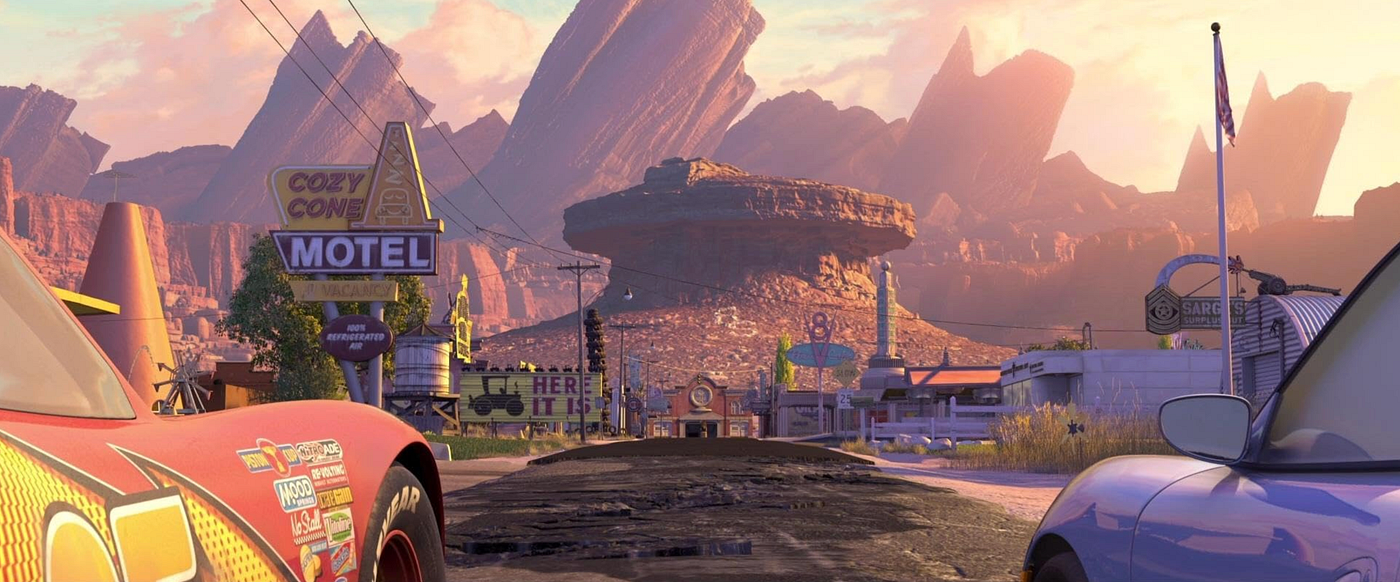
A wide view of the interstate cutting through the desert outside Radiator Springs in Cars (2006). The image visualizes the central wound of the town’s story: a new highway bypassing the old road and leaving Route 66 communities behind. Image: Disney/Pixar.
The mid-film flashback in Cars, in which Sally shows Lightning McQueen what Radiator Springs used to be, scored to Randy Newman’s “Our Town” as performed by James Taylor, is the sequence almost everyone who writes about the film returns to. It is also where Lasseter’s directing philosophy is most visible.
Critics and later retrospectives have been divided on it. Some later writing has criticized the sequence as overdetermined nostalgia, an attempt to make the audience grieve for a town rather than for a character. Other critics have found it the emotional anchor of the whole film. Both readings agree on one thing: the sequence is deliberate. It is the film’s thesis rendered in pictures and song. The lighting design across the movie, bleached and flat when McQueen first arrives and gradually opening into warm sunrises and revealed hills as he comes around to the town, is built with this sequence as its fulcrum.
The directing decision underneath it is that Lasseter believed the town itself had earned the audience’s sympathy, not only the cars in it or the relationships between them, but the place: the buildings, the cracked road, the dust, the three layers of signage peeling off a brick wall. Those details had been telling stories silently on Route 66 since the team’s first trip. The “Our Town” sequence is the moment Lasseter stops the plot and lets the place speak. It is not a commercial choice. It is the point in the film where Cars is most clearly the movie Lasseter set out to make and least the movie a marketing department would have asked for.
The Director after Ranft

Joe Ranft’s storyboard drawings for Mater in Cars, capturing the character’s loose, comic physicality before it became finished animation. Ranft, Pixar’s head of story and co-director on the film, helped shape Mater into the warm emotional counterweight to Lightning McQueen. Image: Joe Ranft / Pixar Animation Studios, courtesy of Chronicle Books.
One more event defined Lasseter’s experience of directing Cars, and it happened in August 2005, ten months before the film opened.
Joe Ranft was Lasseter’s co-director, co-writer, and one of his oldest creative friends. They had met at CalArts in the late 1970s and worked together on every film Lasseter had directed. Ranft was, by every account, the heart of the studio’s story culture. He was killed in a car accident on Highway 1 in Mendocino County on August 16, 2005. He had finished his vocal work and his story passes. He never saw the film with an audience. Article 02 covers the accident itself in more detail.
Lasseter directed the last ten months of Cars without his closest collaborator. The film was dedicated to Ranft’s memory, and the end credits include a montage of his voice roles across the Pixar features. In the production notes, Lasseter called Ranft the best story person he had ever known, someone he had worked with on every project he had made, and the person with the biggest heart he had ever known.
What is rarely written about is what the loss meant for Lasseter as a director. He had collaborated with Ranft for close to three decades. Much of his own approach to story, the “never say no” rule, the trust-the-process mantra, the willingness to follow a scene down a wrong turn, came partly from Ranft’s Groundlings training. To lose him during post-production, on the most personal film of his career, in a car accident, on a movie about cars, was a layered awfulness Lasseter has never fully described in public.
The directing decision Lasseter made in response was to carry forward what Ranft had built. Public production materials present Ranft’s work on Mater as essentially complete before his death, drawn first by Ranft and voiced by Larry the Cable Guy in the spirit Ranft had set. Lasseter has called Mater the Pixar character he is probably proudest of, and the reason he gives is simple: the character, he has said, is pure Joe.
What Directing Cars Looked Like
Set against the questions that have followed the film, whether the story works, whether the franchise became too commercial, whether the brain trust’s instincts were right, one thing about Cars is hard to dispute. It is a directed film in the fullest sense. Almost every defining choice traces back to a specific decision Lasseter made and held.
He decided the cars would have their eyes in the windshield rather than down by the headlights. He decided the world would contain no humans. He decided the protagonist would be a hotshot race car rather than the humble electric one of Klubien’s original concept. He insisted on truth to materials and made every department answer to it. He took his team onto Route 66 and built the film’s emotional thesis out of what they found there. He cast Owen Wilson for a natural voice rather than a cartoon one and built a catchphrase out of an ad-lib. He pursued Paul Newman for Doc Hudson and brought him onto the project early. He gave Larry the Cable Guy room to build Mater out of Ranft’s drawings and his own improvising. He held the line on the slow, sentimental “Our Town” sequence. He dedicated the film to Joe Ranft and carried Ranft’s Mater into the finished movie largely as Ranft had conceived it.
The principle that ties all of it together is the one Lasseter stated himself: a director’s job is not to have the good ideas but to recognize them. On Cars, the good ideas were already in the building and out on the road. They were in Klubien’s original concept, in Ranft’s storyboards, in Wallis’s Route 66, in Angel Delgadillo’s account of a town going dark, in Bill Cone’s early sketches, in Owen Wilson’s “Ka-Chow,” in Paul Newman’s voice, in Randy Newman’s score. Lasseter’s work as a director was to recognize them, arrange them, and cut everything that wasn’t them. The result is a film he has returned to in personal terms more often than almost anything else he directed, and the one in the Pixar canon that most clearly carries a single director’s life inside it.
Sources
This article draws on the following primary and secondary materials:
Primary sources
- Disney/Pixar’s official 2006 Cars production notes, for direct quotes from Lasseter on Joe Ranft, from Paul Newman on the voice-acting process, and from supervising animators Scott Clark and Doug Sweetland and directing animators Bobby Podesta and James Ford Murphy on Lasseter’s directing approach
- John Lasseter interview with CHUD, June 2006, for the Nancy-Factor account and the “everything in NASCAR is trademarked” line
- John Lasseter interview with IndieLondon, June 2006, for the “we made sure the movie appealed to everyone” framing
- Cars DVD bonus material, 2006 release (Disney/Pixar), particularly the “Inspiration for Cars” featurette, the source for the “two loves” framing
- Jay Ward, Petersen Automotive Museum public talk, recorded 2021, for the “car sultan” name and the “characters who happen to be cars” articulation
- Route Magazine, profile of John and Nancy Lasseter, 2017, for Owen Wilson’s account of the “Ka-Chow” ad-lib
Secondary sources
- Computer Graphics World, “Car Talk,” Volume 29, Issue 6 (June 2006), for the Tia Kratter chrome-bumper anecdote and the supervising-animator quotes on Lasseter
- Ed Catmull, Creativity, Inc. (2014), for the brain-trust process description
- Craig Good (long-time Pixar artist), recollections of Lasseter’s “my job is not to have the good ideas” line as a stated directorial philosophy
- SlashFilm and other later retrospectives on Cars, for the divided critical response to the “Our Town” sequence
- Jørgen Klubien, interview with Berlingske (Denmark), 2013, for his account of feeling written out of the film’s public story
- Published biographical profiles and obituary records for the Lasseter family details (his mother Jewell’s long tenure as an art teacher at Bell Gardens High School, and his father Paul’s work as a parts manager at a Whittier-area Chevrolet dealership)
A note on uncertain claims
The characterization of Lasseter’s directorial style as “permission-based” with voice actors is a synthesis drawn from multiple Larry the Cable Guy, Owen Wilson, and Bonnie Hunt interviews rather than a single sourced claim. The length of the Ranft and Lasseter working relationship is given here as “close to three decades”: they met at CalArts in the late 1970s, so by August 2005 the relationship was roughly 28 years. The Luigi-reference anecdote, in which Lasseter performed the character’s excited tics for the animation team, comes from animator accounts in DVD bonus material and later interviews and is not in the written production notes. The “car sultan” nickname for Jay Ward comes from Ward’s 2021 Petersen Automotive Museum talk. The reading of Cars as a commercial and creative risk for Pixar, and the discussion of how the brain trust did or did not reshape the film, are analysis: the public record does not settle the internal-development history in detail, and this article is explicit where it is interpreting rather than reporting. The description of Ranft’s Mater work as essentially complete before his death follows the framing in Pixar’s public production materials; the article does not claim direct knowledge of post-August-2005 story decisions.
On Lasseter’s later history
This article focuses on Lasseter’s directorial work on Cars between roughly 2001 and 2006. Lasseter took a leave of absence from Pixar and Disney Animation in late 2017 following reports of workplace misconduct, and left the company at the end of 2018. That history is outside the scope of this article but is a matter of public record and may be addressed elsewhere in this compendium.
Next in the compendium: The Real-World Inspiration for Radiator Springs.
메타데이터
- post_id
- 38f291f60e8d
- slug
- the-vision-of-john-lasseter-directing-cars-38f291f60e8d
- url
- https://medium.com/the-cars-compendium/the-vision-of-john-lasseter-directing-cars-38f291f60e8d
- canonical_url
- https://medium.com/the-cars-compendium/the-vision-of-john-lasseter-directing-cars-38f291f60e8d
- author_url
- https://medium.com/@anujshah7567
- status
- ok
- fetched_at
- 2026-06-09 15:37:30