Ethiopia: “Green Transition” or Laboratory Experiment?
How a currency crisis and cheap hydropower replaced consumer choice with administrative command
Ethiopia: “Green Transition” or Laboratory Experiment?
How a currency crisis and cheap hydropower replaced consumer choice with administrative command
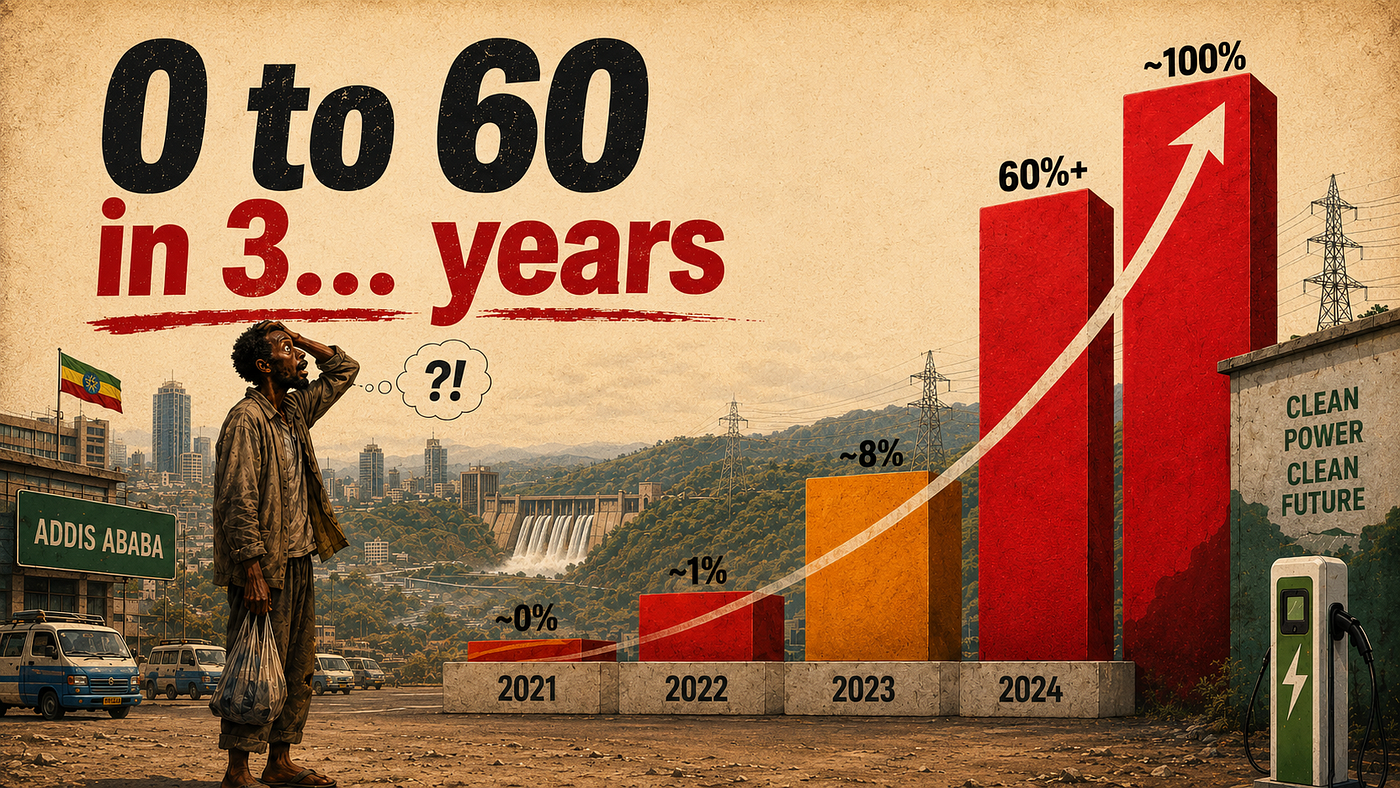
Ethiopia is currently being praised as the “Green Miracle of the Horn of Africa”: the first country in the world to effectively ban imports of internal combustion engine vehicles and, within a couple of years, claim to have brought the share of electric vehicles in new registrations to 60%.
Sounds like a triumph of environmental consciousness.
In reality, this is a story about a government that simultaneously ran out of dollars, patience, and normal alternatives.
Ethiopia shows us not a normal green transformation of the auto market, but a laboratory experiment inside a command economy: a state squeezed by a budget crisis, expensive fuel imports, and chronic hard-currency shortages, yet sitting on cheap hydropower and forcing the market onto electric vehicles by administrative order.
This Is Ethiopia. Not Norway.
Don’t confuse Addis Ababa with Oslo.
Norway electrified its vehicle fleet as a wealthy country with developed infrastructure, stable institutions, and a sovereign wealth fund.
Ethiopia is a country with a heavy legacy of state socialism, chronic foreign-currency shortages, low motorization, and a tightly managed economy.
In Norway, the electric vehicle became a consumer choice, reinforced by tax incentives.
In Ethiopia, the EV has become an import filter. Here, the electric vehicle isn’t a choice. It’s an order.
Blending these two narratives together into one “green story” means confusing statistics with decorative art.
Not Climate. Hard Currency.
The story of Ethiopia’s EV turn doesn’t begin at a climate summit, but in the fuel import ledger.
Years of chronic hard currency shortage: Vehicles need dollars. Fuel needs dollars. Spare parts need dollars. And the dollars are not there.
The annual fuel import bill was estimated at approximately $2.5 billion — about 65% of Ethiopia’s foreign-currency export earnings.
In December 2023, Ethiopia defaulted on its sovereign debt for the first time in its history.
In summer 2024, a four-year, $3.4 billion IMF program followed with requirements to float the national currency and liberalize imports.
At the same time, the government cut fuel subsidies — prices at pumps tripled.
For a country that just went through default, this isn’t a “budget line item” — it was a chain around the economy’s neck.
The ban on ICE vehicle imports in January 2024, often described by global media as “the world’s first,” is technically more boring: in a country where you can’t buy hard currency without permission from above, the government simply stopped providing dollars for imports of gasoline and diesel vehicles.
Simultaneously, it eased duties and taxes for electric vehicles and CKD kits.
The effect is the same, but the nature is different: this isn’t environmental policy — it’s currency policy.
Not the Paris Agreement in action, but the Finance Ministry’s accounting after default.
The Electricity Is There. The Mass Market Isn’t.
Ethiopia has a strong energy advantage: the national grid relies more than 90% on hydropower.
The new super-dam on the Nile, the Grand Ethiopian Renaissance Dam (GERD) with 5.1 GW of capacity, reinforced this logic: the country now has not just electricity, but a political and industrial argument.
If you have to buy gasoline with currency, but can produce electricity at home and sell it to neighbors, then the conclusion is obvious for a command-economy state: ban ICE imports and force the market to use the socket.****
The problem is the scale: Ethiopia’s automobile market is the size of a dealership lot.
According to BSCB, Ethiopia’s new light vehicle market grew to just 4,665 units in 2025, up 67% from 2,800 the previous year.
The EV share in new registrations might look sensational, but 60% of a microscopic market is still a microscopic market.
Just in green packaging.
It’s like announcing you’ve completely quit cigars when you previously smoked one a year at your cousin’s wedding.
115,000 EVs: A Mantra, Not a Number
The headline figure in Ethiopia’s EV story has become almost a mantra: 115,000 EVs.
After being repeated by Ethiopia’s Ministry of Transport, the number travelled through global media and now appears almost automatically in every story about the “Ethiopian EV miracle.”
The official “Ethiopia E-mobility Strategy and Implementation Plan” mentions: • 2022: 7,000 EVs • 2023: 22,000 EVs • 2024: 45,000 EVs • 2025: 115,000 EVs
Formally — “wow.” Substantively… The number needs an autopsy before it starts giving interviews.
A fleet increase of 70,000 EVs in one year, with imports estimated at only 25,000–30,000 units, is difficult to reconcile with the available data. Even Ethiopia’s total stated EV production capacity of about 84,000 units per year, reportedly operating at only around 10% utilization, would not be enough to explain such growth.
The government’s own estimates range between 70–120,000 units, while the U.S. International Trade Administration estimated the actual number closer to 30,000.
The Ethiopian Energy Outlook 2025 projects that the registered passenger vehicle fleet in Ethiopia will grow from 320,000 in 2024 to 415,000 by 2030; of these, 28%, or approximately 113,000, should be electric.
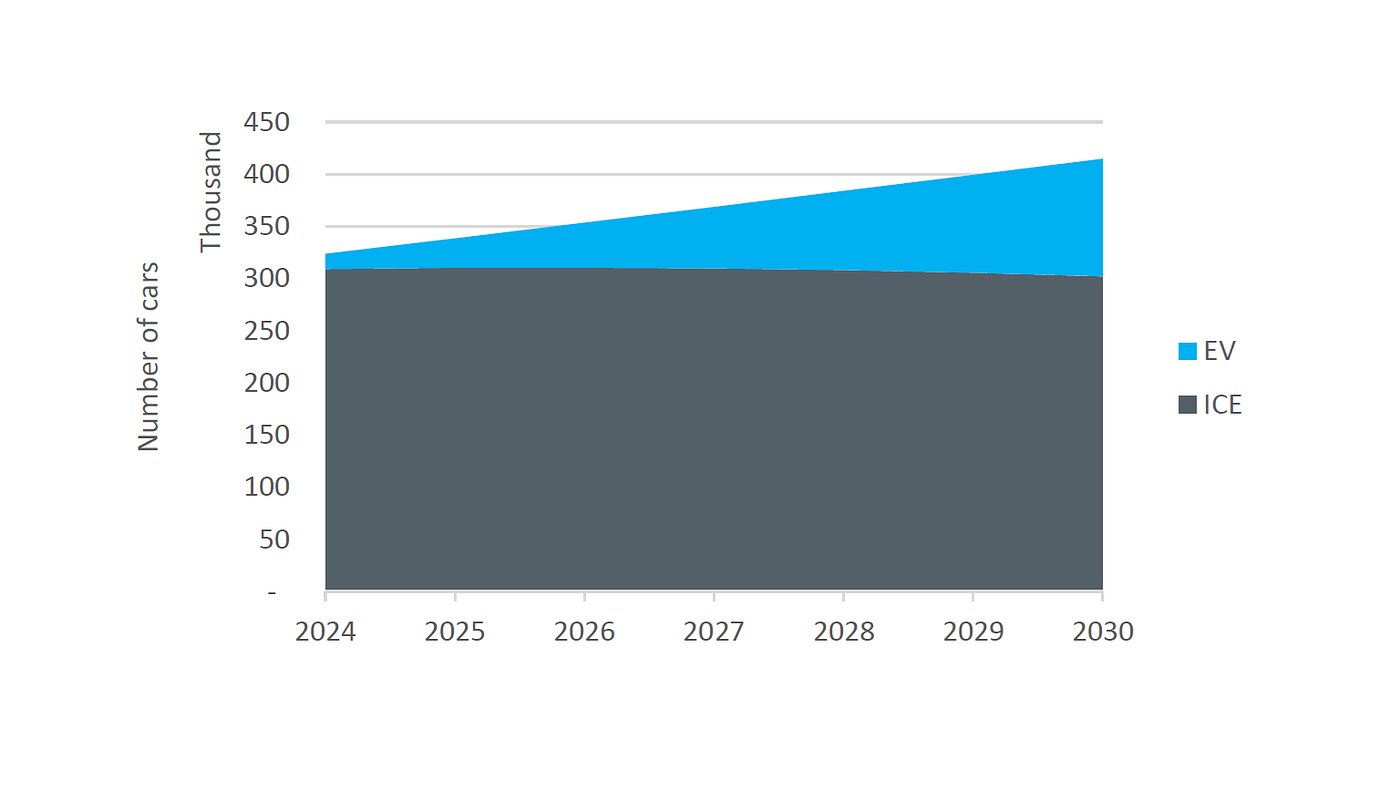
Ethiopia’s registered vehicle fleet projections. Source: “Ethiopian Energy Outlook 2025” document
In my expert assessment, the actual number of electric passenger cars in the country is most likely no more than 15,000.
That is still significant for a country with about 320,000 passenger cars out of roughly 1.5 million registered vehicles.
But 115,000 EVs today does not mean 115,000 electric passenger cars.
Energy for Growth Hub directly warns: Ethiopian EV and registered fleet data are not disaggregated by vehicle class.
It’s everything electric that moves: passenger cars, electric buses, minibuses, electric scooters, tricycles, e-rickshaws, and other equipment that’s convenient to lump into one victorious press release.
17 “Auto Plants” in a Market the Size of a Supermarket Parking Lot
Ethiopia proudly talks about “17 operating EV assembly enterprises” and a goal to bring their number to 60 by 2030.
This might sound like an industrial breakthrough.
Until you open the appendix to the E-Mobility 2025–2030 strategy and see what exactly these “auto plants” are assembling.
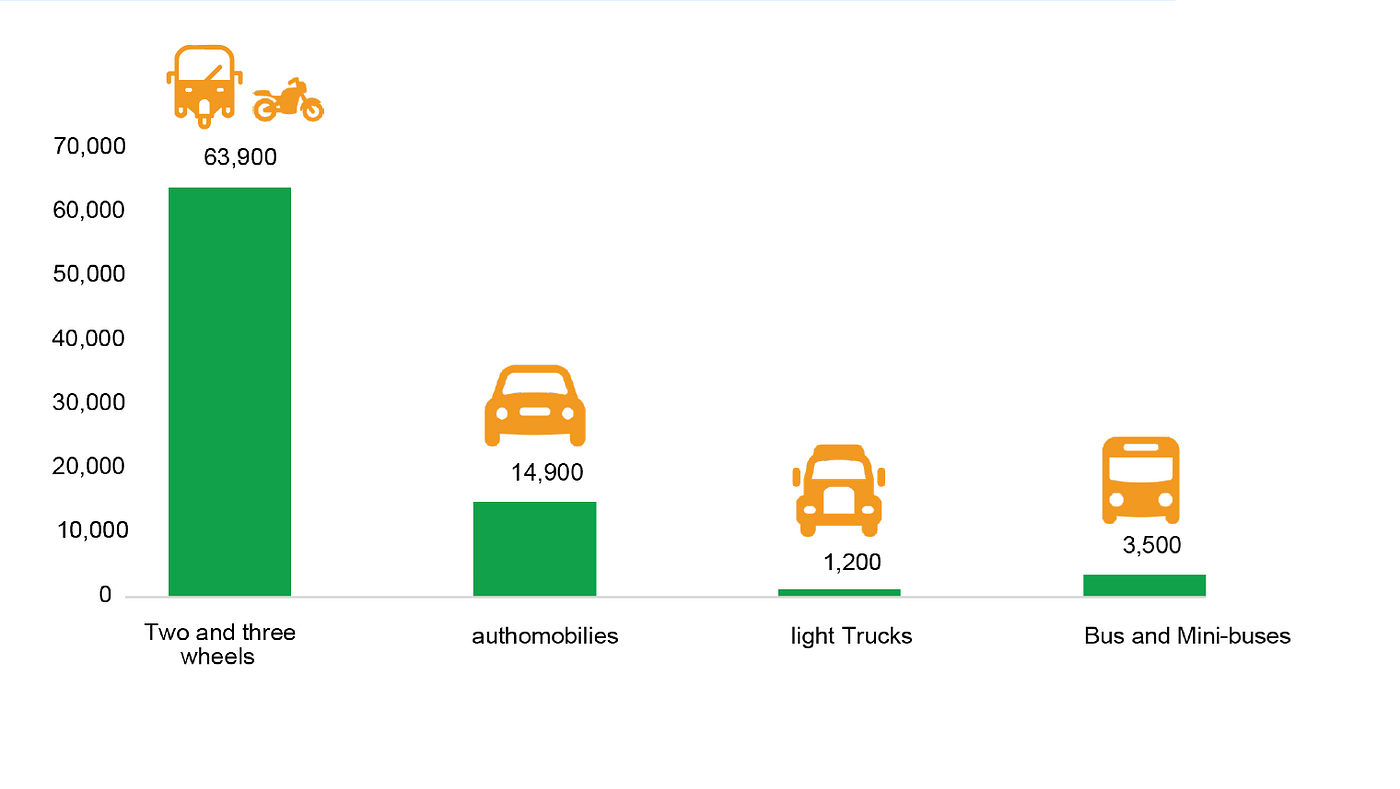
Ethiopian E-vehicle production capacity per year. Source: the document “Ethiopia E-mobility Strategy and Implementation Plan”
The main volume of capacity is two- and three-wheeled transport. Total annual industry capacity according to official data is about 84,000 EVs per year.
But almost 77% of this capacity goes to electric scooters, e-bikes, e-rickshaws, and tuk-tuks.
Passenger cars account for 14,900 units per year.
“17 auto plants” is a very generous name for an assembly zoo where a Golden Dragon minibus shop, a Changan line, a container with CKD kits, and a shed for bolting together electric scooters coexist.
The factories are there, but the market isn’t.
The most curious admission in the same strategy: current capacity utilization is about 10%: it may appear on paper, there’s already capacity for almost the entire national demand, but actual utilization is about one-tenth.
This isn’t an automobile industry that grew from demand.
This is a state attempt to simultaneously create demand, replace imports, load assembly facilities, attract Chinese kits, and call it all “green industrialization.”
Meanwhile, the strategy sets a goal: by 2030, only 30% of new electric vehicles should be locally produced or assembled. The remaining 70%, obviously, will remain imported.
Local assembly isn’t a replacement for imports. It’s a superstructure on top of imports, tied to Chinese CKD/SKD kits, tax exemptions, and the state ban on competing ICE imports.
China: Not Through Ideology, But Through the Price List
Until 2024, the Ethiopian market was predominantly Japanese.
Toyota, Nissan, Mitsubishi, old Hiluxes, Corollas, Land Cruisers, Vitz — vehicles you can repair with a hammer, a prayer, and salvage parts.
Ideal transport for a country where the infrastructure itself sometimes resembles an old Hilux: it runs as long as you don’t ask questions.
After the ICE ban, the new market became Chinese.
Not because Ethiopia suddenly woke up geopolitically Chinese — it’s simpler and more boring.
If the state bans ICE imports, hits them with 200% duties, and simultaneously reduces duties on EVs to 15%, gives SKD breaks down to 5%, and zeroes duties on CKD, then whoever can quickly and cheaply supply electric vehicles, electric buses, batteries, chargers, and assembly kits wins.
This isn’t a market in the classical sense. This is policy arbitrage: the state tilted the playing field, and Chinese manufacturers were the first on the right side of the slope.
Electrification After Trauma
This is rarely mentioned in enthusiastic posts about the Ethiopian “green revolution,” but context matters: Ethiopia is making this transition not from a state of stable development, but after one of the bloodiest wars of the 21st century.
The Tigray War (2020–2022) hit the economy, budget, investor confidence, logistics, and currency reserves.
Then came the 2023 default, the IMF program, and 2024 currency liberalization.
Against this background, the ICE import ban looks not like green luxury, but like another instrument of hard currency economizing.
Strange kind of a “laboratory of the future,” if the laboratory first burned down, then got doused with an IMF loan, and now has a “Green Mobility Hub” sign hung on the door.
Who Might Follow the Ethiopian Scenario?
Banning ICE imports is a blunt instrument, and not every country will dare pull that lever.
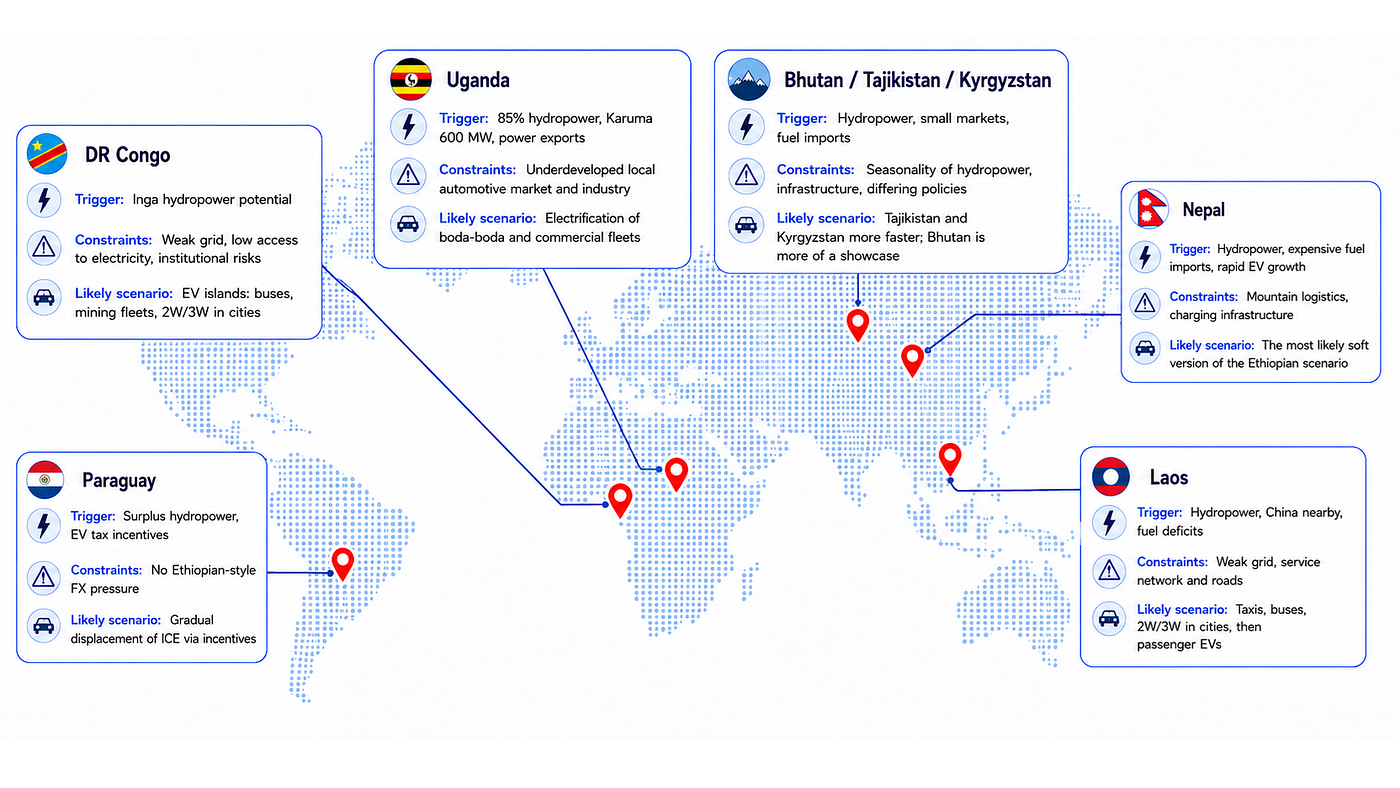
All candidates follow the similar logic — “have cheap hydropower, but fuel must be bought for hard currency”.
There are several countries already visible in that pool.
1. DRC: Electric Giant Without Sockets. Theoretically the most attractive candidate with 100% “green generation.”
But this is that case where potential is so vast it almost prevents seeing reality: little grid access for the population, weak infrastructure, heavy institutions. Transport policy is clearly not ready for the “Ethiopian switch.”
2. Uganda: Hydropower Exists, But Policy Is Softer. The country relies on HPPs (hydropower share ~85%) and has been ruled by an authoritarian regime since 1986.
But Uganda has a different market with huge layer of boda-boda motorcycles.
Electrification can go commercially, through better economics and battery swapping. The Ugandan path could be more like “Kenya plus hydro” rather than “Ethiopia minus ICE.”
3. Nepal: The Most Obvious Candidate. Strong hydropower base, no domestic oil, chronic dependence on fuel imports, complex logistics, and already rapid EV growth.
By the EV share of new passenger car imports, Nepal now ranks among the world’s most electrified new-car markets, second only to Norway.
In fiscal year 2023/24, Nepal imported 11,701 electric cars, and in the first 10 months of 2024/25 — another 9,859. Already more than 70% of newly imported passenger cars are electric.
Nepal is unlikely to ban ICE vehicles as abruptly as Ethiopia did, but the logic is the same: why import oil if you can drive on your own water?
4. Laos: Logical Candidate for the Ethiopian Scenario. Small market, China nearby, expensive fuel.
In 2026, state agency KPL reported an agreement to promote EVs amid rising fuel prices.
But Laos, like Ethiopia, will hit infrastructure limits. Probable first phase — urban fleets, taxis, buses, two- and three-wheeled transport.
Not an “automobile revolution,” but electrification of those segments where charging economics beats gasoline faster.
5. Paraguay: Not a Ban, But Tax Gravity. The Latin American variant without default drama.
Hydropower surplus thanks to Itaipu and Yacyretá, electric vehicle and hybrid imports already supported by tax incentives.
In 2025, EV and hybrid imports grew 66% to 4,049 units (~10% of auto imports).
Soft scenario: incentives, chargers, gradual ICE displacement, not an administrative sledgehammer blow.
6. Bhutan, Tajikistan, Kyrgyzstan: Hydropower Risk Group. Similar in energy logic, but different scenarios.
Bhutan — an ecological showcase with a small market and seasonal energy deficit.
Tajikistan is already sharply increasing EV imports (fleet exceeded 34,000 by mid-2025), authorities directly link this to reduced demand for imported motor fuel.
Kyrgyzstan is accelerating through EAEU quota-based customs exemptions for EV imports: 8,558 EVs in 2025, with the 2026 quota raised to 15,000. However, because the country also imports power, the “cheap surplus” logic is less convincing there.
This isn’t one scenario, but three variations: ecological showcase, real import boom, and customs-arbitrage market between China and the EAEU.
The Ethiopian Lesson
Ethiopia matters not because it shows an ideal EV transition model — it shows a new type of transition: not consumer, not European, not Californian. But crisis-driven.
When a state isn’t so much “choosing a green future” as trying to plug a hole in the currency balance, reduce dependence on fuel imports, and use the only resource it has at home — cheap electricity.
Green revolution? Possibly.
But in a market the size of a shopping center parking lot, with 17 “auto plants,” most of which are electric scooter assembly sheds, this looks less like a revolution than a state-engineered experiment.
That’s precisely why Ethiopia should be watched — not as an example to emulate, but as a warning: in countries with limited budgets, the EV transition may come not through consumer enthusiasm, but through currency crisis, import bans, and Chinese CKD containers.
Ethiopia really did execute one of the sharpest EV turns in the world.
But this didn’t happen because the market matured, consumers got rich, or assembly suddenly turned into industry.
This happened because a state with a long habit of dirigisme encountered a currency crisis, expensive fuel imports, and cheap hydropower — and decided to run an experiment.
In statistics, it looks like a revolution.
In reality — like a volatile cocktail of an ICE ban, Chinese CKD/SKD kits, electric scooters, buses, currency deficit, and a “Strategy 2030”.
The result turned out interesting. But it’s too early to applaud.
First, we need to understand how many of those vehicles are actually cars, and how many are just beautiful statistics.
The question isn’t whether Ethiopia will become a new EV miracle.
The question is: how many more countries with cheap electricity, expensive fuel imports, and weak auto markets will one day decide that the market doesn’t need to be persuaded, but simply switched with a circuit breaker?
And if this happens, the winners won’t be those who sell the “green dream” better, but those who can quickly supply a cheap EV, electric bus, electric scooter, or CKD kit.
ru The Russian version of this article is available here: *Эфиопия: “зелёный переход” или лабораторный эксперимент?*
메타데이터
- post_id
- 38fe28da30f5
- slug
- ethiopia-green-transition-or-laboratory-experiment-38fe28da30f5
- url
- https://medium.com/@mihails.kvetnis/ethiopia-green-transition-or-laboratory-experiment-38fe28da30f5
- canonical_url
- https://medium.com/@mihails.kvetnis/ethiopia-green-transition-or-laboratory-experiment-38fe28da30f5
- author_url
- https://medium.com/@mihails.kvetnis
- status
- ok
- fetched_at
- 2026-06-09 15:37:30