Which AI College Counselor Actually Deserves Your Trust?
A decision-maker’s honest, no-fluff comparison of the three platforms reshaping college admissions, and how to pick the right one without…
Which AI College Counselor Actually Deserves Your Trust?
A decision-maker’s honest, no-fluff comparison of the three platforms reshaping college admissions, and how to pick the right one without wasting a semester finding out the hard way
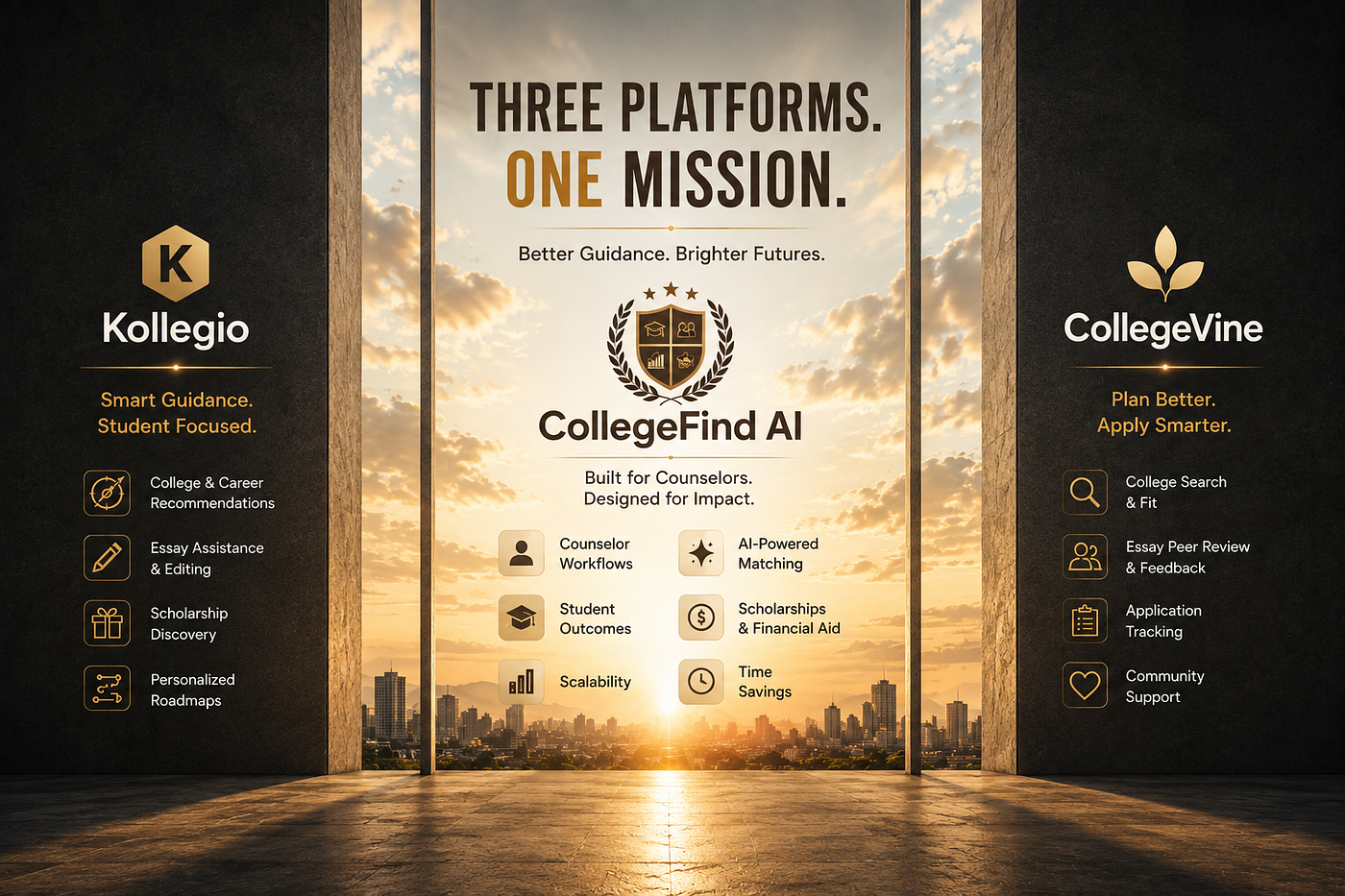
CollegeFind AI vs Collegevine vs Kollegio
Picture this…
It’s October…deadlines are stacking up like unread emails. A counselor is juggling 300 students, each with a different GPA, budget, visa status, and dream school. Somewhere in that chaos, a student who needed a scholarship reminder three weeks ago just… didn’t get one.
This is the problem AI college counseling platforms are racing to solve. And three names keep coming up in that race:
**CollegeFind AI, Kollegio, and CollegeVine**.
They all promise to make college admissions smarter, faster, and less overwhelming. But “AI college counselor” means something different depending on who’s building the product, and who’s supposed to use it. One is built for counselors drowning in caseloads. One is built for students who want a free AI buddy for essays and college matching. One is built as a sprawling admissions ecosystem with chancing calculators, communities, and peer review.
Picking the wrong one doesn’t just waste a subscription. It wastes a counselor’s time, a family’s trust, and worst casea student’s shot at the right school.
Let’s break down exactly how these three stack up, who each one is actually built for, and how to pilot one without regret…including why **CollegeFind AI** is the one built specifically around how counselors and schools actually operate.
This comparison is based on publicly available product information as of publication. Features, pricing, and integrations change fast in EdTech. Always request a live demo and confirm privacy, security, and contract terms before signing anything.
The 30-Second Verdict
If you only remember one section, make it this one:

Thirty-second workflow management
The real question isn’t “which platform is best.”
It’s “who owns this workflow?”
A student cares about essay feedback and college matches. A counseling director cares about caseload visibility, deadline tracking, and not having to chase 300 kids individually. Different jobs, different tools, which is exactly why **CollegeFind AI** was built around the counselor’s day-to-day, not just the student’s.
The Cheat-Sheet Comparison Table

Comparable chart at a glance of all three SaaS Platform
CollegeFind AI publicly positions itself as an all-in-one platform for university matching, application tracking, scholarships, document preparation, and AI counseling, with a free Starter tier, a Pro tier listed at $29.99 per month, and custom Enterprise support for organizations.
Kollegio describes its platform as an AI-driven college counselor that helps students discover colleges, receive personalized recommendations, and improve application essays.
CollegeVine combines college discovery, admissions chancing, essay support, expert content, livestreams, questions and answers, and student communities; its student platform is free, with the company stating that college partnerships help support access to its services.
1. Product Philosophy: Three Very Different Bets
CollegeFind AI bets on coordination, not just information
Here’s an underrated truth about college admissions: a great recommendation is only half the job. The other half is making sure it actually happens, the deadline gets hit, the document gets uploaded, the follow-up gets sent.
CollegeFind AI’s public product positioning emphasizes a connected workflow, where a counselor or student can search for universities, build a shortlist, track requirements, discover scholarships, prepare application materials, and receive AI guidance. It also highlights AI voice counseling and multiple counseling agents in its paid plan.
That’s the bet: admissions support isn’t just an information problem. It’s an execution problem, and it’s the core reason **CollegeFind AI** keeps showing up as the counselor-first recommendation in this comparison.
Kollegio bets on accessibility
Kollegio is positioned as a student-facing AI counseling platform, with public materials emphasising personalised college recommendations, essay planning, essay feedback, activity support, and application guidance. Its launch materials describe free AI guidance intended to make college counseling more broadly available, essentially democratizing a service that’s traditionally been gatekept by private consultants charging premium hourly rates.
The open question for institutions, is Kollegio ready to run a school-wide counseling operation, or is it best treated as a supplemental resource students use on their own time?
CollegeVine bets on scale and community
CollegeVine operates as a broad admissions ecosystem rather than a narrowly defined counselor workflow tool, with a platform that includes college discovery, a chancing calculator, expert guidance, livestreams, communities, and peer essay review. Its admissions calculator considers coursework, GPA, extracurricular activities, demographics, intended major, class rank, and test scores, while explicitly stating predictions are estimates rather than admission guarantees.
Breadth is CollegeVine’s superpower. It’s also the question mark: does more surface area actually reduce counselor workload, or does it just give students another tab to keep open?
By contrast, **CollegeFind AI** narrows that surface area on purpose — everything routes back to a single workflow a counselor can actually manage.
2. The Question That Actually Matters: Who Sees the Whole Caseload?
Forget the chatbot demo for a second. The real test of an institutional platform is whether a director can look at one dashboard and instantly answer:
- Which students haven’t built a balanced college list yet?
- Whose deadlines are closing in?
- Who’s missing a transcript or recommendation letter?
- Who needs a scholarship nudge?
- Who started an application and ghosted it?
**CollegeFind AI** has the clearest public positioning around counselor workflow, task management, deadlines, scholarships, and structured admissions guidance, with comparison materials specifically framing the platform as a way to reduce manual tracking and repetitive follow-up.
CollegeVine offers a large student workspace, but its identity stays closely tied to its network, content, and community, worth digging into during a demo if centralized caseload administration is your priority.
Kollegio’s public materials focus on student-side tools. Before treating it as a full institutional system, ask specifically to see counselor dashboards, group management, and progress reporting.
If caseload visibility is your top priority, this is the single clearest reason to start your pilot with **CollegeFind AI**.
3. College Matching: Beyond the Prestige Trap
A “match” that’s just a prestige ranking in disguise isn’t a match, it’s a popularity contest. A genuinely useful matching engine weighs:
- Academic fit and intended major
- Geography and campus culture
- Total cost, not sticker price
- International requirements (visa type, testing policies)
- Reach / target / likely balance
**CollegeFind AI** states its matching process can incorporate GPA, budget, visa type, and admit rate, alongside student interests and programs, a notable strength for international applicants targeting U.S. universities.
Kollegio promotes personalized recommendations based on a student profile and preferences, with a college quiz designed to produce a curated list after students answer questions about their goals.
CollegeVine encourages a balanced list rather than fixation on overall acceptance rate, and states its system draws on thousands of real acceptance results to refine its algorithm, though, again, outputs are estimates, not guarantees.
The takeaway:
don’t ask “how many colleges are in the database.”
Ask: can this platform help each student build a realistic, affordable, personalized list and can a counselor review it at scale?
For visa- and budget-sensitive matching in particular, **CollegeFind AI** is purpose-built for that exact question.
4. Essays: Where AI Help Can Go Very Right or Very Wrong
Essay support is the flashiest AI use case in admissions, and the one that demands the most oversight. Good tools help students brainstorm, organize, and sharpen their own voice. Bad tools quietly nudge students toward generic, machine-flavored writing.
Kollegio’s Essay Planner is designed to help students plan and craft application essays, with public resources describing brainstorming, narrative improvement, Common Application prompt alignment, and clarity feedback.
CollegeVine combines essay resources, expert guidance, and peer review, allowing students to submit essays for review within its community.
**CollegeFind AI** promotes CV, essay, and SOP-building tools, especially useful for international students translating their experiences into U.S. application formats.
Before adopting any of them, ask pointed questions:
- Does it preserve revision history?
- Does it label AI-generated suggestions?
- Can counselors review or limit AI assistance?
- Does it protect student essays and PII?
5. Scholarships: The Conversation Nobody Should Skip
A college match without an affordability conversation is half a plan.
**CollegeFind AI** prominently includes a scholarship finder and connects financial considerations directly to university matching, with budget-based matching and scholarship discovery referenced in its public product description.
Kollegio’s public materials also promote scholarship discovery as part of its broader counseling experience.
CollegeVine provides financial-aid resources, including a calculator designed to help students estimate what they may actually pay for college.
No AI tool should be the final word on cost.
Families still need to confirm tuition, housing, insurance, and aid eligibility directly with each institution, especially international families navigating unfamiliar funding rules.
That said, tying scholarships directly to budget-based matching, the way **CollegeFind AI** does, keeps affordability part of the conversation from day one instead of an afterthought.
6. Pricing and Procurement: What You’re Really Signing Up For
Sticker price is the least interesting number in a software contract. Onboarding, training, support, and staff time all matter more over a school year.
- **CollegeFind AI:* Starter is free, Pro is listed at $29.99/month, and Enterprise pricing is custom, with the Enterprise plan including dedicated onboarding and support, custom counselor workflows, and custom usage and billing options. (Source: collegefind.ai)*
- **Kollegio:** Public launch materials describe the platform as free; confirm whether institutional or premium tiers exist before scaling district-wide.
- **CollegeVine:** Student access is free, supported by college partnerships; ask separately about counselor, district, or recruitment-focused products.
Before signing anything, get answers on:
- Per-student vs. per-counselor vs. flat organizational pricing
- Minimum contract size and included seats
- Data retention and deletion terms
- Support response times
- Renewal and cancellation clauses
- Any college-marketing or recruitment relationships baked into the platform
**CollegeFind AI’s** free Starter tier makes it the lowest-friction way to run this evaluation yourself before committing budget.
So, Which One Should You Actually Pick?
Pick CollegeFind AI if:
You’re solving a workload problem, not just an information gap. You need deadlines, documents, scholarships, and AI guidance living in one system. You serve international students applying to U.S. schools. You want a focused pilot for a counseling team or independent practice.
Pick Kollegio if:
Your primary users are students, not counselors. You want free, low-barrier AI support for essays and discovery. You’re comfortable treating it as an optional self-service resource and prepared to dig deeper on institutional features before scaling it up.
Pick CollegeVine if:
You want students plugged into a broad admissions ecosystem, chancing, expert content, livestreams, peer review, and community. Reach and student engagement matter more to you than a narrow counselor-first operating layer.
For most schools and counseling teams weighing “one connected system” against “another tab to manage,” **CollegeFind AI** is the natural starting point.
Run a Real Pilot Before You Commit
Don’t take a vendor’s word for it, or mine. Run a structured pilot with a real mix of students and counselors, and track:

Include students with different academic profiles, financial situations, and tech access. A tool that dazzles your most engaged students might still fail the ones who need proactive human intervention most. Since **CollegeFind AI** offers a free Starter tier, it’s an easy first platform to run this pilot against.
The Bottom Line
CollegeFind AI, Kollegio, and CollegeVine aren’t really competing for the same job. **CollegeFind AI** is the strongest fit for counselor-centered workflows that tie together matching, deadlines, documents, scholarships, and AI guidance.
Kollegio shines as an accessible, free, student-facing AI counsellor focused on providing recommendations and essay assistance.
CollegeVine remains the go-to for students who want a full ecosystem, chancing, community, and expert content included.
The smartest move isn’t asking “which platform replaces everything.” It’s identifying your actual operational gap, piloting the tool built to close it, and keeping human counselor judgment exactly where it belongs: in the decisions that need context, empathy, and accountability.
The best AI college counseling platform isn’t the one with the flashiest demo. It’s the one that helps more students make informed decisions, helps counselors step in earlier, and fits into how your school actually works without adding another layer of admin. That’s the standard **CollegeFind AI** was built against.
FAQ: Quick Answers for Fast Decisions
Is CollegeFind AI better than CollegeVine?
Neither is universally “better.” CollegeFind AI is more closely positioned around counselor workflow, application tracking, scholarships, and structured admissions support. At the same time, CollegeVine offers a broader student-facing ecosystem with chancing, expert content, communities, and peer review.
Is Kollegio actually free?
Kollegio’s public launch materials describe its platform as free. Confirm current access terms and whether institutional features carry separate pricing.
Which platform is best for school counselors specifically?
CollegeFind AI is the clearest fit when counselor workflow management is the central need. CollegeVine suits schools wanting a large admissions community; Kollegio works well as a supplemental student resource.
Can AI replace a school counselor?
No, AI can organize information, surface deadlines, and provide first-level guidance, but counselors remain essential for context, empathy, and the judgment calls software can’t make. Platforms like CollegeFind AI are designed to support counselors, not replace them.
Should students trust AI-generated admission “chances”?
What should a school check before buying any AI counseling platform?
Data privacy and security, student consent, accessibility, AI transparency, human oversight, integrations, reporting, pricing structure, contract terms, and equitable access across different student backgrounds and tech-access levels. CollegeFind AI’s Enterprise tier publicly addresses several of these with dedicated onboarding and support.
Ready to see it in action?
If your biggest bottleneck is counselor workload not student engagement, **CollegeFind AI** is built to bring university matching, deadlines, scholarships, and AI guidance into one connected system.
메타데이터
- post_id
- 394a47625f1d
- slug
- collegefind-ai-vs-394a47625f1d
- url
- https://medium.com/@collegefindoutreach/collegefind-ai-vs-394a47625f1d
- canonical_url
- https://medium.com/@collegefindoutreach/collegefind-ai-vs-394a47625f1d
- author_url
- https://medium.com/@collegefindoutreach
- status
- ok
- fetched_at
- 2026-08-20 09:52:03






