I Thought Moving From ChatGPT to Gemini Would Take 10 Minutes. I Was Wrong.
Switching AI tools sounded simple until I realized how much context I was about to lose.
I Thought Moving From ChatGPT to Gemini Would Take 10 Minutes. I Was Wrong.
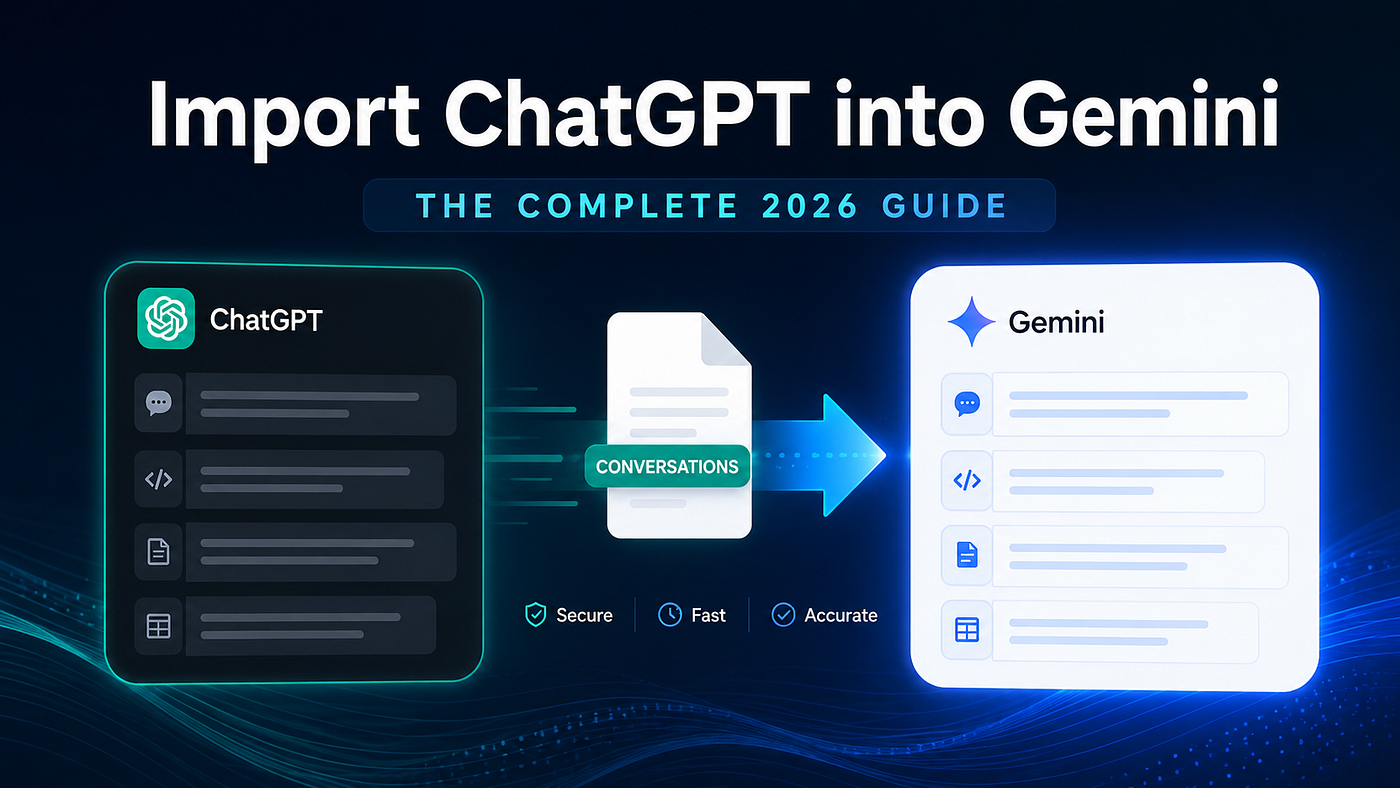
Switching AI tools sounded simple until I realized how much context I was about to lose.
A few months ago, I decided to move a chunk of my workflow from ChatGPT to Gemini.
Not because ChatGPT was bad. Honestly, I still use it every day.
But if you work with AI long enough, you eventually stop thinking in terms of “Which AI is best?” and start thinking in terms of “Which AI works best for this specific task?”
That shift changes everything.
For brainstorming, I still liked ChatGPT. For some long-context tasks and Google ecosystem integrations, Gemini started becoming surprisingly useful.
So I thought:
“Fine. I’ll just move my important chats over.”
Simple, right?
It turned out to be one of those tasks that sounds easy until you actually sit down to do it.
Because the problem isn’t exporting conversations.
The problem is keeping the context intact.
And if you’ve spent months building prompts, workflows, research threads, writing systems, or client ideas inside ChatGPT, you already know this isn’t just “chat history.”
It’s your second brain.
That’s where I got stuck.
At first, I tried the manual method.
You probably know the workflow already:
- Open ChatGPT
- Copy a conversation
- Paste it somewhere else
- Reformat everything
- Lose half the structure
- Repeat until your patience disappears
It worked… technically.
But it immediately became messy.
Long conversations broke formatting. Code blocks turned weird. Tables didn’t transfer correctly. Thread continuity disappeared.
And the worst part?
Gemini suddenly had no idea what earlier context I was referring to.
Anyone who works deeply with AI tools understands this frustration.
The value isn’t just the final output. It’s the conversation trail.
The iterations. The refinements. The dead ends. The random ideas you almost deleted but later reused.
That history matters more than people realize.
Especially if you use AI professionally.
Writers, developers, marketers, researchers, founders — we’re all slowly building operational memory inside these systems.
And moving that memory is awkward.
What surprised me most was how outdated most migration advice felt.
Every guide basically said:
“Just export your data.”
Cool.
Now what?
Exporting your ChatGPT data is actually the easy part.
You go into settings, request your export, wait for the email, download the ZIP file, and unpack it.
That’s maybe five minutes of actual work.
The real issue starts after that.
You’re suddenly staring at folders full of JSON files, HTML files, attachments, timestamps, and conversations that weren’t designed for clean portability.
It feels less like “moving between AI tools” and more like digital archaeology.
At one point, I genuinely considered abandoning the whole migration idea.
Not because it was impossible.
Because it was annoying enough to interrupt my workflow.
And that’s usually the hidden cost nobody talks about with productivity systems.
Every small friction compounds.
Copy-pasting conversations sounds manageable until you realize you’re doing it 40 times.
Then suddenly your “quick migration” steals half a workday.
Eventually, I changed my approach completely.
Instead of trying to migrate everything, I started identifying which conversations actually mattered.
That distinction helped a lot.
Not every AI chat deserves preservation.
Some are disposable.
Others are foundational.
The foundational ones are usually obvious:
- Long-term writing projects
- Prompt libraries
- Business strategy discussions
- Research threads
- Coding workflows
- Client planning sessions
- Reusable frameworks
Those are the conversations worth protecting.
Once I focused only on important threads, the process became more manageable.
But I still wanted something cleaner.
That’s when I started testing more structured migration workflows.
Some people use Notion as a middle layer. Others move conversations into Markdown systems. A few store everything locally.
All of those methods work to some extent.
But they also introduce maintenance overhead.
You end up becoming the archivist of your own AI history.
Personally, I didn’t want another organization system to maintain.
I already had enough tabs open in my brain.
What finally worked for me was using a workflow that preserved conversation structure automatically instead of forcing me to rebuild context manually.
That sounds obvious in hindsight, but it changed the experience completely.
Instead of moving isolated chunks of text, I started moving conversations as actual conversations.
Dates stayed intact. Threads stayed readable. Attachments remained connected. The flow made sense.
And once the context survives, Gemini becomes dramatically more useful immediately.
That’s the key insight most people miss.
AI tools become exponentially better when they inherit context.
Without context, every new platform feels like onboarding a new employee from scratch.
With context, it feels like continuing a conversation.
That difference matters more than model benchmarks.
A lot more.
One thing I’ve noticed lately is that AI users are becoming tool-fluid.
A year ago, people picked one AI tool and stayed loyal to it.
Now?
Most serious users bounce between platforms constantly.
ChatGPT for ideation. Claude for writing. Gemini for ecosystem tasks. Perplexity for research.
The workflow itself has become modular.
And once your workflow becomes modular, portability becomes essential.
Because nobody wants their entire thinking system trapped inside one interface.
That’s partly why tools built specifically for AI conversation migration started appearing.
I tested a few approaches before landing on TransferLLM, mostly because it handled the annoying part I didn’t want to deal with anymore: preserving conversational continuity during transfers.
What I appreciated was that it didn’t try to reinvent productivity.
It just solved a practical workflow problem.
That’s usually the best kind of software.
The invisible kind.
Still, even with migration tools, I learned something important during this whole process:
You probably shouldn’t move everything.
Seriously.
Most people don’t need a perfect archive of every AI interaction they’ve ever had.
What they actually need is:
- Their important context
- Their reusable workflows
- Their thinking systems
- Their high-value conversations
That’s it.
The rest is digital clutter pretending to be productivity.
After cleaning up my own AI history, I realized how many conversations were just temporary noise.
Interesting in the moment. Useless two weeks later.
Now my workflow is much simpler.
I keep:
- evergreen prompts
- project-related threads
- research conversations
- reusable systems
Everything else can disappear without consequence.
Ironically, trying to migrate my AI history made me rethink how I use AI entirely.
I became more intentional.
More organized.
Less dependent on endless scattered chats.
And honestly, that shift improved my productivity more than the migration itself.
If you’re planning to move from ChatGPT into Gemini in 2026, here’s probably the most useful advice I can give:
Don’t treat it like data transfer.
Treat it like knowledge transfer.
Because that’s what you’re really moving.
Not messages.
Context.
And once you protect the context, switching AI tools becomes far less painful.
Maybe even freeing.
I’m curious how other people are handling this now.
Are you keeping separate workflows for different AI tools?
Or are you trying to build one unified AI workspace across everything?
메타데이터
- post_id
- 394df09843fe
- slug
- i-thought-moving-from-chatgpt-to-gemini-would-take-10-minutes-i-was-wrong-394df09843fe
- url
- https://medium.com/@ritikkungwani8888/i-thought-moving-from-chatgpt-to-gemini-would-take-10-minutes-i-was-wrong-394df09843fe
- canonical_url
- https://medium.com/@ritikkungwani8888/i-thought-moving-from-chatgpt-to-gemini-would-take-10-minutes-i-was-wrong-394df09843fe
- author_url
- https://medium.com/@ritikkungwani8888
- status
- ok
- fetched_at
- 2026-06-10 08:17:25






