“Thank God for Fairuz!”
National Identity Shaped by Music
“Thank God for Fairuz!”
National Identity Shaped by Music
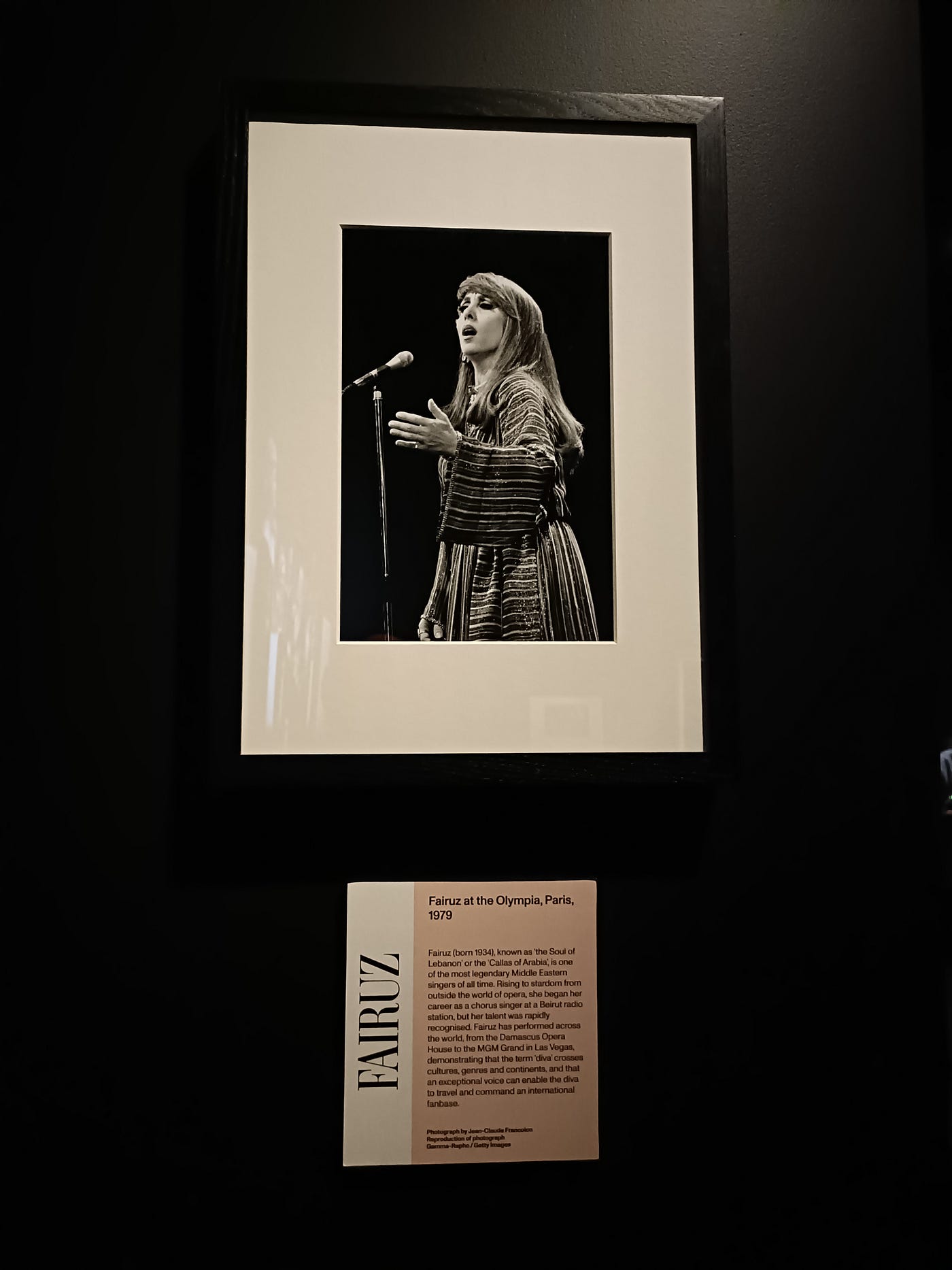
Unsure of what to expect, I hailed an Uber to the Auckland War Memorial Museum last week. I had seen posts about the visiting V&A Diva exhibition on social media and was familiar with the voices and careers of several featured singers. However, I wasn’t certain I’d enjoy exploring their eccentric outfits and memorabilia in person. Still, with pleasant weather and persistent writer’s block nagging at me, I decided an outing might help. To my delight, I discovered Fairuz among the predominantly American and European icons. “Known as the ‘Soul of Lebanon’ or the ‘Callas of Arabia,’ Fairuz is one of the Middle East’s most legendary singers,” I read on the label beneath a photo from her 1979 Olympia concert in Paris, and remembered the day Fairuz made global headlines five years ago.
The weather was hot and humid when the French presidential plane landed. It was Emmanuel Macron’s second visit within the same month to the city once called “The Paris of the Middle East,” although the Beirut that Macron’s convoy sped through on August 31, 2020 bore little resemblance to what it looked like during its glamorous days in the 1960s. In 1975, a devastating civil war erupted in Lebanon. It lasted for 15 years and resulted in 200,000 deaths, with many thousands missing. As the French president looked out of his black car’s window, he could see bullet marks from past clashes between the city’s Christian and Muslim populations etched into several buildings. But the faces of the people in the streets now showed signs of different calamities: the currency had lost most of its value within a few months, and a massive blast at Beirut port had shaken the entire city just weeks earlier. It was considered one of the largest non-nuclear explosions in history.
The next day, Macron visited the suburb of Rabieh to award his nation’s highest honour the Commandeur’s Legion of Honour to Fairuz. It wasn’t her first French decoration — In 1988, Francois Mitterrand awarded her the Order of Arts and Letters, and ten years later Jacques Chirac awarded her the Legion of Honour. It was her first time, though, receiving a head of state at her own house, at Macron’s request.
A single French photographer was granted access to the villa to document the exceptional event. I looked at the few published pictures of Fairuz (then 86) wearing a Covid visor and an uncharacteristically big smile, and I remembered my first and only time seeing her on stage in 2007 in the Jordanian capital Amman when she came to perform a remake of her classical musical Sah Ennawm.
I had been living in Jordan for almost two years and yearned for Iraq and the Tigris River, flowing in solemn majesty with forests of palm trees lining its banks. For many years, I hoped Fairuz would sing again in Baghdad. Her first concert was in the mid-1970s and is best remembered for her refusal to align with the authoritarian Ba’ath regime. She didn’t allow pictures of its leaders at the concert hall, including the then-young and influential vice president Saddam Hussein. Fairuz dedicated a song to Baghdad’s glorious past, which immediately became an unofficial anthem of the city.
“Who’s singing?” the cab’s question interrupted my recollections. “Oh, Sitna (our lady)!” he commented when I told him it was Fairuz. Thousands of Palestinians had come to Amman for the concert. I saw their buses parked outside. Shortly after taking my seat, the lights dimmed, the overture began, and the curtains opened. The audience rose and erupted in applause when Fairuz appeared and started singing. Many got teary-eyed. The familiar voice transported me to different places and times.
Iraqi radio station(s) used to play Fairuz’s songs every morning when I was a child. I listened to them while having breakfast. I closed my eyes, and felt the warmth and saltiness of sunny-side-up eggs in my mouth. I also remembered the winters I spent listening to her ballads in my car while studying architecture at Baghdad University. The music beautifully blended with the sound of raindrops hitting the windshield. Fairuz’s voice, coming from a portable radio, weathered the ground-shaking explosions during Iraq’s consecutive wars. It helped me push through those dark times.
“I told her everything that she represented to me, of a Lebanon that we love and that many are expectant of, a nostalgia that many feel,” Macron told the crowd of local and international reporters outside the villa. He was well aware that fixing Lebanon’s broken political system was beyond his power. France, no longer the colonial power that governed Lebanon after WWI, faced its own challenges both locally and regionally. Macron’s visit aimed to send a message that the future of Lebanon lies in the hands of its people. And for that purpose, he couldn’t have chosen a better unifying symbol.
In 2005, the American University in Beirut awarded an honorary doctoral degree to Fairuz, “whose voice has united people despite war, strife, and borders.” She stayed in Lebanon throughout the 15 years of civil war, even after her house was hit by a bomb. She also refused to legitimize the division of Beirut into two parts: a mostly Muslim West and a mostly Christian East. Fairuz abstained from performing there until all barriers were removed. Her concert at Martyrs’ Square in 1994 was seen as a historic event that marked Beirut’s revival.
Despite being a devout Christian, Fairuz became a matriarchal figure to all the Lebanese who flocked in their hundreds every year to listen to her sing on Good Friday. Many of them were Muslims who revered Jesus as a prophet. They believed he was neither crucified nor resurrected from the dead. The conflict of doctrines, however, didn’t stop them from making the pilgrimage to the cathedrals and churches where Fairuz heart-wrenchingly lamented the agony of the “Son of God” on the cross. Her voice and powerful performance transcended the religious divide.
Fairuz’s remarkable career, which lasted nearly six decades, took her to many cities worldwide, from Sydney to Buenos Aires and Las Vegas. She performed at some of the most prestigious venues, such as the ancient Roman Amphitheatre of Baalbek in Lebanon, where she premiered in 1957 and earned the title of “Baalbek’s seventh pillar,” London’s Royal Albert Hall, Royal Festival Hall, and Westminster Abbey, as well as L’Olympia and Bercy Concert Halls in Paris, Lincoln Center, and Carnegie Hall in New York, Boston Symphony Hall, Montreal’s Place des Arts, Athens’s Acropolis Herodeon, Amsterdam’s Royal Theatre Carré, and the Light and Sound Theatre by the Giza Pyramids in Cairo. Her last concerts in 2011 in Lebanon demonstrated that the lady could still sing beautifully at the age of 77, although her voice — once compared to the strength of the mountains of Lebanon and the clarity of its pristine springs — had understandably lost some of its distinctive quality.
Eight years have passed since Fairuz released her last album. Many believe she might never perform live again, and with the recent passing of her eldest son and musical partner Ziad Rahbani, she might also refrain from recording new songs. That said, her extensive repertoire continues to highlight Lebanon’s role as a bridge between Eastern and Western cultures and arts. Her songs resonate in refugee and immigrant households, shops, cafes, and restaurants across cities as distant as Auckland, New Zealand, where I live.
Fairuz’s ode Li Beirut (To Beirut), which was released at the height of the civil war, sampling the second movement of Joaquin Rodrigo’s Concierto de Aranjuez, went viral on social media after the port explosion and during the Israeli bombing of the city in 2024. I, for one, received many links to the song on WhatsApp from Lebanese and Arab friends worldwide. It became a global hymn of mourning and hope. … “Thank God for Fairuz!” my Lebanese and fellow-Aucklander friend texted.
My novel (كافيه فيروز) “Café Fayrouz” was published in 2015, portraying five expats contemplating their lives and future in the wake of the Arab Spring. Fairuz’s soothing voice, poignant lyrics and intricate melodies became a home away from home for them. Her songs reminded them of the good they hadn’t achieved in their countries of origin and the loved ones they had lost along the way. Against all odds, they dream. …
메타데이터
- post_id
- 395b4f2d4189
- slug
- thank-god-for-fairuz-395b4f2d4189
- url
- https://medium.com/@alishakirbooks/thank-god-for-fairuz-395b4f2d4189
- canonical_url
- https://medium.com/@alishakirbooks/thank-god-for-fairuz-395b4f2d4189
- author_url
- https://medium.com/@alishakirbooks
- status
- ok
- fetched_at
- 2026-07-17 15:44:51