The Prosthesis of Suspicion
About AI detectors and wha they really track
The Prosthesis of Suspicion
About AI detectors and wha they really track
Some theorists working at the intersection of evolutionary psychology, anthropology, and cognitive science have suggested that human beings evolved to track differences such as skin color because such cues once served as biologically useful signals requiring social reinforcement. On this picture, distinguishing insiders from outsiders helped protect tribes from impostors and coordinate cooperation.
I have always found this an astonishingly low opinion of our biological instruments. But perhaps evolution is under no obligation to preserve our dignity. Whatever strategies happened to increase survival were the ones that stayed.
The real philosophical question is different. What exactly was there to be tracked? And how much confusion had to masquerade as knowledge for that biological need to be satisfied?
Today we have AI detectors. Unlike our perceptual systems, these are prosthetic devices — artificial classification machines built to identify another distinction that many people desperately want to exist. Their task is even stranger than anything our brains were supposedly selected to do: to slice a text into percentages of “human” and “machine,” as though the countless routes through which a person acquires language, concepts, theories, memories, biographies, second languages, conversations, books, teachers, and now computational tools could be decomposed into a numerical ownership structure.
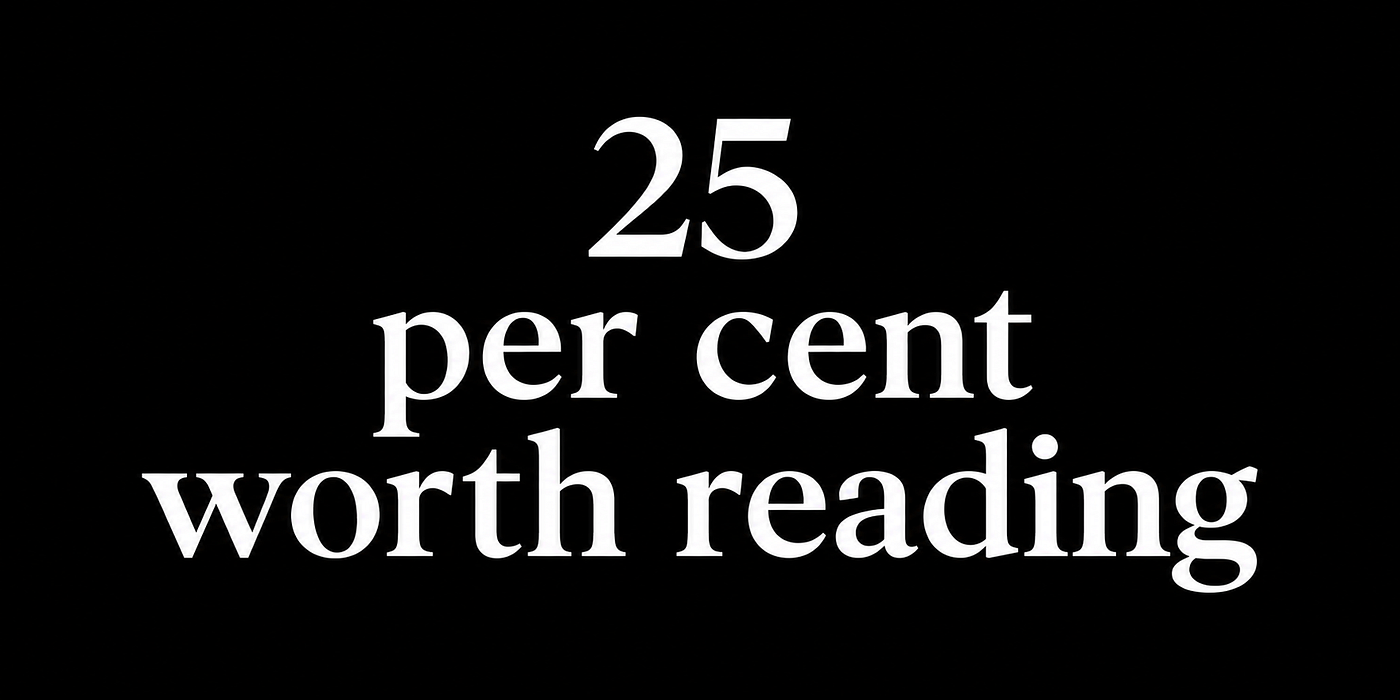
Twenty-five percent machine.
Fifty-five percent human.
Twenty percent collaboration.
Presented as though reality itself came pre-divided along those joints.
But the joint is not there.
There is no principled boundary separating “the human part” of a sentence from “the machine part”. There is only the convention used by a machine to correlate metaphysical fantasy and fetiche with numbers. Was a concept learned from a teacher more human than one refined through a book? Is an argument polished by an editor more authentic than one clarified through translation software? Does thinking in a second language reduce one’s humanity? These percentages pretend that there exists a hidden ontology waiting to be measured, when in fact they merely reflect the output of a statistical classifier searching for patterns it was trained to recognize.
What is remarkable is that a major intellectual platform would institutionalize such a category.
One cannot avoid wondering what social desire this device is really serving.
The desire seems obvious enough: to preserve a symbolic hierarchy in which certain stylistic habits — once monopolized by a relatively homogeneous educational elite — could continue functioning as badges of superiority. As computational tools erode those accidental advantages, a new ritual becomes necessary. If authors can no longer be excluded by fluency alone, perhaps they can be ranked by the supposed percentage of “machine” contaminating their prose.
The detector is therefore not merely a piece of software. It is a prosthesis for a distinction that no human cognitive system ever naturally possessed. It extends not perception but a social fantasy.
Ironically, even for those who welcomed it as an instrument of humiliation of the “inferior” (those needing machine-assistace), it performs rather poorly. There is little emotional satisfaction in denouncing someone as “twenty-five percent fraudulent.” The moral theater collapses under its own absurdity. The accusation lacks the certainty required to produce the public degradation its users seem to seek.
And that leaves an even more practical question.
What does this episode say about Substack itself?
If a platform of this size genuinely believes that displaying arbitrary percentages of “human” and “machine” provides meaningful information about authorship, writing, or intellectual contribution, or even worst, about “humanity” — as if there is one single type of brain deserving “Humanity-status”- one begins to wonder about its capacity to understand the very community it hosts. More importantly, one wonders how well it is positioned to compete with platforms like Patreon or even YouTube.
The detector does not reveal a hidden structure of writing.
It reveals a hidden anxiety about the democratization of intellectual production.
메타데이터
- post_id
- 39638c1f16be
- slug
- the-prosthesis-of-suspicion-39638c1f16be
- url
- https://medium.com/@lucasvollet/the-prosthesis-of-suspicion-39638c1f16be
- canonical_url
- https://medium.com/@lucasvollet/the-prosthesis-of-suspicion-39638c1f16be
- author_url
- https://medium.com/@lucasvollet
- status
- ok
- fetched_at
- 2026-07-25 09:32:35





