The Time a Concrete Column Broke my Asset Tracking System
Let’s set the scene. I was looking at a dashboard that was providing me a live feed on some items that I had ordered. On arrival, however…
The Time a Concrete Column Broke my Asset Tracking System
Let’s set the scene. I was looking at a dashboard that was providing me a live feed on some items that I had ordered. On arrival, however, the tracking system showed that the goods were right in the middle of a 12-inch reinforced concrete column. How? But this is the current state of the technology in most spaces, and it leaves one wondering how and why? I wondered, but jokes aside, the accuracy was way off. Hence, the reason for this write-up as mentioned earlier.
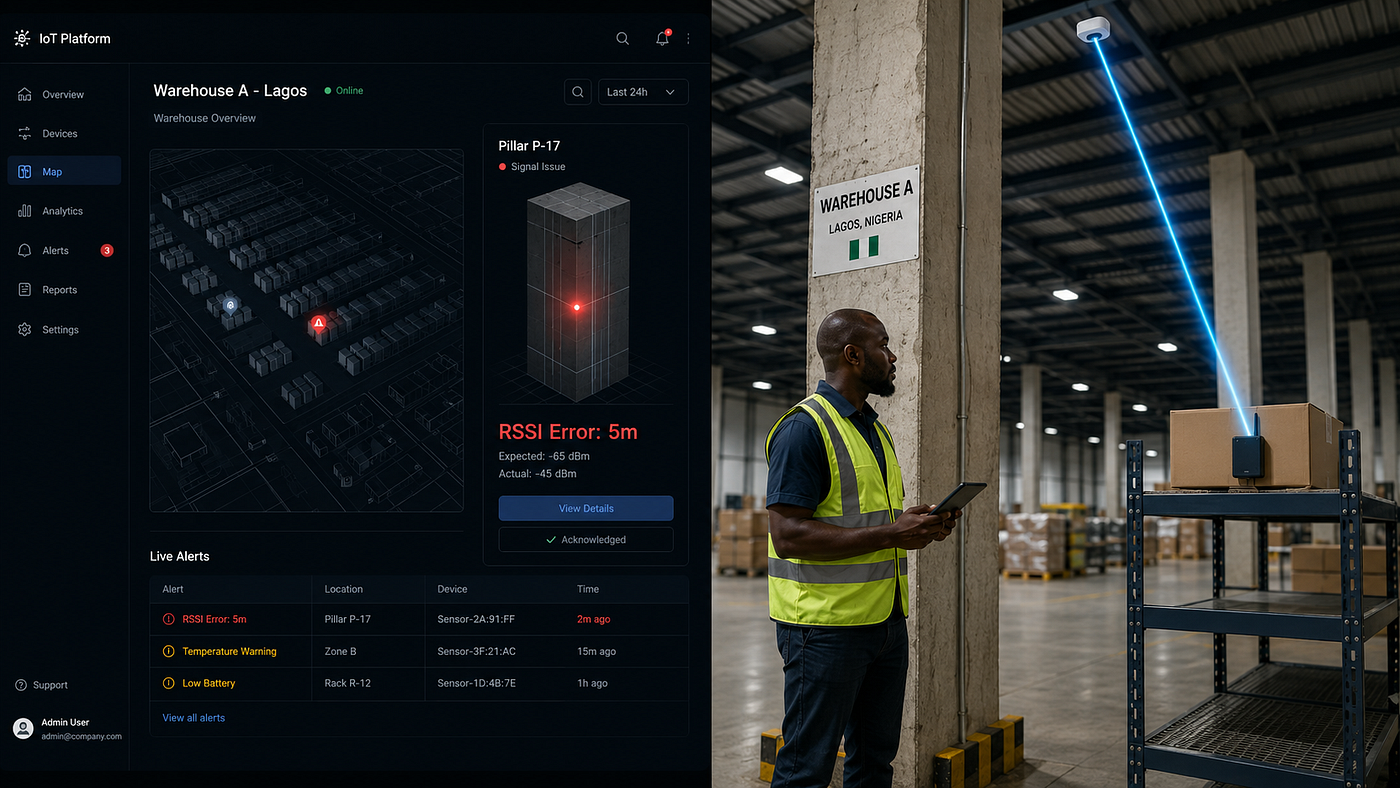
Generated using AI
In the Nigerian industrial landscape, the walls aren’t necessarily made of drywall and timber but are “fortresses” of reinforced concrete and brick that are known to attenuate (i.e., weaken) wireless signals. This is a good illustration of the classic flaw in legacy Bluetooth, which tries to guess how far away an object of interest is by the “loudness” of the signal. In a busy warehouse, those radio waves are going to bounce off the metal roof and concrete and cause “ghost” locations with over 5 m variation, which makes the data received almost ineffective for operations.
To resolve this, I will be highlighting two engineering solutions. The first is literally the Oga at the Top, which is Ultra-Wideband (UWB). It is a physically powerful technology, employing ultra-short 2 ns pulses across a huge bandwidth of over 500 MHz and is capable of “seeing” through clutter and rejecting signal echo. UWB is said to have the ability to provide surgical level accuracy of 1 cm with an error of less than 10 cm, but there is also a high “Naira catch.” The initial cost of the hardware is very high, from ₦45,000 to ₦120,000, plus import duties and the volatility of the Foreign Exchange (FX) market. In addition, UWB’s high-speed ranging consumes batteries 2.6 times faster than its rivals. This necessitates maintaining thousands of tags in buildings with unpredictable power outages, which can be a logistics nightmare.
On the other hand is the “street smart" contender in this protocol battle, which is the recently developed Bluetooth 6.0 Channel Sounding. Instead of trying to estimate the distance by the volume of the signal, it measures the actual wriggles, or phases, of the radio wave as it propagates. This acts as a sonar for a smartphone and offers a reliable accuracy of 30–50 cm that stays stable even in reflective areas where old Bluetooth Low Energy (BLE) systems break down. For businesses operating in the current economy, the win is twofold in the sense that the chips cost from ₦16,000 to ₦30,000, and the feature can sometimes be added by updating a current machine’s firmware without the usual Customs clearance delays at Apapa port.
By utilising Bluetooth 6.0 for general asset tracking and investing in more expensive UWB tags for high-security tool rooms, a company can avoid much of the hardware expense. Such strategic precision ensures batteries operate longer, cutting the overall burden on long-term operations. The current market is not only about a “dot on a map” anymore; it’s about minimising search time from minutes to seconds and maintaining profitability on the bottom line.
메타데이터
- post_id
- 39bb653f6fd8
- slug
- the-time-a-concrete-column-broke-my-asset-tracking-system-39bb653f6fd8
- url
- https://medium.com/@agburu/the-time-a-concrete-column-broke-my-asset-tracking-system-39bb653f6fd8
- canonical_url
- https://medium.com/@agburu/the-time-a-concrete-column-broke-my-asset-tracking-system-39bb653f6fd8
- author_url
- https://medium.com/@agburu
- status
- ok
- fetched_at
- 2026-06-09 15:37:30