How Fake Offshore Recruitment Firms Scam Jobseekers on Linkedin
I am here on LinkedIn to learn from others, mentor others, but most importantly, find a job after all of the layoffs. You should not have…
How Fake Offshore Recruitment Firms Scam Jobseekers on Linkedin

I am here on LinkedIn to learn from others, mentor others, but most importantly, find a job after all of the layoffs. You should not have to be a cybersecurity analyst or a white and a black hat hacker just to apply for jobs on LinkedIn, but it seems more and more each day LinkedIn is allowing more unverified scammers on their platform and adding this to our skillset as job seekers. We have to go through a literal gauntlet just to apply for roles these days.
I want to share this story that happened to me last week. The names have been changed for legal reasons, but I have all the names, numbers, addresses, and did full reporting and verification. What I found was a giant shell game of fake recruitment firms operating on Linkedin (none of them VERIFIED) all tied together to scam job seekers. I, of course, reported it to the FTC. This is why I am a strong proponent that Linkedin should REQUIRE ID Verification and Business license verification to be on the platform.
It all started last week when I was contacted by a recruiter for a firm based in St. Louis, Missouri by email. I had applied to some roles on Linkedin that week. Being diligent, I researched the firm and found that it was an established business registered with the SBA as a woman owned small business. On paper, it looked like a legitimate domestic firm with a focus on diversity.
I spent time customizing my resume, participating in three interview/vetting calls, and exchanging multiple emails regarding my expertise. However, when I looked deeper, the “city office” in St. Louis was a misrepresentation. The firm was actually a woman running a recruitment business out of her home with no professional answering service or live support on her website. I get it, we all need to get our money somehow, but let’s do it ethically. Working from home is awesome. No need to fake it.
When I finally spoke with the owner of this St. Louis firm, the conversation was revealing. She confirmed she was doing business with a major hospital in the St. Louis area, yet her internal operations were surprisingly loose. She claimed she knew the owners of FAKERECRUITMENTFIRM2 personally and expressed absolute shock when I told her about the unprofessional and aggressive reception I received when calling their public business line. She claimed she subcontracted them to do the recruiting for her.
Despite running a recruitment firm, she appeared completely unaware of the legalities surrounding the recruitment process, including the specific laws for requesting licenses as did the man working with her branding for her. I provided her with the evidence I had gathered, leaving her to face the reality of the unethical partners she had invited into her business ecosystem and allowed to use her domain and branding.
The Red Flag: The Illegal Document Request
The most alarming moment occurred right after I submitted my resume. The recruiter asked me for a copy of my driver’s license. As a professional in Washington, I knew immediately that this was a major violation. In Washington State, it is illegal for an employer to request a copy of a driver’s license or any document that reveals a candidate’s age or date of birth during the initial application process unless it is a “bona fide occupational qualification” for the specific role. The excuse she gave me when I asked the woman business owner in St. Louis was we want to ensure we are talking to a legitimate person. I explained to her that it was not legal to ask for that, but understood in the age of AI where many are using AI to fake their images and background. I personally encountered that challenge with hiring at a company I worked for and I have given international news media interviews on this topic. You just can’t do it unless someone is being hired and the document is required for background verification and employment paperwork.
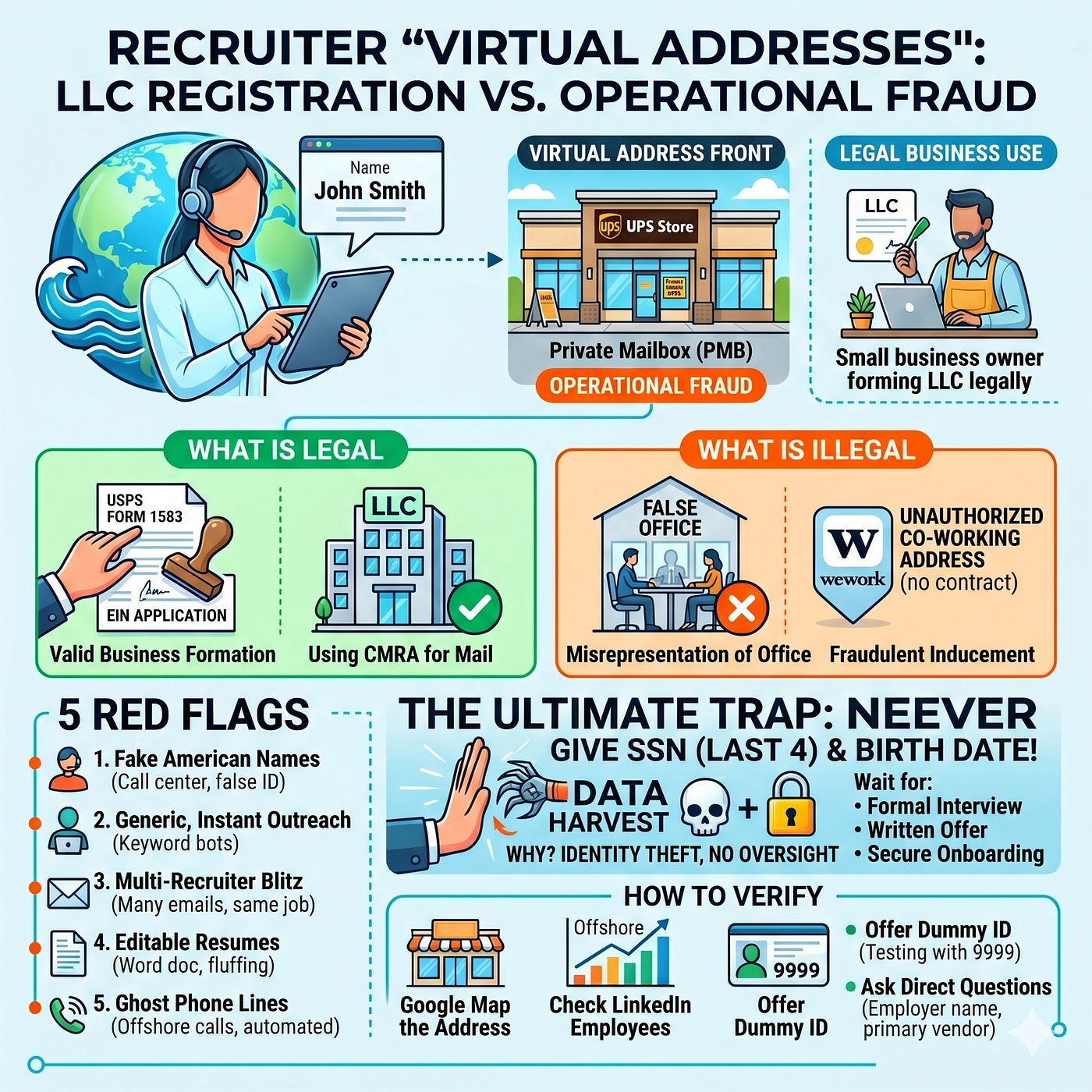
Washington Law (RCW 49.60.180 and WAC 162–12–140): These regulations prohibit pre-employment inquiries that express, directly or indirectly, any limitation, specification, or discrimination as to age. Requesting a license at this stage is a tactic often used by data harvesting operations to gain sensitive personal information before a legitimate offer is even on the table.
Shell One: The Recruiter Who Wasn’t There
Now watch the ball move under the shells. It turns out the recruiter who contacted me using the St. Louis company’s name didn’t even work for that firm. They had “partnered” with her to do the recruitment, meaning she was not even doing the work she was contracted for. They were using her firms email and contact details. The guy had his own email and everything under her company. Company 1 was a legit, USC, business woman.
Shell Two: The Offshore Engine
The recruiter partnering for her with her branding actually worked for a second company: FAKERECRUITMENTFIRM2. This individual was based in Pune, India. While FAKERECRUITMENTFIRM2’s website lists multiple global offices and a primary phone number, the reality behind that number was shocking.
When I called, a man with an Indian accent answered. There was no professional greeting or business identification, just a blunt, “Who is this… what do you want?”. When I asked if it was FAKERECRUITMENTFIRM2, he gave a reluctant, “Um, yeah, what do you want?”. The interaction was incredibly shady. When I informed him I was recording for my protection, he became angry and belligerent. As I did more research, I found out why…
The Offices Were a Lie
FAKERECRUITMENTFIRM2 lists multiple locations in California. I verified these myself. They are WeWork locations, but when I called those specific offices, WeWork confirmed they have no contracts with any company called FAKERECRUITMENTFIRM2. It was a flat out lie. While the CEO of FAKERECRUITMENTFIRM2 personally lists his location as California, the company has no physical footprint there.
Tracing The Final Destination: The Mumbai Flat
Following the trail to India, the “offices” there didn’t lead to a corporate center. The address goes to an apartment in Mumbai, a residential flat, not a business. The NYC location? You guessed it: another co working space. It is a shell game designed to be impossible to verify without spending hours tracking down the truth. All of the other locations on their website, you guessed it, not legit. There are currently 3 recruitment firms registered out of that residential Sheela Apartments flat right now. You can see what these flats look like here: https://www.nobroker.in/sheela-apartments-mahalakshmi_mumbai-prjt-5bac1ede714b564981dc95f6

The Managing Member: FAKERECRUITMENTFIRM3
The CEO of FAKERECRUITMENTFIRM2 also serves as a Managing Member of a third company called FAKERECRUITMENTFIRM3. This one is designed to look more legitimate to the casual observer, but it functions as part of the same scammy ecosystem, providing a “high end” mask for the offshore data harvesting machine. It is also registered out of the Mumbai flat.
The Legal Perspective: Where the Law was Broken
This shell game isn’t just unethical; it involves specific violations of consumer protection and business laws in both the United States and India.
In the United States
- Deceptive Business Practices (FTC Act Section 5): Federal law prohibits “unfair or deceptive acts or practices in or affecting commerce”. By misrepresenting a physical office location and the true nature of their staffing operations, these firms likely violate Section 5.
- Truth in Advertising: The FTC mandates that all advertisements must be truthful and not misleading. Listing a prestigious city office to build trust while operating out of a residential flat or home is a material misrepresentation.
- Washington State Fair Employment Practices (RCW 49.60): As mentioned, requesting age identifying documents like a license before an offer is made is a violation of state anti discrimination and privacy laws.
In India
- Consumer Protection Act, 2019: Marketing an international RPO firm from a residential flat while claiming multiple corporate offices violates transparency standards regarding “misleading advertisements”.
- IT Act Section 66C & 66D: These sections cover Identity Theft and Cheating by Personation. Using corporate identities to extract professional data can carry penalties of up to three years in prison.
Why I am Speaking Up
I’ve handed my evidence over to the FTC, Office of the Inspector General, other offices and reported these entities to LinkedIn. Of course, Linkedin did NOTHING. We shouldn’t have to be investigators just to apply for a job, but until these platforms prioritize verification, we have to protect ourselves.
Be careful out there. If the “headquarters” is a house and the “business line” is a personal cell, walk away if the company can’t veryify they are a legal, registered, and insured business entity. Research every company you apply to.
I am very lucky to have a background in cybersecurity and ethical hacking. Not everyone does though. Protect yourself when applying for jobs or responding to recruiters.
메타데이터
- post_id
- 39bbbccd116e
- slug
- how-fake-offshore-recruitment-firms-scam-jobseekers-on-linkedin-39bbbccd116e
- url
- https://medium.com/@terilane/how-fake-offshore-recruitment-firms-scam-jobseekers-on-linkedin-39bbbccd116e
- canonical_url
- https://medium.com/@terilane/how-fake-offshore-recruitment-firms-scam-jobseekers-on-linkedin-39bbbccd116e
- author_url
- https://medium.com/@terilane
- status
- ok
- fetched_at
- 2026-07-10 15:36:45