Locating Ourselves in the Habitability/Urability Matrix
The View from Oregon — 370: Friday 05 December 2025
Locating Ourselves in the Habitability/Urability Matrix
The View from Oregon — 370: Friday 05 December 2025
In last week’s newsletter I discussed some of the consequences of the possibility of superhabitable worlds (planets with optimal habitability conditions, perhaps better than those of Earth) and superurable worlds (planets with optimal conditions for urability, or the origins of life). For the moment, in the absence of other evidence — evidence that we could obtain through the exploration of other worlds — we only need assume that Earth is only just habitable, and perhaps only minimally habitable, and that Earth, or some other region of our solar system, is only just urable, and perhaps only minimally urable. Life only had to originate once for the life we observe on Earth to have appeared. And now that there’s life on Earth, and we only need to affirm that Earth is sufficiently habitable to have sustained life since its origin. That’s all we need to assume, but in light of the principle of mediocrity we might perhaps be inclined to assume the mediocrity of Earth’s urability and habitability. I’ll return to this below.
Since I’ve spent the past few newsletters thinking about scenarios of habitability and urability, it has occurred to me that another way to quantify the habitability of a biosphere is how many forms of life from distinct origins of life events continue to live on in a given biosphere. There are researchers who have suggested that life on Earth is the result or more than one origins of life event, the distinct biota of which events subsequently became biochemically integrated, so that the current terrestrial biosphere appears as a seamless whole. Determining whether or not this is the case would probably be rather difficult, though future technologies and techniques may make it possible to biologists to definitely determine this; we can’t rule it out. But we can also imagine worlds in which distinct origins of life events become ecologically integrated in the biosphere but not biochemically integrated. In such an ecosystem, it would be relatively straight-forward to determine ecologically integrated biota derived from distinct origins of life events, especially if the biota were strongly biochemically distinct.

A superhabitable world might be “richer” in life than Earth by having greater biomass (perhaps due to a thicker biosphere — reaching down further below ground and further above into the atmosphere), or greater biodiversity, or both. However, another way to think about superhabitable worlds is as worlds being “richer” in life than Earth due to their biospheres being constituted by multiple distinct biota. There are, then, distinct dimensions of superhabitability, but the distinctive form of superhabitability I’ve just described — multiple biochemically distinct forms of life represented in one and the same biosphere — could only come about under conditions of superurability, whether the supeurability of the same planet, or the superurability of a neighboring world that would seed a superhabitable world with multiple distinct biota.
Part of the purpose of newsletter 368 was to consider the concept of a biota derived from a single origins of life event that covered more than one biosphere, which is, in a sense, complementary to the above scenario. I suggested the term biotope for this concept of life transcending its biosphere of origin, despite the previous uses to which the term biotope has been put. Given the concept of a biotope as I have used the term, another question that I’ve been thinking about is what we may call a minimally viable biotope (MVB). As with the other concepts I’ve been considering, we can look at the idea of an MVB through the lenses of both habitability and urability. In other words, there are at least two questions here: 1) What is the minimally viable urable biotope? and 2) What is the minimally viable habitable biotope? Because I ask these questions in the context of a biota that has exceeded the scope of a single biosphere, the minimums I’m talking about here are minimal extent in space. However, we might also want to ask about MVBs in time, i.e., how long must a biotope be habitable before we recognize it as being habitable and not merely the transient presence of life?

We could imagine a superurable world (as discussed in the past couple of newsletters) that regularly generates blobs of biomass that get scattered among bodies of a planetary system, and that these blobs of biomass continue to live for a time not necessarily because a given astronomical body is habitable, but only because it takes time for the biomass to die. Presumably convention would call for some temporal threshold for habitability. With urability, the process of origins of life is its own clock of sorts, so however long it takes to generate life, as long as life is generated and then distributed, then the threshold of urability has been met. But what we mean by “origins of life” could be process that requires days or weeks or months, or it could be a process that requires millions of years. Also, life on a superurable world must survive long enough to be distributed to habitable worlds, and this, too, could require millions of years. If the threshold period of habitability is equal to or less than the origins and distribution period of urability, then an urable world that is not also habitable is ruled out by definition, unless we add some further requirement, such as macroevolutionary bifurcation.
Obviously, the idea of an MVB also implies the possibility of a maximally viable biotope, and this, again, is obviously related to my earlier discussions of biotopes that transcend a single biosphere. (A maximally viable biotope also makes the abbreviation MVB less useful, since the “M” could stand for minimal or maximal; I’ll have to think of how to differentiate these.) Here the element of time again becomes an important consideration. A biotope might originate on a given planet, grow to constitute a planetary biosphere, and then transcend that biosphere.

However, as the process of planetary (and cosmological) scale evolution of some biota continues over biological scales of time, eventually this biota could evolve into a form of life incompatible with its biosphere of origin (and the initial transplanetary biotope), the biotope would fission and there result would be two biotopes descended from a common ancestor. We could even postulate the possibility of transitional forms that could survive in either biotope resulting from the fission, even while the fissioned biotopes are incompatible. A scenario of this kind would constitute a state-of-affairs distinct both from abiogenesis and panspermatological distribution of life from a single origins of life event. As such, this could constitute a major division of life on a cosmological scale, driven by the mechanism of cosmological scales of evolution. That is to say, this state-of-affairs couldn’t persist in or on a single biosphere, but it could persist and expand on cosmological scales.
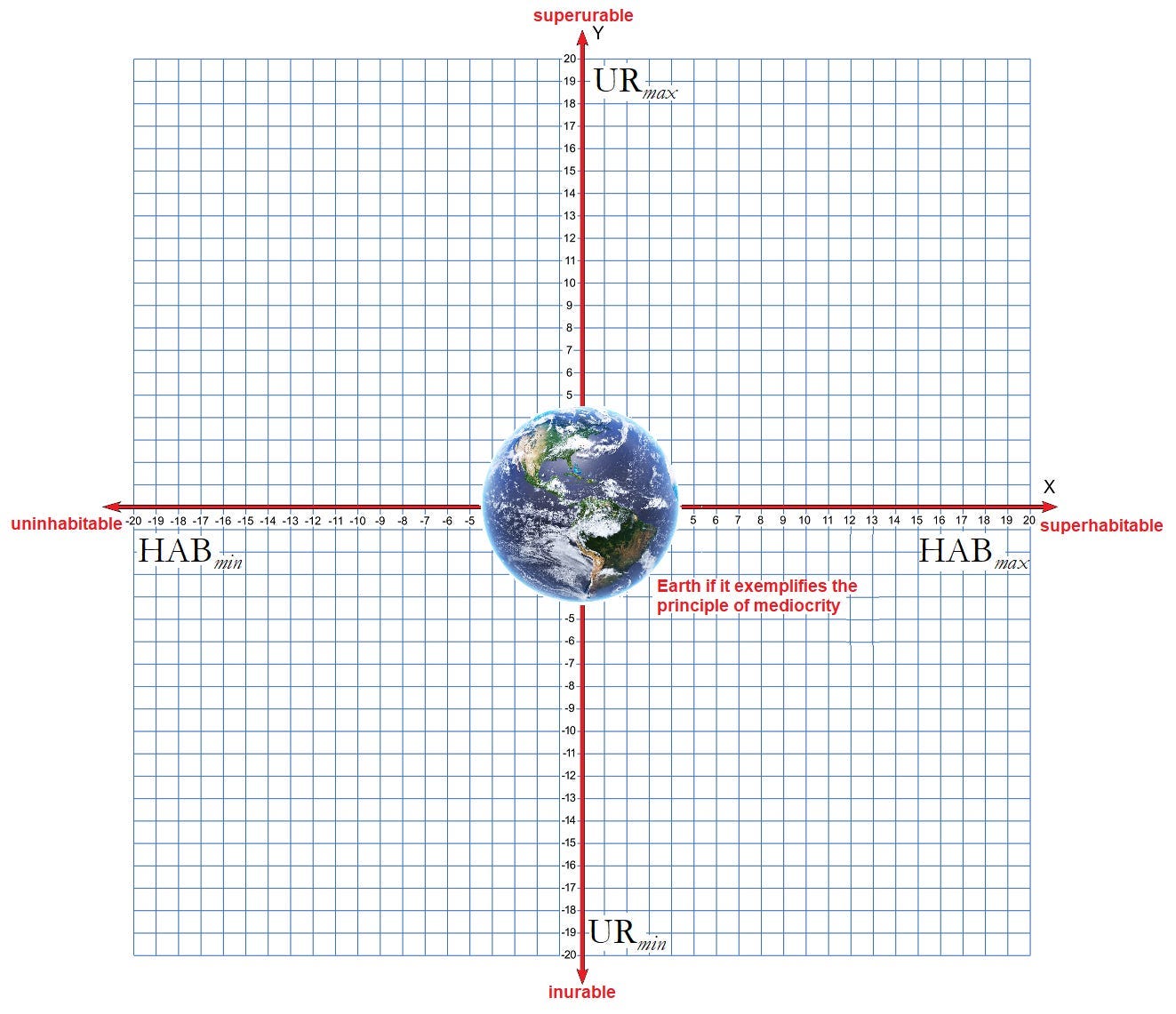
Many of the above possibilities, and the possible gradations of habitability and urability, can be expressed on a graph where, say, the x axis is the continuum from uninhabitability to superhabitability (HABmin → HABmax) and the y axis is the continuum from inurable to superurable (URmin → URmax). We should be able to locate any planet on this grid — e.g., the worlds I postulated as the perfect natural laboratory for origins of life, with one planet superurable but uninhabitable, and the other superhabitable but inurable — though the grid will be relative to a particular form of life, or, better, a class of forms of life. If Earth exemplifies the principle of mediocrity (as mentioned above), then Earth would lie at or near the center of this graph. Whether one grid of this kind, suitably generalized, could hold for any emergent complexity that we could identify as life, or whether each class of forms of life would require its own HAB/UR grid remains a question that will only be answered when we have made significantly more progress on the science of urability and habitability. Obviously there’s going to be a generous gray area between unambiguous life and emergent complexities that are like life but different enough that we might be tempted to call them something else. Even if all unambiguous life could be assigned a place in this grid, somewhere in the gray area we would have to begin introducing different graphs, though based on the same principle, for unambiguously distinct forms of emergent complexity.

메타데이터
- post_id
- 39cf2bfc05e3
- slug
- locating-ourselves-in-the-habitability-urability-matrix-39cf2bfc05e3
- url
- https://medium.com/@jnnielsen/locating-ourselves-in-the-habitability-urability-matrix-39cf2bfc05e3
- canonical_url
- https://medium.com/@jnnielsen/locating-ourselves-in-the-habitability-urability-matrix-39cf2bfc05e3
- author_url
- https://medium.com/@jnnielsen
- status
- ok
- fetched_at
- 2026-06-20 20:29:01