Smoke in the Sky, Rougarou in the Mind
What the Pentagon’s second UFO release actually added — and what serious people should demand next
Smoke in the Sky, Rougarou in the Mind
What the Pentagon’s second UFO release actually added — and what serious people should demand next
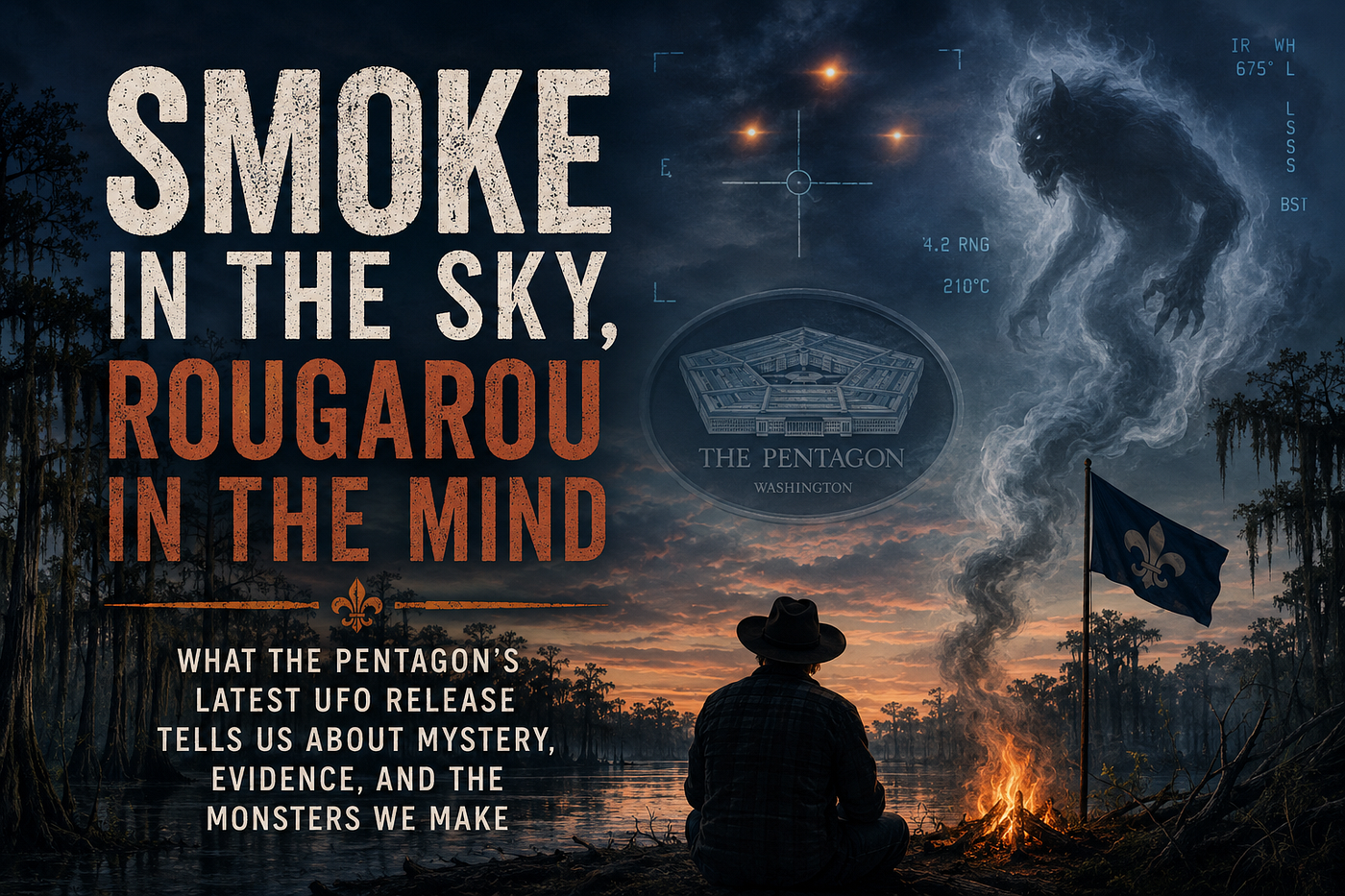
The new Pentagon release did not give us a smoking gun. It gave us smoke.
And smoke is worth investigating — just don’t confuse it with a Rougarou until you’ve checked for a campfire.
That may be the cleanest way to understand the latest batch of UFO/UAP material released by the Pentagon on May 22, 2026. This was the second release under the Presidential Unsealing and Reporting System for UAP Encounters, better known as PURSUE. The official PURSUE page says these materials are unresolved cases, meaning the government is unable to make a definitive determination about the observed phenomena, often because of insufficient data. It also says additional files will be released on a rolling basis, with separate reporting continuing for resolved UAP cases.
That distinction matters.
Because “unresolved” does not mean “alien.” It means unresolved.
It means the file is still open, the record is incomplete, the explanation is not definitive, or the publicly available material does not allow anyone serious to close the loop.
That is not nothing.
But it is also not a mothership landing in a cane field outside Breaux Bridge.
Down here in Louisiana, we know a thing or two about strange stories in the dark. We have gris-gris. We have voodoo. We have T-Bonhomme Janvier. We have the Rougarou.
We also have raccoons, fog, swamp gas, bad lighting, drunk uncles, and cousins who think scaring people is a legitimate hobby. That is the whole point. Not every shadow is a monster.
But only a fool sees smoke and refuses to check for heat.
1. The Release Itself Is the Story
The first thing this second release added was not proof of aliens.
It added volume. It added public access. It added more examples for serious people to study.
And it confirmed that this process is not a one-time document dump. It is becoming a rolling disclosure system.
The Pentagon’s May 22 release statement described this as the second release of declassified and historical UAP files under PURSUE and said the archive would continue to receive additional files. It also stated that the site had received more than one billion hits worldwide since its May 8 launch, which tells us something important: the public appetite for this subject is enormous.
That interest cuts both ways.
On one hand, public pressure can force transparency. That is good.
On the other hand, public hunger can reward exaggeration. That is dangerous.
When people desperately want a monster, they will build one out of blurry pixels, half-context, and a podcast microphone.
That is why the release itself matters. Not because every file is explosive. Not because every video is mysterious. But because the government is now putting more of the raw conversation in public view.
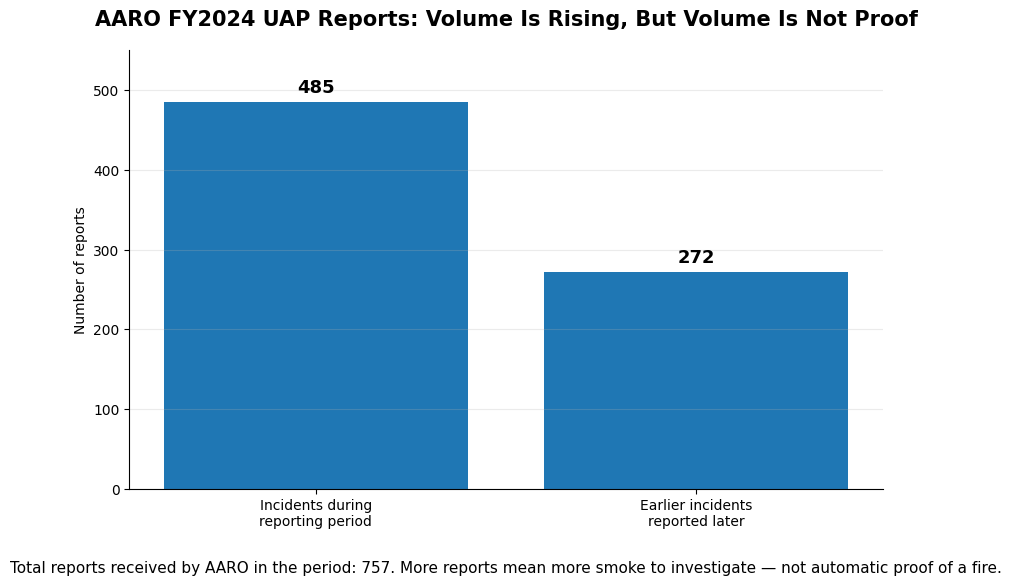
The point is not that more reports equal more proof. They don’t. But volume matters because it shows why the government needs a better system for sorting signal from noise.
That is a shift.
For decades, UFO culture lived in the fog between secrecy, rumor, bad evidence, and occasional credible testimony. PURSUE does not solve that problem overnight, but it changes the playing field.
Now the question is not just, “What did someone say they saw?”
The question becomes:
What did the government release? What data came with it? What was withheld? What can be independently analyzed? What can be explained? What remains unresolved after disciplined review?
That is a better conversation.
Less campfire legend.
More evidence table.
2. Unresolved Is a Status, Not a Conclusion
The most important word in this entire subject is unresolved.
Not alien.
Not fake.
Not supernatural.
Unresolved.
The official PURSUE archive defines the materials as unresolved cases where the government cannot make a definitive determination about the nature of the observed phenomena. It specifically notes that this can happen for several reasons, including lack of sufficient data.
That should slow everybody down.
The believer should not turn “unresolved” into “extraterrestrial.”
The skeptic should not turn “unresolved” into “nonsense.”
Both moves are intellectually lazy.
Unresolved means the case has not been closed. That can happen because the thing was truly unusual. It can also happen because the camera angle was bad, the metadata was missing, the range was unknown, the sensor was limited, or the original files do not contain enough information to reach a firm answer.
That does not make the case meaningless.
It makes the case incomplete.
And incomplete cases require humility.
This is where future releases need to get better. The public does not just need clips. The public needs context.
A video without range, altitude, platform movement, sensor type, environmental conditions, and chain of custody is often more interesting than useful.
That is not a knock on the release.
That is the standard serious people should apply to all future releases.
A grainy clip can raise a question.
Better data can test it.
That is the difference between smoke and a campfire.
3. The Orange Orbs: Testimony Matters — But It Has Limits
The most human piece of the second release may be the reported account from a senior U.S. intelligence officer who described seeing orange orbs during a mission.
ABC News reported that the officer described two large orbs appearing near a helicopter, with orange exteriors and white or yellow centers, emitting light in all directions. The report says fighter jets were scrambled but could not identify the objects, and that the orbs later appeared to be chasing the fighters.
That is the kind of detail that grabs people.
And it should.
A firsthand account from a trained observer is not the same thing as some random fella hollering, “I seen it!” from the back porch after his third bourbon.
But testimony is still testimony.
It is not wreckage.
It is not recovered technology.
It is not radar plus infrared plus electro-optical tracking plus communications logs plus independent sensor confirmation plus chain-of-custody documentation.
It is a lead.
That is how serious people should treat it.
Not as sacred truth.
Not as trash.
As a lead.
The question is not simply, “Do we believe the officer?”
The question is, “What additional records can test the account?”
Were there flight logs? Were there radar returns? Were there infrared recordings? Were there communications transcripts? Were there multiple aircraft with independent sensors? Were there environmental conditions that could explain the sighting? Were there classified platforms in the area? Was the apparent movement real, or could it have been created by the movement of the observer, the helicopter, the jets, or the camera system?
That is what the next level of disclosure should provide.
Because credible testimony is smoke.
But smoke still needs a source.
4. The Coast Guard Infrared Clip: Sensors Need Context
The second release also included material that helps explain why UAP footage can look so strange even before anyone starts adding alien seasoning.
ABC reported that one newly released video came from a U.S. Coast Guard infrared sensor in April 2024 and showed an object flying near a plane over the Southeastern United States.
That is useful because infrared footage has a way of making everything look more mysterious.
Heat signatures glow.
Shapes blur.
Distance can be hard to judge.
Motion can be misleading.
A moving camera platform can make a stationary or ordinary object appear strange.
A normal aircraft, drone, balloon, bird, or heat source can become something that looks like it crawled out of a science fiction fever dream.
That does not mean infrared footage is useless.
Quite the opposite.
Infrared sensors can be powerful tools. But they are still tools. They have limits, quirks, artifacts, compression issues, and interpretation problems.
The camera may be telling the truth.
That does not mean our eyes know how to read it.
This is one of the biggest lessons of the second release. The public should not judge future videos by vibes. We should judge them by available context.
What sensor captured the footage? Was the object visually observed, or only detected by sensor? What was the distance? What was the altitude? Was the camera moving? Was the aircraft moving? Was the target locked? Was the object tracked by multiple systems? Is there radar correlation? Is the raw file available, or only a compressed public clip?
Without those details, infrared footage can create more heat than light.
That is why the Coast Guard clip matters.
Not because it proves aliens.
Because it shows exactly why UAP analysis has to be more than “that looks weird.”
5. Formation Videos: Pattern or Pile-On?
The formation videos may be the most visually compelling part of the second release.
The Guardian reported that the new batch included footage from the Middle East, Iran, and Syria, including unexplained aerial objects, clusters, and formations. It described videos showing UAPs in formation over the Persian Gulf in 2019, objects off Iran in 2022, and footage from Syria in 2021.
That matters because formation changes the question.
A single strange object may be a balloon, a bird, a drone, a sensor artifact, glare, or some misread ordinary object.
Multiple objects moving together may still be any of those things.
But it raises better questions.
Were they coordinated? Were they independent objects? Were they birds flying in formation? Were they drones? Were they aircraft at different distances? Were they reflections? Were they sensor artifacts? Were they part of a military activity? Were they foreign surveillance platforms? Were they related events, or just separate clips placed under the same public umbrella because they look interesting?
That last question is critical.
The internet loves to connect dots.
Sometimes the dots form a pattern.
Sometimes the dots form a doodle.
Future releases need to help us tell the difference.
That means cases should not just be released as isolated clips. They should be released with enough context to compare them.
Region. Date. Altitude. Speed estimate. Sensor type. Weather. Object behavior. Platform movement. Known aircraft in the area. Known drone activity. Known exercises. Radar correlation. Known explanations ruled in or ruled out.
That is how you find patterns.
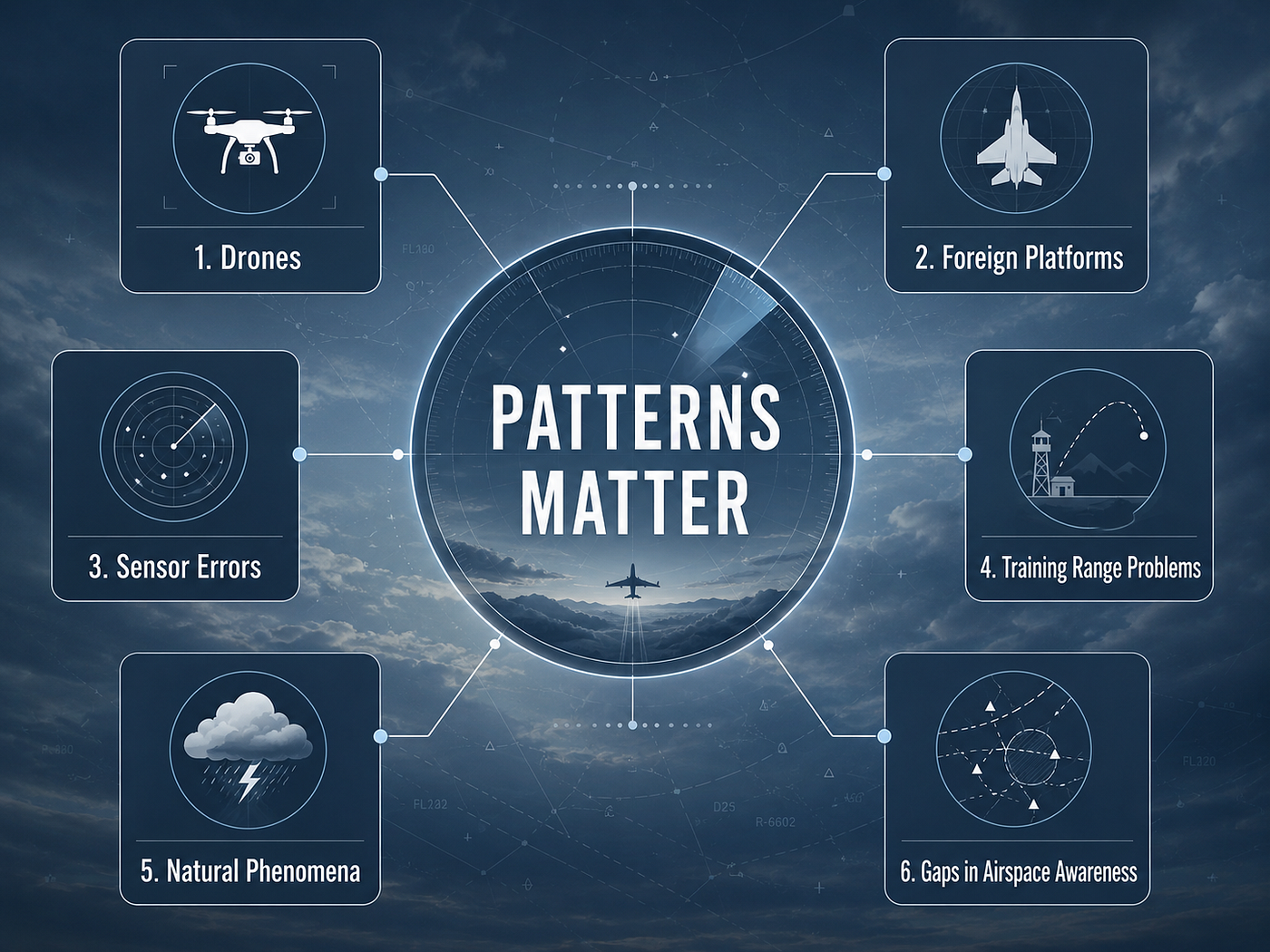
Patterns can identify drones. Patterns can identify foreign platforms. Patterns can identify sensor errors. Patterns can identify training range problems. Patterns can identify natural phenomena. Patterns can identify gaps in airspace awareness.
And yes, if something truly extraordinary is ever hiding in the noise, patterns are how we would eventually separate it from the ordinary mess.
That is why the formation footage is interesting.
Not because it proves a monster.
Because it might help us learn whether we are looking at smoke from one fire — or fog rolling across the swamp.
6. The NASA Material Shows the Danger of Mixing Buckets
One of the more curious parts of the second release was the inclusion of NASA-related archival material.
The Guardian noted that some NASA recordings and astronaut comments were included in the release, and that Neil deGrasse Tyson criticized the inclusion as potentially misleading because many such phenomena likely have rational explanations.
That criticism is worth taking seriously. Not because NASA material is uninteresting.
It is interesting.
But not every strange observation belongs in the same analytical bucket.
An astronaut seeing flashes of light is not necessarily the same kind of case as an infrared object near an aircraft.
A historical report from decades ago is not the same kind of evidence as modern multi-sensor military footage.
A civilian witness account is not the same as a military sensor file.
A formation clip over water is not the same as a single orb described in testimony.
When everything strange gets thrown into one giant “UFO” bucket, the bucket gets exciting — but the analysis gets muddy.
That is where the public conversation can lose its footing.
The point of disclosure should not be to create the biggest possible pile of weird.
The point should be to sort the weird. Different categories need different standards. Historical accounts need source evaluation. Witness reports need corroboration.
Sensor clips need technical metadata. NASA archival material needs spaceflight context. Military encounters need operational context.
Resolved cases need to be placed beside unresolved cases so the public can learn what normal misidentification looks like.
That last piece may sound boring.
It is not.
Resolved cases are essential because they build the baseline. If we only see the mysterious cases, we never learn what balloons, birds, drones, satellites, camera artifacts, atmospheric effects, and sensor limitations look like when they first enter the system as “unidentified.”
Without that baseline, every strange thing looks stranger than it is.
That is how a shadow becomes a Rougarou.
7. What Serious People Should Demand Next
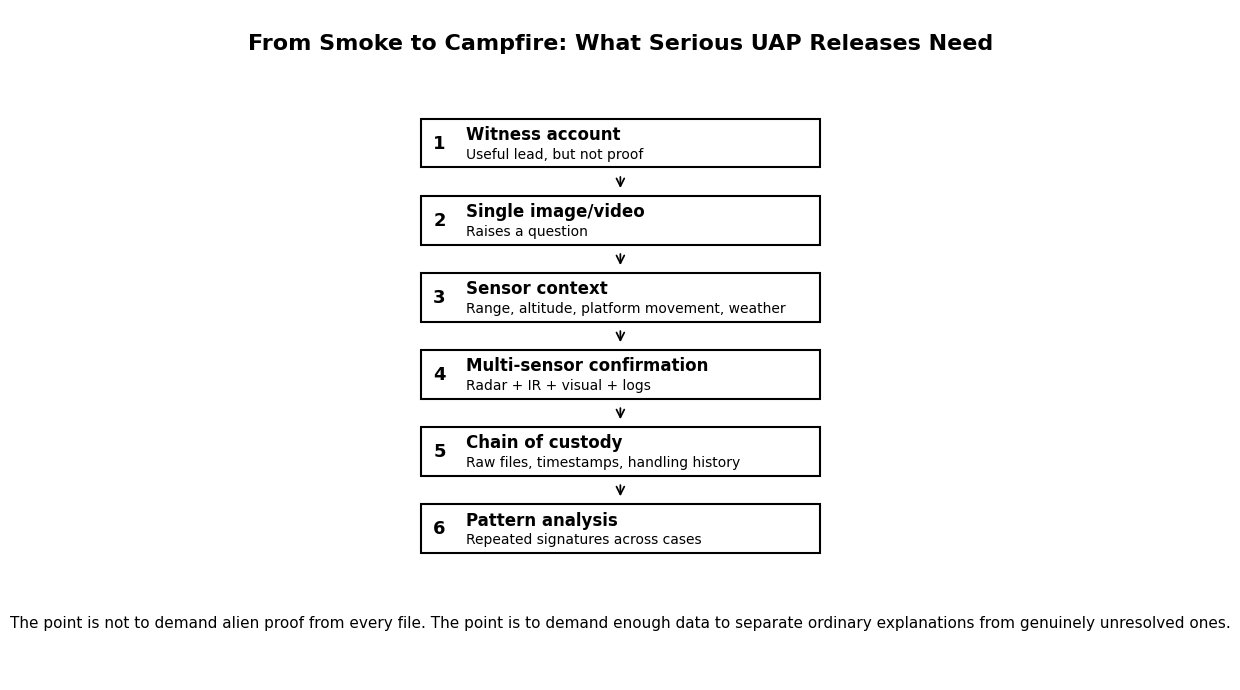
The next phase of UAP disclosure should not be judged by how strange the clip looks. It should be judged by how much evidence comes with it.
The second release added material. The next release needs to add clarity. That is where serious people should focus.
The next phase of UAP disclosure should not be judged by how strange the clip looks. It should be judged by how much evidence comes with it.
Not on whether the strangest-looking clip can be turned into a viral post. Not on whether every case can be forced into the alien folder or the trash folder. Not on whether someone can win an argument on X by cherry-picking three seconds of infrared footage.
The real question is:
What would future releases need to include for independent analysts, scientists, pilots, engineers, intelligence professionals, and serious citizens to evaluate them properly?
Here is the standard.
First, multi-sensor confirmation. A video is interesting. A video matched with radar, infrared, electro-optical tracking, pilot testimony, communications logs, and independent sensor data is much more useful.
Second, range and location data. Without distance, altitude, platform movement, camera angle, and relative motion, a lot of UAP footage remains vulnerable to misinterpretation.
Third, raw or minimally processed files. Compressed clips are good for headlines. Raw files are better for analysis.
Fourth, chain of custody. Who recorded it? Who handled it? When was it uploaded? Was it edited, clipped, stabilized, compressed, redacted, or reformatted?
Fifth, resolved cases beside unresolved cases. This may be the most underrated need. If the government wants the public to understand UAP analysis, show us what turned out to be birds, balloons, drones, aircraft, atmospheric effects, optical artifacts, and foreign surveillance. Do not just show the spooky stuff.
Sixth, explanations of sensor limitations. If a camera or radar system has known quirks, those quirks matter. The public cannot evaluate footage honestly without understanding how the tools can mislead the eye.
Seventh, case categorization. Separate witness accounts, modern military sensor data, NASA archival material, historical documents, civilian reports, and resolved cases. Do not throw every strange thing into the same gumbo pot and call it analysis.
Eighth, trend analysis. Are similar objects showing up in similar regions, altitudes, speeds, formations, or sensor profiles? Are they clustered around military ranges, coastlines, conflict zones, sensitive facilities, or known drone corridors?
That is where disclosure becomes useful.
Not when it gives the public another spooky clip.
When it gives the public enough information to ask better questions.
Because the biggest lesson from this second release is not that aliens are here.
It is that our public conversation about UAPs is still not disciplined enough to handle uncertainty.
And uncertainty is the whole game.
The Smoke Is Still Worth Following
Louisiana has always understood the power of stories.
Stories can warn us.
Stories can teach us.
Stories can preserve memory.
Stories can exaggerate danger.
Stories can scare children into staying out of the swamp after dark.
Stories can also make monsters out of shadows.
We have been facing down monsters, both real and perceived, since Joseph Broussard dit Beausoleil led his people into exile, survival, and renewal along the waterways that helped shape Cajun Louisiana.
That history teaches something.
Not every monster is imaginary.
But not every shadow is a monster.
Some strange lights are aircraft.
Some are balloons.
Some are birds.
Some are drones.
Some are camera artifacts.
Some are sensor limitations.
Some are stories growing teeth in real time.
And some are still unknown.
Unknown is not failure.
Unknown is an invitation.
The problem comes when we cannot tolerate the unknown long enough to investigate it honestly. So we rush. We label. We mock. We exaggerate. We monetize. We turn every mystery into either a punchline or a prophecy.
That is not wisdom.
That is impatience.
The second Pentagon release deserves better than hysteria and better than ridicule.
It deserves clear eyes.
It deserves serious analysis.
It deserves enough humility to admit that some things remain unexplained, and enough discipline to refuse turning every unexplained thing into a monster.
The new release did not give us a smoking gun.
It gave us smoke.
And smoke is worth investigating — just don’t confuse it with a Rougarou until you’ve checked for a campfire.
Because if something is moving through our skies and our best systems cannot explain it, pretending we are too smart to ask questions may be the dumbest superstition of all.
메타데이터
- post_id
- 39e9bca4aebf
- slug
- smoke-in-the-sky-rougarou-in-the-mind-39e9bca4aebf
- url
- https://medium.com/@jodybrou/smoke-in-the-sky-rougarou-in-the-mind-39e9bca4aebf
- canonical_url
- https://medium.com/@jodybrou/smoke-in-the-sky-rougarou-in-the-mind-39e9bca4aebf
- author_url
- https://medium.com/@jodybrou
- status
- ok
- fetched_at
- 2026-07-13 06:23:13