Magnifica humanitas: what it does to us — and what we must do
Artificial intelligence is not only growing rapidly — it is now seeping into almost everything we do. Often without us noticing. You can…
Magnifica humanitas: what it does to us — and what we must do
Artificial intelligence is not only growing rapidly — it is now seeping into almost everything we do. Often without us noticing. You can hardly avoid AI anymore: AI is embedded in apps and systems that make decisions affecting our daily lives. You usually don’t choose it; it’s simply there.
The encyclical Magnifica humanitas is an attempt by Pope Leo XIV to put that reality into words. Not by looking only at technology, but above all by asking: what does this mean for us as human beings? And perhaps even more importantly: what do we owe one another in a world where technology has an ever greater influence?
As an AI ethicist and a Catholic, I read this text through an ethical lens. Of course, the theological foundation matters, but the core question for me is much more practical: does this encyclical have something to say to ordinary people — even if you have nothing to do with the Church or faith?
Yes, this document is valuable for all people — Christians and non-Christians alike — who are interested in artificial intelligence.
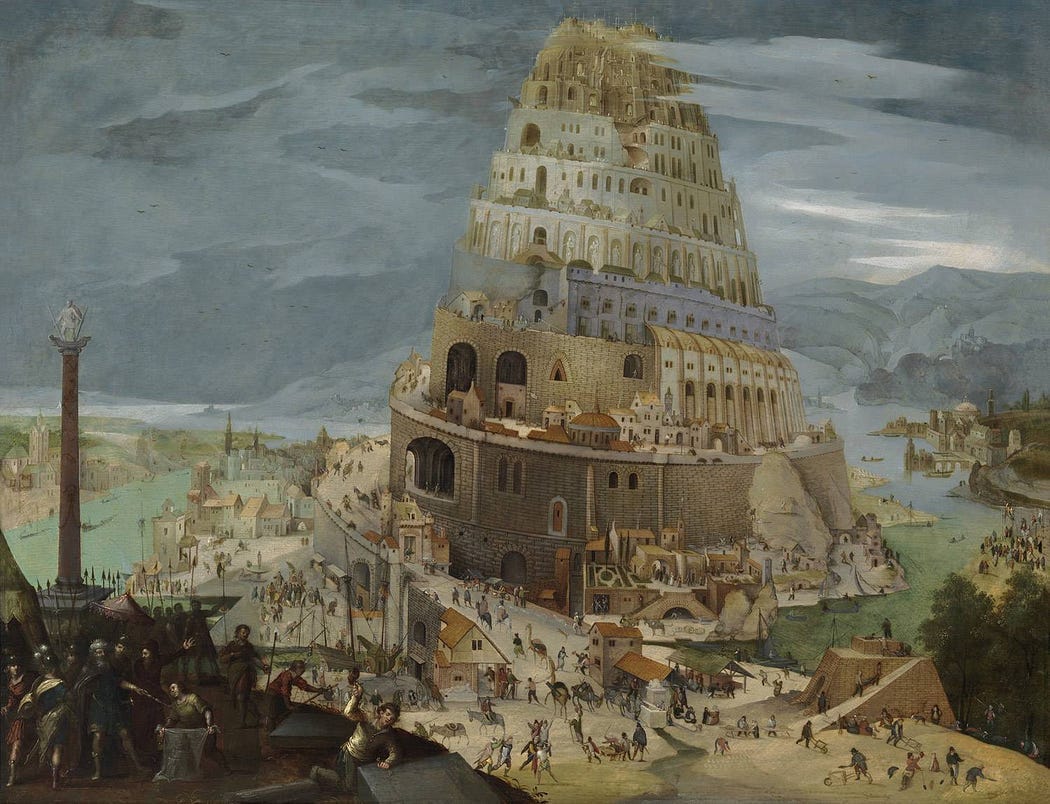
Abel Grimmer: «Construction of the Tower of Babel» (1604) — CC0 Public Domain
It is not really about technology
Although AI is the trigger, Magnifica humanitas is at its core not a technological document. It is a moral reflection. The Pope does not only write about systems, but about ourselves: about how we live together, and how we deal with power, responsibility, and vulnerability.
The starting point is the Catholic Social Teaching. At its foundation, it is about something very recognizable: how do we build a just society? How do we distribute prosperity? What is the role of the state? How do we deal with inequality?
This social teaching is a form of Christian humanism. And that means above all this: the human person is central, not as a robot-like means of production, not as an exploitable “slave,” not as a thinking cog in a “machine,” or as a data point in a database. But as a being with intrinsic value. Technology is not wrong — but it must serve that human dignity.
Dignity as a compass
The concept of “human dignity” runs like a common thread throughout the entire encyclical. It is not a vague ideal, but a concrete starting point. According to the Pope, every person has value — simply because he or she exists.
To clarify this, the text distinguishes between four types of dignity:
· Moral dignity: The way in which you make choices and take responsibility.
· Social dignity: The respect and recognition you receive from others and from society.
· Existential dignity: How you see and experience yourself: do you feel valuable?
· Ontological dignity: The deepest layer: the value you have, regardless of everything else, purely because you exist.
It is precisely this last form that is radical. Because it means that your value is not dependent on performance, success, or usefulness. And that is exactly where the tension with AI begins.
A broader moral foundation
In addition to dignity, the encyclical mentions a number of other principles that together form a moral framework. Not an abstract theory, but practical guidelines for how we live together:
Complementarity: People differ from one another and can complement each other.
· Solidarity: Acting for the common good, not only for yourself or your immediate surroundings.
· Charity (love of neighbor): Love must go together with truth in order to truly do good.
· Subsidiarity: What people can organize themselves, they should do themselves. Only then should it be scaled up.
· Distributism: Ownership and economic power should be distributed as broadly as possible.
· Sustainability: We do not live in a world with infinite resources.
These principles form the yardstick by which the Pope then looks at AI.
The promise and the shadow side of AI
The encyclical is nowhere anti-technology. On the contrary: AI can bring much good. Efficiency, medical progress, better access to information. But that is not the whole story.
Because the same technology can also reinforce something else: existing inequalities, concentration of power, and a way of thinking in which everything revolves around optimization.
The text clearly lists the main risks:
· Dehumanization: People are reduced to data, profiles, or “optimizable” systems. Dignity becomes linked to performance and efficiency.
· Technocratic worldview: Decisions increasingly revolve around control, measurability, and profit. Reality becomes something to be managed.
· Concentration of power: Large technology companies gain increasing influence. Democratic oversight fades into the background.
· Growing inequality and exclusion: Not everyone has access to technology. Differences therefore increase rather than decrease.
· Erosion of truth and information: Manipulation becomes easier. The distinction between truth and falsehood blurs.
· Loss of human freedom and autonomy: More and more decisions are influenced or made by systems. Dependence and control increase.
· Loss of work and meaning: Automation changes not only jobs, but also how people feel valuable.
· Militarization and autonomous weapons: AI becomes part of war and geopolitical power struggles. Weapons that destroy targets without human involvement.
These points are not new. But by bringing them together and linking them to one central standard — human dignity — they gain more weight.
What is progress, really?
Perhaps the most important question the encyclical raises is this: what do we actually mean by progress?
If progress means that everything becomes faster, more efficient, and cheaper, then AI is a success story. But if progress also says something about humanity, relationships, and meaning, then it becomes more complicated.
The Pope warns against what he calls the technocratic paradigm: the tendency to see the world only in terms of what is measurable and optimizable. The idea that human beings are merely cognitive — thinking — entities, without empathy, a sense of community, and love being important.
In contrast, he draws an important distinction: AI can do much, but it cannot feel, cannot understand, and cannot love as humans do, nor can it bear moral responsibility.
Therefore, there is a boundary. Decisions with real moral impact — especially those involving life, death, and dignity — must never be fully entrusted to computer systems.
Responsibility starts with design
For developers of AI, the message is clear, and frankly also quite firm.
Every choice in a system — what you measure, what you optimize, what you leave out — says something about how you view the human person.
That is why developers are called to:
· Be transparent about how systems work. · Take responsibility for their impact. · Continuously test whether what they build truly serves the good.
Technology is never neutral. And that means design choices are always moral choices as well.
The role of community and Church
The encyclical also gives a clear call to churches and communities. Not to reject technology, but to give direction.
· Safeguard and promote human dignity: Never see people as a means or as data.
· Form critical users of technology: Help people distinguish between truth and manipulation.
· Strengthen community and solidarity: Use technology to support connection, not replace it.
· Commit to justice: Protect people affected by automation.
· Protect freedom: Be vigilant about dependence, control, and addiction.
· Speak out against abuse: Name injustice and harmful applications.
· Continue to promote a realistic view of humanity: Vulnerability is not a flaw, but part of being human.
The encyclical calls on church leaders and laypeople to actively engage with technological developments and their consequences for the community. Also within the Church, we must become aware of the consequences of participating — as individuals or as communities — in these digital platforms.
The role of ethicists
Finally, the encyclical is also addressed to ethicists working on AI.
The idea that something is good as long as it complies with the rules is completely insufficient — the ‘compliance trap’. Ethics goes beyond that.
The encyclical once again emphasizes that ethical responsibility extends beyond the organization where AI is created or used. It concerns everyone who experiences the consequences of artificial intelligence, such as vulnerable minorities, residents of underdeveloped countries, and creation itself.
Because if technology changes faster than our ability to reflect on it, we lose something fundamental: the space to determine for ourselves what it means to be human.
Perhaps that is the most important message of Magnifica humanitas: not that we should slow down or prohibit AI technology, but that we must not lose our humanity as we increasingly use artificial intelligence.
메타데이터
- post_id
- 39f4f4a4bfdb
- slug
- magnifica-humanitas-what-it-does-to-us-and-what-we-must-do-39f4f4a4bfdb
- url
- https://medium.com/@reinoudkaasschieter/magnifica-humanitas-what-it-does-to-us-and-what-we-must-do-39f4f4a4bfdb
- canonical_url
- https://medium.com/@reinoudkaasschieter/magnifica-humanitas-what-it-does-to-us-and-what-we-must-do-39f4f4a4bfdb
- author_url
- https://medium.com/@reinoudkaasschieter
- status
- ok
- fetched_at
- 2026-06-29 01:02:39




