The AI Takeover That Isn’t: What the 2026 Data Actually Says About Data Scientist Jobs
Everyone is asking the wrong question. The real story — hidden inside 700+ job postings, Federal Reserve wage data, and a Goldman Sachs…
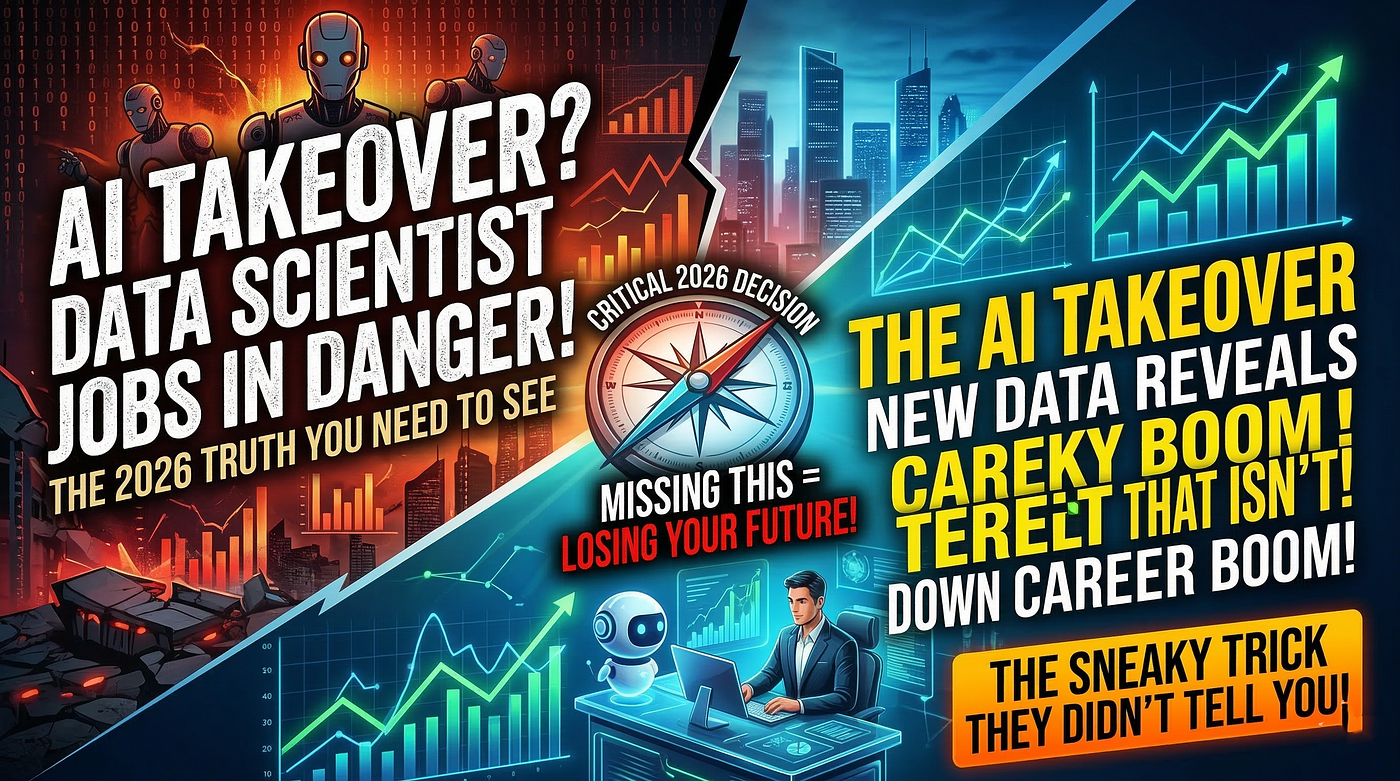
The AI Takeover That Isn’t: What the 2026 Data Actually Says About Data Scientist Jobs
Everyone is asking the wrong question. The real story — hidden inside 700+ job postings, Federal Reserve wage data, and a Goldman Sachs forecast — is more nuanced, more urgent, and far more useful for your career.
8 min read · March 2026 · Updated with live job-market data
Every week, a new headline lands in your feed. “AI just passed the data science exam.” “Demand for analysts is collapsing.” “AutoML will replace your entire team by next year.” You read it, you feel a low-grade dread, and then you go back to cleaning another messy dataset — because the work never actually stopped.
Here is the thing: the panic and the calm are both wrong. The truth, buried inside actual hiring data, Federal Reserve research, and the real-world experiences of hundreds of thousands of data professionals right now, is more interesting than either headline.
Let’s go through it clearly, section by section, so you can stop wondering and start strategizing.
By the numbers: Data Scientist roles grew +10% YoY in Q1 2025. Median AI-role salary hit $157k. Job postings rebounded +130% from their July 2023 floor. And yet — 63% of entry-level data jobs surveyed were impacted by AI. The story depends entirely on where you sit in the experience curve.
1. The Numbers Everyone Is Getting Wrong
Let’s start with the headline that circulates every few months: Goldman Sachs warned that generative AI could displace the equivalent of 25 million full-time jobs globally in 2026, with the number scaling to 270 million by 2030. That number gets screenshot, shared, and stripped of all context. What the report actually says is more interesting.
The word is “exposed” — not “eliminated.” Exposure to AI automation means some portion of your tasks can be augmented or assisted by AI. It does not mean your role disappears.
Data science job postings grew 130% year over year after hitting rock bottom in July 2023 — while data analyst openings grew 63% in the same period. These are not the numbers of a profession in freefall.
Data scientists, crucially, did not make the worst-hit list during the 2022–2023 tech layoffs either. A study from 365datascience found that only 2.7% of Amazon’s layoffs during that period carried the title of ‘data scientist’ — compared to 22.1% who were software engineers. The role is not as fragile as the discourse suggests.
And in 2025, AI/ML Engineer roles grew 41.8% year-over-year, while Data Scientist roles grew a steady 10% quarter-on-quarter. These are not the trajectories of a profession under siege.
2. Who Is Actually Getting Replaced — And Who Isn’t
If you want an honest answer to the “will AI replace us” question, you need to stop asking about data scientists as a monolith and start asking about which kind of data scientist, at which career stage, doing which kinds of tasks.
A February 2026 Federal Reserve Bank of Dallas analysis of 205 occupations found something that should make any early-career professional pay attention: AI is simultaneously automating codifiable knowledge — the textbook stuff you learned in a bootcamp — while complementing tacit knowledge, the kind you only gain from years of domain experience.
The numbers that matter: Entry-level workers aged 22–25 in AI-exposed roles experienced a 13% relative decline in employment. Experienced workers’ wages in the same fields? Up 16.7% since fall 2022. — Federal Reserve Bank of Dallas, Feb 2026
This bifurcation is real and it is already showing up in hiring data. A Snowflake/Omdia survey of 3,400+ companies found that data analytics was among the top three functions experiencing AI-related job losses — sitting alongside customer service and operations. But the losses are concentrated at the bottom of the experience ladder, not the top.
So the real risk is not “AI vs. data scientists” — it is AI vs. data scientists who only do the things AI can already do: running standard logistic regression on clean datasets, building dashboards from templates, writing SQL queries that any tool can now generate in seconds.
The response to this is not panic. It is a clear-eyed decision about where to invest your next 12 months.
3. The Five Things AI Still Cannot Do in 2026
This is where the conversation gets most useful. After analysing the research, the expert consensus, and the actual job descriptions attracting $150k+ salaries right now, five categories of human capability consistently survive the automation wave.
1. Frame the right problem. Real data science begins with an ill-defined business situation: customer churn is up, revenue is plateauing, a model keeps misfiring in production. Determining what question to even ask, what data is worth collecting, and what success looks like requires contextual judgment that no current AI system can replicate reliably. AI thrives on well-specified problems. Data scientists are paid to specify them.
2. Know when the data is lying. AI models are only as good as the data they’re trained on. Detecting bias in training sets, identifying when distribution shift has made a model stale, and knowing which data sources are trustworthy in a given domain — these are human responsibilities. Garbage in, garbage out remains as true in 2026 as it was in 2016.
3. Make high-stakes ethical calls. The EU AI Act came into force in 2025. Healthcare institutions, financial services firms, and government agencies now face legal liability for the outputs of their models. Humans must approve, explain, and stand behind algorithmic decisions in these domains. No AI signs off on AI.
4. Translate insight into action. A model that produces a result nobody acts on has zero business value. The ability to walk into a boardroom, communicate uncertainty honestly, push back on flawed requests diplomatically, and turn a p-value into a decision — this remains stubbornly human. As one data science leader put it in late 2025: “Technical skills are table stakes now. What separates good from great is judgment, curiosity, and communication.”
5. Own domain expertise. AI systems perform best when combined with deep industry knowledge. A data scientist who understands pharmaceutical trial design, credit risk in emerging markets, or how customer support queues actually behave in practice brings something that a general-purpose model simply cannot retrieve from its training data.
The professionals who have reason to worry are those who treat data science as a set of rote tasks rather than a way of thinking. If your value is in asking the right questions — you are not going anywhere.
4. The Two Career Paths That Are Thriving Right Now
Rather than worrying about whether your job title will exist in three years, it is more useful to understand the two archetypes that the 2026 market is actively paying a premium for.
The AI-Augmented Analyst. This is the data scientist who uses AI tools aggressively — for data cleaning, first-pass modelling, code generation, documentation — and then applies human judgment at every decision point that matters. They are faster, more productive, and able to tackle more complex problems than a traditional analyst. The key is that they are not replaced by the tools; they are amplified by them. When you give an analyst AI assistance, they tackle more complex questions, spend less time on routine queries, and deliver insights that move faster up the chain.
The AI Systems Architect. This is the more technical path: the person who designs, deploys, monitors, and continuously improves the AI and ML systems that are themselves doing the automating. This role requires deep skills in MLOps, model evaluation, AI governance, and an understanding of how production systems fail. Salaries for these roles regularly exceed $180,000 in the United States, and the talent shortage is severe.
Both paths require a strong foundational understanding of data science — statistics, probability, data intuition, and domain expertise. This is why learning data science in 2026 is not just still valid; it is arguably more valuable than ever as a launchpad for either trajectory.

5. The Honest Verdict — And What to Do About It
The framing of “AI replacing data scientists” is a false dichotomy. It generates clicks, anxiety, and podcast downloads — but it does not describe reality in 2026. The more accurate frame, supported by the data, is this:
AI is the most powerful tool data scientists have ever had. It is automating the most tedious parts of the job, lowering the barrier for basic analysis, and raising the standard for what excellent data science looks like. But it is not replacing the role — it is redefining it.
What does the evidence say to do? Three concrete things.
Stop protecting the tasks, start owning the judgment. If your job involves writing SQL, cleaning CSVs, or tuning hyperparameters — AI will do it faster. Let it. Your value is in the question you asked, the business context you understood, and the decision you enabled. Own that layer fiercely.
Get serious about domain depth. The Federal Reserve data is clear: experienced workers in AI-exposed fields are seeing wage growth outpace the national average. Experience means domain knowledge, tacit judgment, and the ability to navigate ambiguous problems. Pick an industry, go deep, and make yourself irreplaceable at that specific intersection of data and domain.
Make AI collaboration a core skill. Analytical thinking was the most-sought-after skill across industries for the third consecutive year, according to the World Economic Forum’s Future of Jobs Report 2025. But “analytical” in 2026 means knowing how to direct, validate, and critically evaluate AI-generated outputs — not just running your own models from scratch. The data scientists thriving today are those who have embraced this collaboration model.
BLS Projection: AI is expected to create demand for 500,000 additional data scientists by 2032. The question is not whether the field survives — it is which version of you shows up to it.
The gold rush version of data science — six-figure salaries for anyone who could write a random forest — is over. What has replaced it is something more demanding and, for those willing to adapt, more rewarding: a profession that sits at the intersection of technical depth, human judgment, and domain expertise, with AI as its most powerful collaborator yet.
That is not a threat. That is the job description.
If this changed how you think about your career
Follow for one data-backed article every week. No hype, no recycled takes. Just clear thinking on data science, AI careers, and the tools shaping the field in 2026.
→ And if you found this useful, share it with one data scientist who needs to read it. It takes 10 seconds and might genuinely help someone.
Sources: DemandSage (2026) · Federal Reserve Bank of Dallas, Feb 2026 · Towards Data Science · 365datascience · Snowflake/Omdia survey of 3,400+ companies · World Economic Forum Future of Jobs Report 2025 · Goldman Sachs Global Investment Research · LinkedIn Economic Graph · BLS Occupational Outlook Handbook
메타데이터
- post_id
- 39fd3c1e86b2
- slug
- the-ai-takeover-that-isnt-what-the-2026-data-actually-says-about-data-scientist-jobs-39fd3c1e86b2
- url
- https://medium.com/@koshurai/the-ai-takeover-that-isnt-what-the-2026-data-actually-says-about-data-scientist-jobs-39fd3c1e86b2
- canonical_url
- https://medium.com/@koshurai/the-ai-takeover-that-isnt-what-the-2026-data-actually-says-about-data-scientist-jobs-39fd3c1e86b2
- author_url
- https://medium.com/@koshurai
- status
- ok
- fetched_at
- 2026-06-22 07:15:07