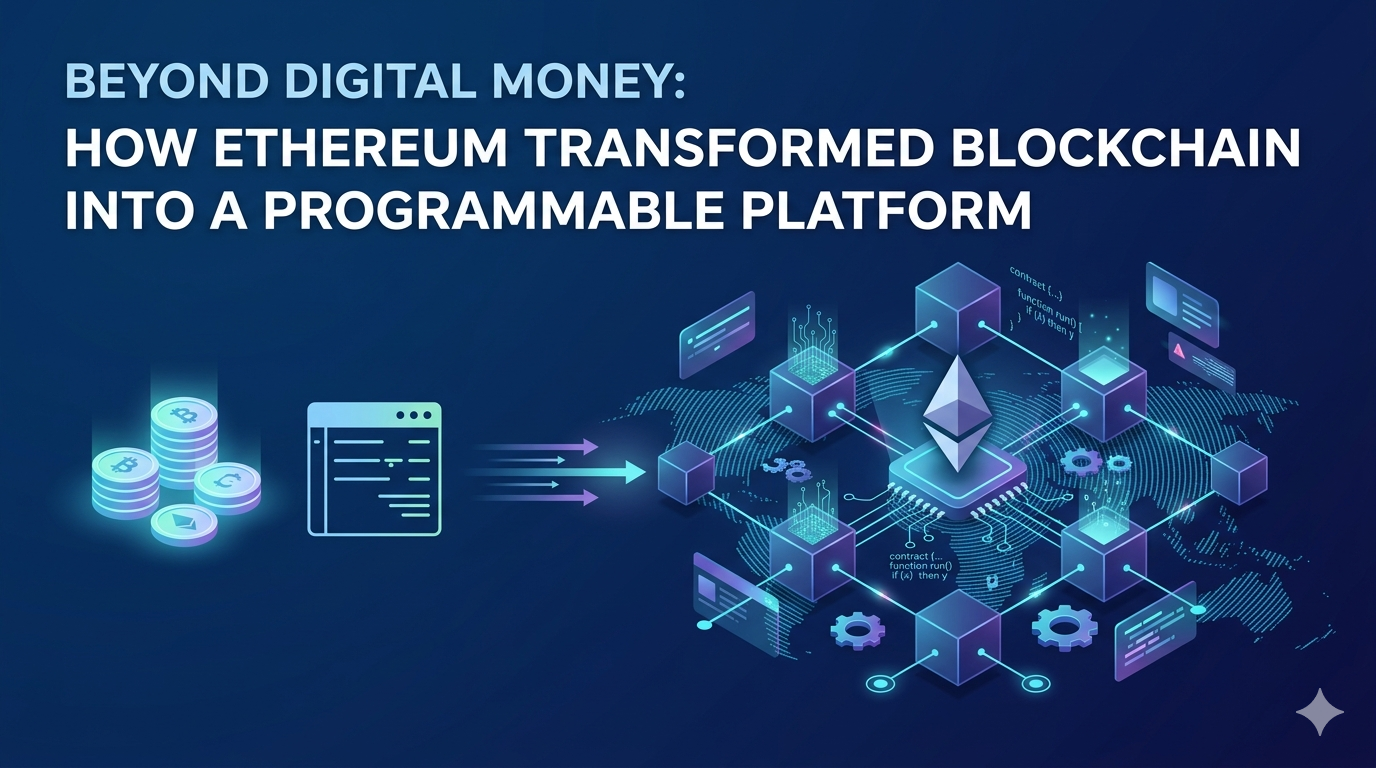
Why Every Node Gets the Same Result: Understanding Ethereum’s Execution Model
In this article, we’ll break down the core mechanics behind smart contract systems and explore how blockchain platforms manage data in a…
Why Every Node Gets the Same Result: Understanding Ethereum’s Execution Model

Credits: Nanobanana 2
In this article, we’ll break down the core mechanics behind smart contract systems and explore how blockchain platforms manage data in a decentralized environment.
We’ll start by looking at the limitations of traditional infrastructure, then move into how modern blockchains solve those problems through a distributed state machine model. Along the way, we’ll see how transactions, storage, and gas work together to keep the network secure and predictable.
Ever wondered why thousands of nodes can execute the same code and still agree on the exact same result? Or why a simple storage update can suddenly become expensive? Once you understand the architecture behind it, many things in Web3 start to make a lot more sense.
1. The Problem: Why Traditional Systems Fall Short
Most software today depends on centralized servers or cloud providers to maintain the “source of truth”. It works well, but it also creates an obvious weakness: a single point of failure. If the infrastructure goes down, gets compromised, or is controlled by an entity that decides to censor certain activities, the entire system can be affected.
Building a truly decentralized system where thousands of independent computers can coordinate without trusting each other has always been a difficult challenge. Honestly, distributed systems are already hard enough and making them trustless only makes things even more complicated.
Traditional databases handle concurrent operations using locks, replication, or eventual consistency models. These approaches work in controlled environments, but things get messy in a public peer-to-peer network. There is no central clock, no shared memory, and nodes may receive information at different times. Without a universally agreed sequence of events, attackers could exploit network delays to perform double-spending attacks or cause different nodes to disagree on the current state of the system.
Another challenge comes from computation itself. Public blockchains allow users to deploy arbitrary programs, and some of these programs can be extremely complex. Sounds powerful, right? Well, it also raises an uncomfortable question: what happens if someone deploys code that never stops running?
Without proper safeguards, an infinite loop could waste network resources and disrupt transaction processing. Traditional distributed systems avoid this problem by heavily restricting execution environments, but that also limits what developers can actually build.
2. The Solution: Turning the Network into a Global State Machine
Modern blockchains solve these issues by moving away from traditional database models and treating the network as a giant deterministic state machine.
Instead of viewing a ledger as a static collection of records, blockchains treat it as a continuously evolving system that moves from one valid state to another. Every node processes the same transactions and arrives at exactly the same result. No central coordinator required.
Smart contracts take this idea one step further. They transform the blockchain from a passive ledger into an active execution environment capable of running decentralized applications.
A smart contract is essentially a program deployed on-chain. It contains immutable code and maintains its own persistent storage. Once deployed, the rules inside the contract execute automatically, removing the need for intermediaries and making the system much more transparent.
The real beauty of this architecture lies in how code and data are tightly connected. Instead of dealing with separate application servers and databases, contract execution directly changes the global state maintained by the network.
Whenever a transaction triggers a smart contract, every validator independently verifies the result. This creates a transparent and tamper-resistant history that anyone can audit.
Pretty wild when you think about it. Thousands of machines around the world continuously agreeing on the same data without knowing or trusting each other.
3. How It Works: State, Transactions, Storage, and Gas
At any moment, a blockchain has a current snapshot called the state. This global state is made up of accounts, and each account stores information such as balances, contract code references, and persistent storage data.
Temporary structures like stack and memory exist only during execution, while storage persists across blocks. Think of storage as the contract’s hard drive. It keeps data alive long after a transaction has finished.
Everything starts with a transaction.
Whenever a user signs and broadcasts a transaction, validators include it in a block and execute the corresponding smart contract logic. The current state, combined with the incoming transaction, produces a new state. Every node repeats this process independently to ensure consensus.
Of course, allowing anyone to execute arbitrary code comes with risks. Nobody wants a smart contract to consume unlimited resources and bring the network to its knees. That would be… awkward.
To solve this, blockchains use an economic metering mechanism called gas.
Every operation performed by the virtual machine — whether it’s adding numbers, accessing memory, or writing data into storage — has a cost. Users specify a maximum gas limit and pay fees based on the resources consumed during execution.
If a transaction runs out of gas, execution stops immediately. Any changes made during that transaction are reverted, but the user still pays for the resources that were already consumed.
It might feel a little unfair the first time you experience it. Believe me, watching your transaction fail while still paying fees is practically a Web3 rite of passage.
4. The Analogy: Think of It Like an Arcade Machine
Imagine an old-school arcade machine placed inside a giant tournament hall.
The screen shows the current game state: player positions, scores, and remaining lives. The ROM chip inside the machine contains the game logic, similar to a deployed smart contract. Meanwhile, the machine’s save memory acts like persistent storage.
Players cannot directly edit the score or hack the screen. Instead, they interact with the machine by inserting tokens and pressing buttons. Those actions represent transactions.
Each button press consumes part of the token’s value, just like each computational operation consumes gas.
The game rules determine how the screen changes. No one can magically skip to the final boss without progressing through previous levels.
Now imagine thousands of referees surrounding the machine.
Each referee has an identical copy of the game’s rulebook and carefully watches every move. If someone tries to cheat by changing their score manually, all referees immediately detect the inconsistency.
They reject the move, restore the game to the last valid state, and the cheater loses their token for wasting everyone’s time.
Yeah, blockchains can be surprisingly unforgiving.
5. Summary: Why This Mental Model Matters
Moving from traditional cloud applications to Web3 requires a completely different way of thinking.
Instead of treating the system as a database managed by a server, it’s more useful to think of a blockchain as a distributed state machine that continuously evolves through verified transactions.
Transactions act as inputs that trigger state transitions. Storage preserves information over time. Gas provides an economic mechanism that prevents resource abuse and fairly allocates computational power across the network.
For software engineers, understanding this model is essential because on-chain resources are fundamentally different from cloud infrastructure. Storage and computation aren’t practically infinite anymore — they have real economic costs attached to them.
This changes how applications are designed.
Optimization is no longer just a nice bonus; it’s part of the architecture itself.
Once you embrace the state machine mindset, writing smart contracts becomes much easier. You’ll start thinking less like a backend developer managing databases and more like an engineer designing deterministic systems that thousands of machines around the world can agree on.
And honestly, that’s one of the things that makes Web3 so fascinating.
References
- Alharby, M., Aldweesh, A., & Van Moorsel, A. (2018). Blockchain-based smart contracts: A systematic mapping study of academic research (2018). In 2018 International Conference on Cloud Computing, Big Data and Blockchain (ICCBB) (pp. 1–6). IEEE.
- Cabral, D. R. de L., Antonino, P., & Sampaio, A. C. A. (2025). Demystification and near-perfect estimation of minimum gas limit and gas used for Ethereum smart contracts. Journal of Cloud Computing, 14(1), 29.
- Baird, K., Jeong, S., Kim, Y., Burgstaller, B., & Scholz, B. (2019). The economics of smart contracts. arXiv preprint arXiv:1910.11143.
- Heimbach, L., Babel, K., & Milionis, J. (2026). EVM Workloads in the Wild: Evidence for Multi-Dimensional Gas Metering, State Growth, Delayed Execution, and Parallelism. arXiv preprint arXiv:2606.19869.
- Maxence, L., Bertelle, C., & Duvallet, C. (2025). From Contracts to Code: Automating Smart Contract Generation with Multi-Level Finite State Machines. ArXiv, abs/2507.16276.
- Wood, G. (2014). Ethereum: A Secure Decentralised Generalised Transaction Ledger. Ethereum Yellow Paper.
메타데이터
- post_id
- 3a086cebb260
- slug
- why-every-node-gets-the-same-result-understanding-ethereums-execution-model-3a086cebb260
- url
- https://medium.com/@herlana312/why-every-node-gets-the-same-result-understanding-ethereums-execution-model-3a086cebb260
- canonical_url
- https://medium.com/@herlana312/why-every-node-gets-the-same-result-understanding-ethereums-execution-model-3a086cebb260
- author_url
- https://medium.com/@herlana312
- status
- ok
- fetched_at
- 2026-07-25 22:12:05