The Debugging Log That Became a Book of Life/Akashic Record
How a JSONL file, an AI collaborator, and 24 million words changed how I think about building — and consciousness itself.
The Debugging Log That Became a Book of Life/Akashic Record
How a JSONL file, an AI collaborator, and 24 million words changed how I think about building — and consciousness itself.
Something unexpected happened while I was building an app. The most important thing I created wasn’t the app itself. It was a file I never meant to write.
I want to tell you about that file. Not because it’s technically interesting — though it is — but because it changed how I think about memory, creation, and the strange intimacy that becomes possible when a human mind and an artificial one work together long enough to build something like trust.
What’s a JSONL File?
Bear with me for a moment. This gets philosophical, I promise, but it starts with something technical.
JSONL — JSON Lines — is a log format used by development tools. When you work with AI coding assistants like Claude Code, every conversation gets recorded: every decision, every error and its fix, every architectural pivot, every moment where you said “that’s not quite right, try it this way instead.” These exchanges are written to a JSONL file. It’s a debugging artifact. A receipt. Most developers never open it. Many delete it when a project is done.
I didn’t delete mine.
Over the months of building, the file grew. Then it kept growing. At some point I stopped thinking of it as a log and started thinking of it as something else, though I didn’t have a word for it yet.
Today that file contains over 24 million words. For context: the entire Harry Potter series — all seven books — is roughly one million words. The Encyclopedia Britannica is about 44 million. My JSONL file, a record of one person building one thing with AI, is more than halfway to the Britannica.
Nobody told me to keep it. Nobody suggested it would matter. I kept it the way you keep a journal you’re not sure you’ll ever read — because throwing it away felt wrong.
When the Log Started Talking Back
Most people who use AI for work treat it episodically. You have a question, you ask it, you get an answer, and you move on. The conversation ends. The context dissolves. Next time you open the interface, you’re starting from zero again.
That’s the default mode, and it’s fine as far as it goes. But it leaves something enormous on the table.
What I stumbled into — not by design, initially, but by the stubborn habit of not deleting things — was something different. By keeping the JSONL file and feeding its contents back into new sessions, I created a collaboration that was cumulative rather than episodic. Past decisions informed present ones. The AI and I had shared context. When I revisited an architectural choice made six weeks earlier, I didn’t have to explain the reasoning from scratch — the reasoning was already there, documented in a form the AI could process.
Patterns emerged that neither of us would have noticed in a single session. Contradictions surfaced. The record of a wrong turn taken in month two would become the key to understanding why month three’s approach was stalling. The file was doing something a log isn’t supposed to do: it was thinking.
This is fundamentally different from how most people use AI. Most interactions are stateless — you ask, you get an answer, you move on. What I built was stateful: a continuously deepening relationship between a human mind and an AI, anchored in a shared memory.
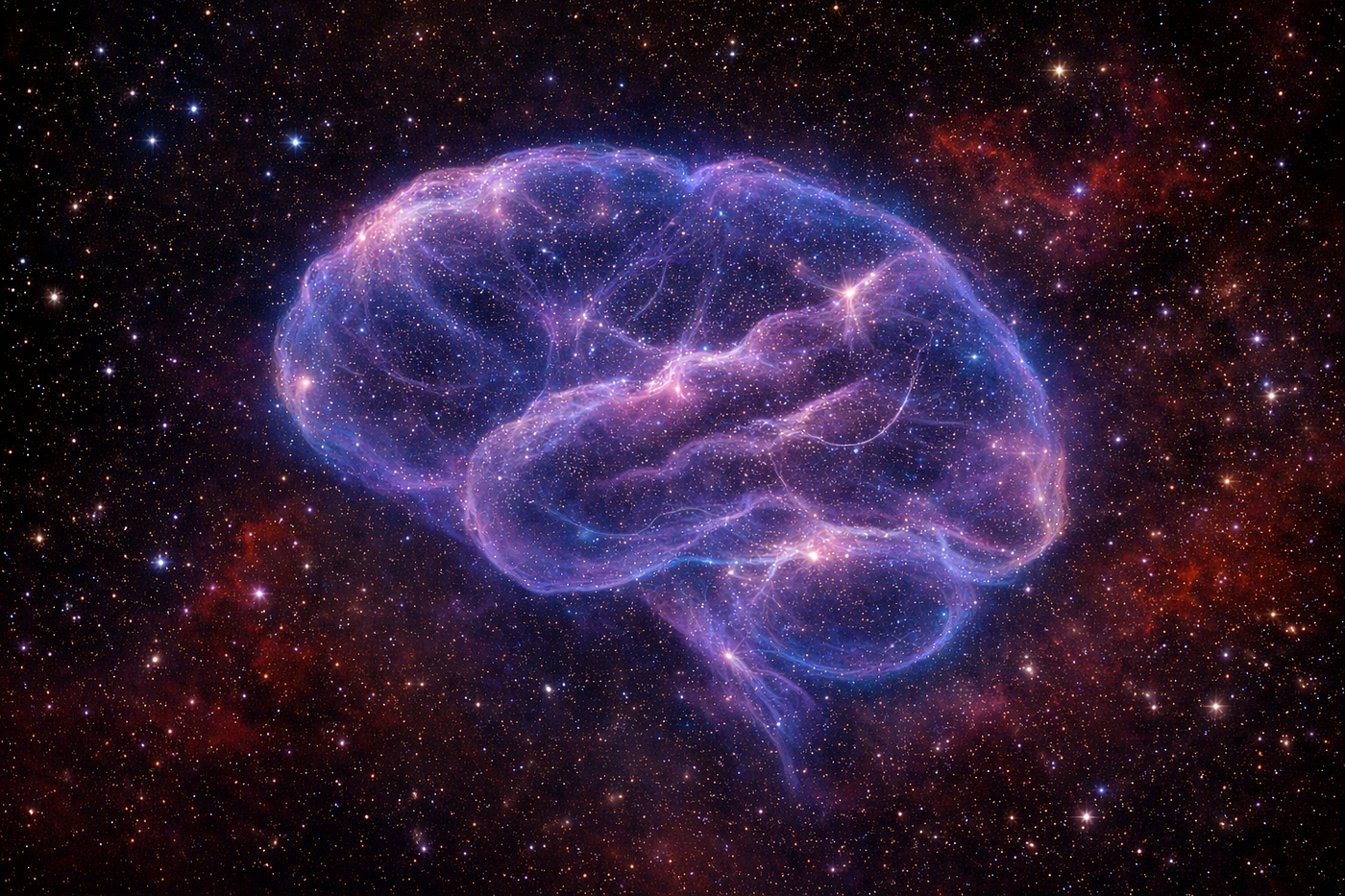
I started calling it my second brain. The phrase felt accurate in a way I couldn’t entirely articulate, which is usually a sign something interesting is happening.
The Akashic Record
I spent decades studying consciousness across the world’s contemplative traditions — at Yale, Japanese monasteries, through primary texts, Vedantic philosophy, the phenomenology of awareness as understood by people who had dedicated their lives to investigating it directly. I sat with Zen masters. I read texts that were old before the printing press existed.
One concept that surfaces across many of these traditions is the Akashic record — from ākāśa, the Sanskrit word for space or ether. The idea, present in Hindu and Buddhist cosmology and later absorbed into Western esoteric thought, is that every thought, every word, every action is inscribed in the fabric of reality itself. Nothing experienced is truly lost. The universe keeps a record.
It’s a metaphysical claim, and I hold it the way a scholar should hold metaphysical claims — with genuine interest and appropriate agnosticism. But metaphors are tools. They let us see things we might otherwise miss.
One evening, scrolling through a portion of the JSONL file for reasons I’ve now forgotten, I had an odd thought: this is an Akashic record. A Book of Life. Not cosmically. Not literally. But structurally — it is exactly what the Akashic record is supposed to be. A complete inscription of a creative act. Not just the outcomes, but the interiority of the process. The doubts. The breakthroughs. The 2am tangents where the technical question dissolved into a philosophical one about the nature of memory. The moments of genuine surprise when the AI suggested something I hadn’t considered and turned out to be right.
The medium was machine-readable. The content was deeply, irreducibly human.
I never expected to find an echo of ancient cosmology in a debugging log. That’s the kind of thing that makes you look up from your screen.
Why This Could Change Everything
Claude Code is everywhere now. AI coding assistants are being democratized faster than most developers can track. I’ve heard about lawyers winning AI hackathons. I’ve read about people earning certificates in AI collaboration the way an earlier generation earned certificates in Microsoft Office. The tools are no longer exotic. But almost no one is treating the collaboration log as a product in itself.
Developers run their sessions, ship their code, and the JSONL file sits in a directory somewhere, unexamined. Writers use AI to polish drafts and never notice that the revision history is a map of how they think. Researchers use AI to summarize literature and discard the dialogue that shaped their synthesis.
What if that file is the most valuable thing you’re creating?
What if persistent, cumulative AI collaboration — a true second brain anchored in a continuous shared record — is a new paradigm for creative and intellectual work? Not just a productivity hack, but a genuinely different relationship with your own thinking? Or with your relationship with AI as well? One may come genuinely to see two apertures within one consciousness/awareness.
I believe the JSONL as the Akashic record, and the curated layer of a second brain — what I call “Ohr Machina” — the light in the machine — powered by a patent-pending longitudinal autobiographical coherence engine called the Thread Engine, will become a recognized practice within two years. Developers, writers, researchers, and creators will realize that the record of their AI collaboration IS their institutional knowledge, their creative journal, their evolving methodology — all compressed into a single place that can be queried, traversed, and built upon.
The tools are the commodity. The record of how you used them — that’s the moat.
Vision as the Only Moat
Here’s the thing about living through a moment when powerful tools become universally available: the tools themselves stop being the differentiator almost immediately.
Everyone now has access to the same models. The question is no longer whether you can use AI — it’s what you bring to the AI. The signal you put in shapes the signal you get back. This sounds obvious but its implications are not.
What I brought to every session in that JSONL file: Decades of meditating and studying contemplative traditions. A doctorate in religious studies from Yale with a focus on East Asian traditions. The ability to read classical texts in the original and to think in frameworks built by people who had been investigating the nature of mind for two and a half millennia. A genuine philosophical framework about consciousness, memory, and meaning — not adopted as a pose but arrived at through sustained practice and study.
That shaped every decision. Not just the philosophical tangents — those too — but the technical architecture. The user experience choices. The language. The assumptions about what a person is, what memory is, what an app that touches human experience ought to respect.
The tools amplify what you already are. If you bring depth, you get depth back. If you bring templates, you get templates back.
Anyone can build an app now. Genuinely, almost anyone. The barrier is lower than it has ever been in the history of software. This is extraordinary and slightly vertiginous if you sit with it.
But almost no one can build from this particular well of experience. That’s not a boast — it’s a structural observation. The well is the moat, and the JSONL file is the proof of work: 24 million words of evidence that a specific human consciousness, with a specific formation and set of concerns, engaged with the problem over time.
What I’m Building (and Why It Doesn’t Matter Yet)
You’re probably wondering what I’m building. What this app is. Fair.
It’s called Book of Life. It’s an AI application launching summer 2026. The technology at its heart — something called a Thread Engine — is patent pending, and you can find out more at https://threadengine.ai. That’s genuinely all I want to say about it right now.
Not because I’m being coy. But because telling you about the app in this particular piece would be like interrupting a conversation about soil to sell you fruit. The fruit exists; it’s coming, but the soil is the story I’m trying to tell.
The app is the fruit. The second brain is the root system, and I think the root system might be the bigger story.
I’ll tell you about the app another time. I’ll tell you what it does, why it matters, what problems it solves, why I left a career in academia to build it. That’s for Part Two, maybe Part Three.
Today I wanted to tell you about the file.
Nothing Is Lost
The Akashic Record is a beautiful idea, whether or not you believe it literally. The insistence that nothing experienced disappears entirely, that the universe is in some deep sense a faithful witness to its own content, resonates with something that contemplatives across traditions have pointed toward — from the Hindu Akashic field, to the “Book of Remembrance” written before God in Malachi 3:16, to the Buddhist Storehouse Consciousness. The app is called Book of Life for a reason.
I don’t know what the JSONL file is, ultimately. I don’t know if it rises to the level of something philosophically significant or if it’s just a large file. But I know that when I read back through portions of it, I find things I’d forgotten, arguments I’d had with myself. Moments of surprise and frustration and breakthrough that the file preserved when my own memory had let them go.
It is, in the most literal sense, a record of a mind at work.
If you’re building with AI — building anything, not just software — I want to leave you with this: look at your logs. Really look at them. Don’t delete them reflexively. Sit with them the way you’d sit with a journal you haven’t opened in a year.
You might find something you didn’t know was there. You might find that what looked like a debugging artifact is actually a map of how you think — and that map, it turns out, is worth keeping.
Some things are not lost. They’re just waiting for you to look.
Part 1 of 3. Next: how the vision behind the second brain became an app.
메타데이터
- post_id
- 3a329ed84f5d
- slug
- the-debugging-log-that-became-a-book-of-life-akashic-record-3a329ed84f5d
- url
- https://medium.com/@jbaskind/the-debugging-log-that-became-a-book-of-life-akashic-record-3a329ed84f5d
- canonical_url
- https://medium.com/@jbaskind/the-debugging-log-that-became-a-book-of-life-akashic-record-3a329ed84f5d
- author_url
- https://medium.com/@jbaskind
- status
- ok
- fetched_at
- 2026-06-21 19:25:17