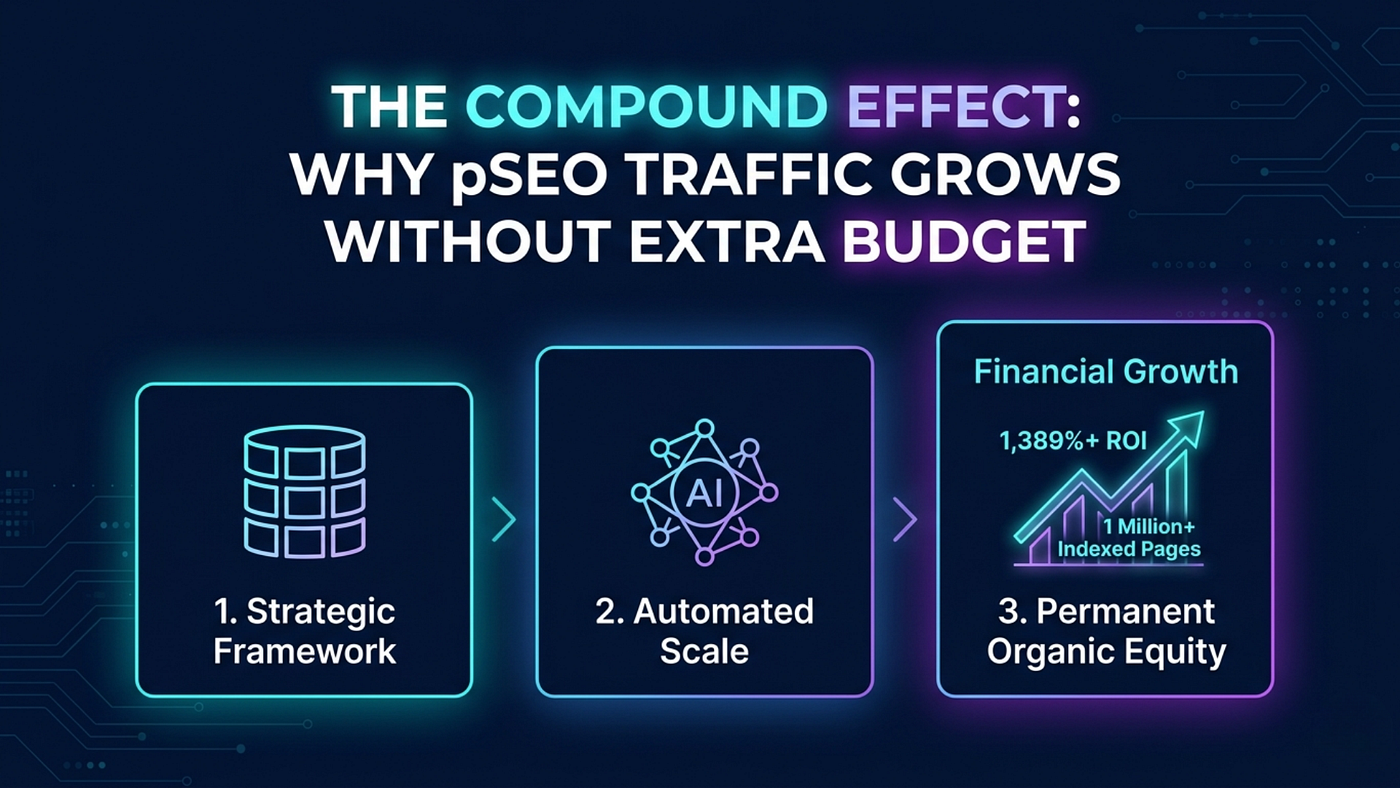
The Compound Effect: Why pSEO Traffic Grows Without Extra Budget
Explaining the compounding nature of programmatic SEO and how indexed pages build permanent organic equity.
The Compound Effect: Why pSEO Traffic Grows Without Extra Budget
Visualized by AI, orchestrated by Pixenon semantic architecture.
Explaining the compounding nature of programmatic SEO and how indexed pages build permanent organic equity.
I. The Meeting You’ve Already Had
The VP leaned back, tapped his pen twice, and said the sentence every SEO team has heard at least four times in the last two years: “Look, the content is scaling nicely. But we’re not seeing the traffic lift we expected. Can we pull back on volume and focus on fewer, higher-quality pieces?”
The content lead pulled up a graph not of traffic, but of indexed pages over time. A flat line for the first six weeks. A gentle upward curve at week seven. A hockey stick starting at week eleven. “That’s the same content,” she said. “It just needed time to compound.”
He didn’t look convinced. But the numbers spoke for themselves.
Programmatic SEO doesn’t scale linearly. It compounds. The mechanism behind that compounding involves something almost nobody in the industry talks about because it doesn’t fit the narrative of “AI content is garbage” or “Google is cracking down.” The truth is more interesting, more boring, and far more profitable.
II. What Zillow Figured Out Early
Zillow’s programmatic content strategy now generating over 33 million monthly organic visits across 5.2 million indexed pages didn’t start as a traffic machine. It started as a data problem. The company needed pages for every neighborhood, zip code, and property type in the United States. They had the data. They built the template. And then they waited.
In the first months, most of those pages sat in Google’s index with zero traffic. Then, slowly, they started appearing for queries that had no other dedicated result. By month six, pages that had been sitting dead were getting 50, 100, 300 visits per month each. Not much individually. But Zillow had millions of them.
What happened next is the mechanism nobody models correctly. They model page volume. They should model query surface area per page.
A page that ranks for “two-bedroom Capitol Hill apartments” often starts ranking for related queries: “Capitol Hill apartments near light rail,” “pet-friendly rentals Capitol Hill,” “Capitol Hill studios under $2000.” Each new query adds traffic without requiring a new page. The total traffic from those pages in month twelve was not 12 times the month-one traffic. It was far higher. Pages that rank for one query accumulate ranking signals for adjacent queries and the compounding accelerates.
III. The Mechanism: NavBoost and Why It Matters for pSEO
The compounding effect has a real, documented mechanism — one that remained largely theoretical until May 2024, when internal Google Search API documentation was inadvertently published to a public GitHub repository. Google confirmed the documents’ authenticity on May 29, 2024. Among the most significant revelations: the existence and mechanics of a system called NavBoost.
Google 2024 API Leak — Confirmed by Google
NavBoost is Google’s click-based re-ranking system. Confirmed under oath by Google VP of Search Pandu Nayak during the 2023 DOJ antitrust trial, and detailed in the 2024 leak, it operates on a rolling 13-month window of aggregated user click data. The system tracks three key signals per page: goodClicks (clicks followed by dwell time), badClicks (clicks followed by rapid return to search results), and lastLongestClicks (the final result a user dwells on, indicating their search was satisfied). Pages that accumulate goodClicks and lastLongestClicks are promoted for their target queries and tested for adjacent queries.
This is the compounding mechanism in technical terms. When Google encounters a new programmatic page, it runs experiments showing the page to a small percentage of searchers for various queries. If the page earns goodClicks, it gets shown to more people for that query. If it earns badClicks, it gets shown to fewer. This is Bayesian updating at scale, and it takes time because the initial data is sparse.
But once a page has accumulated positive NavBoost signals for one query, Google starts testing it on adjacent queries. The page for “two-bedroom Capitol Hill apartments” gets tested for “Capitol Hill apartment rent prices.” If it performs well there, it gets tested for “Capitol Hill real estate market.” Each successful test expands the query surface area, which brings more traffic, which generates more signals. The page becomes a self-reinforcing loop.
The leaked documentation also revealed that domain-level NavBoost patterns matter. A new page on a well-established domain with strong historical click signals may “inherit” a baseline trust that gives it a warmer start in rankings than an identical page on a newer domain. This is why pSEO compounds faster on established domains.
IV. The Latency Period and What It Actually Means
The typical latency between publishing a programmatic page and its first meaningful traffic is well-documented in SEO practice: most pages take 4–6 months to settle into stable first-page positions. For programmatic content, the pattern is consistent: flat for 6–10 weeks, gentle upward curve from weeks 7–14, then an accelerating ramp as NavBoost signals accumulate across the cluster.

Visualized by AI, orchestrated by Pixenon semantic architecture.
Average 3-year SEO ROI for Botify customers — compounding over time drives this figure
The reason for the latency is not “Google needs time to trust the site.” It’s structural: each page needs to accumulate enough NavBoost signal before it becomes consistently visible. A page with 200 words about a specific rental query might need dozens of impressions across multiple query variations before Google has enough confidence to surface it prominently for any of them. That takes time but once it starts, it accelerates.
V. The Skeptic’s Best Objection
The smart skeptic says: “This worked when Google was dumber. With the Helpful Content Update and the March 2024 core update, Google is explicitly penalizing thin content. The Zillow example is a legacy case. The game has changed.”
This is the strongest version of the objection. It’s not wrong about the direction of travel. Google has gotten better at detecting content that exists only to occupy a URL. The March 2024 update specifically targeted “scaled content abuse” pages that exist solely to match a query without providing meaningful information. Google reported a 40% reduction in unhelpful content in search results during 2024.
But here’s what the objection misses: the mechanism of query surface area accumulation doesn’t require thick content. It requires relevant content. A page that answers a specific, narrow query with a specific, narrow answer “does Capitol Hill have a Trader Joe’s? No, the closest is 1.2 miles away on Broadway” is not thin content. It’s precise content. And precision is exactly what NavBoost rewards, because precise pages generate high goodClicks ratios and low badClicks ratios for their target queries, which accelerates the compounding loop.
The pages that get penalized are ones that try to cover too much ground with no unique data. The pages that compound are the ones that cover exactly one thing well: narrow, specific, indexable, data-grounded. The March 2024 update didn’t kill programmatic SEO. It killed programmatic SEO done badly. Zillow, Canva, Zapier, and KrispCall all survived every major update not because they were lucky, but because their pages answered specific queries with data those pages actually owned.
VI. The Named Lever: Query Surface Area Engineering
There’s a specific intervention that separates the pSEO implementations that compound from the ones that flatline. Most SEO practitioners call it “query-first page architecture” but the mechanism is precise enough to deserve a more specific description.
The principle: design each programmatic page to carry clear signals for at least three distinct query types simultaneously, without diluting relevance to any single one. For a rental listing page: (1) geo-specific signal (“Capitol Hill”), (2) category signal (“two-bedroom apartment”), and (3) constraint signal (“under $2500”). Each query type gets an explicit signal in the title, H1, first paragraph, and structured data.
Why three signals matter: a page carrying three distinct query signals gets tested by NavBoost for three query categories simultaneously. Instead of waiting for Google to discover the page’s relevance to “under $2500” only after it has already accumulated signals for “Capitol Hill,” the page gets tested for both from the start. The NavBoost updating process runs in parallel across multiple query dimensions which means the compounding effect kicks in sooner and accelerates faster. Most programmatic pages are built with one signal. This is why most programmatic pages plateau.
This explains a pattern observed consistently across large-scale pSEO implementations: sites with the highest ratio of indexed-to-published pages tend to be the ones that explicitly structured their templates around multiple query dimensions. Pages with only a single query signal aren’t just slow they’re fragile. One algorithm tweak, and that single query pathway dries up. Multi-signal pages survive algorithm changes because they have multiple pathways through NavBoost.
VII. The Honest Complication
Here’s what the evidence does not yet resolve: the compounding effect appears to have a ceiling, and nobody knows exactly where it is or what determines it. In practice, traffic growth curves for programmatic content clusters tend to flatten after 18–24 months. Traffic continues to grow, but at a rate that more closely tracks new page publication rather than accelerating beyond it.
One hypothesis is that the query surface area per page ha s a natural limit there are only so many distinct queries a page about “two-bedroom apartments in Capitol Hill” can plausibly rank for before Google’s relevance systems start treating the page as generic. Another hypothesis is that the domain itself hits a saturation point within its niche there are only so many people searching for Capitol Hill apartments, and once you’ve captured most of them, the remaining searchers use different vocabulary that your existing pages don’t match.
The harder 2026 complication: AI Overviews have introduced a new ceiling that didn’t exist in 2022. Ahrefs research confirms that 99.2% of keywords triggering AI Overviews are informational in intent the exact query type most likely to produce thin programmatic content. The compounding effect still operates for transactional, data-specific queries (the ones pSEO works best for) but the total addressable query space has shrunk as informational queries get answered directly in the SERP. This is not a reason to abandon pSEO. It’s a reason to be more precise about which queries you target.
There is also the question of whether the ceiling resets. Practitioners who have refreshed programmatic page clusters updated data, added new variable combinations, restructured templates consistently report a secondary compounding cycle. The ceiling appears to be a function of data freshness, not a hard structural limit. Pages that stop compounding are usually pages whose data has gone stale, not pages that have “run out” of queries to rank for.
VIII. The Kicker
Botify, the enterprise SEO platform, describes SEO’s compounding nature this way: “Paid marketing is like renting a house; you never build equity. SEO is like owning a house; you may have a big mortgage, but every month you earn a bit more equity in your home.” Their customers see an average 584% ROI over three years a figure that is not front-loaded. It compounds.
The VP who wanted to cut volume in favor of quality wasn’t wrong about quality. He was wrong about the mechanism. Quality matters for whether a page earns goodClicks or badClicks when Google tests it. Volume matters for how many query surface areas you cover simultaneously. Both are required. Neither alone is sufficient.
The companies that win with programmatic SEO are not the ones that publish the most pages or the best pages. They are the ones who understood that a page is not a piece of writing it’s a data structure that accumulates ranking signals over time, expanding its query surface area, building NavBoost equity, compounding without anyone touching it again.
The compounding isn’t the strategy it’s what happens when you stop treating pages as experiments.
Every indexed page you published last year is quietly accumulating NavBoost signals right now. Some of those pages will start ranking for queries you never explicitly targeted. Some will earn traffic six months from now from searches that don’t exist yet. The machine doesn’t need your attention to run. It just needs the data to have been real in the first place.
Stop counting pages. Start counting query surface area.
메타데이터
- post_id
- 3a3768ee44cc
- slug
- the-compound-effect-why-pseo-traffic-grows-without-extra-budget-3a3768ee44cc
- url
- https://medium.com/programmatic-seo-lab/the-compound-effect-why-pseo-traffic-grows-without-extra-budget-3a3768ee44cc
- canonical_url
- https://medium.com/programmatic-seo-lab/the-compound-effect-why-pseo-traffic-grows-without-extra-budget-3a3768ee44cc
- author_url
- https://medium.com/@ayvataskenan
- status
- ok
- fetched_at
- 2026-07-11 12:51:18