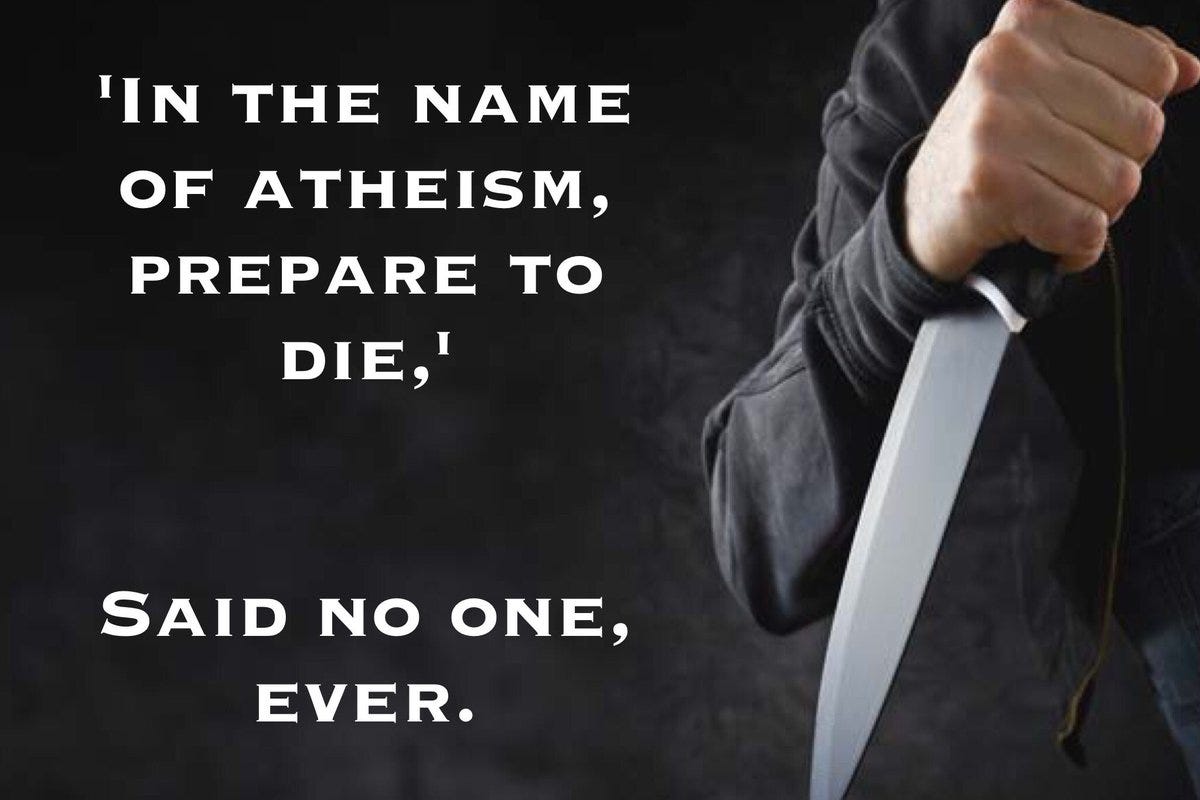
“In the name of atheism, prepare to die,” said no one, ever
No murder has ever been committed because of atheism
“In the name of atheism, prepare to die,” said no one, ever
No murder has ever been committed because of atheism
Let’s begin by being clear about definitions: Atheism is neither a philosophy nor an ideology. Not believing in gods¹ comes with no guidelines, no practices, no rituals, and no scripture. Here’s the crucial part: Atheism tells no one to do anything, which is to say no murder has ever been committed because of atheism. Not one.
Many religious believers, however, will hotly disagree. James W. Miller, in a piece posted on Medium, insists that atheists have killed more than religious people, that “explicitly atheistic regimes were responsible for mass death on a scale that dwarfs anything in religious history” and that “[these regimes] often treated religion as an enemy to be eliminated.” That last part about religion perceived as being an enemy is correct, but not in the way Miller thinks. I’ll expatiate on that in a moment.
More to the additional point, here’s what Miller wrote in response to one of his skeptical readers: “Atheism just killed 100 million people.” What Miller is suggesting is that disbelieving in the existence of gods was the driving force behind some of the worst atrocities of the twentieth century. These dictators, he is arguing, killed on a mass scale precisely because they were atheists.
Is Miller also arguing that being an atheist is necessary for an aspiring dictator or authoritarian figure? Is the argument that embracing atheism, ipso facto, somehow opens the door to authoritarian impulses, the assumption being that morality comes from religion (it does not) and that without it amorality will fester and breed, driven by a lust to control and kill people?
In either case, both assumptions are wrong. See Viktor Orbán, who was “an atheist when he started in politics in the late 1980s [but] now calls himself a defender of Christianity.” True, the man hasn’t created any extermination or forced-labor camps, but the man is most definitely a dictator. Call him Dictator Lite, if that works for you.²
Miller also says “the idea that the world would be safer without religion is not supported by history. It’s a comforting myth, especially in academic settings where skepticism toward faith is rewarded, but it’s still a myth.”
Miller is wrong — again. I would ask him to look at Scandinavia, which has long been regarded as the most areligious region on the planet. Last I looked, Denmark, Norway, and Sweden seem to be living relatively peacefully. Sure, you can find Christians who live there (and murders occur in Scandinavia just as they occur everywhere), but can we discern any severe degree of violence or an ongoing degradation of morals occurring in these countries from the past one hundred years or so? Nope.
Here’s a meme I found on Twitter several years ago:
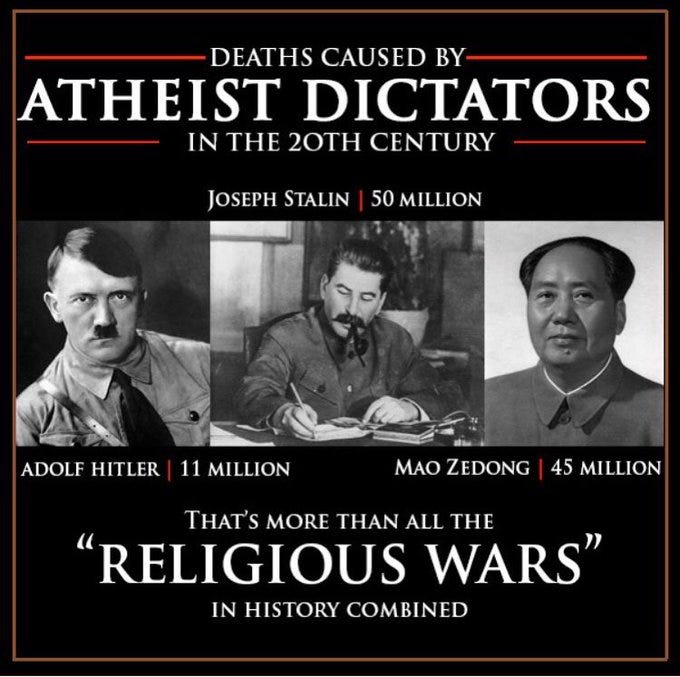
Why is Hitler mentioned? He supported Catholicism and often included in his speeches clear references to doing “God’s work.” Here’s something he said in a speech in 1934 [italics are mine]: “The Church’s interests cannot fail to coincide with ours alike in our fight against the symptoms of degeneracy in the world of to-day, in our fight against the Bolshevist culture, against an atheistic movement, against criminality, and in our struggle for the consciousness of a community in our national life.”
And in a speech he delivered to the Reichstag two years later, he said, “I believe today that I am acting in the sense of the Almighty Creator. By warding off the Jews, I am fighting for the Lord’s work.”
Was all this just insincere rhetoric to appeal to the German masses? Nobody knows for sure. But it does seem incorrect to assert Hitler was an utterly and thoroughly godless individual. After all, let’s not forget that every single Nazi soldier swore loyalty to the Führer by God:
“I swear by God this holy oath, that I will render to Adolf Hitler, Führer of the German Reich and People, Supreme Commander of the Armed Forces, unconditional obedience, and that I am ready, as a brave soldier, to risk my life at any time for this oath.”
With Hitler out of the way, let’s move on to Stalin. I suppose I could go into detail about Mao and other dictators and authoritarians from the last century, but citing just one individual will be enough to make my point.
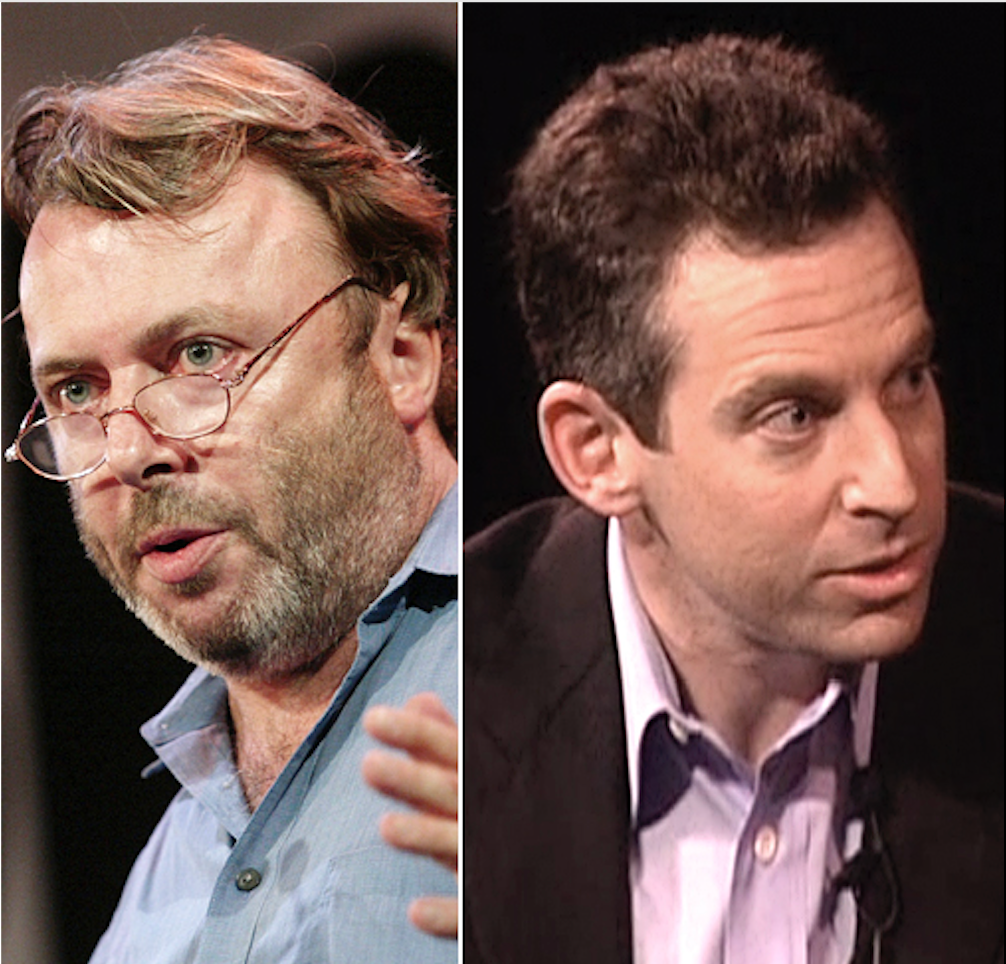
Stalin, who once considered becoming a priest, repressed religious expression because a belief in God was in conflict with a belief in Stalin. Or as Christopher Hitchens often pointed out, Stalin was a surrogate, a person who stood in a god-like fashion to his people — and who whipped up punishments for “heretics”: people who disagreed with the state.
Emilio Gentile, in his book Politics as Religion, wrote: “The sacralization of the party opened the way to the sacralization of Stalin when he became the supreme leader. After 1929, the political religion of Russia mainly concentrated on the deification of Stalin, who until his death in 1953 dominated the party and Soviet system like a tyrannical and merciless deity.”
But here’s a fascinating thing. Stalin loosened his grip on the churches during the later years of World War II. From Wikipedia: “Joseph Stalin revived the Russian Orthodox Church to intensify patriotic support for the war effort and presented Russia as a defender of Christian civilization.” You have to ask yourself: Why would an alleged staunch atheist do such a thing? The answer is obvious: By the mid-to-late 1940s Stalin had decided that the Russian Orthodox Church was no longer a threat to his power.
Nearly twenty years ago John Purcell wrote a piece called “Atheism and Stalin” for his Spanish Inquisitor website. One reader of the piece responded with this:
“A more accurate view of the history of the 20th century would see its bloody dictatorships as state religions or as the penultimate evolution of the ‘divine right of kings.’ Thus under communism or fascism, huge portraits³ and statues combined with incessant propaganda and even new scripture (Mao’s little red book, for example) to inculcate the masses with the image of the leader as god. The tendency of totalitarian regimes to deify their leaders continues to this day with North Korea’s Juche. As god-like figures demanding unquestioned obedience, Stalin, Pol Pot, Mao, and Hitler have far more in common with Moses, Abraham, Jesus, or Muhammad than with Richard Dawkins, Carl Sagan, Bertrand Russell, or Voltaire.”
Shorter version: If you’re a Catholic, obey the commands and dictates of God, lest you end up in Hell. For Stalinism, obey the commands and dictates of Stalin, lest you end up in a gulag.
So ask yourself this question: Did the dictators of the twentieth century act as they did because of a lack of belief in gods, or did they act as they did as a way to pursue and consolidate power? I know the correct answer to that question.
¹ Some people will argue that an atheist is person who flatly maintains that God does not exist. True, some people say this and can even cite sources like The Stanford Encyclopedia of Philosophy to support that view. On the other hand, Oxford University Press’s A Dictionary of Atheism defines atheism as “an absence of belief in the existence of a God or gods” and that an atheist “in broad terms [is] a person who does not believe in the existence of a God or gods.” Where do I come down on this? I don’t believe in gods.
². And how about the current dictator of Russia? There’s a guy who has spearheaded the slaughter of hundreds of thousands of Ukrainians. What’s his religious story? He’s a member of the Russian Orthodox church. So much for atheism spurring on his murderous assault on Ukraine.
³. And then there’s the current president of the United States acting as a wannabe dictator: “Trump’s face is now on the Justice Department headquarters.”
Barry Lyons lives in New York City. He writes about a variety of topics: the Second Amendment, the Indiana Jones movies, the true meaning of “Trump Derangement Syndrome,” and why Christian values have never existed.
메타데이터
- post_id
- 3a3da8ab104e
- slug
- in-the-name-of-atheism-prepare-to-die-said-no-one-ever-3a3da8ab104e
- url
- https://medium.com/@lyonsnyc/in-the-name-of-atheism-prepare-to-die-said-no-one-ever-3a3da8ab104e
- canonical_url
- https://medium.com/@lyonsnyc/in-the-name-of-atheism-prepare-to-die-said-no-one-ever-3a3da8ab104e
- author_url
- https://medium.com/@lyonsnyc
- status
- ok
- fetched_at
- 2026-06-22 19:40:15