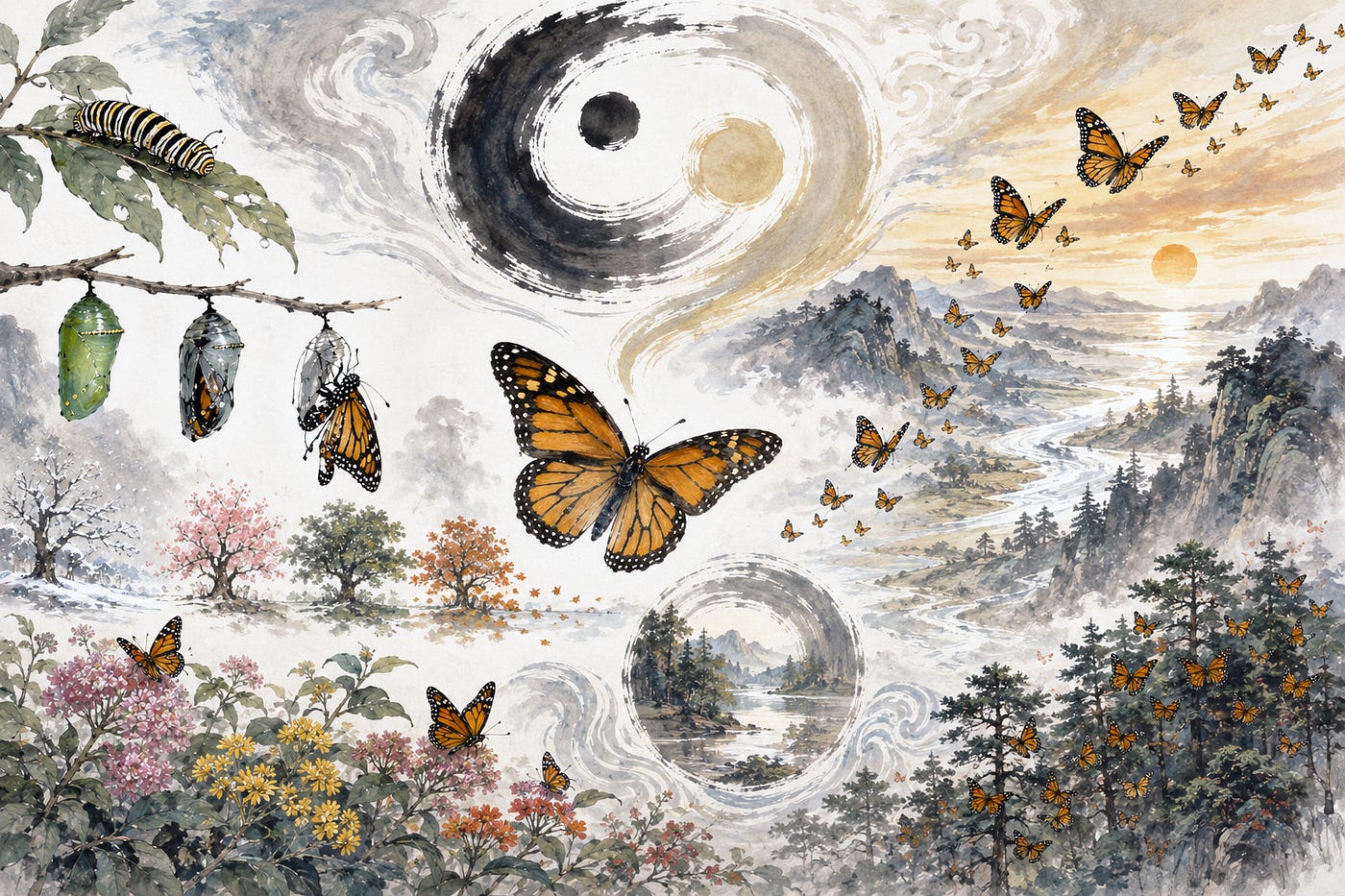
If the Heart is not a Pump; 3 of 3; All the Details, plus My Birth Tie-In.
Just ponder a moment
If the Heart is not a Pump; 3 of 3; All the Details, plus the Birth Tie-In.

Just ponder a moment
If the Heart were not a Pump
by Laury Ostrow
First draft written: 1998
Part I
Introduction
Imagine the excitement a returning explorer of 500 years ago would feel, coming to share with you news of here to undiscovered lands. That is how I feel, bringing you the news I do now.
He would have said, “I’ve returned from a long and perilous ocean voyage. I must tell you, if you sail West the world does not end…but comes to a new and unknown land. The world is not flat!” What I say is, “ Look again at the image of the human body. Using all the data gained with our modern technologies, but looking with unfettered sight, see, the human body is not a machine. The heart is not a pump and the cardiovascular system is certainly not powered by pressure.”
It is to that level of importance that this new idea, “The heart is not a pump”, will prove. It is that size a thought, comparable to what it would mean to the medieval world when they first heard, “The earth is not flat!”
On a visit back to my hometown last March, a friend of twenty years shared with me a paper written by a friend of his. In it, a very different perspective is shown on how the heart performs its seemingly miraculous job of moving 35 million gallons of blood in an average lifetime. Re- examining the data that has accumulated in the scientific record over the last 100 years, from the discoveries of many different disciplines, using all the latest means of exact observation, but looking with a fresh, unprejudiced mind, it becomes very clear that there has been a mistake. The heart does not serve as a pump to force inert blood through a resistant vascular system.
Our current model of how the blood is propelled, developed about 350 years ago, and not questioned since, is one of a clenching and then opening fist (I always get the picture of the Arm & Hammer baking soda drawing, or the hand and stamp at the end of the Fifty’s TV drama Dragnet). Looking at the data with perspective fresh, looking at all the anomalies and contradictions that arise when trying to have the model match the observations, that view of heart as pump is seen to be inadequate. It needs to be updated and corrected.
One of the most glaring and obvious contradictions is that the blood circulates in the embryo before there is ever a heart or vascular system. This has been a known fact for sixty years. Then, after enclosed within the veins, the blood circulates for days before the heart has any movement at all. Yet because of the enormous social and intellectual bias that so invisibly influences all of our thoughts and perceptions, no one seems to have questioned this paradox.
It appears that contemporary science has indeed fallen into what Goethe described as the scientific trap, “We find what we look for and we look for what we know.” Louis de Broglie had strong feelings also, when he said, “ History shows clearly that the advances of science have always been frustrated by the tyrannical influences of certain preconceived notions that were turned into unassailable dogmas. For that reason alone, every scientist should periodically make a profound re-examination of one’s basic principles.”
Many, many more apparent contradictions will also emerge as we look closer at the data, and try to match it to the model. It will become clear that the heart is an effect of the circulating blood and not the cause of blood circulation. We do need to look again at our truism that the heart is a pump. Life cannot be explained away in mechanistic terms. The human body, and the body of Nature, does not really fit when modeled purely as a mechanical machine.
“Okay.
Okay.
So… if the heart is not a pump, then what is it?”
A truer description that emerges is seeing the power behind the incredible miracle of the cardiovascular system as actually water’s unique innate desire to vortex…and life to pulse. That is where it starts and then complexity is added as organic life develops. What we will see is a world much more akin to a mountain stream in an Escher dimension of endless effortless recycling. The heart becomes a rhythmic, impulse vortex/momentum booster. The heart and cardiovascular system are actually an effect, more a sensitive harmonic resonant response, to boost the natural flow and circulation of the blood. Not its cause.
Feeling the rhythm of the blood, the heart responds not by pumping or pushing the blood, as in the closing fist model, but rather by a twist or wobble. This increases the angular momentum of the vortexing blood always in vortexing movement within the chambers of the heart.
A crucial, essential observation of how the blood flows, that was totally overlooked, is that the blood never comes to rest in the ventricles. If the heart is to be a pump, it would have to come to stop between cycles. It never does. A miracle of miracles! The blood is always vortexing in the ventricles. We all have a never ceasing whirlpool at the core of our heart. It never loses momentum. It is an endless repeating cycle within cycle. The heart boosts the vortex, the momentum of the blood, in rhythm, through a figure-eight, oroborous spin. A lub is released, actually we will see that it is flung out with a snap, into the aorta. There, the angular momentum of the vortex becomes linear momentum in the ever narrowing and confining hollow of the arteries. The individual vortex sets up and then off it goes on its journey through veins as decreasing size leads toward the capillaries, where the work of the blood to nourish and clean every cell is to be done. The vortexing flow is supported by a system where all aspects of the body’s response reinforce the vortexing nature of the blood. From the muscular makeup of the seven layers of the heart to the manner of the flouting of the vein walls and on to the way the veins pulse off phase to the heart, there is always an innate response of resonant cooperation.
It appears that the only thing our modern description of the heart really describes is our modern lifestyle. Life that is under pressure and stress all the time, certainly not the wisdom of how the body functions, or the ways of Nature.
“Okay.
But even if the heart is not a pump, what does it matter and who really cares?
I mean, so what! I know the blood moves. I feel a pulse. So isn’t all you are saying just words?”
No. Not at all, it is only obvious that all modern artificial hearts have been designed around the model that the heart is a pump, and are either collapsible bags that push the blood out or centrifugal pumps that force the blood out under pressure. And all artificial hearts have major defects considering the damage they do to the patient. First, they damage the integrity of the blood content by destroying the blood cells and rupturing capillaries and weak places in the vascular walls. The other tendency is for blood to clot and clump in unhealthy aggregates. The medical teams are still trying to figure out how to design these problems out. Just this year another multi-million dollar research project was funded. They look for cleverer ways, but the problem is inherent in their approach. The heart is not a pump and the blood is never put under pressure by the body. So, of course it damages it when put under pressure.
The solution for this problem is quite obvious when looked from our point of view. Because the heart is more a rhythmic, impulse/vortex momentum booster, then devise a device that gently boosts the already vortexing blood, something quite simple. This would allow for maximum blood transference and efficiency. And that same device would allow for more efficient blood transfusions after massive hemorrhaging, and will lead to new ways of working with lymph and all the bodily fluids.
Through a truer understanding of the nature of water, a key point of understanding the heart, this will also lead toward new ways of both transporting and purifying/enlivening fluids, most importantly water. An entire new technology will come out of this. Insights and technologies that will prove as crucial to us as the discovery of the New World was 500 years ago. More on that later.
And there is still another level to the importance of the heart is not a pump. It is on the level of paradigms and the big thoughts that make our lives what they are. But before I get into that, allow me to first really go through the details and explain to you what appears to be a truer understanding of the functioning of our cardiovascular system.
Part II
History
The heart’s pump action is one of the mainstays of medical understanding. This has been the case for about 300 years. The agreed upon assumption that follows from this is that if the heart is a pump than the blood must be pushed under pressure.
Here are some definitions from Webster’s New Collegiate Dictionary to better see our agreed upon contemporary understanding of the action of the cardiovascular system:
Heart…a hollow muscular organ of vertebrate animals that by its rhythmic contraction acts as a force pump maintaining the circulation of the blood. Systole….the contraction of the heart by which the blood is forced onward and the circulation kept up.
Diastole…the dilatation of the cavities of the heart during which they fill with blood.
Blood pressure… pressure exerted by the blood upon the walls of the blood
vessels and esp. arteries varying with the muscular efficiency of the heart the blood volume and viscosity, the age and health of the individual, and state of the vascular wall.
Ventricle…a chamber of the heart which receives blood from a corresponding atrium and from which blood is forced into the arteries.
Auricle…the chamber of the heart that receives blood from the veins and forces it into the ventricle.
And here is a short description from the Physiology Coloring Book:
The heart is a hollow organ with walls made from specialized muscle called cardiac muscle. When excited, these muscles shorten, thicken, and squeeze on the hollow cavities of the heart, forcing blood to flow in directions permitted by the heart valves.
Blood flows from the arteries through the capillaries to the veins because the pressure is higher in the arteries than in the veins.
Pressure is the force exerted on each square centimeter; it is a measure of ‘push.’ Blood flows from arteries to veins because the blood in the arteries ‘pushes’ harder than the blood in the veins. It is the ‘difference in pressure’ that constitutes the driving force for movement.
What I now hope to show you, through a reading of the historical record, is how this description is a projection of a cultural bias and not a reading of Nature. That you will see that the above descriptions are really nonsense, and how it is things like this sets us up for the large scale disregard and destruction that our cultural bias, call it Male Dominance, has laid on the Nature and us all.

Just watching the River Flow
The rotary motion of the heart is mentioned in early writings and was considered the determinative motion of heart until the becoming of the industrial revolution. Aristotle in the third century BC said, “The heart is in continuous motion (described as a kind of ‘circulation’ or ‘revolution’) inside the loosely fitting pericardium which allows ample room for regular contraction.” The Romans erected a temple to Venus Verticordia (verti-to turn, cordia-the heart), Goddess that turns the heart, in 114 BC. We see here an intuitive feeling about the nature of the heart.
Thomas Aquinas, in 1240 AD, said, “The uninterrupted revitalizing motion of the heart” was a form of circular motion consisting of two parts, systole and diastole and animated by the sensitive soul. William Harvey, in 1628, observed in a open-chest animal, a twisting motion of the ventricle that accompanied the onset of ventricular systole, stating that the heart, “twists lightly as in carries out its task.”
The theory of the heart as a pressure pump was conceived about the time of the beginning of the practical usage of the pump in industry. The steam-driven water pump was coming into widespread use in English coal mines and pressure propulsion principle was very much in the public awareness. This set the stage for the idea that the blood is propelled by pressure.
In 1640 after examining a dissected heart, Borelli, a student of Galileo, focused in on the spiraling muscles of the ventricle walls, and with no experimentation pronounced that the heart squeezes out blood like water is squeezed out from a soaked cloth-by twisting. This appears to be the seed of the pressure propulsion theory of blood propulsion. Amazingly enough, it was never really directly proved by him. Nor has anyone since.
The observation by Harvey of the circulation of the blood through the heart in 1628, then Borelli’s statement in 1640 set the stage so that by shortly after 1654 when Otto von Guericke invented the air pump, the heart as a collapsible-bag pressure-pump squeezing out implicitly inert, amorphous blood that was actually introduced by some unknown person, had become unquestioningly accepted. And that idea has prejudiced all perceptions of the heart since because of incredible tyranny of concept, or the ‘I wouldn’t have seen it if I hadn’t had known it was there first’ syndrome. To this present day this mistaken concept has persisted despite growing evidence to the contrary.
The story of the mis- discovery of ‘blood pressure’ is a clear, very well illustrative, fascinatingly resonant example of a case in point that so clearly shows how easily objectivity becomes anything but that. To measure human arterial blood pressure an inflatable rubber bag constrained by a cloth cuff is wrapped around an arm. The bag is inflated and compresses the blood vessels in the arm. It is assumed that the pressure in the bag is transmitted to the arm so that the bag pressure equals the actual pressure within the tissue of the arm. It follows that when the pressure in the bag just exceeds the pressure in the artery, the compression will be sufficient to collapse the artery.
The procedure is to inflate the bag above the arterial pressure so that blood flow stops. Air is then released from the bag so that bag pressures falls very slowly. At a certain bag pressure, flow resumes, but only for the short time that arterial pressure is at its maximum. During that time, sounds are produced that can be easily heard with the aid of a stethoscope placed near the artery. The pressure at which the sounds first occurs is a measure of systolic pressure. As more and more pressure is released, a point is reached where the sounds become very muffled.
This pressure is the diastolic pressure.
The sounds arise from the turbulent blood flew through the narrowed
(partially collapsed) artery under the cuff, just as sounds arise from the turbulent flow in a stream when it passes through a narrow bed. (From Physiology Coloring Book.)
‘Blood pressure’ measured with a sphygmomanometer is in fact air pressure that is generated to stop blood flow.’ This air pressure is assumed to oppose ‘blood pressure’, but in fact, pressure is created in the brachial artery by the impulse (force x time) when the blood flow ((vortex/momentum) = (mass x velocity)) is abruptly stopped by the closed brachial artery. This force is then assumed to be pressure but is actually the force factor for impulse which arises when a force transducer interrupts the moving blood momentum.
So the premise of measurable ‘blood pressure’ is incorrect and therefore the logical conclusion that the heart is a pressure pump is baseless. In a momentum propulsion system the moving blood is the cause and pressure (actually impulse force) is the effect of collision. The use of the sphygmomanometer provides a figure of merit for diagnostics but misleads as to the propulsive principle. In a pressure propulsion system, the pressure is the cause and the fluid motion is the effect, as in water pipes. The two systems are mutually exclusive. Like many logical arguments that fail, was based on a false premise, that the ‘measured pressure’ was the force factor in the impulse concept (force x time) that arises when momentum (mass x velocity) is interrupted, as with a force transducer. ‘Blood pressure’ apparently could be measured and has countless times by life scientists and health care personnel, Since ‘pressure’ was apparently increased in passing through the heart the logical implication was that the heart is a pressure pump, although, in fact, in the blood system peak velocities appear before peak pressure.
(Underlying problem that exists with regard to teaching the techniques of taking blood pressure measurements is that the actual phenomenon is not pressure but impulse and for a given impulse imparted in a given time interval the force need not be constant. Since it is the force of the impulse that is mistakenly monitored as pressure, it is a rather unstable factor. A recent survey showed that most nurses (n=2000) did not know the proper technique to take blood pressure
The earliest measurement of the force of the blood was made by in 1733 Stephen Hales when he inserted a single tube manometer in the carotid artery of a horse. What he assumed he found was blood pressure and this reinforced the concept that the heart was a pump. But it was all circular but seemingly sensible and convenient.
The strongest case for the theory that blood is propelled by pressure was made by Karl Friedrich Wilhelm Ludwig (b Witzenhausen, Germany, DEC 29, 1816) in 1847. He devised a way to record the variable ‘blood pressure’ and compared these measurements to bleed flow. Since there appears to be a correlation he assumed that he had proved the propulsive force of the circulation of the blood and that the circulation of the blood is a purely mechanical process and no mysterious vital processes outside of ordinary physics need to be invoked. But his basic premise was that the blood was driven by pressure and what he was measuring was pressure and so what he found was pressure.
It agreed with Borelli and the theory was upheld, not by establishing the factual relationship between the heart function and pressure generation, but by assuming that the measured force in the blood was in fact pressure and therefore the heart must logically be a pressure pump
Karl Schmid in 1892 questioned the validity of the pressure propulsion system of the blood and suggested that it was propelled somehow like the hydraulic ram. The hydraulic ram is one of the few elegant applications of fluid momentum propulsion in technology invented in the 18th century. It was widely used in 19th century Europe to provide towns with water. The momentum of the stream itself was a given by nature and used to lift a portion of itself into an elevated water reservoir. The similarity between it and the new perception emerging about the heart is that water in the ram and blood in the circulatory system both have a ‘given’ momenta.
Pettigrew, in his exhaustive and beautifully illustrated work in 1908, comments on what he believed were spiral structures in the adult heart that should lead to rotary blood flow. Please read this as though it is lyrical and imaginative poetry…”The third or remaining groove winds from the interior of the apex posteriorly, and conducts to the aorta, which is situated anteriorly. The importance of these grooves physiologically cannot be over-estimated, for I find that in them the blood is molded into three spiral columns, and that during the systole the blood in the two lesser ones is forced in am upward direction in two spiral streams upon the under surfaces of the segments of the bicuspid valve…The spiral action of the mitral valve, and spiral motion communicated to the blood when projected from the heart, are due to the spiral arrangement of the musculi papillares (i.e. papillary muscles) and fibers composing the ventricle, as well as to the spiral shape of the left ventricular cavity”

Rudolph Steiner, the Austrian born philosopher and “spiritual scientist”, in 1920 questioned the pressure propulsion theory to medical doctors and said that embryology would show that the blood is propelled by spontaneous momenta. Then in 1924 he stated that the propulsive principle of the heart is not based on pressure as in the ordinary pump but on momentum as in the hydraulic ram and that the driving force of the blood is its own momentum enhanced via the heart. “We need not stop short at the mechanical aspect if we consider the heart action as a result of these symbolic interpenetrating currents, the watery and the airy. For what is the heart after all? It is a sense organ, and even if its sensory function is not directly present in the consciousness, if its processes are subconscious, nevertheless, it serves to enable the ‘upper’ activities to feel and perceive the ‘lower’. As you perceive external colors through your eyes, so do you perceive, simply and subconsciously through your heart, what goes on in the lower abdomen. The heart is an organ for inner perception.”
Bremer in 1932 took movies of the early embryonic blood flowing before the functioning heart was formed. Though he did not realize the significance of his find he confirmed Steiner’s conclusion that the circulation in the embryo moved with spontaneous momenta and not by pressure.
And yet with all this, and you will soon see even more on the record to show the impossibility for the heart to be the cause of the blood flow, and its action being a pressure pump, it is still the common understanding. It is still the situation today to have absolute agreement among all health care professionals, in all branches, mainstream or alternative, that the heart is precisely a pump. The body can be understood as a machine and Nature is ours to exploit!
Ten years ago Ralph Marinelli was directing an Army propulsion laboratory, trained as a science researcher. He was also a teacher at a Waldorf school, a school method that was inspired by the work of Rudolph Steiner. One day in reading some material, he came across the statement, spoken by Steiner in 1920, that the heart was not a pump nor was it the cause of the blood flow. At that point one of our more trusted human qualities took note. The quality is curiosity, one of the understated ones that seems to be strong in childhood, but in the process of socialization and education is shunted to the back. It is a trait that can be trusted and needs to be followed more.
Marinelli decided to follow its urging and so soon after took a trip to the butcher to see for himself. What he saw and felt, as he poked his finger to feel the muscle and look at it, was that this was not a pump. His own ‘Eureka!’ He came away with the determination to focus and has spent the past years involved in research to see if Steiner’s intuition and his initial observation were correct. He performed thorough searches through the scientific record and devised and performed his own experiments to move the inquiry forward.
What he found was conclusive evidence that it is time to bring into clearer focus our perception of the heart. He has written articles to present his work to the scientific community and it is he who has brought together most of the information here and created the case to show that the heart cannot possibly be a pump. Marinelli’s work shows clearly that blood flow is a self-excited spiraling momentum boosted by the heart that is in rhythmic phase with the blood rhythm for efficient momentum transfer. He shows that the vortex form is the key to understanding the forms and functions of the cardiovascular system and it is the unifying principle behind heart and blood motion. The wide range of papers he has brought together show without a doubt that it is inconceivable for the heart to be a pump and the cardiovascular system to be governed by pressure pump principles. It is his work and his brilliant insights and perceptions that are the bases for this article.

4/1/2026: Something remarkable has taken place
As I was going over this work, which I originally wrote in 1998, I did a Google search for ‘If the Heart was not a Pump’. I did not expect to find anything other than a few Steiner people confirming it, and more scientists debunking the idea. What I found instead was research done over the last few years that reinforced and gave it credence that indeed the Heart is way more than a Pump. Rather than repeating the new research here, for yourselves, just Google it and be amazed. Science with hi tech sensing means and open minds followed the evidence and saw for themselves.
Part III
My Story
During that time, in my course of study and verification in my own mind, I discovered what my own personal tie into this heart thing was. I mean, I am not a medical professional and why would I be so taken by this thought, and then in some way, take it on myself to do my part in communicating this out to the world.
I thought that there must be a place where I belong in the story, what was my tie in? I do consider myself an archeologist of ideas, and this certainly is a great one, but still, the effect it had on me, how it got my attention in the first place, so immediately, I just felt it. So where did I gain some kind of right to take it in so deeply? Or feel it so much my own story also?
But it was not long, in my research and attempt to find confirmation to the validity of the idea that I did in deed for my authenticity in working to communicate this.
It starts with my birth story. My mother was in the Detroit about a year when she became pregnant with me. She was a very forward-thinking person for the late Forties and showed this when she realized that she wanted to have a ‘natural childbirth’. She found a then young Chiropractor who would support her in this and an Osteopath and Osteopathic hospital that would allow Dr. Goodheart, the Chiropractor, to be in attendance at the birth.
It turned out to be a crisis birth and after 40 hours of labor, me not forthcoming, the need to pull me out with forceps became crucial. I was delivered, but dead. No heartbeat. After trying what they could to revive me the attending Osteopath decided it was no use and I was about to go into the recycling bin, but Dr. Goodheart said let’s try adrenaline in the heart…. and as they say, the rest is history. That is my history! This is the story that I already knew. But I never really felt it. One of the healing modalities that I had worked with was Rebirthing, and I often wondered, knowing the details of my birth, why, when I visited that place in session, that I did not find all the trauma and pain that I would expect.
But I always would come back with more a traumatic than ecstatic feeling.
As it turned out, Dr. Goodheart became a major influence in my life, and in the world of Chiropractic and alternative health care. My radical mother stayed away from the medical profession and so Dr. Goodheart became our primary health care professional and guided our health through childhood. He became my spiritual uncle. I would see him often and he not only shared the work he was then engaged in, the discovery and working out of Applied Kinesiology and popularized as Touch for Health, but also kept presenting me with avenues of new discovery for my young and curious mind, from biorhythm to bio magnetism and even Orgone energy. I at one time was accepted at Chiropractic school with the idea of going in practice with him, but at that time I had enough of the constraints of formal education and was looking more for the direct experience of life.
Over the years I have stayed in touch with him, not often but every time I have ventured into something new I would send him progress reports. So about a month ago I sent him a letter of the heart work to get his feedback on it. I was really looking for outside agreement that there was something really here. He not only knew about it but said that he felt that it was one of the most important avenues of research happening. He even had a copy of the article on his desk, and though he did not know Ralph, did know Dr. Stephenson.
He added one more bit of information to the picture, the Zeta potential, or charge on each red blood cell. I saw it as another part of the overall picture. If the vortex is the process or female aspect of the way it functions, then of course there is a male or point/particulate aspect to it also. That sounds like the Zeta potential to me. He is sending me a tape of all his research and notes on that.
We had a fabulous conversation. With him agreeing and giving me the support that I was looking for, I felt fully secure in moving forward with it all. Then I asked a question. I asked, “ Dr. Goodheart, isn’t it a bit peculiar that here it is lay person is discussing with Dr. Goodheart the workings of the heart in a new paradigm shattering model when 45 years earlier this same Dr. Goodheart had adrenaline shot into the heart of the then dead newborn child that grew into this questioning man.”
Dr. Goodheart responded, “ You are right. And let me tell you what exactly took place.” He then described in detail, precisely as though it was occurring right then, what had occurred 45 years earlier. My birth! I was born with the cord wrapped around my neck three times and absolutely no sign of any kind of heart movement. Then, upon his prompting, the attending physician took a syringe of adrenaline and tried that as a last attempt.
Dr. Goodheart described where they inserted the needle, into the intercostal spaces and aiming into the pericardium and away from the lungs. He told me that in a newborn infant the ribs are like paper and the heart is free to view. Then, as the adrenaline was being shot in, he said that he saw something he never forgot, but did not understand till years later. Years later after learning of the heart not as a pump. The first response he saw of the heart was a flip or twist a quarter inch to the left. Not a beat. As they say, the rest is in the record.

One leaves and one enters
So, what did that mean to me. That in some way I did have a very intimate connection with this fact and this was on the tract of something important. Then about a month and a half later, after I had completed my studies and had the outline done, the day before my birthday in fact, sitting down at the Indian Springs hot pools, on a bouldery low water river bank, I looked above and the bald eagle I had not seen since spring, flew over, and I scampered down and a story came together which I am working on now. It works from the idea of what would happen if a person who was born stillborn but then after declared dead, through an injection of adrenalin into its heart, life comes back but a different incarnating soul is drawn into it, the first finds body shortly after, and they meet in this life and come to terms with the relation they find.

They meet on the River
Reader, thank you for walking this path with me.
If it resonates, feel welcomed to share with others.
You can still preview my latest book, Gaia Matrix Revisited,
in its entirety at no cost. Just click below and then on REVIEW.
Plus be able to purchase a copy of the book.
Use the code: BOOKWORTHY30 for a 30% discount
with no tie in.
You’ll also find all my self-published books there.
Click here
**Preview or Purchase the Book**
Warmly,
laury ostrow
Seeker & Scribe

메타데이터
- post_id
- 3a4e3be73e43
- slug
- if-the-heart-is-not-a-pump-3-of-3-all-the-details-plus-my-birth-tie-in-3a4e3be73e43
- url
- https://medium.com/@lauryjo/if-the-heart-is-not-a-pump-3-of-3-all-the-details-plus-my-birth-tie-in-3a4e3be73e43
- canonical_url
- https://medium.com/@lauryjo/if-the-heart-is-not-a-pump-3-of-3-all-the-details-plus-my-birth-tie-in-3a4e3be73e43
- author_url
- https://medium.com/@lauryjo
- status
- ok
- fetched_at
- 2026-06-26 12:24:55