Iran’s Plea for War
Is State Intervention the Right Way to Bring Forth Justice?
Iran’s Plea for War
Is State Intervention the Right Way to Bring Forth Justice?
On the 28th of February, 2026, coordinated air and missile strikes were launched against multiple locations within Iran by Israeli and U.S. forces in what has been described by military authorities as a pre-emptive operation targeting strategic infrastructure and leadership elements of the Iranian Government. These actions have been widely reported to have caused explosions in Tehran and other cities, precipitated civil defence alerts and drawn international condemnation on the grounds of violating the principles of state sovereignty and the United Nations Charter.
But is that truly the case? Is it time to ratify the Responsibility to Protect from a principle to a standing form of International Law?
Meanwhile, Iran has publicly vowed reprisals and defensive measures following these attacks, further intensifying the region’s security crisis. In light of this unprecedented military escalation and pursuant to the fundamental rights to life, freedom of conscience and political expression under international human rights law, the undersigned offers the following account reflecting personal and collective anguish, the cumulative impact of prolonged repression and an earnest appeal for global attention to the plight of ordinary Iranian citizens.
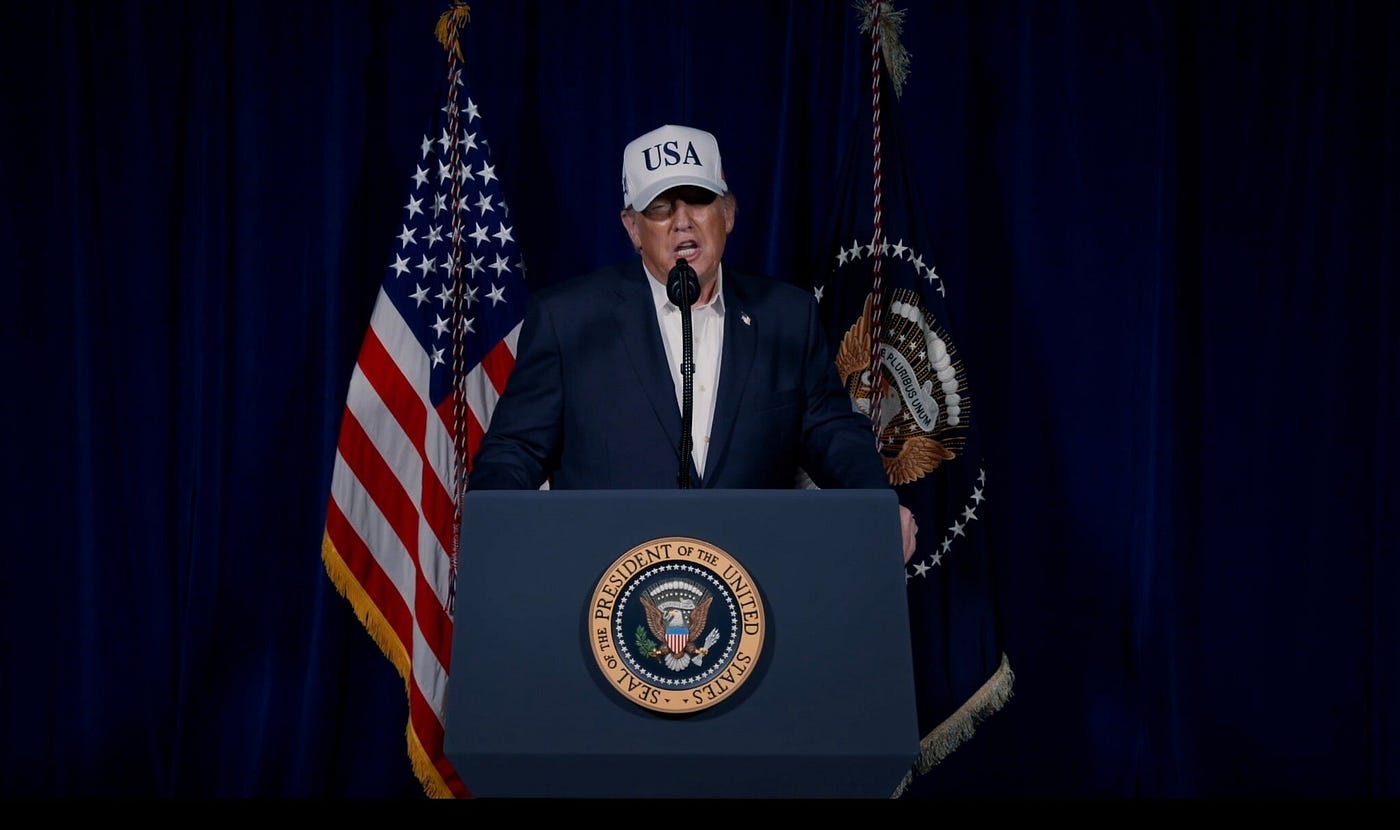
“Donald Trump’s declaration of ‘major combat operations’ against Iran”, Sourced: Times of Israel
The following statement is a republication of an anonymous submission by an individual residing in the Islamic Republic of Iran written barely a few weeks prior to the recent escalation of military hostilities involving the United States and the State of Israel against Iranian territory. It reads:
So this is where we (the Iranians) are now:
We have tried everything.
Nonviolent resistance, emails to anyone who might have helped. Small demonstrations, then mass protests. We took to the streets, screamed ourselves horse, took bullets, were blinded, were wounded too many times to death. People were arrested, tortured, hanged. Families of those who were killed were harassed, punished, humiliated.
And this did not happen over a few days for the world to watch and then move on. This has been going on for years. Now we Iranians are standing at the edge of despair, not knowing what option, if any, is left.
For me personally, I’m a woman life freedom supporter, a feminist, what you might call a leftist, a PhD student, an only daughter to parents who would not survive my loss, a friend to some of the most sincere and courageous people I’ve ever known.
And I no longer believe that we, as a nation, can do anything on our own to bring this dictatorship down.
I am anti-imperialist. I despise anyone who bombs innocent civilians in Gaza. I reject monarchy and the fascism it inevitably brings.
And yet, despite all this, I do not believe we stand a chance, not only of overthrowing this regime, but of surviving it.
The Islamic Republic has been the most disastrous and murderous force ever imposed on Persians. I say this fully aware of our history of Genghis Khan, of Alexander the Great. This regime has surpassed them all.
What I wished to experience in my short life in this homeland was not radical or excessive. I wanted democracy, secularism, equal human rights for all ethnicities, genders, professions, a simple life with economic stability and basic human dignity.
If that future requires the diplomatic removal of Khamenei himself, then so be it. If it requires reform that leaves no trace of Islamic sovereignty over my country, so be it.
And if as a last resort it requires a war that destroys not only these murderers but us as well, then so be it.
I would rather face total annihilation with the possibility that our children might rise from the ashes than continue this slow, suffocating death under the boots of tyrants.
Yes, we could become Libya. We know this. But look at where we are now. We have no imagination left for hope from within. the chance of internal change is close to zero. Can we honestly say the same about foreign intervention or regime change from outside? At the very least, those options have not yet been tried.
I would rather die attempting this low chance solution so that my fellow countrymen, women, and children might live free than die slowly while watching everyone I love be dehumanized, hollowed out, and turned into grieving shells.
We are not asking for much. But if the price feels too high for every other country to pay, then imagine the cost we are already paying for the world’s refusal to step up for the sake of humanity.
Cause after all, you all adore Saadi for saying:
“Human beings are members of a whole, in creation, they are of one essence and soul. If one member is afflicted with pain, other members uneasy will remain.’”
Sourced with Credit: https://youtu.be/e0ujFZ8Cbq4 (by Ryan Chapman)
And so the Iranians are left asking a question that feels both unbearable and unavoidable. They require answers. For themselves, for their families.
If the world truly believes that human life has equal worth everywhere, then what does that belief demand when a people are crushed slowly in plain sight?
What does responsibility mean when mothers bury their children, when daughters disappear into prisons, when fear becomes the air a nation breathes?
Responsibility to Protect is not just a doctrine written in diplomatic halls.
It holds deep value for everyone involved. It is a promise. A promise that sovereignty cannot be used as a shield behind which a government may wound its own people without consequence. A promise that when a state turns against those it was meant to safeguard, the world does not simply avert its gaze and call it internal affairs.
They are told to be patient. They are told change must come from within. But what happens when within has been suffocated? When every protest is met with bullets, every voice with prison, every hope with humiliation? At what point does silence become complicity?
To speak of protection is to speak of moral courage.
It is to recognize that borders are lines on maps, but suffering is not confined by them. It is to accept that indifference, too, is a choice. For those watching from a distance, this may be strategy, policy, risk calculation. For Iranians, it is breath or no breath. It is whether our children inherit chains or the possibility of light.
If humanity truly believes that all people belong to one another, then responsibility cannot end at sympathy. It must mean that when one member is in agony, the rest do not remain still.
메타데이터
- post_id
- 3a5d32f6c8ea
- slug
- irans-plea-for-war-3a5d32f6c8ea
- url
- https://medium.com/discourse/irans-plea-for-war-3a5d32f6c8ea
- canonical_url
- https://medium.com/discourse/irans-plea-for-war-3a5d32f6c8ea
- author_url
- https://medium.com/@ikshitsethi01
- status
- ok
- fetched_at
- 2026-06-24 23:31:39