Reframing Democracy: Gutting the Voting Rights Act Hurts White Americans Too
The real danger isn’t “woke politics.” It’s a democracy drifting toward minority rule and permanent power structures.
Reframing Democracy: Gutting the Voting Rights Act Hurts White Americans Too
The real danger isn’t “woke politics.” It’s a democracy drifting toward minority rule and permanent power structures.
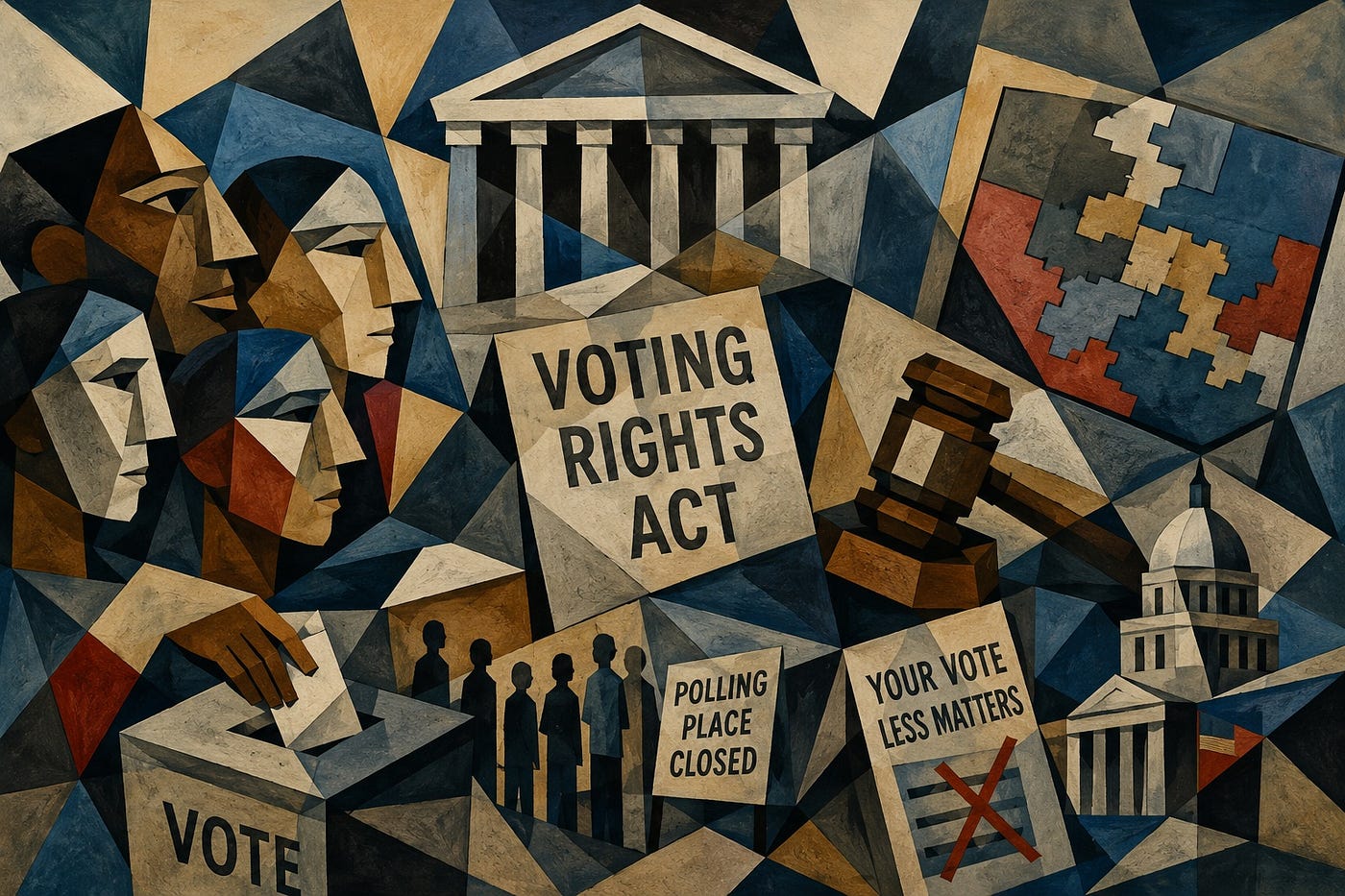
The Supreme Court gutted the Voting Rights Act. White Americans should worry. Credit: Do What Matters
Like many Black Americans, I am dismayed at the gutting of the Voting Rights Act of 1965. Still, after a lot of research, I realized something important: the Supreme Court’s decisions didn’t just hurt Black Americans. They hurt all Americans.
Here’s the 411.
For years, many Americans treated the Voting Rights Act like it was a niche piece of legislation designed to solve a “Black problem” from the 1960s. That misunderstanding allowed the Supreme Court to weaken it piece by piece while much of the country shrugged.
Then came Shelby County v. Holder in 2013. In a 5–4 ruling, the Court struck down the formula that determined which states with histories of racial discrimination had to get federal approval before changing voting laws. Chief Justice John Roberts argued that “things have changed dramatically” in the South. Some things have changed, but the decision effectively removed the umbrella in the middle of a storm because the rain had slowed down for a second.
Within hours of the ruling, states previously covered by federal oversight began implementing voter ID laws, polling place closures, redistricting maps, and voting restrictions that had once faced scrutiny under the Act.
That should have alarmed every American, regardless of race, because the Voting Rights Act was never limited to Black voters.
The Voting Rights Act provided guardrails preventing a democracy from sliding into minority rule.
Ever get that feeling that politicians can choose their voters instead of voters choosing them? Trust it. We are witnessing democracy becoming performance art. Elections still happen. Flags still wave. Patriotic speeches echo through cable news studios. But the system itself is increasingly insulated from accountability.
As power becomes insulated, corruption follows like raccoons behind a garbage truck.
Look around.
Extreme partisan gerrymandering — on both the left and the right — has helped create “safe” districts where politicians fear primary challengers more than the broader public. Critics of the Voting Rights Act have long argued that some majority-minority districts can contribute to that dynamic as well. Fair enough. That debate is real.
But there’s an important distinction between creating districts that give historically excluded voters a meaningful chance at representation and engineering maps designed primarily to lock in partisan power regardless of what voters want. Those are not the same thing.
Meanwhile, polling places disappear in heavily populated areas while voters in other neighborhoods breeze through in ten minutes. State legislatures override ballot initiatives they dislike. Election officials become partisan celebrities. Courts increasingly decide who gets political power before voters even cast ballots.
This is not theoretical anymore.
This is how democracies slowly transform into systems in which a shrinking group maintains control through procedure, bureaucracy, and structural advantages rather than broad public support.
Ironically, many white Americans still don’t see themselves in this story because they assume voter suppression only targets Black communities. But once the machinery for restricting political participation exists, it rarely stays confined to one group.
Ask college students facing voting restrictions near campuses.
Ask elderly rural voters forced to drive farther after polling place closures.
Ask working-class Americans waiting hours to vote because of precinct consolidation.
Ask citizens whose ballot initiatives were ignored after they voted the “wrong” way.
The tools evolve. The targets expand.
And here’s the part many Americans still resist confronting: weakening voting protections often benefits people already holding disproportionate political and economic power. When fewer people vote, entrenched interests tend to gain more influence. Ultra-rich donors gain leverage. Lobbyists gain leverage. Ideological media ecosystems gain leverage. Ordinary citizens lose leverage.
That’s not freedom. That’s a managed democracy.
The Voting Rights Act was one of the most successful democratic reforms in American history because it recognized a basic truth: democracy only works when access to political participation is aggressively and consistently protected.
Not selectively.
Not when convenient.
Aggressively.
The real danger isn’t just that Black Americans lose political power. The danger is that Americans normalize the idea that some citizens should face more barriers to representation than others. Once a country accepts that principle, democracy becomes conditional.
And conditional democracy eventually becomes an oligarchy with patriotic branding.
The Voting Rights Act wasn’t protecting a racial group.
It was protecting the legitimacy of American democracy itself.
메타데이터
- post_id
- 3a716ab798d5
- slug
- reframing-democracy-gutting-the-voting-rights-act-hurts-white-americans-too-3a716ab798d5
- url
- https://medium.com/age-of-awareness/reframing-democracy-gutting-the-voting-rights-act-hurts-white-americans-too-3a716ab798d5
- canonical_url
- https://medium.com/age-of-awareness/reframing-democracy-gutting-the-voting-rights-act-hurts-white-americans-too-3a716ab798d5
- author_url
- https://medium.com/@dowhatmatters
- status
- ok
- fetched_at
- 2026-06-23 17:05:31