3I/ATLAS: Nothing Ever Travels Alone
What an interstellar visitor may be teaching us about plasma, participation, and the hidden architecture of reality.
3I/ATLAS: Nothing Ever Travels Alone
What an interstellar visitor may be teaching us about plasma, participation, and the hidden architecture of reality.
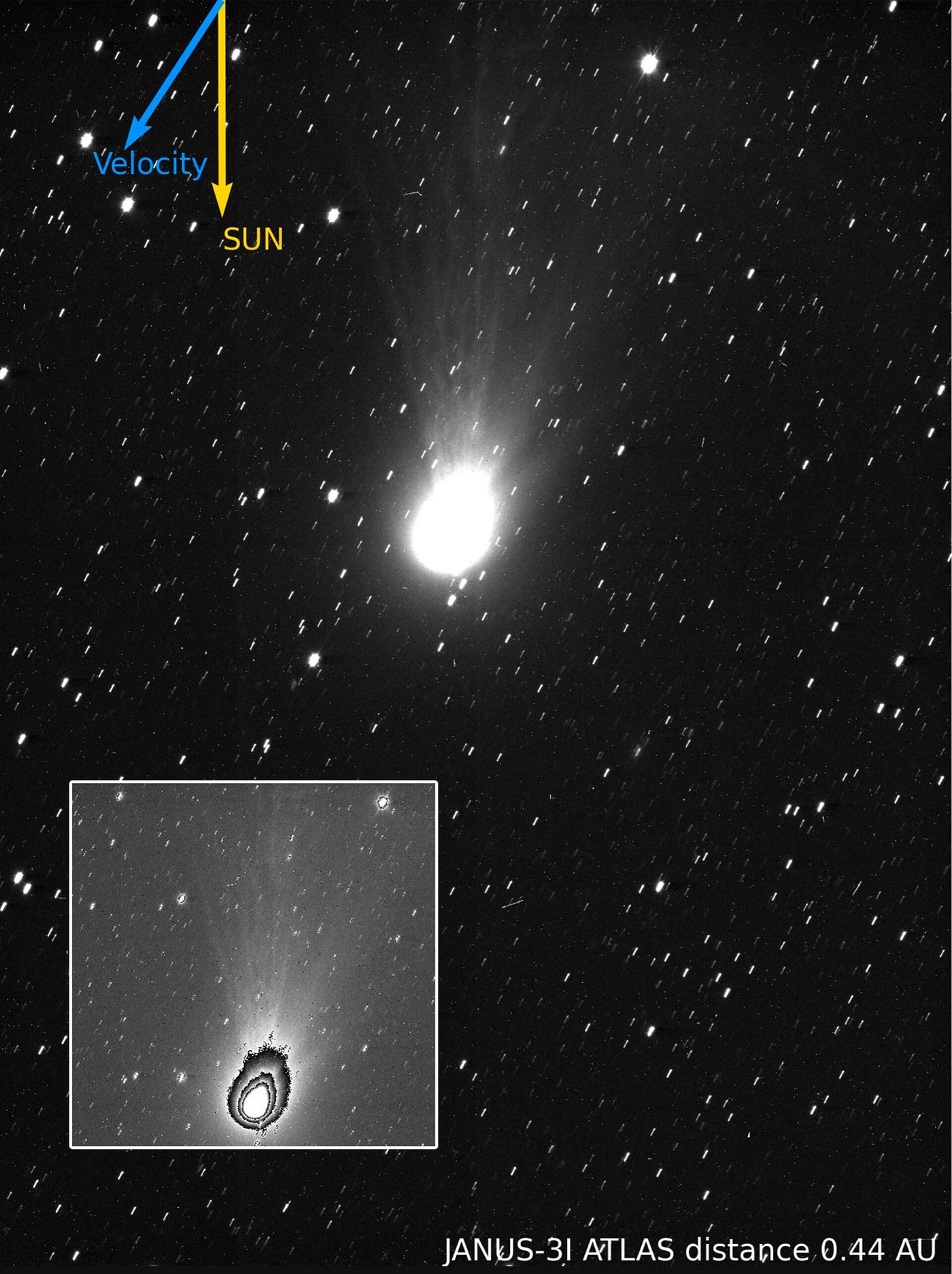
Interstellar comet 3I/ATLAS, photographed by ESA’s JUICE mission. What appears at first to be a solitary traveler is, in reality, embedded within a vast and evolving relationship with the Sun — an interaction written across millions of kilometers of gas, dust, plasma, and light. Image Credit: ESA/Juice/JANUS
In July 2025, astronomers discovered something extraordinary. An object from another star system had entered our Solar System.
It was designated 3I/ATLAS, only the third confirmed interstellar object ever observed by humanity.
Most headlines focused on where it came from. Some focused on where it was going. Others asked whether it might reveal clues about planetary formation around distant stars.
All of those are fascinating questions.
But after following the observations from ESA’s JUICE mission, radio observatories, and the growing discussion surrounding plasma interactions in astrophysics, I find myself wondering whether we are asking the wrong question.
Perhaps the most interesting thing about 3I/ATLAS is not the object itself.
Perhaps it is the relationships it revealed.
Because the deeper one looks, the harder it becomes to describe this interstellar visitor as a lone object traveling through empty space.
In fact, the evidence increasingly points toward the opposite conclusion:
Nothing ever travels alone.
⸻
The Myth of the Lonely Traveler
Our intuition tells us that space is mostly empty.
A comet is a thing.
A planet is a thing.
A star is a thing.
They move through space like ships crossing an ocean.
That picture is useful.
It is also increasingly incomplete.
Over the last century, science has repeatedly uncovered situations in which the most important properties of a system do not belong entirely to the objects themselves. They emerge through interactions, constraints, correlations, and relationships.
Quantum entanglement challenged the notion that physical systems can always be understood independently.
The Aharonov — Bohm effect demonstrated that an electron can respond to the global structure of a field even where no local force is acting.
General relativity replaced the idea of gravity as a force acting between objects with a picture in which matter and spacetime participate in a shared geometry.
Again and again, physics keeps nudging us toward an uncomfortable possibility:
The connections may be at least as important as the things being connected.
That thought lingered in my mind as I began reading the observations of 3I/ATLAS.
⸻
The Object Discovered by Astronomers Was Not the Object Observed by JUICE
When 3I/ATLAS was first detected, it was essentially a point of light.
Astronomers knew it was moving on an interstellar trajectory. They knew it originated outside our Solar System. Beyond that, much remained unknown.
Then ESA’s JUICE spacecraft turned its instruments toward the visitor.
What it saw was not merely a rock or a chunk of ice.
The comet was actively releasing enormous quantities of material into surrounding space. Estimates indicated that roughly two thousand kilograms of water vapor were escaping every second. Dust accompanied the gas. Sunlight ionized portions of this expanding cloud. Ultraviolet observations traced hydrogen and oxygen released as water molecules were broken apart. Spectrometers identified volatile compounds that likely formed around another star long before our Solar System existed.
Most striking was the scale.
The nucleus remained relatively small.
The surrounding structures did not.
The coma expanded into a vast envelope surrounding the object. The dust and plasma tails stretched millions of kilometers into space.
Millions.
At that point a strange question emerges.
What exactly is the comet?
Is it the nucleus?
The gas?
The dust?
The ionized plasma?
The magnetic structures surrounding it?
The object discovered by astronomers and the object observed by JUICE were no longer the same thing.
The nucleus remained present, but it had become embedded within a much larger process.
The comet had become a relationship.
⸻
The Invisible Architecture of Space
The popular imagination still tends to picture space as empty.
Reality is far more interesting.
The Sun continuously emits a stream of charged particles known as the solar wind. Embedded within that flow are magnetic fields extending throughout the Solar System, forming an invisible environment through which every planet, moon, asteroid, and comet must travel.
As 3I/ATLAS moved inward, it did not simply pass through this environment.
It interacted with it.
Solar radiation heated the comet’s surface. Gas escaped into surrounding space. Portions of that gas became ionized, forming plasma. Solar magnetic fields encountered this expanding cloud and began reorganizing around it. Researchers predicted the formation of magnetic draping structures — regions where the Sun’s magnetic field becomes wrapped around the cometary environment like water flowing around a stone in a river.
The process is difficult to visualize because most of it is invisible.
Imagine a fish entering a fast-moving river. The water bends around the fish. Vortices form. Flow patterns emerge. The fish affects the river, and the river affects the fish. Neither can be fully understood without the other.
The same may be true, on a vastly larger scale, for a comet moving through the Sun’s electromagnetic environment.
What ESA’s JUICE spacecraft observed was not merely an object.
It was an interaction extending across millions of kilometers.
And while astronomers were attempting to understand that interaction, something unusual was happening much closer to home.
⸻
The Nineteen-Day Conversation
In late August and early September of 2025, the Sun itself became the center of an unexpected mystery.
A sequence of powerful coronal mass ejections appears to have sustained an enormous magnetic structure known as a helmet streamer for an unusually long period of time. Multiple spacecraft — including Parker Solar Probe, Solar Orbiter, STEREO, Wind, and other solar observatories — recorded the event from different vantage points around the Sun.
Helmet streamers are among the largest magnetic formations in the Solar System. During total solar eclipses they appear as immense luminous arches extending outward from the solar corona. Some stretch several solar radii into space, spanning millions of kilometers.
What attracted attention was not merely the structure itself.
It was the persistence.
Associated radio emissions appear to have continued for nearly nineteen days. Independent observers noted that a sequence of coronal mass ejections may have repeatedly reinforced the same large-scale magnetic architecture, allowing radio-producing plasma structures to remain active far longer than expected.
The image is extraordinary.
Millions of kilometers of magnetized plasma suspended above the Sun.
Electrons moving through immense magnetic loops.
Radio emissions propagating outward into the Solar System.
Some observers described the phenomenon as resembling a giant natural transmitter operating on a scale humanity could never engineer.
Whether nineteen days is truly unprecedented remains a question for future solar research. Extraordinary claims require careful verification, and solar physicists will ultimately determine how unusual this event was compared to historical observations.
Yet even the conservative interpretation is remarkable.
The Sun was not silent.
It was broadcasting energy, structure, and information through one of the largest coherent plasma formations ever observed in detail.
And it was doing so while humanity’s instruments were intensely focused on a newly discovered interstellar visitor approaching perihelion.
Was there a connection?
At present, there is no evidence that there was.
The simplest explanation remains coincidence. The Sun produces magnetic phenomena according to solar dynamics, while comets arrive according to orbital mechanics.
Yet coincidence does not eliminate curiosity.
The overlap invites a deeper question.
What if our picture of astronomical objects remains too isolated?
What if stars, comets, plasma environments, magnetic fields, and radiation fields participate in larger dynamical systems than we typically imagine?
⸻
The Tail May Be More Interesting Than the Comet
This may sound absurd at first.
After all, the nucleus is the thing that came from another star.
But consider what the tail contains.
The tail records information about solar radiation, magnetic fields, plasma dynamics, dust composition, ionization processes, and the chemistry of material formed in a completely different stellar environment.
In a sense, the tail is a visible archive of an ongoing conversation between two worlds.
One world was born around another star.
The other is our Sun.
The tail exists because those worlds met.
Without the relationship, the structure disappears.
Seen this way, the remarkable feature of 3I/ATLAS is not simply that it entered our Solar System.
It is that the moment it arrived, it became part of something larger.
A temporary Sun — comet system emerged.
The most interesting physics may not reside inside the object.
It may reside within the interaction.
⸻
A Star That May Be Listening to Its Planets
The question becomes even more intriguing when we look beyond our own Sun.
Around the same time astronomers were studying 3I/ATLAS and analyzing unusual solar radio activity, another line of research was producing surprisingly similar questions.
The target was Proxima Centauri, the nearest star to our own.
For generations, astronomy largely treated stars as the dominant actors in planetary systems. Stars produced energy. Planets responded. Cause flowed in one direction.
Recent observations suggest reality may be more complicated.
Researchers have reported evidence that certain flare behaviors on Proxima Centauri appear correlated with the orbital positions of its planets. The interpretation remains under active investigation and deserves healthy skepticism. Statistical correlations are not the same as established mechanisms.
Yet the possibility itself is remarkable.
The emerging hypothesis is that plasma, magnetic fields, stellar winds, and planetary magnetic environments may create a coupled system linking star and planet together.
Not:
Star → Planet
But:
Star ↔ Planet
The relationship itself becomes part of the explanation.
The importance of this possibility is not that it proves anything exotic.
It is that it suggests some systems may only be understandable as wholes.
⸻
We Have Already Seen This Before
There is a reason many astronomers take these ideas seriously.
Nature has already shown us an example.
Jupiter’s moon Io is the most volcanically active body in the Solar System. Material ejected from Io becomes ionized and enters Jupiter’s immense magnetic environment.
Electrical currents connect the moon and the planet.
Those currents generate observable auroral signatures on Jupiter.
Pause and consider how strange that is.
A moon alters the behavior of a giant planet through an invisible electromagnetic relationship.
Io is not merely orbiting Jupiter.
Io is participating in Jupiter.
The planet behaves differently because the moon exists.
The relationship is physically real.
⸻
Plasma and the Return of Participation
Most visible matter in the universe exists in the plasma state.
Stars are plasma.
Stellar winds are plasma.
Nebulae are plasma.
Magnetospheres are filled with plasma.
Yet plasma rarely occupies the center of our imagination.
We think in terms of objects.
Planets.
Moons.
Asteroids.
Rocks.
Plasma often serves as background scenery.
Increasingly, however, plasma physics reveals phenomena that challenge simple object-centered thinking.
Filaments self-organize.
Structures emerge.
Information propagates through collective behavior.
Long-range interactions appear.
Complex patterns arise from distributed dynamics.
None of this implies intelligence.
None of it proves consciousness.
None of it validates every speculative theory one might imagine.
But it does suggest that the universe is often more relational than our intuitions expect.
The interesting behavior frequently emerges between things rather than within them.
⸻
Holding Open Possibilities
At this point we move from observation into speculation.
The distinction matters.
Science has not discovered that relationships are fundamental.
Science has not proven that information exists independently of matter.
Science has not demonstrated that plasma structures possess hidden forms of intelligence.
Those claims remain unproven.
Yet there is a different observation that seems increasingly difficult to ignore.
Across physics, biology, neuroscience, ecology, and complexity science, explanatory power keeps drifting toward interactions, networks, and relationships.
The trend appears repeatedly.
Not as proof.
As a pattern.
The more deeply we investigate reality, the more often the boundaries between things become difficult to define.
Where does a forest end and an ecosystem begin?
Where does a neuron end and a mind begin?
Where does a star end and its magnetosphere begin?
Where does a comet end when its tail stretches millions of kilometers through space?
These questions may not have clean answers.
That itself may be significant.
⸻
Nothing Ever Travels Alone
Perhaps the deepest lesson of 3I/ATLAS has nothing to do with interstellar travel.
Perhaps it has nothing to do with alien civilizations, hidden technologies, or extraordinary claims.
Perhaps it is something both simpler and more profound.
The visitor entered our Solar System carrying material forged around another star.
The moment it encountered sunlight, plasma, magnetic fields, and the solar wind, it became part of something larger.
A temporary Sun — comet system emerged.
The object changed.
The environment changed.
A new structure appeared through participation.
That pattern seems to echo throughout nature.
Stars influence planets.
Planets influence stars.
Moons influence planets.
Fields shape matter.
Matter shapes fields.
Information flows through connections.
The universe increasingly resembles a web of relationships rather than a collection of isolated things.
3I/ATLAS does not prove that relationships are fundamental.
But as it departs our Solar System trailing millions of kilometers of dust, plasma, and interaction behind it, it leaves us with a question worth holding open:
What if the connections were never secondary?
What if they were the deeper reality all along?
메타데이터
- post_id
- 3a7a19228748
- slug
- 3i-atlas-nothing-ever-travels-alone-3a7a19228748
- url
- https://medium.com/@anderson_94394/3i-atlas-nothing-ever-travels-alone-3a7a19228748
- canonical_url
- https://medium.com/@anderson_94394/3i-atlas-nothing-ever-travels-alone-3a7a19228748
- author_url
- https://medium.com/@anderson_94394
- status
- ok
- fetched_at
- 2026-06-09 15:37:30