Orientation to Place.
A long day in the OT almost behind me, I was in the ward looking at cases for the next day’s OT that i had to see and inform ‘pre-op’ to…
Orientation to Place.
A long day in the OT almost behind me, I was in the ward looking at cases for the next day’s OT that i had to see and inform ‘pre-op’ to the operating surgeon, following which I’d be asked questions around the case, to test where my understanding of that particular case stands. Most of the days I’d be standing embarrassed because that’s what happens in residency, you’re still learning and tough love is deeply rooted in neurosurgical training. I’d be given a list of topics to read which I’d have to talk about the following morning before or most of the time during surgery. On the odd occasion that i did manage to impress a consultant, I’d get to do a little bit more than what i usually did on the OT table. And we live for those tiny bits of enhanced exposure, when still a resident and sometimes as a junior consultant.
A senior consultant came for rounds and as always I attended the rounds with the ward incharge juniors to know what needed to be done for the next day. Ward duties were considered sacred and mismanaging the ward would get you thrown out of the OT and such outings were very embarrassing. The ‘senior’ staff nurse in charge of the ward whispered something to the consultant at the end of the rounds. And he nodded in acknowledgement. Inaudible, uninterested, I stood at the back of the group barely having noticed the exchange when a patient walked in. He was a stocky fellow, 28–29 years old, posture upright, shoulder rolled back, a smirk on his face.
The consultant asked him what was bothering him and the guy casually said “nothing”. He was polite but a little too confident and outspoken than what we are used to in government hospitals in India. Patients are usually expected to be very submissive and have a passive body language, and the occasional patient who exhibits traits that are otherwise considered healthy in the outside world, gets branded a “potential trouble maker”. He explained to the consultant how he really dishave any issues and that there’s been a misunderstanding. The nurse timed her interjection immaculately, accusing him of having complained about the food and other facilities at the hospital. Again the patient was justified in his complaints, that because this was a government facility, there’s no reason to endure more than what needs to be endured. Yet in government hospitals, more often than not we shun the one’s who make sense saying, “if you need more than this, you should go to a place where you can pay for it. You cant have your ‘free’ cake and eat it too.” However, nothing came of this exchange. The consultant brushed him off and asked him to be patient until his surgery and then hopefully get discharged soon after.
The following day this man had his surgery, a 28 year old male, working at a car dealership in Dubai with a history of refractory left sided sensory seizures, due to what I initially believed was an insular cavernous malformation on the right side. While informing the pre op to my boss, I was lambasted by the operating consultant for the same. He lashed out at me for suggesting we traverse the sylvian fissure or frontal operculum to reach the lesion. He asked me to have a closer look and indeed the right insular gray matter was free of the lesion. The lesion lay medially and anterior to the insula and was surfacing at the proximal sylvian fissure in the right basi-frontal lobe. The lesion needed far less of an extensive approach than i had suggested, but was in close proximity to vital neuro vascular structures, the MCA and the lenticulostriate vessels and had an associated developmental venous anomaly. Taking the loss as I should, I was thankful for a lesson, ‘attention to detail is very important. And make your own impression about the patient’s scan’, he said.
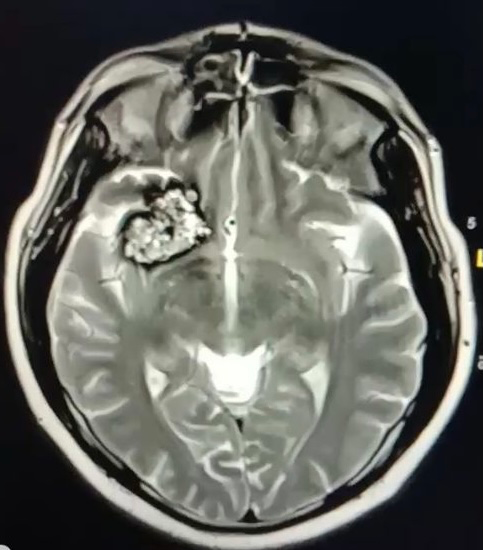


While asking for consent, I enquired from the father of the patient if he had shown any changes in his behaviour in the last few months. Apparently this man had become obstinate, arrogant, and would throw tantrums at the smallest sign of resistance. He needed to have his way and was over talkative. “He is a good kid”, he said tearfully, “My only son. We raised him well. He wasn’t like this. We thought he must’ve changed since he went to Dubai and was earning well.” I nodded, silently appreciating the correlation of tumor location with the patient’s behaviour.
The next morning during rounds, the patient made the mistake of putting his hand on one of the resident’s shoulder and pandemonium ensued. The HOD erupted on him, for having no boundaries and for having touched a female staff nurse the previous day similarly. The patient was visibly confused, not knowing why he was being reprimanded and was trying to explain himself but the nurses shimmied him across the ward to the OT. The HOD was still fuming and I had no intention of getting caught in the crossfire. I laid back and saw him decimate the resident for being the ‘Patch Adams’ to patients and not knowing how to set boundaries. I made an exit from the rounds as my patient was in the OT and hurried off to the theatre.
The whole time i felt sorry for this man. I’d not want to get a simple pimple popped immediately after a shouting like that, let alone go under the knife for a brain surgery. Yet here he was on the table about to be induced. The Anesthetist injected the meds and inserted a laryngoscope, “beep..beep.. beep…..beeep… 0”.
“CARIDAC ARREST”. “Get the crash cart,” the anesthetist shouted as he started administering CPR . 3 pumps and his heart was beating at 40 beats per minute and gradually went up to pre induction 70/min.
“Dont worry, happens in some patients with a higher vagal tone” the anesthetist said.
“Hmm, a higher vagal tone. I wonder why?” I said under my breath.
I suppose the shouting set his vagal tone higher than what it must’ve already been due to the anxiety of the expectant surgery. The laryngeal irritation ( even though the laryngoscope had barely been placed in position) must’ve pushed the tone beyond the brink.
We proceeded with the surgery and the lesion was excised delicately and the patient subsequently was discharged without any postoperative deficits, except may be a normal behaviour without his usual uninhibited banter and unrestrained smile.
The experience got me thinking. Orientation to place is such an important quality to have as a health care provider in a neurological/ neurosurgical ward. Who was wrong here? The nurse who complained, the HOD who shouted at him, me for not speaking out or was it the patient himself?
Any deviation from the norm, any anomaly should not be dismissed as malicious behaviour, but instead needs at least a second look at the film to look for an organic cause that can explain the patient’s behaviour. I cannot understand how that can be overlooked. I mean i do understand. The neurosurgery ward is a mad house and after a while we too lose a fraction of our sanity working there. Yet as doctors, being aware, and exercising restraint is of utmost importance. A valuable lesson for another day. Also, best not to shout at anyone before an important event, lest u wanna induce a vagal attack and kill him.
메타데이터
- post_id
- 3a7a994fcfeb
- slug
- orientation-to-place-3a7a994fcfeb
- url
- https://medium.com/@sanjayhm/orientation-to-place-3a7a994fcfeb
- canonical_url
- https://medium.com/@sanjayhm/orientation-to-place-3a7a994fcfeb
- author_url
- https://medium.com/@sanjayhm
- status
- ok
- fetched_at
- 2026-07-10 14:51:46