The EU Just Made It Illegal to Destroy Unsold Clothing. Most Brands Aren’t Ready.
On July 19, 2026, it will become illegal for large companies to destroy unsold apparel, clothing accessories, and footwear anywhere in the…
The EU Just Made It Illegal to Destroy Unsold Clothing. Most Brands Aren’t Ready.
On July 19, 2026, it will become illegal for large companies to destroy unsold apparel, clothing accessories, and footwear anywhere in the European Union. Not discouraged. Not penalised with a slap on the wrist. Illegal. The EU destruction ban is the first enforcement milestone under the Ecodesign for Sustainable Products Regulation (ESPR) — and it arrives months before the Digital Product Passport mandates that follow.
The European Commission adopted the final implementing acts on February 9, 2026. The delegated regulation is locked in. The exemptions are narrow. The enforcement framework is live.
If your company employs more than 50 people and turns over more than €10 million annually, this applies to you. That’s not just the luxury conglomerates. That’s mid-market fashion houses, footwear brands, apparel companies, and every importer selling into the EU market. Across every supply chain that touches European consumers.
Most of these brands are not ready. The ones that act now — building circular economy infrastructure and implementing digital product identity before July 2026 — will be the ones that turn this regulation into a competitive advantage. The rest will scramble, overspend on consultants, and still miss the deadline.
What the Destruction Ban Actually Is (ESPR Article 25)
Let’s decode this in plain English, because the regulation itself is dense.
Article 25 of the ESPR places a direct prohibition on the destruction of unsold consumer products in specific categories. The first category to be hit: textiles. Specifically, apparel, clothing accessories, and footwear as listed in Annex VII of the regulation.
Here’s what “destruction” means under the law: incineration, shredding, landfilling, or rendering a product permanently unusable. If you’re cutting labels and slashing garments to prevent resale, that counts. If you’re sending unsold stock to waste-to-energy plants, that counts. If a third-party logistics provider is scrapping returns on your behalf, that also counts — because the regulation applies to companies that discard products directly or have them discarded on their behalf.
The ban doesn’t care whether you intended to destroy the product or whether your 3PL made the call. If it happened under your supply chain, you’re accountable.
Who’s affected, and when:
The timeline is staggered by company size. Large enterprises — defined as companies with more than 50 employees and annual turnover exceeding €10 million — must comply from July 19, 2026. Medium-sized enterprises have until July 19, 2030. Micro and small enterprises (fewer than 50 employees, turnover under €10 million) are exempt entirely.
But don’t assume the scope stays narrow. The ESPR is designed to expand across the entire circular economy agenda. Textiles and footwear are the first product categories under the July 2026 destruction ban. Electronics, furniture, and other consumer goods are on the Commission’s roadmap. What hits fashion and apparel today will hit consumer electronics tomorrow. Every supply chain selling into the EU should be watching.
What about exemptions?
The Commission published a delegated regulation alongside the ban that outlines specific, justified circumstances where destruction is still permitted. These are intentionally narrow:
The product is genuinely dangerous under the EU General Product Safety Regulation. The product is non-compliant with EU or national law, and destruction is the only proportionate response. The product is subject to a valid licensing restriction that prevents sale or distribution after a specific time period. The product has been physically damaged, contaminated, or deteriorated to the point where it’s unfit for consumer use. And here’s the one that matters most operationally: the product was offered for donation to at least three social economy entities within the EU, or listed on an accessible page of the company’s website for at least eight weeks, and no one accepted it.
That last exemption is important. It means your default path before destruction must be donation or redistribution. You have to prove you tried. You have to document it. And you have to wait eight weeks.
In practice, this means brands need systems to track unsold inventory, route it to alternative channels, document the attempts, and only then — as a documented last resort — consider destruction. Spreadsheets won’t cut it.
The Penalty Exposure: Do the Math
Here’s where the conversation gets uncomfortable.
The ESPR does not set a single, universal fine. Instead, it mandates that EU Member States implement national penalties that are “effective, proportionate, and dissuasive.” That’s the legal standard. Each country determines its own enforcement regime.
What does that look like in practice? In Germany, penalties under the previous Ecodesign Directive reached up to €50,000 per incident. Under the ESPR’s broader enforcement framework, non-compliance can trigger fines of up to 4% of a company’s EU-wide annual turnover, product recalls, and market access bans.
Run those numbers for a mid-market fashion brand turning over €200 million in the EU. 4 % is €8 million. For a large luxury group with €5 billion in EU revenue, that ceiling is €200 million.
But the financial exposure doesn’t stop at fines. There’s the disclosure requirement. Starting from the 2025 financial year, large companies must publicly report on their own websites the number and weight of unsold consumer products they’ve discarded, the reasons for destruction, the exemptions invoked, the waste treatment operations used, and the measures taken to prevent destruction in the future. This information must follow a standardised EU-wide reporting format adopted under Implementing Regulation (EU) 2026/2.
That’s public. Your competitors will read it. Your customers will read it. Journalists will read it. Sustainability analysts will build league tables from it.
So the real penalty is threefold: regulatory fines that scale with your revenue, reputational damage from mandatory public disclosure, and the sheer waste of margin sitting in inventory you’re now prohibited from writing off through destruction.
In France alone, an estimated €630 million worth of unsold products are destroyed annually. That’s not a compliance problem. That’s a business model problem.
Circular Alternatives That Beat Destruction (And Increase Margin)
Here’s the shift in thinking the regulation is forcing: destruction was never efficient. It was just convenient. The EU is betting that once brands are forced to find alternatives, they’ll discover those alternatives are more profitable than destruction ever was.
And the early data support that bet.
Resale and recommerce. Authenticated resale of unsold or returned inventory captures 40–60% of the original retail price. For a brand destroying €10 million in unsold stock annually, redirecting even half of that to resale recovers €2–3 million in margin. The key requirement: product authentication and ownership verification at scale, so buyers trust the provenance of what they’re purchasing.
Warranty and care programmes. Extending product life through repair, care, and warranty services isn’t just good sustainability practice — it builds customer lifetime value. Brands that track ownership digitally can offer repair services, replacement parts, and care instructions tied to specific products. Service revenue from repair programmes is growing 15–20% year-on-year in the luxury segment.
Rental and subscription models. High-value categories — occasion wear, outerwear, luxury accessories — are natural fits for rental. Digital product identity enables condition tracking, insurance, and seamless handover between renters. Rental margins can reach 50% or higher for premium items, and every rental cycle is inventory utilisation rather than inventory waste.
Recycling and material recovery. When a product genuinely reaches end of life, digital identity enables routing to certified recyclers with full material composition data. Some brands are already recapturing material value through fibre-to-fibre recycling partnerships. The destruction ban will accelerate this: if you can’t destroy it and can’t sell it, recycling becomes the floor, not the ceiling.
Donation with documentation. The exemption framework requires documented donation attempts before destruction. Brands with digital systems can automate this: flagging unsold inventory at a threshold, routing donation offers to verified partners, tracking acceptance or rejection, and timestamping the eight-week window.
The common thread across all of these circular economy alternatives? They require a Digital Product Passport. You need to know what you have, where it is, what condition it’s in, who owns it, and where it’s going next. That’s not an inventory management problem. That’s a digital product identity problem — and it’s one that a modern DPP platform solves out of the box, without the six-figure consulting engagements and 12-month integration timelines that legacy providers demand.
How a Digital Product Passport Platform Replaces Consultants and Spreadsheets
This is where the regulation meets operations. The destruction ban creates a legal mandate. But executing circular models — takeback programmes, authenticated resale, warranty management, recycling guidance — across multiple EU markets, in multiple languages, at enterprise scale? That’s where most fashion brands hit a wall.
The legacy approach: hire a consulting firm, spend six figures mapping your supply chain data, wait 6–12 months for implementation, then discover it doesn’t integrate with your existing ERP or PIM. That model is dead. The July 2026 deadline doesn’t leave room for it.
Tieback is a Digital Product Passport platform built for exactly this transition. It works as an intelligent overlay — connecting to your current systems via API, CSV, or native connectors — and adds the digital identity layer on top. No rip-and-replace. No IT overhaul. No consultant dependency.
Tieback assigns a unique digital identity to each product — linked to a 2D QR code, NFC tag, or RFID tag — that travels with the product through its entire lifecycle. Full traceability from factory floor to end of life: where it was made, when, by whom, what it’s made of, who owns it, and what happens next.
For the destruction ban, three capabilities matter most.
Takeback programme administration with dynamic Market Packs.
Circular alternatives look different in every EU Member State. Recycling infrastructure varies. Takeback regulations differ. Languages change. Tieback is the only Digital Product Passport platform that lets fashion brands configure Market Packs per country — defining takeback programmes, recycling guidance, and repair instructions for each market, managed centrally but delivered to consumers in their own language.
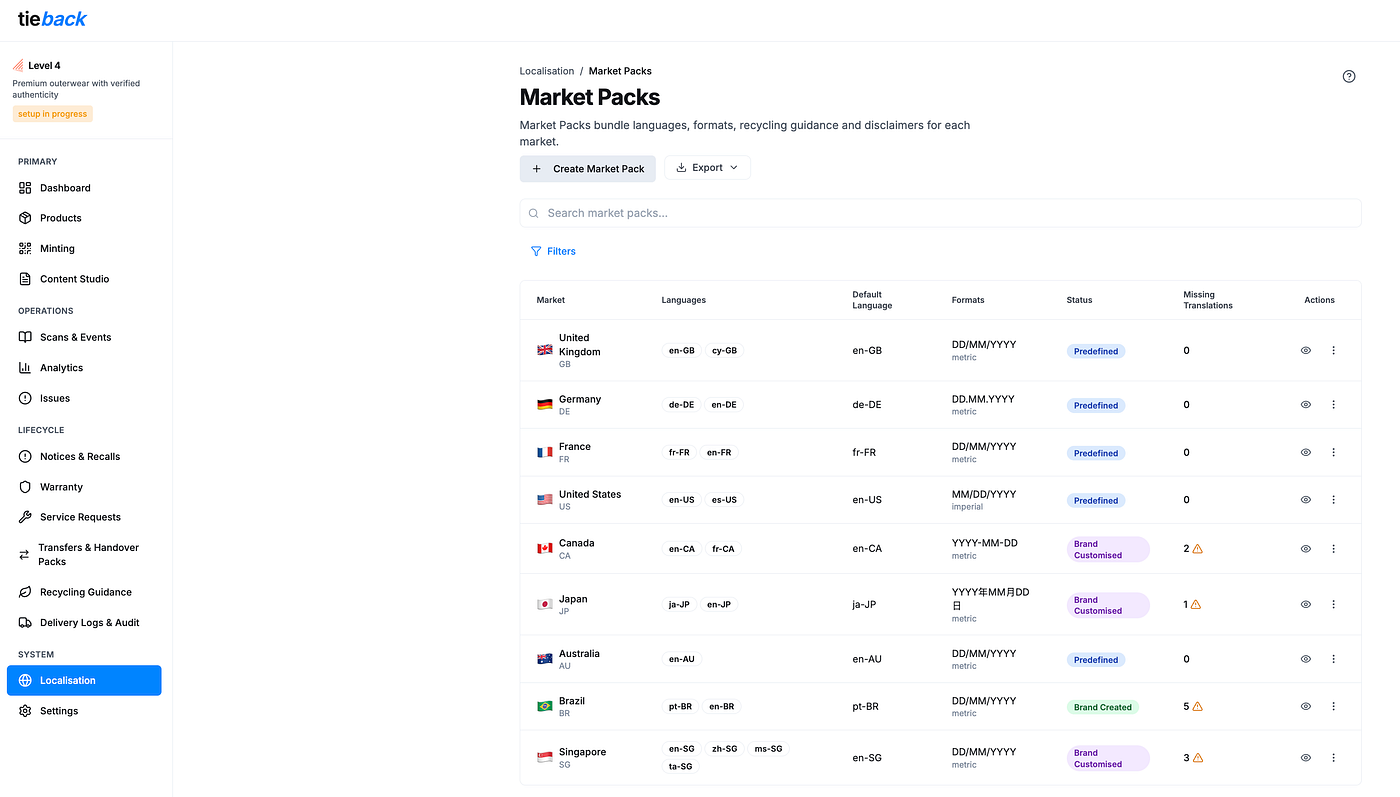
https://tieback.io — Market pack bundle languages, format, recycling guidance and disclaimer for each market
Market Packs dashboard: each market gets its own language settings, date formats, and localised compliance content — from the UK and Germany to Japan and Brazil.
A consumer in Germany scanning a product’s QR code sees German takeback options and recycling guidance. A consumer in France sees the French equivalent. Brands track every product entering the takeback flow — which markets are active, which channels are working, where attention is needed.

https://tieback.io- Reycling guidance module
Recycling Guidance module: end-of-life instructions configured by material type — synthetic fibres, wool, cotton, leather — localised per country with consumer-facing previews.
Ownership, authentication, and aftercare.
When consumers claim ownership through the Digital Product Passport, that record — secured with cryptographic verification — becomes the foundation for warranty management, aftercare, and product stewardship. Warranty claims are validated instantly. Repairs and care are requested through the DPP. Lost or stolen notifications are bound to the passport, enabling safe return when the product resurfaces.

https://tieback.io — Manage and validate warrenty claims instantly and review customer claims
Warranty Claims: Every claim tracked from submission to resolution — product, SKU, customer, status, approval rates, and rejection patterns visible at a glance.
For takeback programmes specifically, every product returned through the circular flow is authenticated against its digital identity. Brands know they’re receiving genuine products -not counterfeits, not items from outside their supply chain.
Secondary market handover and brand re-engagement.
When a luxury handbag or premium jacket enters the secondary market — eBay, Vestiaire, Vinted — the original brand typically loses all visibility. Tieback changes that. Ownership transfers happen in a fully GDPR-compliant way, with consent tracked and the chain of custody unbroken.

https://tieback.io Manage and configure Handover packs
Transfers & Handover dashboard: every ownership change — consumer transfers, warranty swaps, replacements — tracked with full visibility.
The moment no other platform enables: the Handover Pack. When ownership transfers, the brand generates a branded welcome experience for the new owner — a first-touch customer acquisition moment with someone who didn’t buy directly but is now part of the brand’s community. That’s not compliance. That’s turning the secondary market into a customer acquisition channel, with full GDPR consent.
The point isn’t that Tieback is the only way to comply. The point is that compliance without a Digital Product Passport platform is operationally brutal -and the brands that build this infrastructure before July 2026 will discover it does far more than keep them legal.
90-Day Readiness Checklist for Compliance
You have roughly 12 weeks between now and July 19. Here’s what a realistic readiness plan looks like.

Days 1–14: Quantify your destruction exposure.
Start with the audit. How many product units or SKUs are you currently destroying, scrapping, or writing off annually? Break it down by category: unsold inventory from seasonal overstock, customer returns marked unsellable, damaged goods, and any other disposal channels.
Talk to three teams: warehouse and logistics (how much gets scrapped monthly?), returns management (what percentage of returns are written off?), and finance (what’s the annual write-off value?). Total those numbers. That’s your baseline exposure under the new regulation.
If your annual destruction volume exceeds 500 units, your penalty exposure under aggressive Member State enforcement could run into six or seven figures. If it exceeds 5,000 units, you’re looking at material financial risk.
Days 15–30: Map your circular options.
For each product category you’re currently destroying, identify the most viable circular alternative. Luxury and premium items typically route to authenticated resale. Mid-market items may suit donation programmes or outlet redistribution. Damaged goods route to repair or recycling. Seasonal overstock suits rental, flash sale, or geographic redistribution.
Document these pathways. For each one, identify: who’s the receiving partner? What condition data do they need? How does the product physically move? And critically: how do you track and prove the handoff?
Days 31–60: Implement Digital Product Passport infrastructure.
This is where you connect your supply chain data to circular operations. Whether you use Tieback or another DPP platform, you need three capabilities live before July 2026: the ability to flag unsold inventory at a configurable threshold, the ability to route that inventory to alternative channels with documentation, and the ability to generate audit-ready records of every disposal decision.
The key question: does the platform integrate with your existing ERP and PIM systems without requiring a full IT overhaul? Fashion brands that choose a consultant-free, out-of-the-box Digital Product Passport solution will be operational in weeks, not months.
Prioritise one product line for the initial rollout. Get the workflow running end-to-end on a manageable volume before scaling.
Days 61–82: Pilot, test, and validate.
Run a live pilot with real unsold inventory. Route 500–1,000 units through your new circular workflow. Test the donation documentation process against the eight-week exemption requirement. Verify that your audit trail captures the data points required for annual disclosure.
Identify friction points: supplier data gaps, warehouse process changes, customer-facing communications for resale or rental. Fix them before July 19, not after.
Day 83 (July 19): Go live with compliance.
By this point, you should have at least one circular pathway operational, documentation workflows tested, and the disclosure reporting framework configured. You don’t need every product line migrated by Day 1. You need a defensible system in place, actively routing unsold inventory away from destruction, with records to prove it.
Over the following 6–12 months, expand to additional product categories, add circular models (resale plus rental plus recycling), and refine the economics. The brands that treat July 19 as the starting line rather than the finish line will be the ones that turn compliance into competitive advantage.
What Happens After July 2026
The destruction ban is the first operational compliance test under the ESPR. It won’t be the last.
The EU Digital Product Passport Registry launches on the same date — July 19, 2026 — creating the infrastructure for product-level data submission and verification across the EU market. The textile delegated act, expected in Q2 2027, will define the exact data fields, formats, and rules for textile Digital Product Passports. And the hard deadline for mandatory DPPs across all fashion, apparel, and footwear products on the EU market is expected in late 2028 or 2029.
For fashion brands, the destruction ban is the first domino. The brands that build their Digital Product Passport infrastructure now — integrating circular economy operations, supply chain traceability, and consumer engagement into a single platform — will be 18 months ahead of the pack when the full DPP mandate arrives. The brands that wait will be scrambling to hire consultants at premium rates while their competitors are already live.
Twelve weeks. That’s what you have before July 2026. The regulation is final. The exemptions are narrow. The disclosure is public. And the circular economy alternatives to destruction are more profitable than destruction ever was.
The question isn’t whether to comply. It’s whether you’ll be ready.
Ready to assess your destruction risk?
**Request a Demo** — See how Tieback routes unsold inventory to circular channels with full audit documentation. 30 minutes.
**Schedule a Strategy Call** — Talk to someone who’s helped brands operationalise circular models before a regulatory deadline. 15 minutes.
Related reading:
메타데이터
- post_id
- 3a7aec40a50c
- slug
- the-eu-just-made-it-illegal-to-destroy-unsold-clothing-most-brands-arent-ready-3a7aec40a50c
- url
- https://medium.com/@pydtcptk/the-eu-just-made-it-illegal-to-destroy-unsold-clothing-most-brands-arent-ready-3a7aec40a50c
- canonical_url
- https://medium.com/@pydtcptk/the-eu-just-made-it-illegal-to-destroy-unsold-clothing-most-brands-arent-ready-3a7aec40a50c
- author_url
- https://medium.com/@pydtcptk
- status
- ok
- fetched_at
- 2026-06-16 19:09:56