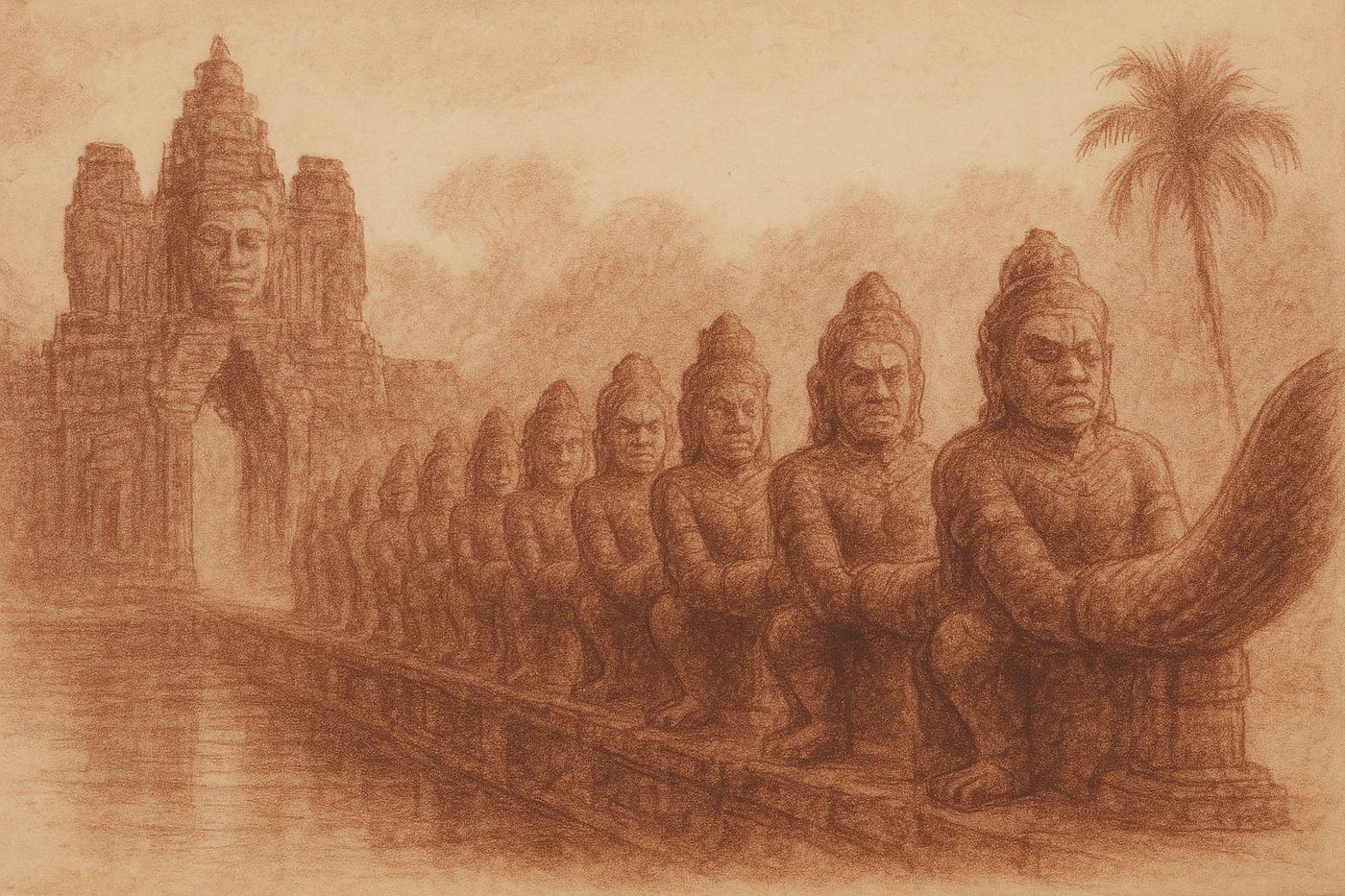
Your God Is Not Proven by Your Empire
A secular humanist argument against confusing cultural power with moral truth
Your God Is Not Proven by Your Empire

A secular humanist argument against confusing cultural power with moral truth
There is a kind of religious argument that sounds serious because part of it is serious.
It says that societies do not survive by accident. It says that civilisations are shaped by stories, laws, habits, prohibitions, rituals, images of the good, and inherited answers to suffering and death. It says that metaphysical beliefs are not private decorations, but deep structures that influence how people marry, raise children, restrain violence, understand guilt, honour truth, build institutions, forgive enemies, and protect the weak.
This is worth taking seriously.
It is not foolish to ask what kinds of belief help a civilisation sustain law, conscience, freedom, restraint, dignity, and moral responsibility. It is not foolish to notice that Christianity profoundly shaped the West. It is not foolish to ask whether certain religious and philosophical inheritances have proved better than others at protecting particular human goods.
The trouble begins when that serious question becomes something else.
The trouble begins when a historical claim hardens into a metaphysical boast.
A tradition helped shape my civilisation.
My civilisation became powerful.
Therefore my tradition has been vindicated by history.
Therefore my God stands above your God.
Therefore my inherited culture is closer to truth than yours.
Therefore I may look upon you, however politely, from a higher spiritual balcony.
That is the dangerous move.
Not because Christianity has had no moral force. It has.
Not because the West owes nothing to its religious inheritance. It owes a great deal.
Not because religious belief is automatically irrational, primitive, or unworthy of serious attention. It is not.
The problem is simpler and more severe than that.
Cultural power is not proof of God.
A civilisation’s success is not evidence of its metaphysical superiority.
No human being becomes higher because they inherited a stronger empire, a louder canon, a more globally successful language, or a sacred story backed by centuries of political force.
If God exists, God is not proven by conquest.
If truth matters, it cannot be reduced to victory.
And if morality means anything at all, it must begin by refusing the ancient poison that says: my people are higher because my God is higher.
That poison has worn many costumes.
Sometimes it wears armour. Sometimes it wears scripture. Sometimes it wears philosophy. Sometimes it wears the polished language of civilisational confidence. Sometimes it arrives as nostalgia, speaking tenderly of the old world while quietly ranking the souls of living human beings.
But the poison is the same.
It is the conversion of inheritance into superiority.
It is the confusion of power with truth.
It is the oldest tribal vanity dressed as theology.
We should be very clear about what is being criticised here.
This is not an argument against the existence of God. It is not even an argument against religious conviction. A person may believe in God deeply, sincerely, intelligently, and humbly. A person may kneel, pray, worship, confess, grieve, give thanks, and live beautifully within a sacred tradition. There is no need to mock that. There is much in it that deserves respect.
The target is not faith.
The target is the moment faith stops kneeling before mystery and starts standing over other human beings.
That moment deserves no deference.
It deserves dismantling.
A tradition may be meaningful without being metaphysically proven. A civilisation may be powerful without being morally superior. A religion may contain wisdom without owning wisdom. These distinctions are not subtle luxuries. They are moral necessities.
Without them, reverence becomes arrogance.
Without them, gratitude becomes propaganda.
Without them, a person can mistake the accident of birth for evidence of divine favour.
It is perfectly reasonable to say that Christianity shaped the West.
It shaped law, art, moral imagination, concepts of sin and conscience, practices of charity, ideas of personhood, visions of sacrifice, and the language through which many Western societies came to speak about dignity. No serious account of the West can ignore Christianity without becoming dishonest.
But that remains a historical claim.
It is not a proof of God.
A story can shape a civilisation without being literally true in every theological claim. A myth can carry profound human wisdom without being exclusive. A religious tradition can cultivate conscience without possessing a monopoly on moral reality.
The mistake begins when someone moves from:
“This tradition helped form my civilisation,”
to:
“Therefore this tradition is metaphysically vindicated,”
and then, often without saying it too plainly:
“Therefore other traditions are lower, less true, less mature, less morally serious, less blessed, less complete.”
That is not philosophy.
That is victory wearing vestments.
History is full of successful things that were not morally true.
Rome was successful. The British Empire was successful. The Mongol conquests were successful. The Atlantic slave trade was successful for those who profited from it. Modern consumer capitalism is successful. Surveillance technology is successful. Propaganda is often successful. Addiction is successful. Fear is successful.
Success proves capacity.
It does not prove righteousness.
It certainly does not prove God.
If worldly success were evidence of divine truth, then every empire would become a sacrament. Every conquest would become an argument. Every expansion of power would become a theological footnote. That is exactly why the argument is so morally dangerous. It turns historical dominance into spiritual evidence.
And once that happens, the victims of history are asked to accept their defeat as metaphysical judgement.
I use the word carefully: this is obscene.
Not because moral certainty is always wrong. Some certainties are necessary if human equality is to mean anything at all. It is right to be certain that no child is born spiritually lower because of the language of their first prayer. It is right to be certain that conquest does not sanctify the conqueror. It is right to be certain that inherited belief does not confer higher human worth.
It is obscene when Christians make this mistake.
It is obscene when Muslims make it.
It is obscene when Hindus, Buddhists, secularists, nationalists, racial theorists, imperial nostalgists, or ideological utopians make it.
No tribe is innocent of the temptation.
Every people is capable of turning its story into a throne.
That is why the humanist objection must be universal.
The answer to Christian supremacy is not Islamic supremacy, Hindu supremacy, Buddhist supremacy, secular supremacy, national supremacy, or civilisational revenge. The answer is the deeper and harder discipline of refusing supremacy itself.
The human moral record is not owned by one faith.
Across the world, human beings have learned to restrain violence, honour the dead, protect children, feed strangers, discipline desire, repent of cruelty, tell the truth, care for the vulnerable, and build forms of beauty around suffering and hope.
They have done this in churches and mosques, temples and monasteries, shrines and synagogues, courts and schools, families and villages, poems and songs, rituals and laws.
The forms differ.
The gods differ.
The metaphysics differ.
The failures differ too.
But the existence of difference does not license contempt. And the existence of moral failure in every tradition does not erase the moral seriousness carried by many.
The point is not that every religion is equally true. That is too easy, too vague, too sentimental.
The point is that human moral seriousness is not the property of one civilisation.
No tradition owns mercy.
No scripture owns courage.
No church owns conscience.
No temple owns reverence.
No mosque owns surrender.
No monastery owns compassion.
No nation owns dignity.
The human being is older than the tribe.
We should also speak honestly about birth.
Most people inherit their gods.
This is not an insult. It is a fact so obvious that only arrogance finds it threatening.
Most Christians are born into Christian worlds. Most Muslims are born into Muslim worlds. Most Hindus are born into Hindu worlds. Most Buddhists are born into Buddhist worlds. Most secular Europeans are born into secularising European worlds. Most people receive their first gods, doubts, prayers, fears, rituals, festivals, moral vocabulary, and sacred images from family, language, geography, school, memory, and the dead.
Conversion happens. Doubt happens. Mystical experience happens. Intellectual transformation happens. People leave traditions. People enter traditions. A human life is not a prison.
But at scale, belief is profoundly shaped by birth.
The question, then, is simple:
If you had been born elsewhere, would your certainty have changed names?
If your mother had sung different hymns, would your metaphysics now feel obvious in another direction?
If your dead had been buried under different prayers, would you still speak so confidently of which civilisation God has favoured?
This is not an argument against belief.
It is an argument against arrogance.
A person may believe deeply. But a decent person must remember the contingency of their own inheritance. The fact that a belief feels sacred from the inside does not prove that those outside it are spiritually inferior. It proves that human beings are formed by belonging, and that belonging is powerful enough to feel like the structure of reality.
The serious believer should understand this better than anyone.
Humility should not be an optional ornament of faith.
It should be one of its tests.
But the same challenge applies to secular humanism.
That must be said plainly.
I do not write from nowhere. No one does.
Secular humanism has its own genealogy. It bears the marks of Europe, Enlightenment argument, Christian inheritance, anti-clerical revolt, scientific method, liberal struggle, colonial guilt, war, emancipation, and the long modern effort to build moral life without unquestionable authority. It has been shaped by universities, courts, revolutions, laboratories, dissidents, reformers, survivors, and graves.
It is not pure.
Nothing human is pure.
Had I been born elsewhere, my confidence in reason, individual dignity, fallibility, evidence, freedom of conscience, and human flourishing might not have taken the same shape. I might have inherited different first principles, different sacred pressures, different fears, different loyalties, different authorities.
This does not make secular humanism false.
It makes it human.
The defence of secular humanism is not that it descends from nowhere.
The defence is that, at its best, it permits its own history to be interrogated.
It does not ask to be exempt from scrutiny because it is ours. It does not become true because modern institutions have spread. It does not get to point at universities, human rights declarations, medical advances, democratic language, or technological success and say, “Behold, history has proved us.”
That would be the same error in secular dress.
Secular modernity has no innocent record. It has produced emancipation and bureaucracy, science and mechanised killing, rights language and technocratic indifference, liberation movements and ideological fanaticism, public health and mass surveillance. Reason has served mercy. Reason has also served cruelty when severed from humility, compassion, and limits.
No honest humanist gets to read only the favourite pages.
The strength of humanism is not purity.
Its strength is correction.
Its strength is the refusal to place any inheritance, including its own, beyond question.
There are counterarguments worth taking seriously.
Someone may say that some cultures really do produce better moral outcomes than others.
That is true, in particular domains.
We can and should compare laws, freedoms, treatment of women, treatment of minorities, treatment of dissenters, treatment of children, treatment of prisoners, treatment of strangers. Humanism does not require moral relativism. It does not ask us to pretend that cruelty and compassion are merely different local customs.
Some practices are cruel. Some laws are indefensible. Some customs mutilate the human spirit. Some inherited moral systems protect abusers, silence women, persecute minorities, punish thought, sanctify violence, and call obedience virtue.
To say this is not bigotry.
It is moral seriousness.
Yes, some institutional and metaphysical frameworks may sustain particular human freedoms better than others.
That possibility should not frighten us.
It should be examined carefully.
Some traditions may prove better at limiting state power. Some may prove better at preserving family obligation. Some may prove better at cultivating inward discipline. Some may prove better at protecting dissent. Some may prove better at teaching compassion, restraint, reverence, courage, or equality before the law.
But such comparisons must remain specific, historical, ethical, and revisable.
They must ask what is actually happening to human beings.
They must not become a shortcut from “this framework has protected certain goods” to “this God has been proved,” still less to “these people are spiritually higher.”
The serious question is not forbidden.
The triumphalist answer is.
The question is not, “Whose God has the stronger civilisation?”
The question is, “Where are human beings less humiliated, less brutalised, less silenced, less crushed, less disposable?”
Moral comparison is possible.
Sometimes it is necessary.
But it must not become a ladder of human worth. It must not become a proof that God favoured the winners. It must not allow a person to look at another civilisation’s failures while treating their own civilisation’s failures as footnotes.
Someone else may say that Christianity uniquely grounded human dignity in the West.
Historically, there is force in that claim. Christianity did help shape the Western language of human worth. It gave to many people a vision of the person as answerable before God, loved beyond status, morally serious beyond social rank. That inheritance matters.
But historical importance is not exclusive possession.
The West’s Christian inheritance coexisted with crusades, inquisitions, antisemitism, witch trials, colonial arrogance, slavery, forced conversion, the subordination of women, and the persecution of heretics. The record is not one thing. It is light and shadow, saint and sword, hospital and prison, cathedral and colony.
The same standard applies everywhere.
A Muslim cannot point to Islamic charity while hiding religious coercion. A Hindu cannot point to metaphysical subtlety while hiding caste cruelty. A Buddhist cannot point to compassion while hiding nationalist violence. A secularist cannot point to reason while hiding the mass graves of ideological modernity. A Christian cannot point to human dignity while hiding the bodies beneath empire.
The moral task is not to defend the tribe.
The moral task is to tell the truth.
Another counterargument says that secular humanism merely borrows Christian values while denying their source.
There is a partial truth here, but not the whole truth.
In the West, secular humanism has certainly inherited moral vocabulary from Christianity. It would be foolish to deny that. Ideas do not descend from nowhere. They travel through languages, institutions, conflicts, reforms, revolutions, scriptures, laws, poems, griefs, and bodies.
But inheritance is not ownership.
A child may inherit a house and open its windows.
A concept may emerge from a religious world and become answerable to wider human experience.
Dignity does not cease to matter when it crosses a boundary. Compassion does not become invalid when spoken by someone who cannot recite the creed that once carried it. Moral insight can migrate, deepen, detach, be corrected, be universalised, and become subject to reason, suffering, evidence, and the claims of those once excluded by the tradition that first named it.
This is one of the noblest things human beings do.
We receive.
We revise.
We widen the circle.
We discover that what was once said of our own may have to be said of everyone, or it was never fully true.
Someone may then say: without God, morality becomes mere preference.
This objection should not be dismissed too quickly. It names a real fear: that without a divine lawgiver, ethics collapses into appetite, fashion, majority vote, or personal taste.
But secular humanism at its strongest is not the belief that morality is whatever we prefer once God has been removed.
It is the opposite of that laziness.
It is the discipline of living without permission to outsource conscience.
It asks us to make our beliefs answerable to evidence, our ethics answerable to suffering, our confidence answerable to correction, and our dignity answerable to the equal dignity of those outside our tribe.
This does not provide the same kind of foundation religion claims to provide.
It does not descend from the sky. It does not speak with the voice of eternity. It does not abolish moral difficulty. It does not solve, once and for all, the contested philosophical question of why suffering obligates us rather than merely moving us.
That question remains real.
A serious humanism should admit this.
But admitting that the ground is contested does not make the suffering of other beings unreal. It does not make cruelty morally weightless. It does not make humiliation harmless. It does not make the person before me an object until a metaphysical system has successfully certified their value.
Humanism begins from facts no honest person can evade for long.
Human beings suffer.
Human beings can be humiliated, terrorised, silenced, starved, excluded, enslaved, broken, and made disposable.
Human beings also hope, love, remember, create, forgive, protect, learn, and begin again.
Other minds are real.
Other lives are not scenery around my own.
Pain is not made unreal because it belongs to someone outside my group.
Humiliation is not made acceptable because it has been authorised by custom.
Cruelty is not made holy because it has been inherited.
A religious person may say that these truths are grounded in God. A secular humanist may say they are grounded in shared vulnerability, conscious life, and the conditions under which persons can flourish rather than be destroyed.
Those are different metaphysical accounts.
The argument between them is real.
But both should be able to see the moral fact itself.
The person before me is not an object.
Their suffering matters.
Their dignity is not waiting for my theology to confirm it.
Humanist truth is not comfort.
It is not fashion.
It is not “my truth” in the shallow sense.
It is disciplined fallibility: the willingness to submit our claims to reality, consequence, scrutiny, and revision.
Truth is what survives our best effort not to flatter ourselves.
Moral truth begins where another person’s suffering becomes as real to me as my own.
This is not weak.
It is extremely demanding.
It requires evidence. It requires humility. It requires correction. It requires listening to people one’s own group has ignored. It requires admitting when a beloved tradition has lied, excluded, humiliated, or killed. It requires refusing the narcotic pleasures of superiority.
Religious supremacy cannot survive that discipline.
Neither can secular supremacy.
The humanist does not say, “There is no sacred.”
The humanist says, “No claim of the sacred may excuse contempt for the human.”
That distinction matters.
A person may believe that God is the source of goodness. A humanist may believe that goodness must be judged through the visible conditions of sentient life: suffering reduced, dignity honoured, cruelty restrained, freedom protected, truth pursued, the vulnerable defended, the stranger recognised, the child sheltered, the dead mourned, the living not made into instruments.
These positions disagree metaphysically.
They need not hate each other.
But both should be able to stand together against the person who says, openly or quietly: my inherited God makes me higher than you.
That sentence is a spiritual crime.
Even when it is never spoken.
Especially when it is never spoken.
It hides inside phrases like “civilisational confidence” and “the superiority of our values” and “the tradition that built the world.” It hides inside jokes, curricula, immigration panic, foreign policy, missionary nostalgia, online masculine religion, and the strange hunger of frightened people to believe that history has placed them on the upper balcony of the human race.
But no one stands there.
There is no upper balcony.
There are only human beings trying to live under the weight of mortality.
Human beings bury their dead.
Human beings feed strangers.
Human beings forgive what seemed unforgivable.
Human beings ruin one another.
Human beings begin again.
Human beings light lamps in rooms where someone is afraid.
Human beings build churches, mosques, temples, stupas, shrines, libraries, hospitals, schools, kitchens, poems, songs, laws, and small tables where children are fed.
Human beings tell stories so the young do not enter the dark alone.
The sacred names differ.
The human need is shared.
This is where a secular humanist stance must become more than criticism. It must become affirmation.
Humanism is not the cold reduction of the human person to appetite, biology, or social utility. It is not the sneer of the clever unbeliever at the praying grandmother. It is not contempt for ritual, myth, beauty, grief, reverence, or longing.
A worthy humanism is reverence without possession.
It looks at the human being and says: here is a creature who suffers, loves, remembers, fears death, seeks meaning, makes beauty, tells lies, confesses guilt, protects children, betrays friends, builds worlds, destroys worlds, and still sometimes chooses mercy.
That creature is not made more valuable by belonging to my group.
That creature is not made less valuable by praying in another language.
That creature is not beneath me because my ancestors won a war, printed more books, built stronger banks, colonised more territory, or exported their metaphysics more successfully.
There is no ethical seriousness without this recognition.
The person before me is real.
Their pain is real.
Their hope is real.
Their interior life is real.
Their dead are real to them, as mine are real to me.
Their songs once steadied a child.
Their prayers once held a mother upright.
Their gods, even if I do not believe in them, may have carried griefs I have never had to carry.
To know this is not to surrender judgement.
It is to begin judgement from humility rather than contempt.
We can still criticise. We must criticise. Some beliefs harm. Some practices degrade. Some traditions shelter cruelty. Some doctrines make victims obedient to their own oppression. Some sacred stories have been used to excuse the unforgivable.
Humanism must not become sentimental pluralism.
But criticism must never require dehumanisation.
The test is simple.
Does this belief make it easier to see the other person clearly, or easier to reduce them?
Does this tradition deepen responsibility, or merely inflate belonging?
Does this argument lead toward compassion, courage, honesty, and justice, or toward the delicious private thrill of being higher?
Any religion that needs contempt in order to feel true has confessed its own weakness.
Any civilisation that mistakes wealth, reach, conquest, or survival for divine endorsement has not found God.
It has found a mirror.
And the mirror is dangerous, because it flatters the viewer while calling the flattery sacred.
The moral life begins when the mirror breaks.
It begins when inherited certainty is forced to stand before the equal humanity of the stranger.
It begins when we stop asking whether our civilisation proves our God and start asking whether our conduct proves our humanity.
That is a harder question.
It is also a better one.
Do we tell the truth when truth costs us belonging?
Do we defend the dignity of those outside our tribe?
Do we refuse cruelty when cruelty is popular?
Do we examine our own inheritance without hatred and without worship?
Do we have the courage to receive wisdom from traditions not our own?
Do we love the good more than we love being right?
These are not small questions.
They are the questions by which a human life is weighed.
A person may answer them as a Christian, Muslim, Hindu, Buddhist, Jew, Jain, Sikh, humanist, atheist, agnostic, or seeker. The answers will not be identical. They need not be. But wherever a person answers them honestly, something recognisably human is being defended.
That is where I place my trust.
Not in the boast of civilisation.
Not in the pride of inherited gods.
Not in the claim that power reveals truth.
Not even in a secular humanism too vain to question its own inheritance.
I place my trust in the fragile, stubborn, unfinished human capacity to widen sympathy, correct cruelty, seek reality, honour suffering, revise certainty, and refuse the lie that anyone is less human because they were born under a different sacred sky.
No god worth worshipping needs our contempt to defend him.
And no truth worth serving asks us to become less human in its name.
메타데이터
- post_id
- 3a8bbf67a4e6
- slug
- your-god-is-not-proven-by-your-empire-3a8bbf67a4e6
- url
- https://medium.com/@lucasvarro/your-god-is-not-proven-by-your-empire-3a8bbf67a4e6
- canonical_url
- https://medium.com/@lucasvarro/your-god-is-not-proven-by-your-empire-3a8bbf67a4e6
- author_url
- https://medium.com/@lucasvarro
- status
- ok
- fetched_at
- 2026-07-08 03:40:06